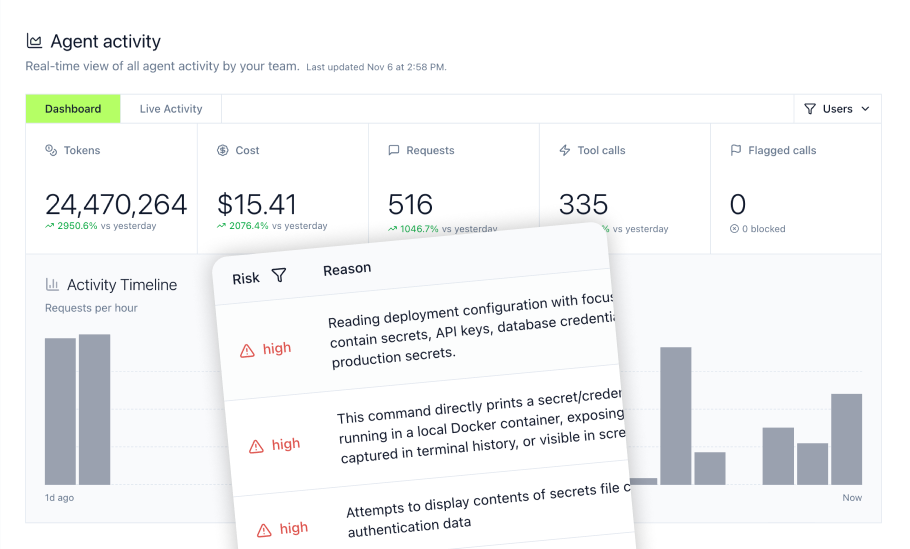
Your CFO approved a $20/user/month AI assistant. Your actual cost can climb far beyond the seat price once usage limits, governance, security controls, and integration work are included. Understanding why requires looking beyond licensing fees to the operational, security, and integration infrastructure that transforms Claude Cowork from a productivity tool into an enterprise-ready platform. For organizations deploying AI agents across multiple platforms, centralized governance through an MCP Gateway becomes essential for managing the true cost and risk profile of autonomous AI agents.
Claude Cowork, launched in January 2026, represents Anthropic's shift from conversational AI to autonomous desktop agent. Unlike traditional assistants that provide advice, Cowork executes multi-step workflows autonomously: organizing files, generating documents, analyzing data, and delivering finished work without human intervention at each step. For enterprises, this capability creates significant value alongside substantial hidden costs that most vendor pricing discussions fail to address.
This article breaks down the complete cost structure of Claude Cowork deployments, covering direct licensing, infrastructure requirements, security hardening, talent needs, and the governance gaps that create ongoing risk exposure.
Key Takeaways
- True TCO can exceed the seat price when usage limits, infrastructure, security tooling, implementation labor, and governance controls are included
- Cowork activity is excluded from Anthropic's Audit Logs, Compliance API, and Data Exports across all tiers including Enterprise, creating a critical compliance gap for regulated industries
- API consumption scales non-linearly as agentic workflows involve multiple tool calls, context loading, and response generation cycles that exceed standard chat usage
- Data readiness work is often underestimated because agentic workflows need clean permissions, structured connectors, reliable source data, and clear audit ownership before broad rollout
- Break-even depends on workflow fit and should be modeled from measured time savings, implementation labor, governance costs, and ongoing ownership
- Enterprise AI agent ROI depends heavily on use-case scoping, governance at launch, and clear ownership rather than seat pricing alone
Unpacking the True Expense of AI Coding Assistants in the Enterprise
The gap between Claude Cowork's stated pricing and actual enterprise cost stems from four categories most budget discussions ignore: infrastructure scaling, security hardening, integration complexity, and talent requirements.
Direct licensing represents roughly 20% of total cost. The remaining 80% breaks down across:
- API consumption: Heavy users can consume significant API allocation beyond seat limits
- Infrastructure: Vector databases, cloud hosting, and RAG implementations add $50-$2,000/month depending on scale
- Security tooling: MDM deployment, SIEM integration, and MCP governance layers add $15K-$45K in initial setup
- Implementation labor: $5,000-$15,000 for small teams; $50,000-$200,000 for enterprise deployments
Cost factors by organization size:
| Organization Size | Seat Cost | Additional Cost Drivers | TCO Risk |
|---|---|---|---|
| Small team (1-10 users) | $20/seat Team or $20/month Pro | Usage limits, basic governance, connector setup | Moderate |
| Mid-market (10-50 users) | $20/seat Team | Admin controls, SIEM monitoring, connector governance, implementation labor | Moderate to high |
| Enterprise (50+ users) | Custom | SSO/SCIM, RBAC, Compliance API gaps, OpenTelemetry, SIEM, audit controls, internal ownership | High |
The economies of scale at enterprise tier come from shared infrastructure and negotiated API pricing, not from reduced per-user requirements.
Why API Costs Escalate
Cowork consumes significantly more compute than standard Chat interactions. Each autonomous workflow involves multiple tool calls, context loading, and response generation cycles. Agentic workflows can consume usage limits faster than standard chat because they involve multiple sub-agents, tool calls, and context-heavy steps.
Prompt caching can become important at scale because cached context can reduce repeated input costs for long-running or context-heavy workflows, but it requires architectural planning and implementation effort. Without it, economics becomes unsustainable for context-heavy workflows.
MintMCP's Gateway provides centralized cost analytics across teams and projects, enabling organizations to track API consumption patterns and implement per-user spend controls before budgets spiral. This visibility layer is often the difference between controlled scaling and runaway costs.
Navigating Data Governance with Generative AI for Enterprise Tools Like Claude Cowork
Data governance represents both the largest compliance risk and the most misunderstood cost center for Claude Cowork deployments. The critical issue: Cowork activity is explicitly excluded from Anthropic's enterprise audit mechanisms.
The Audit Gap Every Enterprise Must Address
As of Anthropic’s current Team and Enterprise documentation, Cowork activity is not captured in the Compliance API, and Cowork conversation history is stored locally on users’ computers. Admins cannot centrally manage or export that local conversation history, and OpenTelemetry monitoring does not replace audit logging for compliance purposes.
This exclusion has significant implications across compliance frameworks:
- SOC 2 Type II: Limited applicability to Cowork deployments since operational visibility via OpenTelemetry does not constitute a compliance audit trail
- HIPAA: Not ready for PHI workloads until audit coverage is confirmed
- GDPR: Requires careful evaluation because Cowork can access local files and because Cowork activity is not currently captured in audit logs, the Compliance API, or data exports
- PCI-DSS: Not suitable for cardholder data environments
Compensating Controls Available
Organizations deploying Claude Cowork in regulated environments need third-party governance layers:
- OpenTelemetry export to SIEM: Provides usage metrics, tool calls, and cost data, but not a full audit trail
- Endpoint security logging: EDR and file integrity monitoring capture local activity
- MCP Gateway solutions: Centralized MCP audit trails across all connected tools
MintMCP's audit and observability capabilities fill this gap by providing audit logging for prompt submissions, tool calls, agent actions, and user-attributed activity. For organizations that need compliance-ready audit trails, this governance layer transforms Claude Cowork from a compliance liability into an enterprise-viable tool.
HIPAA and SOC 2 Type II Considerations
For healthcare organizations, Anthropic offers Business Associate Agreements on Enterprise plans. However, the Cowork audit exclusion creates a significant barrier. Organizations handling protected health information should:
- Avoid using Cowork for PHI workloads unless Anthropic, legal, security, and compliance teams confirm the exact deployment, logging, retention, and BAA requirements are covered
- Implement compensating controls through MCP Gateway logging
- Maintain separate audit infrastructure for compliance evidence
MintMCP is SOC 2 Type II audited, with continuous compliance monitoring via Drata. MintMCP is compliant with HIPAA standards, and customers handling protected health information can request HIPAA documentation. MintMCP signs BAAs. Visit the Trust Center for compliance documentation.
Enterprise AI Architecture: Securely Integrating Claude Cowork with Internal Systems
Claude Cowork connects to enterprise systems through MCP (Model Context Protocol) servers, creating both integration opportunities and security considerations that require architectural planning.
MCP Connector Ecosystem
Cowork can use connectors and integrations depending on the user's plan, admin settings, and configured tools, including:
- Productivity: Slack, Gmail, Google Drive, Notion, Google Calendar
- Development: GitHub, Linear, CI/CD pipelines
- Data: Snowflake, Elasticsearch, internal data warehouses
- Business systems: Salesforce, HubSpot, Stripe
MCP servers can introduce supply chain risk, especially when local servers receive broad file, credential, or system permissions. Security researchers have documented Claude Code vulnerabilities, including CVE-2025-59536 and CVE-2026-21852, involving malicious project configurations and pre-trust execution or exfiltration risks. Teams should avoid treating those CVEs as Claude Cowork-specific issues unless the source explicitly connects the same flaw to Cowork.
Seamless Authentication for Claude Cowork
Enterprise authentication requirements include:
- SSO/SCIM: Available on Enterprise tier only; required for identity governance
- OAuth 2.0 and SAML: Supported for connector authentication
- Tenant restrictions: Enterprise feature that limits which organizations users can access
Team plan settings require careful admin review before broad rollout, especially around Cowork access, connector controls, Chrome usage, RBAC, and monitoring coverage.
MintMCP's tool governance capabilities provide granular tool-level access control, enabling organizations to allow database reads while blocking writes, or permit specific Slack channels while restricting others. This level of control is essential for enterprise deployments where different teams require different permission profiles.
Connecting Claude Cowork to Your Databases
Database connections require careful credential management:
- MCP servers need database credentials that must be rotated regularly
- Shared service accounts create audit attribution challenges
- Per-user credential scoping is difficult to maintain at scale
Organizations connecting Claude Cowork to production data should:
- Implement read-only database users for AI access
- Use MCP Gateway solutions that provide OAuth brokering and credential rotation
- Maintain separate audit trails for AI-initiated database queries
The Hidden Costs of Unmanaged AI: Shadow AI Detection and Prevention for Enterprise Teams
Shadow AI represents unauthorized AI usage outside governed channels. For Claude Cowork, this manifests as employees using personal Pro subscriptions, configuring unauthorized MCP servers, or running Cowork against sensitive folders without IT oversight.
Why Shadow AI Costs Multiply
Enterprise deployments often struggle when employees adopt AI tools faster than governance catches up, creating data exposure, compliance gaps, and redundant spending on personal subscriptions.
Shadow AI costs include:
- Data leakage: Cowork uses authenticated browser sessions, inheriting all cookies and permissions. This bypasses traditional DLP controls because activity looks like normal user behavior.
- Credential sprawl: Each unauthorized MCP connection creates unmanaged credential exposure
- Compliance violations: Unaudited AI activity in regulated environments creates investigation risk
- Redundant spending: Personal subscriptions across an organization add up while providing no centralized visibility
Identifying Off-Gateway Claude Cowork Usage
Detecting shadow AI requires visibility into:
- MCP server configurations on developer machines
- Browser extension activity for Claude in Chrome
- Local file system access patterns
- Scheduled task configurations
MintMCP's Agent Monitor provides shadow AI detection through hooks in developer tools, identifying off-gateway MCP usage. This visibility extends beyond the gateway to cover local non-MCP agent activity including Bash commands, file reads/writes, and prompt submissions.
Enforcing Policies on Developer Machines
Enterprise enforcement options include:
- MDM-deployed configurations: Push
managed-settings.jsonto lock down MCP server allowlists - Detect-only mode: Identify shadow AI usage without blocking for initial assessment
- Enforce mode: Block unauthorized MCP connections at the endpoint level
Organizations should start with detect-only policies to understand actual usage patterns before implementing enforcement. The goal is bringing shadow AI into governed channels, not pushing users toward alternative ungoverned tools.
Measuring AI Productivity Tools: Beyond the Hype to Real ROI with Claude Cowork
Enterprise AI investments require measurement frameworks that connect productivity gains to business outcomes. The challenge: most organizations lack baseline metrics for the knowledge work Claude Cowork automates.
Quantifying Time Savings with AI Assistants
ROI should be modeled from your own baseline workflows, including the time spent on document processing, research synthesis, file organization, reporting, and approval-heavy tasks. For a defensible business case, compare measured time savings against seat costs, usage limits, implementation labor, governance tooling, and ongoing ownership.
Specific use case benchmarks:
| Use Case | Manual Time | Cowork Time | Value at $75/hr |
|---|---|---|---|
| Meeting transcript processing | 2 hours | 5 minutes | $146/occurrence |
| Expense report from receipts | 90 minutes | 5 minutes | $106/occurrence |
| Competitive intelligence synthesis | 2-3 days | 1 hour | $1,200/quarter |
| Invoice data extraction (200/month) | 20 hours | 2 hours | $1,350/month |
Payback periods vary by workflow, adoption depth, and how much integration and governance work is required before rollout.
Optimizing Claude Cowork Adoption Across Teams
Enterprise AI agent ROI depends heavily on use-case scoping, governance at launch, and clear ownership rather than seat pricing alone. Organizations usually need a clear internal owner for agent rollout, governance, and measurement.
MintMCP's Agent Monitor provides org-level analytics on MCP adoption and usage patterns, enabling measurement of:
- Tool adoption rates by team and department
- Task completion patterns and workflow efficiency
- Error rates and intervention frequency
- Cost attribution by project and use case
This visibility transforms ROI measurement from guesswork into data-driven optimization.
Crafting a Secure AI Environment: Per-Agent Credential Scoping and Policy Enforcement
Credential management represents one of the most significant security challenges in Claude Cowork deployments. Each MCP connection requires credentials, and those credentials need rotation, scoping, and audit attribution.
Giving Claude Cowork Its Own Secure Identity
Traditional approaches share service account credentials across all AI access. This creates several problems:
- No attribution when credentials are used
- Rotation affects all connections simultaneously
- Overly broad permissions because scoping is difficult
- Audit trails show the service account, not the responsible user or agent
Per-agent identity solves these challenges by giving each deployed agent its own rotatable credentials and permission scope independent of the creator's access level.
MintMCP's Agent Bundles provide this capability through:
- Bearer API keys plus OAuth 2.0 client-credentials per agent
- Rotation and revocation independent of human users
- "Act as agent" admin flow for connectors requiring per-agent OAuth
- Permission scopes explicitly tied to agent identity, never shared service-account keys
Implementing Granular Access Policies for AI Agents
Policy enforcement requires more than simple allow/deny rules. Enterprise deployments need:
- Custom policy code execution: Run validation logic on every tool call
- DLP integration: Connect to existing data loss prevention investments
- Context-aware decisions: Apply different rules based on data sensitivity, user role, or time of day
MintMCP's Gateway supports customer-authored JavaScript middleware in a sandboxed environment with:
- Allowed-domains fetch for external validation
- Secret injection for secure credential access
- Built-in templates for OpenAI moderation, jailbreak detection, and AWS Bedrock Guardrails
- Pre- and post-phase hooks that can transform, mask, or block requests
This programmable layer enables organizations to integrate with existing security investments including AWS Bedrock Guardrails, Google Cloud DLP, Microsoft Purview, Nightfall, and Skyflow.
Streamlining AI Governance: Why Simplicity Matters for Enterprise AI Platforms
Configuration complexity directly impacts deployment success. Organizations requiring manual configuration of separate plugin, access rule, and credential objects for each tool face multi-month implementation timelines and ongoing maintenance burden.
Reducing Configuration Burden for AI Agents
MintMCP's Bundle architecture addresses this complexity by packaging tool access, policy enforcement, and audit logging into single governance units per team or role. Each Bundle:
- Ties SCIM group membership to curated MCP server lists
- Applies custom policy rules at the Bundle level
- Creates isolated audit trails for compliance separation
- Syncs automatically with Okta/Azure AD group changes
This approach reduces configuration from dozens of objects per tool to a single Bundle definition per use case.
Virtual MCPs and Non-Technical Users
MintMCP's Virtual MCP (VMCP) abstraction bundles multiple servers with role-based tool access, enabling business teams to consume governed AI capabilities without understanding the underlying MCP infrastructure.
For organizations rolling out Claude Cowork across departments, this abstraction layer means:
- IT defines Bundles with appropriate permissions and policies
- Business users access a single endpoint scoped to their role
- Changes to underlying servers propagate automatically
- Audit trails remain centralized regardless of endpoint used
Optimizing Your Investment: Understanding AI Pricing Models and Enterprise Costs
Claude Cowork's pricing structure varies significantly by tier, with feature gates that affect enterprise viability:
| Tier | Monthly Cost | Key Features | Enterprise Limitations |
|---|---|---|---|
| Pro | $20/user | Cowork access, basic allocation | No admin controls, data may train models (opt-out required), no SSO |
| Team | $20/user | Admin toggle, connector controls | Limited RBAC, no Compliance API |
| Enterprise | Custom | SSO/SCIM, custom RBAC, Compliance API | Cowork excluded from all audit mechanisms |
Beyond Subscription: The Full Cost of Enterprise AI
First-year total investment by scenario:
Small Team (10 users, file/document workflows)
- Implementation: $32,000
- 12 months ongoing: $57,000
- Total Year 1: $89,000
- Break-even: Month 4
Mid-Market (50 users, mixed workflows)
- Implementation: $75,000
- 12 months ongoing: $300,000
- Total Year 1: $375,000
- Break-even: Month 5
Enterprise Private Deployment (100 users, regulated industry)
- Implementation: $150,000
- 12 months ongoing: $540,000
- Talent (3 FTE): $460,000
- Total Year 1: $1,150,000
- Break-even: Month 5-6
Flexible Deployment Options for Claude Cowork
Organizations with data residency requirements have several options:
- Standard SaaS: Anthropic processes API requests; conversation storage local on user machines
- AWS Bedrock: Full control via Amazon's infrastructure with regional deployment
- Google Vertex AI: Alternative cloud path with Google Cloud residency guarantees
- Cloud-provider deployment paths: Claude access may be available through supported cloud providers, but organizations should verify data handling, logging, residency, and audit coverage directly with Anthropic and their cloud provider
Custom or cloud-provider deployment paths may reduce some control gaps, but they do not automatically eliminate data residency, logging, or compliance concerns. Regulated teams should validate the exact deployment model before relying on it for sensitive workloads.
MintMCP offers managed SaaS, with VPC/self-hosted deployment available on request. Organizations with strict data residency or multi-region compliance requirements should validate deployment needs directly before rollout.
Collaboration and Control: Enhancing Team Collaboration Software with Claude Cowork
Claude Cowork's value multiplies when integrated into existing collaboration workflows. However, current limitations affect team-wide deployments:
- Limited cross-device workflow: Cowork work runs on the desktop, while mobile task assignment is available in research preview for eligible Pro and Max users
- Limited Cowork collaboration model: Cowork conversation history is stored locally, so teams need separate systems for shared governance, reusable workflows, and centralized review
- Workflow standardization still requires setup: Teams may need shared Skills, admin-defined instructions, or gateway-level bundles to standardize repeatable Cowork workflows
Securely Sharing AI Agent Workflows
Organizations working around these limitations typically:
- Document successful prompts and workflows in shared knowledge bases
- Create standardized "Skills" (instruction sets) distributed through admin channels
- Build department-specific global instructions that establish consistent behavior
MintMCP's Bundle model addresses collaboration through SCIM group membership. When an employee joins a team in your identity provider:
- They automatically receive access to appropriate Virtual MCPs
- Policy rules cascade from org to team level
- Their activity joins the team's audit trail
- No manual provisioning required
Integrating Claude Cowork with Existing Collaboration Tools
MintMCP's managed agents platform enables coworker agents that live in Slack, hold persistent memory, continue work across days, and operate alongside employees. This approach:
- Provides a shared interface where multiple team members interact with the same agent
- Maintains conversation history accessible to authorized users
- Scopes tool access via Virtual MCP Bundles at the team level
- Creates audit trails that span individual user sessions
For organizations deploying Claude Cowork alongside other AI tools, MintMCP's Agent Gateway serves as the control layer for agent identities, permissions, memory, and monitoring, built on top of its MCP Gateway foundation.
Making Claude Cowork Work for Your Enterprise
Claude Cowork represents a significant shift in how knowledge workers interact with AI, moving from conversational assistance to autonomous task execution. This shift creates substantial value, but also introduces hidden costs and risks that go far beyond the seat price.
The key to successful Claude Cowork deployment is treating governance as a first-class concern from day one, not an afterthought. Organizations that scope governance from the beginning ship faster overall and avoid the rework that stalls deployments. This means defining success metrics, establishing audit requirements, and naming accountable owners before the first employee logs in.
MintMCP provides the governance infrastructure enterprise teams need to deploy Claude Cowork and other AI agents safely at scale. Through centralized MCP Gateway capabilities, Virtual MCP abstraction, per-agent credential scoping, programmable policy enforcement, and comprehensive audit trails, MintMCP transforms Claude Cowork from a compliance liability into an enterprise-viable tool.
Beyond Claude Cowork, MintMCP's coworker agent feature lets teams own their own agent memory system, own their own MCP data governance, and choose which AI models to use instead of being tied to a single provider. This flexibility enables cost optimization through cheaper model options while maintaining the security and compliance posture enterprise teams require.
The real cost of Claude Cowork is not just dollars. It's the organizational investment in governance, security, integration, and change management required to capture value while managing risk. Organizations that understand this complete picture and invest appropriately will find Claude Cowork delivers substantial ROI. Those that focus only on seat pricing will struggle with runaway costs, compliance gaps, and stalled deployments.
Frequently Asked Questions
What security vulnerabilities have been discovered in Claude Cowork deployments?
Security researchers have documented vulnerabilities affecting Claude Code and MCP-adjacent workflows, including CVE-2025-59536 and CVE-2026-21852. These should be described as Claude Code vulnerabilities unless a source explicitly confirms the same issue affects Claude Cowork. Organizations should maintain MCP server allowlists, audit source code for community servers, use MDM-deployed configurations to prevent unauthorized servers, and disable Chrome integration for sensitive systems. Network egress controls and endpoint security logging provide additional protection layers.
How do Claude Cowork's Team plan defaults compare to Enterprise security requirements?
Team plan settings require careful admin review before broad rollout, especially around Cowork access, connector controls, Chrome usage, RBAC, and monitoring coverage. Enterprise plans offer stronger administrative controls, including RBAC, tenant restrictions, analytics, OpenTelemetry observability, and enterprise deployment options. However, neither tier captures Cowork activity in Audit Logs or Compliance API. Organizations on Team plan should disable Chrome integration, configure connector allowlists, enable admin approval for new tools, and implement third-party audit logging before broad rollout.
What talent investment is required for successful Claude Cowork enterprise deployment?
Organizations usually need a clear internal owner for agent rollout, governance, and measurement. That role typically costs $120K-$180K annually. Full enterprise deployment often requires ML engineer support ($150K-$200K/year) for prompt optimization and model selection, plus data engineer support ($110K-$160K/year) for integration and data pipeline work. For year one, talent costs frequently exceed API and platform costs combined. Organizations attempting deployment without dedicated ownership consistently struggle with ROI realization.
How does Claude Cowork's browser automation create unique DLP challenges?
Cowork uses authenticated browser sessions for web automation, inheriting all cookies, session tokens, and permissions from the user's browser. From a DLP perspective, this activity looks like normal user behavior, bypassing traditional controls. Organizations should configure site allowlists and blocklists, disable Chrome integration for banking, cloud consoles, password managers, and HR portals, implement network egress monitoring, and consider separate browser profiles for AI-assisted work. MCP Gateway solutions provide additional visibility into which sites agents access and what data flows through connections.
What is the recommended phased approach for enterprise Claude Cowork deployment?
Successful deployments follow a structured four-phase approach. Phase 1 (Weeks 1-6): Discovery and architecture, including pain point audits, data source mapping, and security requirements. Phase 2 (Weeks 6-14): MVP build targeting a single high-value workflow with 5-10 pilot users. Phase 3 (Weeks 14-26): Enterprise hardening with RBAC, audit trails, per-user spend limits, and SSO integration. Phase 4 (Month 6+): Scale and ecosystem expansion to additional departments. Organizations that scope governance from the beginning ship faster overall and avoid rework that can stall deployments.