Choosing the right AI agent platform for your enterprise requires evaluating execution models, integration ecosystems, security postures, and governance capabilities. Claude Tag, Microsoft 365 Copilot Cowork, and ChatGPT Workspace Agents each take distinct approaches to AI-powered productivity, from Slack-native team collaboration to deep Microsoft 365 integration to team-centric workflow automation. But all three share a common challenge: they provide productivity without the cross-platform governance infrastructure enterprises need to deploy them safely. This comparison examines each platform's strengths, use cases, and architectural differences, then explains how MintMCP's governance layer fills the critical gaps security and compliance teams face when rolling out AI agents at scale.
Key Takeaways
- Claude Tag operates as a Slack-native coworker agent that teams can tag into shared channels, with access to selected channels, tools, data, and codebases
- Microsoft 365 Copilot Cowork runs in Microsoft's cloud across Microsoft 365 apps and organizational context, suited for organizations standardized on the Microsoft ecosystem
- ChatGPT Workspace Agents deliver team-centric automation with flexible MCP integrations, designed for SaaS-heavy environments needing quick agent deployment
- MintMCP provides cross-platform governance for Claude, Cursor, ChatGPT, Gemini, and Copilot from a single control plane, addressing audit and policy gaps all three platforms share
- Enterprises need both an AI agent platform and a governance layer; MintMCP makes any agent choice enterprise-ready through tool-level RBAC, per-agent identity, and pre-execution guardrails
- MintMCP's Agent Monitor detects off-gateway MCP usage in developer tools like Cursor and Claude Code, providing visibility into shadow AI activity
Understanding the Enterprise AI Agent Landscape in 2026
The Model Context Protocol ecosystem has driven significant enterprise AI adoption. MCP adoption has expanded across major AI platforms, creating a clearer need for governance infrastructure around tool access, policy enforcement, and audit trails. This standardization wave created a clear need: enterprises deploying AI agents across multiple platforms require infrastructure that governs tool access, enforces policies, and maintains audit trails regardless of which agent platform teams choose.
The challenge isn't selecting between Claude, Copilot, or ChatGPT. Most organizations will deploy multiple platforms based on team needs and existing technology stacks. The challenge is governing all of them consistently.
Why Governance Matters More Than Platform Choice
Each AI agent platform excels in its domain. But platform-native security features focus on their own ecosystem:
- Claude's governance covers Claude usage only
- Copilot's governance integrates with Entra ID but remains M365-centric
- ChatGPT's governance applies to ChatGPT Workspace but not cross-platform activity
This creates three separate audit streams, three policy configurations, and three potential blind spots. Enterprise security teams managing AI risk across the organization need a unified governance layer that works across all platforms simultaneously.
Claude Tag: Slack-Native Coworker Agent for Team Workflows
Claude Tag represents Anthropic's Slack-native approach to coworker agents: a shared team agent that can join channels, follow context, and work with selected tools, data, and codebases. Rather than acting like a one-to-one chatbot, Claude Tag is designed for shared team workflows inside Slack, where multiple people can bring Claude into the same workstream.
Key Features of Claude Tag for Teams
Claude's Slack-native architecture provides capabilities for team collaboration:
- Shared channel access: Claude Tag joins Slack channels as a team member, following conversations and context without manual briefing
- Shared channel context: Claude Tag can use Slack conversation context and approved connected tools so teams can delegate work without repeatedly restating background
- Team-accessible agent: Multiple team members can interact with Claude Tag in shared channels, enabling collaborative problem-solving
- MCP server support: Claude connects to MCP servers for tool integrations, enabling access to external data sources and services
These capabilities make Claude Tag particularly relevant for teams that want a persistent AI teammate inside shared Slack workflows.
Integrating Claude into Your Enterprise Workflow
Claude Team pricing starts at $25 per seat monthly, with Enterprise tiers offering custom pricing and governance features. Organizations can share skills and connectors across teams through shared configurations.
For enterprises deploying Claude at scale, the Slack-native model creates both opportunities and challenges. Shared channel access enables powerful team workflows, but each agent interaction becomes a potential point of data access that security teams must account for. Claude's native logging provides usage visibility, though tool-level audit trails and cross-platform governance require additional infrastructure.
MintMCP's Agent Gateway works well with Claude Tag because MintMCP's agent identity system connects cleanly with Slack-native workflows. MintMCP's broader coworker agent approach lets teams own their own agent memory system, own their own MCP data governance, choose which AI models to use instead of being tied to Claude, and use cheaper model options such as GLM-5.2. The Agent Monitor tracks Claude Code activity through hooks that detect MCP calls, file operations, and bash commands outside the gateway, providing visibility into local agent behavior.
Microsoft 365 Copilot Cowork: Automating Work Across Microsoft 365
Microsoft 365 Copilot Cowork takes a different architectural approach: cloud-based work orchestration within the Microsoft 365 ecosystem. It is built around Microsoft 365 apps, organizational context, and Microsoft’s agent governance stack.
Advantages of Copilot Cowork for Microsoft 365 Workflows
For organizations standardized on Microsoft 365, Copilot Cowork offers native integration:
- Microsoft Graph access: Copilot queries organizational data across M365 services, understanding context from emails, calendars, documents, and team communications
- Entra ID integration: Enterprise identity management applies automatically, with policies and permissions inherited from existing Azure AD configurations
- Cross-device continuity: Cloud-based execution means tasks persist across devices and sessions
- Workflow automation: Copilot Studio enables custom agent creation and workflow automation within the M365 environment
Copilot's Work IQ intelligence layer provides contextual understanding across the Microsoft Graph, enabling queries that reference organizational knowledge without explicit file uploads.
Licensing and Accessibility for Microsoft 365 Copilot Cowork
Copilot pricing varies by deployment model:
- Microsoft 365 Copilot add-on: Standard pricing is commonly listed at $30 per user monthly on top of eligible Microsoft 365 subscriptions
- Promotional Microsoft 365 Copilot offers: Discounts may vary by plan, require annual commitment, and usually apply only to the first year
- Microsoft 365 E7: Listed at $99 per user monthly and includes Microsoft 365 E5, Microsoft 365 Copilot, Entra Suite, and Agent 365
The total cost of ownership requires factoring in existing M365 infrastructure. Organizations already invested in the Microsoft ecosystem see Copilot as a natural extension; those with multi-cloud or non-Microsoft environments face additional overhead to realize Copilot's full capabilities.
For governance, Copilot inherits Entra ID policies and can connect into Microsoft’s broader security and compliance ecosystem, including Microsoft Sentinel. However, this governance remains Microsoft-centric. Organizations deploying both Copilot and non-Microsoft AI agents need additional infrastructure to maintain consistent policies and unified audit trails across platforms.
MintMCP Gateway provides this cross-platform governance, enabling security teams to enforce consistent policies whether tool calls originate from Copilot, Claude, ChatGPT, or other MCP-compatible clients.
ChatGPT Workspace Agents: Versatile Automation for Business Operations
ChatGPT Workspace Agents targets a different use case: team-centric automation that runs in OpenAI's cloud with flexible integrations across SaaS tools. Rather than Slack-native execution or Microsoft-exclusive integration, Workspace Agents emphasizes multi-tool connectivity and shared team resources.
How ChatGPT Agents Transform Workflows
ChatGPT Workspace Agents provides capabilities designed for business teams:
- Team-shared agents: Workspace Agents are shared across team members with consistent configurations
- Connected-tool workflows: Workspace Agents can work across approved tools and shared workspace resources, depending on admin settings and available connectors
- Cloud execution environment: OpenAI’s workspace environment supports multi-step agent workflows, with usage governed by workspace settings and credit rules
- Slack deployment: Agents can be invoked through Slack, integrating AI assistance into existing communication workflows
The guided agent builder UI enables non-technical users to create agents in minutes, lowering the barrier to entry compared to platforms requiring developer configuration.
Implementing ChatGPT for Enterprise Use Cases
ChatGPT Business pricing starts at $20 per user monthly with annual billing or $25 monthly, with a two-seat minimum. Workspace Agents are available for Business and Enterprise workspaces, with Business rollout and admin controls managed through workspace settings.
OpenAI says Workspace Agents pricing is expected to take effect on July 6, 2026, with indicative rates for Business and Enterprise customers, so teams should verify current credit rules before forecasting usage costs.
For governance, ChatGPT provides workspace-level controls and a Compliance API for audit data. However, like other platforms, these controls apply to ChatGPT usage only. Organizations deploying multiple AI agent platforms need additional infrastructure to maintain unified governance.
MintMCP's security governance layer addresses this by providing consistent tool-level RBAC, policy enforcement, and audit logging across ChatGPT and all other MCP-compatible platforms.
Comparing Coworker Agents: Claude Tag vs Microsoft 365 Copilot Cowork
For enterprise teams, the choice between Claude Tag and Microsoft 365 Copilot Cowork involves where work happens: Slack-native shared channels or Microsoft 365 apps, files, meetings, and work graph context.
Feature Comparison: Agent Capabilities
| Capability | Claude Tag | Microsoft 365 Copilot Cowork |
|---|---|---|
| Execution location | Slack channels | Cloud (Microsoft Graph) |
| Primary workspace | Slack channels | Microsoft 365 Copilot, Teams, Outlook, Word, Excel, PowerPoint, and calendar workflows |
| Context source | Slack channel context and connected tools | Microsoft Graph and Microsoft 365 context |
| Action model | Team tags Claude into shared Slack context | Cowork carries out approved actions across Microsoft 365 workflows |
Claude's Slack-native approach provides shared channel context, enabling workflows where teams collaborate with an AI teammate directly in Slack conversations. Copilot's cloud-based model offers cross-device continuity and Microsoft Graph integration but requires workflows to occur within Microsoft services.
User Experience and Integration Ecosystems
Claude Tag strengths for teams:
- Shared team context in Slack channels
- Integration with Slack-native workflows
- Better fit for teams that do not center daily work inside Microsoft 365
Microsoft 365 Copilot Cowork strengths for teams:
- Native integration with Microsoft 365 apps and services
- Consistent experience across Microsoft collaboration tools
- Organizational context from Microsoft Graph
The choice often depends on existing infrastructure. Teams standardized on Microsoft's collaboration stack find Copilot's integrations seamless. Teams using Slack as their primary collaboration hub may prefer Claude's Slack-native approach.
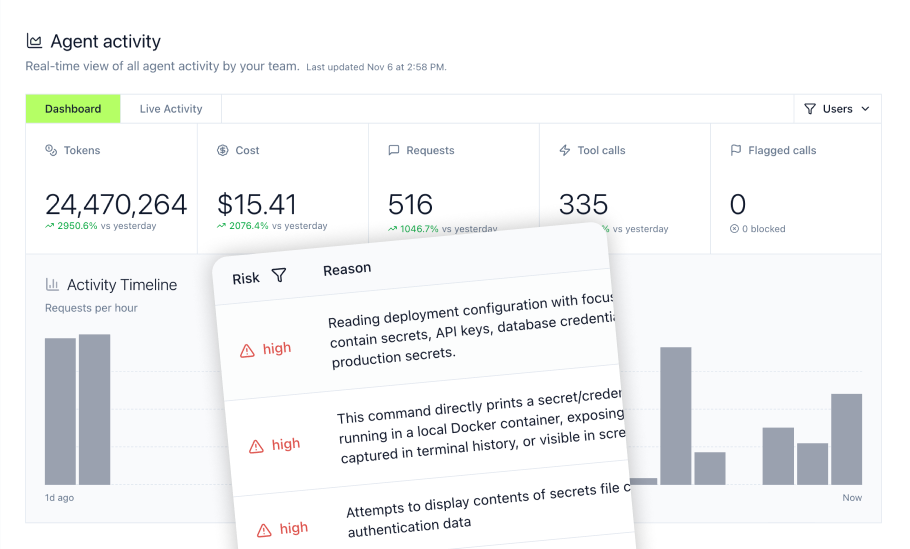
Regardless of platform choice, teams benefit from centralized governance that tracks agent activity across collaboration platforms. MintMCP's Agent Monitor provides this visibility, detecting PII exposure, credential leakage, and risky bash commands from AI agents.
Beyond the Hype: Best AI Productivity Tools for Enterprise
Selecting AI productivity tools requires evaluating factors beyond feature comparisons: scalability, security architecture, compliance readiness, and total cost of ownership.
Evaluating AI Tools for Scalability and Security
Enterprise AI deployment at scale introduces governance challenges:
- Credential sprawl: Each AI agent platform requires its own credential configuration, multiplied across users and teams
- Policy fragmentation: Separate policies for each platform create inconsistency and audit gaps
- Shadow AI risk: Employees may use unsanctioned AI tools outside IT visibility
- Tool access proliferation: New MCP server capabilities may be silently added without admin approval
These challenges compound as organizations deploy multiple AI platforms across different teams.
Cost-Benefit Analysis of Enterprise AI Adoption
A pricing comparison should separate public seat pricing from variable usage and base-platform requirements:
| Solution | Public seat / plan pricing to verify | Additional costs to check |
|---|---|---|
| Claude Team / Enterprise | Team pricing starts at $25 per seat monthly, while Enterprise is custom | Usage limits, add-ons, connectors, and enterprise terms |
| Microsoft 365 Copilot Cowork | Microsoft 365 Copilot is typically priced as an add-on to eligible Microsoft 365 plans, while Microsoft 365 E7 is listed at $99 per user monthly | Base Microsoft 365 licensing, Copilot Credits, Agent 365 licensing, and Azure usage |
| ChatGPT Workspace Agents | ChatGPT Business seat pricing plus Workspace Agent credit rules | Workspace Agent credits, Codex usage, connected apps, and Enterprise terms |
These costs cover the agent platforms alone. Enterprise-grade governance infrastructure adds to the total investment but addresses security and compliance requirements that platform-native controls do not satisfy.
MintMCP's Bundle architecture packages tool access, policy enforcement, and audit logging into single governance units per team or role, eliminating the configuration complexity of managing separate access rules across multiple platforms.
Securing Your AI Agents: Governance for Claude, Copilot, and ChatGPT
Each AI agent platform provides security features within its own ecosystem, while broader agent-governance tools differ in scope, supported environments, and protocol coverage. MintMCP's angle is vendor-neutral MCP and Agent Gateway governance across Claude, Cursor, ChatGPT, Gemini, and Copilot.
Security Capabilities Comparison
| Security Feature | Claude Tag | Microsoft 365 Copilot Cowork | ChatGPT Workspace |
|---|---|---|---|
| SSO/SAML | Enterprise tier | Entra ID native | Enterprise tier |
| Provisioning model | Enterprise controls vary by plan | Entra ID and Microsoft 365 admin controls | Workspace-level admin and RBAC controls |
| Audit logging | Usage logs | M365 audit | Compliance API |
| Data residency | Limited options | Azure regions | Limited options |
| Tool and action controls | Enterprise controls vary by plan | Microsoft 365 and Entra-governed controls | Workspace-level controls vary by plan |
Each platform's security and compliance options vary by plan, contract, and documentation, so regulated teams should verify current enterprise terms directly before deployment.
Preventing Data Breaches with AI Governance
AI agents with tool access create new attack surfaces. Enterprise teams can use frameworks like the NIST AI Risk Management Framework to structure risk identification, monitoring, and governance:
- Tool poisoning: Malicious MCP servers could manipulate agent behavior
- Credential exposure: Agents may inadvertently include API keys or tokens in prompts
- Data exfiltration: Agents with broad tool access could send sensitive data to unauthorized destinations
- Prompt injection: Malicious inputs could manipulate agent actions
Platform-native security features focus on preventing abuse within each platform. Cross-platform governance requires infrastructure that monitors and controls agent behavior regardless of which platform initiates tool calls.
MintMCP's pre-execution guardrails block risky tool calls before they execute, based on policy rules that apply across Claude, Copilot, ChatGPT, Gemini, and Cursor. This prevents data exfiltration attempts rather than just logging them after the fact.
Ensuring Compliance in AI-Driven Workflows
Regulated industries face specific requirements for AI agent governance:
- Audit trail completeness: Every tool call must be logged with user attribution and full context
- Access control granularity: Tool-level permissions, not just platform-level access
- Policy enforcement consistency: Same rules across all AI platforms
- Evidence readiness: Audit logs exportable for compliance investigations
MintMCP's SIEM export capabilities deliver audit data to Microsoft Sentinel, Splunk, or S3 in formats ready for compliance review. The platform maintains immutable audit records with conversation-level logging that captures prompts, tool calls, responses, and context with per-user attribution.
MintMCP: The Enterprise-Grade Solution for AI Agent Governance
MintMCP serves as the governance infrastructure layer that makes Claude, Copilot, ChatGPT, Gemini, and Cursor enterprise-ready. Rather than competing with these agent platforms, MintMCP enables organizations to deploy any combination of them with consistent security, compliance, and observability.
MintMCP's Unique Value Proposition in AI Governance
MintMCP provides two connected capabilities:
MCP Gateway: Governed data and tool connections for the AI systems users already run. MintMCP manages and hosts MCP servers with enterprise authentication and access controls, enabling organizations to deploy AI agents with centralized security and observability.
Agent Gateway: Identities, permissions, memory, and monitoring for agents that work alongside users. This layer enables per-agent credentials, scoped tool access, and long-term memory with governance controls.
Key capabilities include:
- Cross-platform governance: Single control plane for Claude, Cursor, ChatGPT, Gemini, and Copilot
- Virtual MCP Bundles: Per-use-case endpoints with SCIM-driven group membership, curated tool lists, and policy inheritance
- Agent Bundles: Per-agent identity with M2M authentication, rotation/revoke independent of human users
- Pre-execution guardrails: Policy enforcement that blocks risky tool calls before execution
- Shadow AI detection: Agent Monitor hooks detect off-gateway MCP usage in Cursor and Claude Code
- 10,000+ MCP servers and hosted connectors: Discovery across a large MCP server ecosystem, with hosted connectors for common enterprise tools such as Salesforce, GitHub, Slack, and Snowflake
How MintMCP Addresses the Governance Gap
Each AI agent platform provides security for its own ecosystem. MintMCP addresses the gaps:
| Governance Need | Platform-Native | MintMCP Solution |
|---|---|---|
| Cross-platform policy | Separate per platform | Single policy framework |
| Unified audit trail | Multiple streams | One audit log for all platforms |
| Tool-level RBAC | Workspace/role level | Granular per-tool permissions |
| Per-agent identity | User-based or workspace-based | M2M auth per agent |
| Shadow AI visibility | Own platform only | Cross-platform detection |
| Pre-execution blocking | Post-hoc logging | Policy-based blocking |
Security and Compliance Posture
MintMCP is SOC 2 Type II audited with continuous compliance monitoring via Drata. Enterprise SSO, complete audit trails, PII detection, role-based access control, penetration testing, encryption in transit and at rest, data residency options, and uptime SLA support are built into the platform. Customers handling protected health information can request HIPAA documentation, and MintMCP signs BAAs to support compliance with HIPAA standards.
For security documentation, visit the MintMCP Trust Center or contact security@mintmcp.com.
Real-World Implementation
MintMCP is designed for enterprise teams that need governed MCP access, tool-level permissions, audit trails, and per-agent identity across the AI systems employees already use. For implementation details, security teams should review MintMCP's product documentation and Trust Center.
Getting Started with Enterprise AI Governance
The decision isn't which AI agent platform to choose. Most enterprises will deploy multiple platforms based on team needs and existing technology investments. The decision is how to govern whichever platforms your teams adopt.
MintMCP provides the governance layer that makes Claude Tag, Microsoft 365 Copilot Cowork, and ChatGPT Workspace Agents enterprise-ready:
- Deploy in minutes: One-click activation of hosted MCP connectors with OAuth, SSO, and audit trails built in
- Govern by role: Virtual MCP Bundles scope tool access to teams and use cases with SCIM-driven membership
- Monitor everywhere: Agent Monitor tracks activity across gateway and local agent usage
- Start free: No sales call required for trial access
Give your team AI everywhere, without losing control. Start your free trial or book a demo to see MintMCP's governance capabilities in action.
Why MintMCP is Essential for Multi-Platform AI Governance
Enterprises deploying Claude Tag, Microsoft 365 Copilot Cowork, or ChatGPT Workspace Agents face a consistent challenge: each platform provides powerful capabilities within its ecosystem but leaves critical governance gaps when teams use multiple AI systems simultaneously. MintMCP's cross-platform approach addresses what platform-native controls cannot.
When a security team needs to enforce the same data protection rules across Slack-native Claude agents, Microsoft 365 Copilot workflows, and ChatGPT team assistants, managing three separate policy configurations creates compliance risk. MintMCP's Virtual MCP Bundles enable consistent tool-level permissions across every agent platform through a single policy framework, eliminating the configuration overhead and audit gaps that come with platform-by-platform security management.
The Agent Gateway layer provides per-agent identity with M2M authentication that works independently of which AI platform employees choose. This means credential rotation, tool access scoping, and audit attribution remain consistent whether the underlying agent runs in Slack channels, Microsoft Graph workflows, or OpenAI's cloud execution environment. Security teams gain unified visibility into agent behavior across every platform without requiring employees to abandon the tools that fit their work patterns.
MintMCP's Agent Monitor detects shadow AI activity that platform-native telemetry cannot surface, including off-gateway MCP usage in developer tools like Cursor and Claude Code. Pre-execution guardrails block risky tool calls before they execute, applying the same policy rules to every MCP-compatible client regardless of vendor. This proactive approach prevents data exfiltration attempts rather than discovering them in post-incident log reviews.
For regulated industries, MintMCP's SIEM export capabilities deliver audit data with conversation-level logging that captures prompts, tool calls, responses, and context with per-user attribution across all platforms. This unified audit trail meets compliance requirements that fragmented platform-specific logs cannot satisfy, providing evidence readiness for regulatory investigations and internal reviews.
Frequently Asked Questions
What is the primary difference between Claude Tag and Microsoft 365 Copilot Cowork?
Claude Tag operates as a Slack-native coworker agent that teams tag into shared channels, following Slack conversations and connecting to selected tools and data. Microsoft 365 Copilot Cowork runs in Microsoft's cloud with durable execution, accessing organizational data through Microsoft Graph and carrying out approved actions across Microsoft 365 apps. Claude excels for teams that use Slack as their primary collaboration hub; Copilot excels for organizations standardized on Microsoft's ecosystem.
How do ChatGPT Workspace Agents enhance business automation?
ChatGPT Workspace Agents provide team-centric automation that runs in OpenAI's cloud with shared configurations across team members. Agents connect to approved workspace tools and can be invoked through Slack for conversational interaction. The guided agent builder UI enables non-technical users to create agents without developer assistance, lowering the barrier to entry for business process automation. This team-first approach differs from individual-focused agent models.
What security challenges do AI agents pose for enterprises?
AI agents with tool access create new attack surfaces including credential exposure (agents inadvertently including API keys in prompts), data exfiltration (agents sending sensitive data to unauthorized destinations), tool poisoning (malicious MCP servers manipulating agent behavior), and prompt injection (malicious inputs controlling agent actions). Each platform provides security features for its own ecosystem, but enterprises deploying multiple platforms face policy fragmentation, audit gaps, and shadow AI risks that platform-native controls don't address.
How does MintMCP help address the governance gap in enterprise AI?
MintMCP provides cross-platform governance for Claude, Cursor, ChatGPT, Gemini, and Copilot from a single control plane. Rather than managing separate policies and audit streams for each platform, security teams use MintMCP's Virtual MCP Bundles to enforce consistent tool-level RBAC across all agents. Pre-execution guardrails block risky tool calls before they execute, and Agent Monitor detects off-gateway MCP usage in developer tools. This unified approach addresses the audit completeness, policy consistency, and shadow AI visibility gaps that platform-native controls cannot fill.
Can MintMCP integrate with existing enterprise security tools?
Yes. MintMCP supports customer-authored JavaScript middleware that runs inline at the gateway, with built-in templates for AWS Bedrock Guardrails, OpenAI moderation, and jailbreak detection. Documented integrations include AWS Bedrock Guardrails, Google Cloud DLP, Microsoft Purview, Nightfall, and Skyflow for data loss prevention. Audit logs export to SIEM platforms including Microsoft Sentinel and Splunk, enabling integration with existing security monitoring infrastructure.