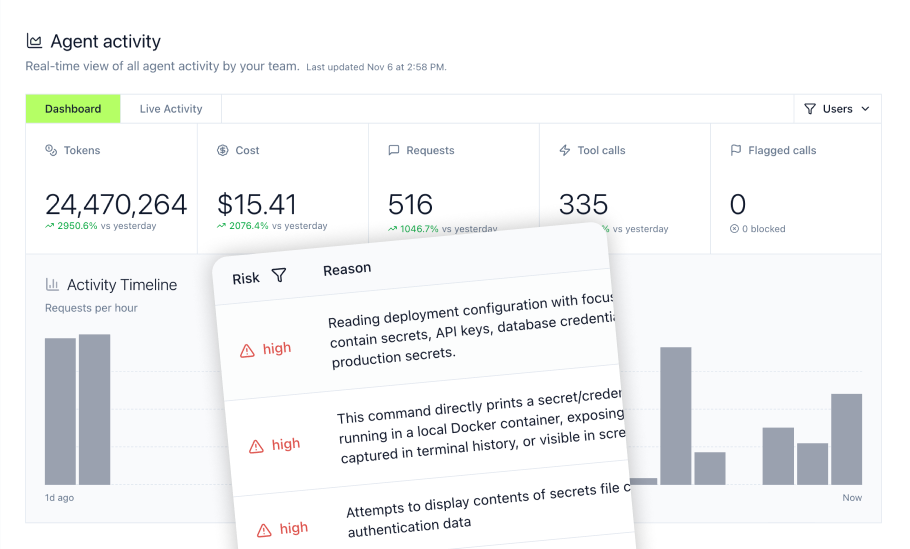
A single unchecked AI agent reportedly drove roughly $47,000 in cloud costs—with 127,000 API calls in about 8 hours, reportedly caused by a runaway automation loop. This scenario illustrates why rate limiting isn't optional for production AI agents using the Model Context Protocol (MCP). Unlike traditional API throttling, MCP rate limiting must account for autonomous agents making rapid-fire tool calls, consuming unpredictable token volumes, and executing expensive operations without human oversight. Enterprise teams deploying AI agents need an MCP gateway with centralized governance, including unified authentication, audit logging, and rate control for all MCP connections.
This article covers how to implement effective traffic controls for your AI agents, from policy design and gateway configuration to monitoring strategies and compliance requirements—ensuring your MCP deployment remains cost-effective, secure, and production-ready.
Key Takeaways
- Rate limiting is a security control, not just optimization: The Coalition for Secure AI lists "Resource Management" as one of 12 core MCP threats requiring active mitigation
- Token-aware limits outperform request counts: Variable-length prompts mean a single request can consume vastly different resources—effective enforcement requires token-based quotas
- Organizations achieve significant cost savings by preventing LLM overages through proper rate limiting enforcement
- Hierarchical policies enable scale: Global baselines with team and user-level overrides allow granular governance across enterprise deployments
- Compliance requirements demand audit trails: Complete logging of every throttled request supports SOC2 and GDPR requirements
Understanding API Rate Limiting for AI Agents
What is Rate Limiting and Why Does it Matter for AI?
Rate limiting controls how frequently AI agents can invoke tools, consume tokens, and execute operations through MCP servers. For traditional APIs, rate limiting protects backend systems from overload. For AI agents, the stakes are higher: autonomous systems can make hundreds of tool calls per minute without human intervention, each potentially triggering expensive LLM operations or downstream API costs.
The unpredictable nature of AI agent behavior—where a simple query might spawn multiple sub-tasks across databases, file systems, and external services—requires traffic controls that traditional API rate limiting wasn't designed to handle.
Core rate limiting mechanisms for MCP:
- Token-based quotas: Limit actual compute usage (input + output tokens) rather than raw request counts
- Multi-dimensional limits: Apply restrictions by user, team, model type, tool category, and time window
- Burst allowances: Use token bucket algorithms allowing short spikes (e.g., 2,000 requests/minute burst) while enforcing sustained limits (e.g., 1,000 requests/minute average)
Common Scenarios Requiring Rate Limiting for MCP
Several enterprise scenarios demand robust MCP rate limiting:
- Runaway agent loops: An agent stuck in a retry cycle can exhaust API budgets within hours
- Multi-tenant resource contention: One team's aggressive agent usage degrades performance for others
- Development environment spillover: Test agents accidentally hitting production MCP servers
- Credential compromise: Stolen API keys enabling unlimited agent operations
The OWASP AI Agent Security recommendations emphasize implementing rate limits at multiple layers—gateway, application, and individual tool level—to provide defense in depth against these scenarios.
The Critical Need for Traffic Control Devices in AI Workflows
Preventing System Overload and Ensuring Stability
AI agents operating through MCP can overwhelm enterprise systems in ways traditional users cannot. A single coding assistant might simultaneously query databases, read file systems, execute bash commands, and call external APIs—all within seconds. Without traffic controls, this creates cascading failures across interconnected systems.
Organizations implementing gateway-based rate limiting report eliminating "noisy neighbor" problems in multi-tenant environments while achieving more predictable resource consumption patterns.
Key stability benefits:
- Predictable resource consumption across teams and applications
- Protection against both malicious attacks and accidental overuse
- Graceful degradation under load rather than complete system failure
Optimizing Resource Utilization and Performance
Traffic controls enable smarter resource allocation beyond simple protection. By understanding actual usage patterns, organizations can:
- Right-size infrastructure: Match capacity to actual demand rather than worst-case scenarios
- Prioritize critical workflows: Ensure production agents receive resources over development/testing
- Implement fair scheduling: Prevent resource monopolization by any single team or application
MintMCP's MCP Gateway provides real-time monitoring with live dashboards for server health and usage patterns, enabling data-driven decisions about rate limit policies and infrastructure scaling.
Why the Model Context Protocol (MCP) Demands Rate Limiting
Managing Autonomous Agent Behavior with MCP
MCP's power lies in enabling AI agents to directly interact with tools, databases, and services. This same capability creates unique governance challenges. Unlike human users who naturally pace their interactions, AI agents operate at machine speed—an industry write-up reported an agent making 127,000 calls in 8 hours before anyone noticed the runaway behavior.
The Coalition for Secure AI threat taxonomy specifically identifies "T10: Resource Management" as a core MCP security concern requiring:
- Maximum request frequency limits per agent/user
- Token consumption caps across time windows
- Circuit breakers that pause agents after repeated failures
Preventing Excessive Tool Calls and External API Usage
MCP agents often chain multiple tool calls to complete tasks. A simple "analyze sales data" request might trigger database queries, file reads, API calls to external services, and LLM inference—each with its own cost and rate limit implications.
In practice, effective MCP rate limiting typically requires:
- Tool-level granularity: Different limits for read operations (loose) versus write operations (strict)
- Cost-aware throttling: Higher restrictions on expensive models (GPT-4) versus cheaper alternatives
- Context preservation: Ensuring rate-limited agents can resume gracefully rather than losing state
MintMCP's LLM Proxy monitors every MCP tool invocation, bash command, and file operation from coding agents, providing the visibility needed to set effective rate limits based on actual usage patterns.
What is the Model Context Protocol (MCP) and How is it Governed?
The Role of MCP in Modern AI Architectures
MCP serves as the industry standard for connecting AI clients—Claude, ChatGPT, Cursor, and others—to enterprise tools and data sources. Supported by Anthropic, OpenAI, Google, and Microsoft, MCP enables AI agents to query databases, manage files, send emails, and execute code through a standardized protocol.
This standardization brings governance challenges. Cisco's security analysis notes that MCP introduces new attack surfaces including tool manipulation, credential exposure through agents, and resource exhaustion through unconstrained tool calls.
Enterprise Governance Challenges Introduced by MCP
Shadow AI grows 120% year-over-year as employees adopt AI tools without IT oversight. MCP exacerbates this by enabling any developer to spin up local MCP servers that connect AI assistants directly to production systems—often without authentication, logging, or rate limiting.
Key governance gaps MCP creates:
- Visibility: Which MCP servers are running? Who's using them?
- Authentication: Are connections properly authorized?
- Audit trails: What operations did agents perform?
- Resource controls: How much capacity are agents consuming?
Understanding MCP gateways helps organizations address these gaps by centralizing governance for all MCP connections.
Implementing Effective API Rate Limiting for Enterprise AI Agents
Designing Granular Rate Limit Policies
Effective MCP rate limiting requires hierarchical policies that balance protection with usability. Organizations should implement YAML-based declarative configurations evaluated in order from most specific to least:
Policy hierarchy example:
- Level 1 - User specific: Heavy users get tighter limits on expensive models
- Level 2 - Team quotas: Data science team receives 500,000 tokens/day across all models
- Level 3 - Global baseline: All users default to 10,000 requests/day
This approach ensures legitimate use cases aren't blocked while preventing abuse. Start with generous limits (95th percentile of current usage) and tighten based on monitoring data.
Technical Considerations for Rate Limit Enforcement
Implementation requires choosing an enforcement point and configuring appropriate responses:
Gateway-based enforcement (recommended):
- Centralized policy management across all MCP connections
- Consistent behavior regardless of client or server implementation
- Minimal latency overhead for properly configured gateways
Response handling best practices:
- For HTTP transports, return 429 with Retry-After; for non-HTTP transports, return a rate-limit error that includes a retry-after timestamp/duration
- Implement exponential backoff in agent code to handle throttling gracefully
- Log all rate limit events with user ID, tool, and timestamp for analysis
For enterprise MCP deployment, MintMCP Gateway provides OAuth + SSO enforcement with automatic enterprise authentication wrapping for MCP endpoints.
Leveraging Traffic Controls to Prevent Cost Overruns and Operational Issues
Tracking Spending and Identifying Abnormal Usage
Without rate limiting, AI agent costs are unpredictable. The $47,000 Azure incident resulted from a single agent loop—imagine dozens of teams running unrestricted agents across your organization.
Cost control mechanisms:
- Budget thresholds: Pause agents when costs exceed daily/weekly limits
- Approval workflows: Require human authorization for operations exceeding cost thresholds
- Usage attribution: Track spending per team, project, and tool for chargeback
Organizations implementing these controls report significant savings in prevented LLM overages.
Avoiding Unnecessary Cloud Costs with Proactive Controls
Beyond preventing disasters, rate limiting enables cost optimization:
- Model routing: Automatically redirect non-critical queries to cheaper models
- Caching: Reduce redundant LLM calls for repeated queries
- Quota management: Ensure teams stay within allocated budgets
The financial services organization that experienced the $47,000 incident implemented token-based limits and circuit breakers, dramatically reducing future overages while preventing future overruns by capping agents at manageable daily limits per team.
Ensuring Compliance and Security with MCP Rate Limiting
Meeting Regulatory Requirements with Controlled AI Access
Rate limiting supports compliance requirements by demonstrating controlled, auditable AI operations. AWS's MCP security implementation guide documents how rate limits combined with audit logging enabled organizations to prove AI agents operate within defined parameters.
Compliance applications:
- SOC2: Rate limiting demonstrates access controls and monitoring
- GDPR: Audit trails of throttled requests prove data access governance
- Financial regulations: Limits on API access frequency support oversight requirements
MintMCP Gateway is SOC 2 compliant and uses OAuth-based authentication, providing complete audit logs for compliance requirements.
Detecting and Mitigating Security Threats via Usage Monitoring
Rate limiting serves as a security control beyond cost management. Unusual usage patterns—sudden spikes, off-hours activity, repeated access to sensitive tools—indicate potential compromise.
Effective security monitoring includes:
- Anomaly detection: Alert on usage patterns deviating from baselines
- Geo-blocking: Restrict MCP access to expected locations
- Behavioral analysis: Identify agents exhibiting unusual tool call sequences
Monitoring and Analytics for Effective Rate Limit Management
Key Metrics for Assessing Rate Limit Efficacy
Effective rate limiting requires ongoing measurement and adjustment. Organizations should track:
- Throttle rate: Percentage of requests hitting limits (aim for low single-digit throttling once policies stabilize)
- Cost per request: Average LLM/API costs to identify optimization opportunities
- Error rates: Reduced rate limit exceeded errors from downstream APIs when gateway limits are properly configured
- Latency impact: Enforcement overhead should remain minimal and operationally negligible
Setting Up Alerts for Exceeded Thresholds and Anomalies
Automated alerting catches problems before they become incidents:
Alert triggers to configure:
- Rate limits breached 5+ times in 10 minutes (potential abuse or misconfiguration)
- Token costs exceeding budget thresholds
- Specific high-risk tools showing unusual usage spikes
- New users/agents consuming abnormal resources
MintMCP Gateway provides real-time monitoring with live dashboards for server health, usage patterns, and security alerts—enabling proactive response to emerging issues.
Future-Proofing Your AI Infrastructure with Dynamic Traffic Controls
Adapting Rate Limits to Evolving AI Agent Needs
Static rate limits become obsolete as agent capabilities and usage patterns evolve. Forward-looking organizations implement:
- Adaptive limits: Automatically adjust based on historical usage and available capacity
- Seasonal policies: Higher limits during peak business periods, tighter during off-hours
- Progressive rollouts: Gradually increase limits for new teams as they demonstrate responsible usage
Integrating AI for Intelligent Traffic Management
Emerging approaches use machine learning to optimize rate limiting:
- Predictive scaling: Anticipate usage spikes before they occur
- Anomaly-based throttling: Dynamically restrict unusual patterns without manual rule creation
- Cost optimization: Automatically route requests to minimize spend while meeting SLAs
Organizations combining these advanced techniques with foundational gateway controls achieve superior reliability and cost efficiency for their AI services.
MintMCP's Role in Governing Your MCP Ecosystem
Transforming Local MCPs into Production Services
MintMCP Gateway transforms local MCP servers into production-ready services with one-click deployment. Teams can deploy both STDIO-based servers and other remote MCP servers, making them accessible across the organization with built-in:
- OAuth protection: Add SSO and OAuth to any local MCP server automatically
- Rate control: Centralized governance with configurable limits per user, team, and tool
- Audit logging: Complete trail of every MCP interaction for compliance
This approach turns shadow AI into sanctioned AI—enabling AI tools safely while maintaining enterprise governance standards.
Controlling AI Agents with Enterprise-Grade Security and Governance
For coding agents specifically, MintMCP's LLM Proxy provides essential visibility and control:
- Tool call tracking: Monitor every MCP tool invocation, bash command, and file operation
- MCP inventory: Complete visibility into installed MCPs and their permissions across teams
- Security guardrails: Block dangerous commands in real-time, including reading env secrets or executing risky operations
- Sensitive file protection: Prevent access to .env files, SSH keys, and credentials
Combined with the MCP Gateway's centralized rate control, organizations gain comprehensive governance over their AI agent ecosystem—from deployment through ongoing operations.
Frequently Asked Questions
What's the difference between token-based and request-based rate limiting?
Request-based limiting counts API calls regardless of size, while token-based limiting measures actual compute consumption. For AI agents, token-based limits are essential because a single prompt can range from 100 to 100,000 tokens depending on context. An agent making 10 requests with massive context windows consumes far more resources than one making 1,000 small queries. Effective MCP rate limiting combines both approaches.
How do I determine appropriate rate limits?
Start by establishing a baseline of current usage patterns—track requests per user, tokens consumed, and costs incurred over 2-4 weeks. Set initial limits at the 95th percentile of observed usage plus a 20% buffer. Deploy in monitoring-only mode first (log violations without enforcing) to validate policies won't disrupt legitimate work. Gradually tighten limits based on data, implementing team-specific overrides for power users. Review and adjust quarterly.
Can rate limiting prevent all AI security incidents?
Rate limiting is one layer of defense, not a complete solution. It prevents resource exhaustion, cost overruns, and detects anomalous behavior—but doesn't address other MCP security concerns like prompt injection, tool manipulation, or credential exposure. The Coalition for Secure AI recommends combining rate limiting with input validation, output filtering, authentication enforcement, and comprehensive audit logging for defense in depth.
How does rate limiting interact with agent retry logic?
Properly configured rate limiting returns HTTP 429 responses with Retry-After headers indicating when agents should retry. Agent code should implement exponential backoff—waiting progressively longer between retries (e.g., 1s, 2s, 4s, 8s) to avoid hammering the gateway. Graceful degradation strategies include falling back to cached results, queuing requests for later processing, or notifying users that operations are delayed. Without this coordination, rate limiting causes cascading failures instead of controlled throttling.