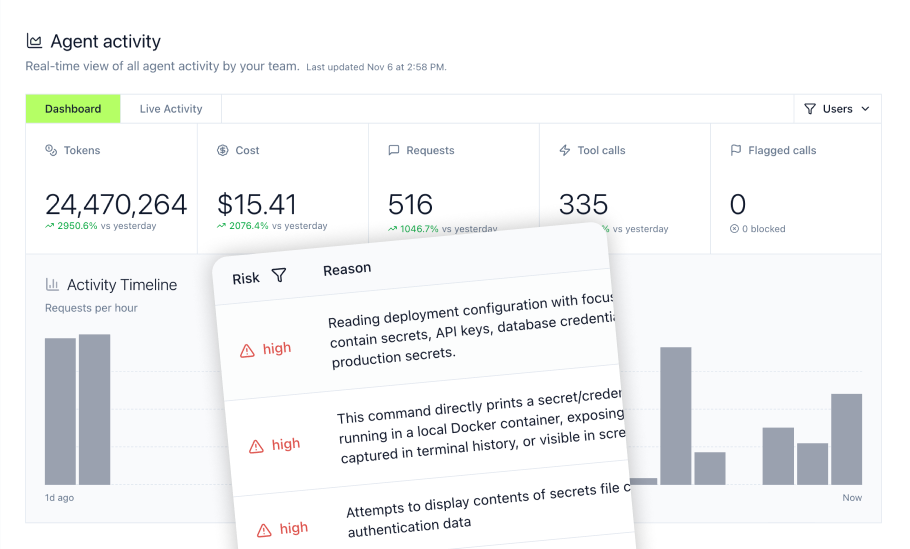
AI agents are transforming how teams work, but deploying them to enterprise collaboration platforms without proper governance creates serious security and compliance risks. Organizations need a management layer that sits between AI applications and enterprise systems, providing centralized authentication, audit trails, and policy enforcement. An MCP Gateway governs the data and tool connections used by AI systems such as Claude, ChatGPT, Gemini, Cursor, and Copilot. For persistent agents that work alongside employees, an Agent Gateway adds agent identities, permissions, memory, and monitoring. MintMCP currently documents Slack-native coworker-agent deployment, while Microsoft Teams requires a separate Teams agent or bot integration.
This article provides actionable steps for deploying governed AI agents to Slack and Teams, covering platform setup, authentication configuration, policy enforcement, compliance requirements, and shadow AI detection.
Key Takeaways
- MintMCP customer stories describe faster onboarding, centralized tool governance, and Slack-native agents, but productivity gains vary by workflow
- MCP ecosystem adoption has accelerated dramatically, with the protocol now supported by all major foundation model providers including OpenAI, Anthropic, Google, and Microsoft
- MintMCP's quickstart targets about five minutes for connecting a first MCP server, while production rollout timelines vary based on identity, security, integration, and change-management requirements
- Shadow AI detection addresses the critical gap where employees use AI tools outside IT visibility, creating compliance exposure
- Per-agent identity with scoped credentials enables audit attribution and credential rotation independent of human users
- Bundle architecture packages tool access, policy enforcement, and audit logging into single governance units per team or role
Understanding AI Agents for Enterprise Collaboration
AI agents extend beyond simple chatbots by connecting to enterprise systems and executing multi-step workflows autonomously. Where a chatbot answers questions from a knowledge base, an AI agent can query your Salesforce CRM, draft a response email in Gmail, and create a follow-up task in Linear based on a single user request.
Common Enterprise AI Agent Types
- Data analysis agents that query databases, generate reports, and surface insights from Snowflake, BigQuery, or Elasticsearch
- Customer support agents that access CRM systems, ticket platforms, and knowledge bases to resolve customer issues
- Development workflow agents that connect to GitHub, Jira, and CI/CD pipelines to automate engineering tasks
- Compliance and audit agents that monitor systems and generate reports for regulatory requirements
The Model Context Protocol provides the standardization layer that makes these connections possible. MCP gives AI agents a consistent interface to interact with enterprise tools, regardless of whether the underlying system uses REST APIs, GraphQL, or legacy protocols. With 10,000+ MCP servers available in managed catalogs, teams can connect agents to virtually any enterprise system.
Deploying AI Agents to Slack with Governance
Slack integration requires configuring both the Slack application layer and the governance gateway that controls what agents can access.
Setting Up Slack Bot Infrastructure
Slack apps can be created and configured through Slack's app tooling. Administrator approval is not universally required; installation depends on the workspace or Enterprise Grid app-management settings. OAuth grants the scopes approved for the app.
Common Slack Permissions
chat:writefor sending messagesapp_mentions:readand anapp_mentionevent subscription for @mention-based invocation- The relevant channel-history scope for reading conversations where the app is installed
files:writeorreactions:writeonly when the agent needs those capabilitiescommandsonly when the implementation includes slash commands
Connecting Slack to Your Gateway
Do not use the Slack MCP connector guide as the bot-deployment flow. That guide configures Slack as a data and messaging connector for AI clients. To deploy a MintMCP coworker agent in Slack, create the agent, assign its tools and identity, then use the Slack coworker-agent setup to give that agent its own Slack app and bot identity.
Practical Setup Steps
- Create a Coworker Agent and connect its GitHub repository
- Configure the agent's model, tools, secrets, memory files, and sandbox
- Assign a Virtual MCP Bundle containing only the tools the agent needs
- Connect the agent to Slack and install its dedicated Slack app
- Invite the app to the relevant channels and test it with an @mention
Users can invoke the agent with @mentions. Ambient mode can also allow proactive replies in threads where the agent has already been mentioned. MCP tool calls remain attributed to the agent identity and governed through the gateway.
Slack Coworker Agents
Beyond simple bot interactions, coworker agents represent a more advanced deployment pattern. These are long-running agents that live in Slack, maintain memory across conversations, continue work across days, and operate alongside employees as persistent team members. Coworker agents hold their own identity, can be assigned to specific channels, and accumulate context about ongoing projects.
Deploying AI Agents to Microsoft Teams
Microsoft Teams deployment generally uses a Teams agent or bot built with the Microsoft 365 Agents SDK and Agents Toolkit, together with Microsoft Entra ID and Azure Bot Service configuration.
Microsoft Entra ID and Teams Agent Registration
Teams agents can be built with the Microsoft 365 Agents SDK and registered with the required Microsoft Entra ID and Azure resources:
- Build the Teams agent or bot with the Microsoft 365 Agents SDK or another supported Teams framework
- Register the agent with Azure Bot Service and Microsoft Entra ID
- Request only the Microsoft Graph or resource-specific consent permissions the agent actually needs
- Set the messaging endpoint to the deployed agent or bot service
- Create and validate the Teams app manifest and app package
- Upload or publish the app according to the tenant's custom-app and app-access policies
Common Teams Deployment Issues
- Bot not responding: Verify that the messaging endpoint points to the deployed agent backend and that the bot ID matches the app manifest
- Authentication failures: Verify the Microsoft Entra ID application, redirect URI, tenant settings, and OAuth configuration
- Permission denied errors: Check the requested Graph or resource-specific consent permissions and the tenant's app-access policies
Unifying Slack and Teams Under One Governance Layer
Organizations using both platforms can centralize tool governance when each Slack or Teams agent routes its MCP tool calls through the same gateway. This can provide a shared audit and policy layer for tool access, but MintMCP does not currently document a native Teams coworker-agent channel equivalent to its Slack integration.
Essential Governance Controls for Enterprise AI Agents
Governance controls address three primary concerns: who can use agents, what agents can access, and what happens when something goes wrong.
Authentication and Identity Management
Enterprise deployments require SSO integration with your identity provider. SAML 2.0 and OIDC protocols connect your governance platform to Okta, Microsoft Entra, or Google Workspace. This ensures that agent access follows the same authentication policies as other enterprise applications.
Agent identities extend this model to non-human principals. Each deployed agent receives its own persistent identity with scoped credentials that can be rotated or revoked independently, keeping agent activity separate from the human who created it.
Key Authentication Capabilities
- OAuth 2.0 and SAML authentication for human users
- Per-agent bearer API keys with independent rotation
- OAuth 2.0 client-credentials flow for agent-to-system connections
- Credential expiry and independently rotatable or revocable keys, with automatic token refresh for supported OAuth flows
- SCIM-based group membership sync from your IdP
Access Control and Permissions
Granular access control determines which tools each user or agent can invoke. This goes beyond binary allow/deny to support action-level permissions. For example, an agent might have permission to read from a database but not write, or to create support tickets but not close them.
Permission Model Options
- Tool-level allowlisting for specific connectors and tools
- Read, write, and destructive-action restrictions through tool curation
- Rate controls where configured
- Rules and supported hooks that allow, block, mask, or require approval
- SCIM-driven access policies for teams and roles
Ensuring Compliance and Auditability
Regulated deployments need audit records appropriate to their risk and compliance requirements. MintMCP's MCP Gateway logs governed tool traffic, while Agent Monitor can capture prompts, tool activity, chat history, and model responses for supported clients. Retention and access should be configured according to data sensitivity rather than assuming every prompt and response must always be stored.
Audit Log Configuration
Audit logs should capture:
- User identity and authentication method
- Timestamp and duration of each interaction
- Relevant prompt or conversation data when Agent Monitor is enabled and retention policy permits
- Every governed tool call, with sensitive parameters redacted where required
- Tool results, status, and policy decisions needed for investigation
Retention periods should be defined by applicable law, contracts, security policy, and incident-response requirements. HIPAA requires certain compliance documentation to be retained for six years, not a blanket seven-year retention period for all audit logs, and SOC 2 does not impose a universal one-year log-retention minimum. MintMCP Agent Monitor defaults to seven days and allows enterprise customers to customize retention by field.
Compliance Certifications
When evaluating governance platforms, verify their compliance posture:
- SOC 2 Type II audited status and access to the relevant audit documentation
- Compliance with HIPAA standards and Business Associate Agreement availability for healthcare use cases
- Data residency options that match the organization's specific regional requirements
- Penetration testing and documented encryption in transit and at rest
MintMCP is SOC 2 Type II audited, with continuous compliance monitoring. It is compliant with HIPAA standards; customers handling protected health information can request HIPAA documentation, and MintMCP signs BAAs. Full security documentation is available at trust.mintmcp.com.
Detecting and Preventing Shadow AI
Shadow AI represents one of the most significant risks in enterprise AI adoption. Employees using ChatGPT, Claude, or other AI tools outside IT visibility can inadvertently leak sensitive data, violate compliance requirements, or create security vulnerabilities.
Shadow AI Detection Methods
Agent Monitor addresses shadow AI through hooks in development tools like Cursor and Claude Code. These hooks detect MCP calls made outside the governance gateway, identifying when developers connect AI tools directly to production systems without going through approved channels.
Detection Capabilities
- Off-gateway MCP and local tool activity in supported coding-agent environments
- Credential and secret exposure, including API keys, tokens, and passwords
- Risky shell commands and sensitive file access
- Prompt injection and unauthorized tool-access attempts
- PII and PHI inspection through gateway middleware or an integrated DLP or content-safety service
Enforcement Options
Once detected, shadow AI activity can trigger various responses:
- Alert-only mode: Notify security team without blocking
- Flag for review: Allow the action but mark for audit investigation
- Block and redirect: Prevent the action and guide user to approved channels
- MDM-pushed enforcement: Deploy configurations to developer machines via mobile device management
Customizing Governance with Policies and Bundles
The Bundle architecture packages tool access, policy enforcement, and audit logging into single governance units. Rather than configuring separate objects for plugins, access rules, and credentials, a Bundle ties everything together per team or role.
Virtual MCP Bundles
Virtual MCPs create curated endpoints for specific use cases. A Virtual MCP Bundle for your customer success team might include Salesforce (read-only), Intercom, and Notion, while an engineering Bundle includes GitHub, Linear, and database access.
Bundle Configuration
- SCIM group membership (who gets access)
- Curated MCP server list (which tools are available)
- Policy rules specific to that Bundle
- Isolated audit trail for compliance segmentation
- Tool-update policy, including automatic enablement or administrator approval for new upstream tools
Custom Policy Code
For organizations with existing DLP investments, governance platforms support middleware integration. MintMCP provides a JS sandbox where customers can author custom policies that execute on every tool call. Current gateway middleware templates include AWS Bedrock Guardrails, Google Cloud Model Armor, OpenAI moderation, and Teleskope. Other API-accessible DLP, classification, or moderation services can be connected through the JS sandbox.
Policy Enforcement Options
- Pre-call inspection (block before execution)
- Post-call masking (redact sensitive data in responses)
- Conditional routing (different policies for different data types)
- External API calls to existing security tools
Scaling AI Agent Deployments
Enterprise deployments often start with a single team and expand across the organization. The governance layer must scale without requiring proportional increases in administration overhead.
Transition Planning
Continue with the current setup when:
- The gateway and agent runtime meet tested concurrency and reliability targets
- Policy and administration overhead remain manageable
- The deployment model satisfies the organization's security and data-handling requirements
Consider additional infrastructure when:
- Load testing identifies capacity, availability, or latency constraints
- Network isolation or deployment requirements call for VPC or self-hosted architecture
- Disaster recovery, operational ownership, or custom runtime requirements exceed the managed defaults
CI/CD Integration
Mature deployments integrate governance configuration into infrastructure-as-code workflows. REST APIs and SDKs enable programmatic management of Bundles, policies, and MCP server deployments. This allows security policies to follow the same review and deployment processes as application code.
The MCP ecosystem continues to mature, with the protocol now governed by the Linux Foundation's Agentic AI Foundation. This standardization reduces vendor lock-in risk and ensures that governance investments made today remain relevant as the ecosystem evolves.
Why MintMCP for Governed Agent Deployment
MintMCP's approach to governed agent deployment rests on two connected layers:
- The MCP Gateway governs tool and data access for Claude, Cursor, ChatGPT, Gemini, and Copilot through a single audited, policy-enforced layer.
- The Agent Gateway extends that foundation with agent identities, permissions, memory, monitoring, and behavioral controls.
- Together, these layers reduce credential sprawl, enforce consistent access policies, and provide the audit trails security teams need.
Unlike ephemeral chat sessions, coworker agents hold state, continue work across days, and operate with credentials independent of the humans who created them. MintMCP treats agent memory as company-owned, versioned, reviewable, auditable, and portable infrastructure. For Slack deployments, teams can connect an agent's GitHub repository, configure its model and tools, assign scoped MCP Bundles, and deploy it as a Slack-native team member. Additional capabilities include:
- Ambient mode for participating naturally in relevant Slack threads
- Private, team, org, and customer memory scopes to provide context without unnecessary data exposure
- Centralized visibility and governance for Shadow AI detection, regulatory compliance, and cross-department agent deployment
Frequently Asked Questions
How do I migrate existing chatbots to a governed AI agent architecture?
Migration from legacy chatbot platforms is usually a workflow-by-workflow rebuild rather than a direct import. Inventory the most-used interactions and integrations, recreate them as governed tools or MCP connections, validate their permissions and audit behavior, and run both systems in parallel until the replacement meets functional and security requirements. The timeline depends on integration count, custom code, testing, and internal approval processes.
What latency does a governance layer add to AI agent responses?
There is no reliable universal latency figure for governance layers. Overhead depends on the network path, policy evaluation, logging, external DLP calls, and connector behavior. MintMCP documents sub-millisecond overhead for allowed Agent Monitor hook actions, but that is not the same as end-to-end MCP gateway or agent-response latency. Benchmark the complete path under expected production load.
Can I use multiple AI models through the same governance gateway?
Yes. MCP is model and client-agnostic at the protocol layer, but an MCP gateway governs tool and data connections rather than model-inference traffic. Claude, ChatGPT, Gemini, Copilot, and compatible custom or open-source clients can use the same governed MCP endpoints, while model selection and switching remain the responsibility of the client or agent runtime.
How do I handle governance for agents that need to operate autonomously without user oversight?
Autonomous agents require tighter scoping than interactive agents. Configure Agent Bundles with the minimum permissions required for the specific task, implement approval workflows for any destructive operations, and set up alerting for anomalous behavior patterns. Regular audit log reviews should verify that autonomous agents stay within expected behavior boundaries.
What happens to agent memory and context when I switch governance platforms?
Agent memory portability depends on how the governance platform stores context. Platforms using Git-like memory principles with versioned, exportable storage enable migration. Opaque vendor-controlled memory stores create lock-in risk. Before committing to a platform, verify that conversation history, agent memory, and configuration can be exported in standard formats. MintMCP treats memory as company-owned infrastructure that can be reviewed, audited, and moved.