Shadow AI has evolved from a niche IT concern into a board-level risk that security teams can no longer ignore. Eight in ten employees use AI tools not approved by their organizations, and more than 1,550 distinct generative AI SaaS applications now tracked across the broader market create a visibility gap that exposes sensitive data, creates compliance failures, and undermines security posture. Organizations with high levels of shadow AI experienced average breach costs $670,000 higher than organizations with low or no shadow AI.
The challenge compounds because IT teams often lack a complete inventory of the AI tools operating across their organizations. This detection gap requires coverage across multiple surfaces because network, browser, SaaS, identity, endpoint, API, and agent-level approaches each have different strengths and blind spots. For organizations seeking to govern AI agents across Claude, Cursor, ChatGPT, and custom deployments, platforms like MintMCP's Agent Monitor provide the visibility layer that transforms detection into actionable governance.
Key Takeaways
- MintMCP provides end-to-end AI governance combining detection, centralized authentication, policy enforcement, and complete audit trails for AI agents and tools
- Multi-layer detection combining network, browser, identity, endpoint, and API methods can provide broader visibility than relying on a single detection method
- organizations with 11 to 50 employees averaged 269 shadow AI tools per 1,000 employees according to recent research
- Shadow AI risks include data leakage through prompts, compliance violations, intellectual property exposure, audit failures, and credential sprawl
- Governance frameworks should address discovery, risk classification, access control, data protection, and continuous monitoring
- GenAI-specific DLP capabilities track exactly what data employees input into AI tools to quantify exposure risk
- IDE-layer visibility captures AI coding assistant activity that network-based tools miss
- Email-based discovery surfaces historical AI account creation for immediate visibility into existing footprints
- Organizations standardized on Microsoft 365/Azure gain shadow AI governance through ecosystem-native controls
- Effective shadow AI programs layer browser-level detection with identity monitoring, network analysis, and DLP
Understanding the Growing Challenge of Shadow AI in the Enterprise
Shadow AI represents unauthorized AI tool usage that bypasses IT approval processes, security reviews, and governance frameworks. Unlike traditional shadow IT focused on SaaS applications, shadow AI introduces unique risks because AI systems can access, process, and potentially expose sensitive data through natural language interactions that leave no obvious audit trail.
What is Shadow AI and Why It Matters
The problem extends beyond employees signing up for ChatGPT accounts. Shadow AI includes:
- Unsanctioned AI applications employees adopt for productivity
- AI features embedded within approved SaaS platforms that activate after initial security reviews
- Browser extensions and IDE plugins that process code and documents through external AI services
- AI coding assistants operating with extensive system access on developer endpoints
organizations with 11 to 50 employees averaged 269 shadow AI tools per 1,000 employees, while enterprises face 223 average monthly data-policy violations related to AI usage. The financial impact compounds quickly when one in four security teams defend AI footprints they cannot fully see.
The Hidden Costs and Risks of Unmanaged AI
Organizations face multiple categories of shadow AI risk:
- Data leakage through prompts containing PII, credentials, or proprietary information
- Compliance violations when regulated data flows through ungoverned AI systems
- Intellectual property exposure when code, documents, or strategies enter AI training pipelines
- Audit failures due to missing activity logs and attribution gaps
- Credential sprawl as employees create accounts with corporate email addresses
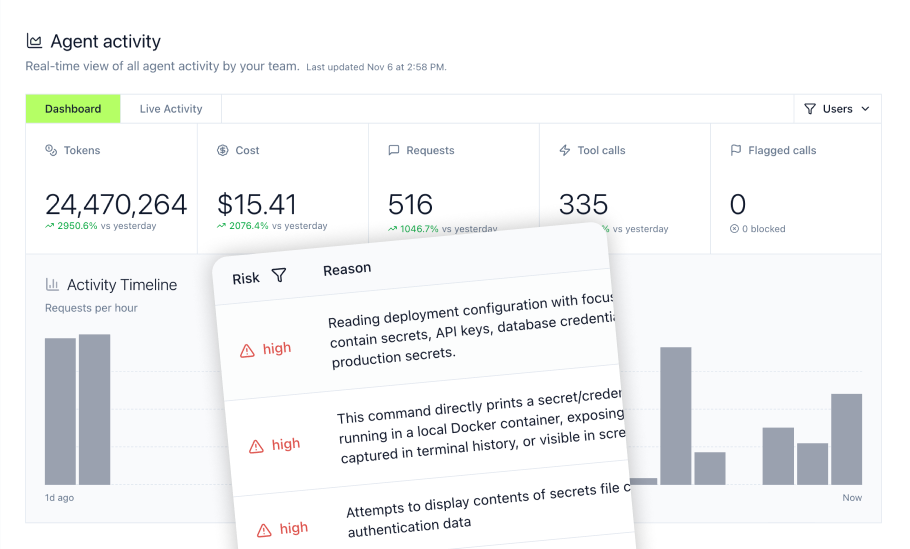
For teams operating AI coding agents like Claude Code, Cursor, or GitHub Copilot, visibility becomes critical when agents can read files, execute commands, and access production systems. MintMCP's Agent Monitor addresses this by capturing file reads, commands, MCP tool calls, and prompts across supported agent environments.
Establishing an AI Governance Framework for Detection and Control
Detection without governance creates alert fatigue rather than security improvement. Organizations with strong shadow AI programs layer browser-level detection with identity monitoring, network analysis, and DLP rather than relying on any single approach.
Key Pillars of Effective AI Governance
A complete framework addresses five interconnected areas:
- Discovery and inventory to identify which AI tools exist across the organization
- Risk classification to prioritize high-risk applications for immediate remediation
- Access control to determine who can use which AI systems
- Data protection to prevent sensitive information from reaching unauthorized AI
- Continuous monitoring to detect new AI adoption and policy violations
The governance architecture should connect detection outputs directly into risk assessment and remediation workflows. Platforms like MintMCP's MCP Gateway provide this integration by centralizing authentication, tool curation, and audit logging for AI systems.
Building Proactive Defense Against Shadow AI
Rather than treating shadow AI as purely adversarial, effective governance transforms unsanctioned AI into sanctioned AI. This requires:
- Centralized authentication that routes AI agent connections through governed infrastructure
- Catalogs of approved AI tools with pre-configured security controls
- Role-based access controls determining which users access which tools
- Complete audit trails of tool invocations across all AI activity
- Real-time blocking of unauthorized server connections
The goal shifts from blocking AI adoption entirely to providing governed alternatives that maintain productivity while ensuring security and compliance.
1. MintMCP
MintMCP provides end-to-end AI governance that transforms shadow AI detection into actionable control. The platform combines real-time activity monitoring, centralized authentication, policy enforcement, and complete audit trails across AI agents and tools. Unlike detection-only platforms, MintMCP enables organizations to govern AI agent connections through a unified infrastructure that maintains productivity while ensuring security and compliance.
Primary Focus
MintMCP focuses on governance infrastructure that converts detected shadow AI into governed AI. The platform provides centralized authentication, access control, and audit capabilities that work alongside detection tools to enable remediation rather than alerts alone.
Core Capabilities
Agent Monitor for Activity Visibility
Agent Monitor provides real-time visibility into what coding agents and AI systems actually do:
- Live activity feeds showing file reads, commands, MCP tool calls, and prompts across Claude Code, Cursor, Codex, and GitHub Copilot
- Security rules with built-in detection for secrets, prompt injection, and tool permissioning
- Usage and cost tracking attributing token spend by model, user, agent, and session
- SIEM export via OTLP or Splunk HEC for integration with existing security infrastructure
MCP Gateway for Centralized Control
MCP Gateway transforms detected shadow AI into governed AI by providing:
- Virtual MCPs bundling approved connectors behind governed endpoints with SCIM-driven membership
- Centralized authentication through SSO with credential injection for downstream tools
- Tool curation determining which capabilities each role can access
- Audit trails logging tool calls, credential lifecycle events, and access-policy changes
Agent Gateway for Agent Identity
Agent Gateway extends governance to autonomous agents with:
- First-class agent identities separate from human credentials
- Scoped permissions defining exactly which tools each agent can access
- Independent credential rotation without affecting users or other agents
- Per-agent audit attribution answering "who did what" for compliance
Guardrails for Runtime Protection
Guardrails screen and control supported agent and tool activity at applicable enforcement points with:
- Mint Guard for prompt injection, PII, credential, and harmful content detection
- Rules matching tool names, arguments, and content patterns
- Gateway Middleware running custom JavaScript for DLP integrations and policy enforcement
Why MintMCP
MintMCP addresses the governance gap that detection tools alone cannot solve. Organizations gain:
- Unified governance across heterogeneous AI environments through single policy enforcement points
- Reduced credential sprawl by eliminating per-tool authentication across developer endpoints
- Complete visibility through centralized logging for governed and supported monitored activity
- Compliance foundation with SOC 2 Type II audited status and HIPAA compliance standards
The platform is SOC 2 Type II audited and compliant with HIPAA standards, and MintMCP signs BAAs for customers handling protected health information.
2. Knostic (Kirin)
Knostic delivers AI-native shadow AI detection through a platform that provides IDE-layer visibility traditional security tools cannot match. The platform implements multi-layer detection across logs, APIs, browser activity, and traffic patterns while enabling real-time intervention through its MCP proxy architecture.
Primary Focus
Knostic focuses on development environments where AI coding assistants operate, implementing detection via MCP proxy that enables real-time guardrails. The platform can block AI agents from accessing sensitive files like .env configurations before the access occurs.
Core Capabilities
- IDE-layer detection via MCP proxy for AI coding assistants
- Real-time guardrails blocking dangerous file access and tool calls
- Multi-layer detection across network, browser, identity, and API channels
- Identity provider integration with Okta and Entra for identity-aware controls
- Operational context mapping connecting AI usage to users, roles, and data sources
Where Knostic Fits
The platform suits organizations prioritizing development environment security where AI coding assistants have extensive system access. Teams using Claude Code, Cursor, or similar tools may find value in Knostic's IDE-layer visibility that network-based tools miss.
3. Nudge Security
Nudge Security provides email-based shadow AI discovery that surfaces AI accounts created in the past, delivering immediate visibility into entire AI footprints rather than forward-looking detection only. The patented approach discovered 1,000+ new AI tools entering the market over the past two years.
Primary Focus
The platform specializes in historical discovery through email analysis, catching AI adoption through personal accounts that network monitoring misses. Pattern-matching technology recognizes AI tools without prior knowledge of their existence.
Core Capabilities
- Historical AI discovery surfacing past AI account creation immediately upon deployment
- Email-based detection analyzing account confirmation and notification patterns
- Dynamic tool identification without maintaining static application lists
- Browser extension integration for forward-looking detection
- SSO and API connection monitoring for enterprise AI tools
Where Nudge Security Fits
Organizations seeking instant visibility into existing AI adoption rather than waiting for future usage to appear in logs may find value in the email-based approach. The platform complements network-based detection by catching activity that occurs through personal email accounts.
4. Netskope
Netskope extends its Security Service Edge (SSE) platform with GenAI-specific detection capabilities and maintains a large catalog of tracked GenAI SaaS applications for network-layer discovery. The platform holds Leader status in the 2026 Gartner Magic Quadrant for both SASE Platforms and Security Service Edge.
Primary Focus
Network-layer detection through CASB integration, applying real-time DLP policies to data flowing toward AI tools. The AI Command Center provides centralized management for AI security across the enterprise.
Core Capabilities
- Network telemetry for GenAI application discovery
- Real-time DLP policies on data flowing to AI tools
- AI Command Center for centralized security management
- SASE/SSE integration providing unified networking and security
- Policy violation tracking averaging 223 monthly incidents per enterprise
Where Netskope Fits
Enterprises seeking network-centric shadow AI detection integrated with broader SSE/SASE infrastructure may find value in the unified approach. Organizations already using Netskope for cloud security gain AI visibility without deploying additional tools.
5. Reco AI
Reco AI combines SaaS security with AI agent governance through unified discovery across 260+ applications. The platform's no-code App Factory enables new AI platform onboarding in 3-5 days, addressing the rapid pace of AI tool proliferation.
Primary Focus
Unified SaaS security and shadow AI detection with rapid expansion capabilities. The Reco Graph maps every identity, permission, connection, and event into a living risk map spanning both traditional SaaS and AI applications.
Core Capabilities
- Unified discovery across 260+ apps including AI agent platforms
- App Factory adding new applications in 3-5 days without code
- Reco Graph mapping identities, permissions, and events
- Complete lifecycle coverage from discovery through threat response
- Shadow AI research reporting 269 tools per 1,000 employees among organizations with 11 to 50 employees
Where Reco AI Fits
Organizations seeking a single platform for SaaS security and shadow AI detection rather than point solutions may find value in the unified approach. The rapid app onboarding capability suits enterprises facing fast-evolving AI landscapes.
6. Lasso Security
Lasso Security provides agentic AI security with automated red teaming capabilities spanning 3,000+ attacks across the OWASP Top 10. The platform holds Gartner Cool Vendor 2024 recognition along with multiple InfoSec awards.
Primary Focus
Runtime enforcement at proxy, API, or AI Gateway layers. The platform implements intent analysis for behavioral anomaly detection beyond pattern matching.
Core Capabilities
- Automated AI Red Teaming with 3,000+ attack library
- Runtime enforcement at proxy, API, or gateway layers
- AI Detection & Response with vendor-reported benchmarks of 98.6% threat detection accuracy and under-50ms classification or blocking decisions
- Intent analysis for behavioral anomaly detection
- Multi-turn agentic attack protection
Lasso also publishes vendor-reported cost and performance benchmarks for its enforcement engine.
Where Lasso Security Fits
Organizations prioritizing agentic AI threat protection with automated testing capabilities may find value in the platform's focus on multi-turn attack detection.
For organizations that need to complement detection with governed AI connectivity, MintMCP's Guardrails provide runtime controls including prompt injection detection, PII filtering, and custom policy enforcement through gateway middleware.
7. Wiz (AI-SPM)
Wiz extends its Cloud Native Application Protection Platform with AI Security Posture Management (AI-SPM) capabilities. Wiz says it was the first CNAPP to introduce integrated AI-SPM capabilities. The platform discovers self-hosted AI models and services through agentless scanning across cloud environments.
Primary Focus
Cloud-native AI discovery via posture monitoring that audits OAuth grants revealing third-party AI connections. The Security Graph unifies AI assets, identities, and data flows in a single view.
Core Capabilities
- Agentless AI discovery scanning cloud environments
- OAuth grant auditing revealing AI service connections
- Security Graph unifying AI assets with cloud infrastructure
- Self-hosted model detection in cloud infrastructure
- AI IDE extension tracking with 80% organizational adoption reported
Where Wiz Fits
Cloud-first organizations seeking AI discovery integrated with cloud security posture management may find value in the unified approach. Teams operating self-hosted AI models in AWS, Azure, or GCP gain visibility that application-layer tools miss.
8. Microsoft Purview
Microsoft Purview provides shadow AI governance for organizations standardized on the Microsoft 365 and Azure ecosystem. The platform implements a four-stage shadow AI protection model: discover, block unsanctioned tools, prevent sensitive data exposure, and govern through audit and retention.
Primary Focus
Ecosystem-native shadow AI controls within Microsoft's data security and compliance framework. Microsoft's shadow AI approach integrates with the broader Microsoft stack, including Purview, Defender for Cloud Apps, Entra, and Intune.
Core Capabilities
- Four-pillar governance framework from discovery through enforcement
- Integration with Microsoft 365/Azure infrastructure
- Data security controls preventing sensitive information in AI prompts
- Audit and retention for compliance documentation
- Directory integration leveraging existing identity infrastructure
Where Microsoft Purview Fits
Microsoft-centric enterprises gain shadow AI governance without introducing new vendors or deployment complexity. The bundled approach reduces tool sprawl for organizations managing security through the Microsoft ecosystem.
9. Cyberhaven
Cyberhaven specializes in GenAI-specific Data Loss Prevention, quantifying data-leakage risk by tracking exactly what data employees input into AI tools. The platform represents a fast-growing capability segment as data leakage becomes a primary shadow AI risk vector.
Primary Focus
Data-centric shadow AI protection focused on preventing sensitive information from reaching AI systems. End-to-end data flow tracking shows where leaked data travels through AI pipelines.
Core Capabilities
- Data leakage quantification tracking specific information input to AI
- End-to-end flow tracking from data source through AI processing
- GenAI-specific DLP policies tailored to AI interaction patterns
- Risk exposure insights showing data flow paths
- Sensitive content identification before AI transmission
Where Cyberhaven Fits
Data-focused organizations prioritizing prevention over detection may find value in the approach. Teams handling regulated data requiring detailed visibility into what information flows to AI systems can benefit from GenAI-specific DLP.
For organizations seeking DLP integration with AI governance, MintMCP's Gateway Middleware enables custom DLP logic and external classifier integration through sandboxed JavaScript execution.
10. AppOmni
AppOmni extends SaaS Security Posture Management to shadow AI detection with particular strength in discovering embedded AI features within approved applications. The platform addresses AI adoption that occurs after initial security reviews when vendors add AI capabilities to existing tools.
Primary Focus
SSPM-based detection catching AI features activated within approved SaaS applications. AppOmni extends SaaS security into AI discovery, including sanctioned and unsanctioned AI applications, embedded AI features, and AI agents operating within SaaS environments.
Core Capabilities
- Embedded AI detection within approved SaaS platforms
- Sanctioned and unsanctioned AI application discovery
- AI agent monitoring within SaaS environments
- SaaS audit capabilities tracking AI feature activation
- Prevention strategies beyond discovery
Where AppOmni Fits
Organizations concerned about AI features appearing in already-approved applications may find value in the SSPM-based approach. Teams seeking SSPM capabilities extended to AI rather than deploying separate detection tools can benefit from the unified platform.
Transforming Detection Into Governance
Shadow AI detection identifies unauthorized AI usage, but governance determines what organizations can do with that visibility. Effective programs connect discovery to authentication, access control, runtime enforcement, and audit.
MintMCP supports this transition through connected governance layers:
- Agent Monitor provides visibility into supported agent activity, including prompts, commands, file access, MCP tool calls, usage, and cost
- MCP Gateway centralizes authentication, credentials, tool access, and audit behind governed endpoints
- Agent Gateway gives autonomous agents their own identities, scoped permissions, credentials, and attributable audit trails
- Guardrails apply runtime controls through Mint Guard, Rules, and Gateway Middleware
Together, these controls help organizations move from fragmented AI access to centrally governed infrastructure. Instead of managing authentication and policy separately for every AI tool, teams can centralize access, reduce credential sprawl, and maintain unified activity records for governed and supported monitored activity.
This approach can simplify:
- Policy enforcement across multiple AI environments
- Credential and access management
- Security monitoring and investigation
- Audit preparation for frameworks such as SOC 2, HIPAA, and the EU AI Act
For teams implementing AI risk programs, MintMCP provides the operational controls needed to turn shadow AI visibility into governed access and enforceable policy.
Frequently Asked Questions
What is shadow AI and why is it a significant concern for enterprises?
Shadow AI refers to the use of artificial intelligence tools, applications, or services within an organization without explicit approval from IT or security teams. Unlike traditional shadow IT focused on SaaS applications, shadow AI introduces unique risks because AI systems process data through natural language interactions that can expose sensitive information, create compliance violations, and generate security vulnerabilities. Research indicates over 80% of employees use AI tools without IT approval while IT teams often lack complete inventories of the AI tools operating across their organizations.
How do AI governance tools help in detecting and preventing shadow AI?
AI governance tools work across multiple detection layers including network traffic analysis, browser monitoring, email-based discovery, identity provider integration, and API monitoring. Multi-layer detection combining network, browser, identity, endpoint, and API methods can provide broader visibility than relying on a single detection method because each approach has different strengths and blind spots. Governance platforms then provide the policy enforcement, access control, and audit capabilities needed to convert detection into remediation rather than alerts alone.
What role does data loss prevention play in AI security?
DLP capabilities have become critical for AI security because the primary risk vector involves sensitive data flowing into AI systems through prompts and file uploads. GenAI-specific DLP tracks exactly what information employees input to AI tools, quantifies exposure risk, and can block sensitive content before transmission. Traditional DLP platforms are extending capabilities to cover AI interactions, while purpose-built solutions focus specifically on the unique patterns of AI data exchange including conversational interfaces and multi-turn interactions.
Can AI agents operate securely with their own identities, and how is this managed?
Yes, platforms like MintMCP's Agent Gateway enable autonomous agents to operate with first-class non-human identities separate from human credentials. Each agent receives its own identity, scoped permissions, independent credentials, and attributable audit trail. Authentication mechanisms range from bearer keys for simple deployments through M2M OAuth tokens to workload identity federation where the agent's infrastructure mints short-lived tokens. This architecture prevents agents from operating through whichever human credential happens to be available and enables proper access rotation and revocation.
What are the key compliance standards relevant to AI governance and security?
Organizations deploying AI governance should evaluate platforms against SOC 2 Type II attestation demonstrating security control effectiveness, HIPAA compliance for healthcare data, and emerging frameworks like the EU AI Act requiring AI system documentation and risk assessment. Complete audit trails become essential for demonstrating compliance, including logs of which users and agents accessed which tools, what data flowed through AI systems, and how security policies were enforced. Platforms providing tamper-evident audit records and SIEM export simplify compliance documentation across multiple regulatory frameworks.