AI agents now execute autonomous actions across enterprise systems—querying databases, sending emails, modifying code, and interacting with production environments. While 88% of organizations use AI in at least one business function, the question of liability when these agents cause damage remains largely unresolved. When an AI agent sends an incorrect customer communication, deletes critical data, or triggers a security breach, the responsibility chain becomes murky. Understanding who pays requires examining the intersection of traditional product liability, emerging regulatory frameworks, and the technical infrastructure that governs agent behavior. Organizations deploying AI agents need robust MCP gateway infrastructure to establish accountability trails before incidents occur.
This article examines the liability landscape for AI agent deployments, identifying responsible parties, outlining risk mitigation strategies, and explaining how enterprise governance infrastructure reduces exposure while enabling safe AI adoption.
Key Takeaways
- Liability remains distributed across developers, platform providers, deployers, and end users—with deploying organizations bearing significant responsibility for governance infrastructure
- An autonomy-based liability gradient helps teams assign responsibility based on oversight level, delegated authority scope, risk mitigations, and deployment context
- Shadow AI adoption continues to accelerate, creating unmonitored liability exposure that enterprises cannot assess or defend
- Complete audit trails for every agent action become essential evidence in liability disputes—platforms without observability cannot demonstrate due diligence
- EU AI Act and emerging US frameworks will establish clearer liability chains, making governance infrastructure investments critical now
Understanding the Autonomous Agent Landscape
AI agents differ fundamentally from traditional software tools. While conventional applications execute predetermined logic, agents make autonomous decisions based on context, instructions, and learned patterns. This autonomy creates novel liability questions that existing legal frameworks struggle to address.
Defining agent autonomy levels
- Assistive agents: Suggest actions requiring human approval before execution
- Semi-autonomous agents: Execute predefined action categories independently while escalating novel situations
- Fully autonomous agents: Make and execute decisions across broad operational domains without human intervention
The liability exposure increases dramatically as autonomy levels rise. An assistive agent that suggests an incorrect response creates less exposure than a fully autonomous agent that executes the action immediately.
MCP and tool use
Modern AI agents connect to enterprise systems through standardized protocols like MCP, enabling them to access databases, send communications, modify files, and interact with external APIs. This capability expansion means agents can cause real operational damage—not just generate incorrect text, but take actions with financial, legal, and reputational consequences.
Understanding MCP gateway infrastructure is essential for organizations deploying agents with tool-use capabilities.
The Intricacies of Product Liability in the Age of AI
Traditional product liability frameworks distinguish three defect types: design defects, manufacturing defects, and failure to warn. Applying these categories to AI agents creates significant challenges.
Design defect challenges
Proving an AI agent has a "design defect" requires demonstrating that an alternative design would have prevented the harm. With agents that learn and adapt, the "design" includes training data, fine-tuning processes, and deployment configurations—distributed across multiple parties.
Manufacturing defect complications
Traditional manufacturing defects involve deviations from intended specifications. AI agents may behave exactly as designed yet still cause harm due to edge cases, prompt variations, or environmental factors not anticipated during development.
Failure to warn considerations
Did the model developer adequately warn the platform provider? Did the platform warn the deploying organization? Did the organization warn end users? Each handoff creates potential liability exposure and defense opportunities.
Causation difficulties
Establishing direct causation between agent behavior and resulting damage requires understanding the decision-making process—often opaque in complex AI systems. Organizations without comprehensive audit and observability infrastructure cannot reconstruct the causal chain.
Who is Responsible? Identifying Liable Parties
AI agent liability distributes across multiple stakeholders, each bearing different exposure levels based on their role in the deployment chain.
Model developers (OpenAI, Anthropic, Google, etc.):
- Responsible for base model capabilities and safety training
- Typically limit liability through terms of service
- Exposure increases for foreseeable misuse not adequately addressed
Platform providers (cloud infrastructure, MCP hosts):
- Enable agent deployment and connectivity
- Bear responsibility for infrastructure security and access controls
- May face liability for inadequate permission systems
Deploying organizations (enterprises):
- Make operational decisions about agent deployment scope
- Control access permissions, monitoring, and governance policies
- Often bear primary liability for damages to customers or third parties
End users (employees, customers):
- Liability limited to instructions outside authorized scope
- May face exposure for deliberate misuse
- Generally protected when following organizational guidelines
Data providers:
- Supply training data, context documents, or real-time information
- Exposure exists for providing inaccurate or harmful data
- Liability increases when data quality directly causes agent failures
Mitigating Risks: Proactive Strategies for Safe AI Agent Deployment
Organizations can substantially reduce liability exposure through structured governance and technical controls. As enterprises increasingly recognize this imperative, the focus has shifted toward implementing comprehensive governance frameworks.
Establish internal governance frameworks
- Define clear policies for agent deployment approval processes
- Create escalation procedures for agent actions exceeding defined thresholds
- Require documented risk assessments before production deployment
- Establish incident response protocols specific to AI agent failures
The NIST AI Risk Management Framework provides comprehensive guidance for organizations building AI governance programs.
Implement comprehensive testing
- Conduct red-team exercises simulating adversarial inputs
- Test agents against edge cases and failure modes
- Validate behavior across expected operational scenarios
- Document testing procedures and results for liability defense
Maintain transparency and documentation
- Record all agent interactions with complete context
- Preserve configuration states and policy versions
- Document decision rationale for deployment choices
- Create audit trails demonstrating due diligence
Deploy technical safeguards
- Implement rate limits on sensitive operations
- Require human approval for high-risk actions
- Configure role-based access controls for agent capabilities
- Enable real-time monitoring and anomaly detection
Organizations seeking practical guidance should review enterprise MCP deployment approaches before production rollout.
Ensuring Accountability: The Role of Observability and Control
When liability disputes arise, organizations must demonstrate what their agents did, why, and what controls were in place. This requires comprehensive observability infrastructure.
Critical observability capabilities
- Tool invocation tracking: Record every MCP tool call, including parameters, timing, and outcomes
- Data access logs: Document exactly what information agents accessed and when
- Decision reconstruction: Preserve sufficient context to explain agent behavior
- Anomaly detection: Flag unusual patterns before they cause significant damage
Granular control mechanisms
- Role-based tool access: Configure which tools each agent role can invoke
- Operation-level permissions: Enable read operations while blocking write actions for specific contexts
- Approval workflows: Require human authorization for defined action categories
- Kill switches: Maintain ability to immediately halt agent operations
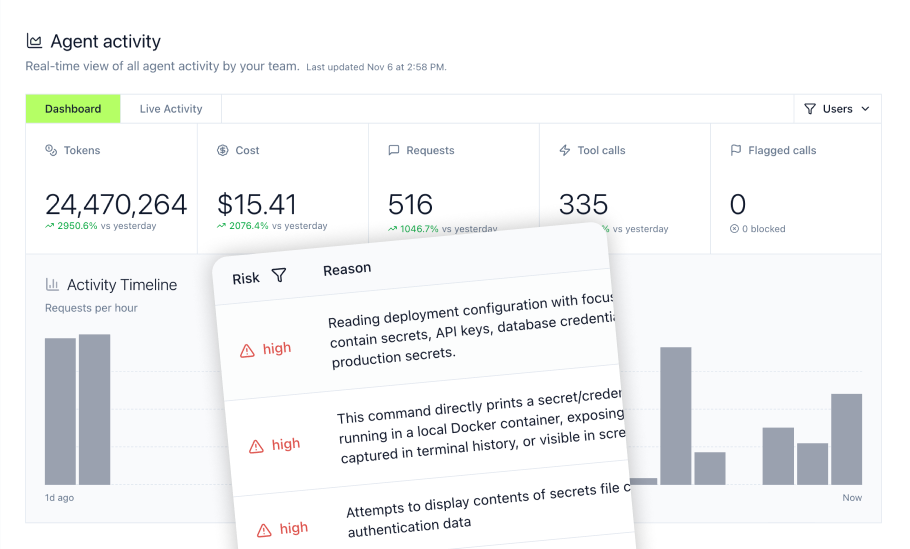
The LLM Proxy provides essential visibility into agent behavior, tracking every tool call, bash command, and file operation. This observability becomes critical evidence when establishing accountability after incidents.
Post-incident analysis requirements
Organizations facing liability claims need to demonstrate:
- Complete record of agent actions leading to the incident
- Evidence of appropriate governance policies in place
- Proof that technical controls functioned as designed
- Documentation of reasonable precautions taken
Without this infrastructure, organizations cannot defend against liability claims effectively—the absence of evidence itself suggests negligence.
Turning Shadow AI into Sanctioned AI
Shadow AI—unsanctioned AI tool usage within organizations—creates unquantifiable liability exposure. When employees deploy AI agents without organizational oversight, the enterprise remains liable for resulting damages while lacking any visibility into agent activities.
Shadow AI liability risks
- No audit trail for agent actions taken on company systems
- No governance policies governing agent behavior
- No technical controls limiting agent capabilities
- No documentation for liability defense
Enterprise security and compliance requirements
Organizations deploying AI agents at scale need infrastructure that provides:
- SOC2 Type II certification: Demonstrates security control effectiveness
- GDPR compliance: Ensures data protection requirements are met
- Complete audit trails: Provides documentation for regulatory compliance
The FTC has issued guidance emphasizing that companies must substantiate AI-related claims and maintain accountability for AI system outputs.
Bringing agents under governance
- Centralize MCP connections through managed gateway infrastructure
- Apply OAuth and SSO enforcement for all agent access
- Implement tool governance policies across all deployments
- Monitor usage patterns across teams and applications
The MCP Gateway transforms local MCP servers into enterprise-ready infrastructure with built-in authentication, monitoring, and compliance capabilities.
Legal Precedents and Emerging Frameworks
While comprehensive AI agent liability law remains nascent, several frameworks provide guidance and signal future regulatory direction.
EU AI Act
The European Union's AI Act establishes risk-based categories for AI systems with corresponding obligations:
- High-risk systems: Subject to conformity assessments, monitoring requirements, and transparency obligations
- Accountability obligations: The EU AI Act sets role-based compliance duties for providers, deployers, and other actors. Liability questions are addressed separately through contract terms, product liability rules, and national law.
- Enforcement mechanisms: Significant penalties for non-compliance
NIST AI Risk Management Framework
The US National Institute of Standards and Technology framework provides voluntary guidance for:
- AI system governance and risk assessment
- Mapping, measuring, and managing AI risks
- Documentation and transparency practices
Contractual approaches
In absence of clear statutory frameworks, liability allocation increasingly occurs through:
- Indemnification clauses in model provider agreements
- Limitation of liability provisions in platform terms
- Insurance requirements for deploying organizations
- Service level agreements with defined liability caps
Emerging insurance products
Traditional cyber insurance policies often exclude AI-specific risks. Specialized AI liability coverage is developing to address:
- Errors and omissions from AI agent actions
- Third-party damages from agent behavior
- Regulatory defense costs
- Business interruption from agent failures
The Future of AI Agent Governance
As enterprise AI agents become ubiquitous, liability frameworks will mature. Organizations making governance investments now position themselves advantageously for this evolution.
Anticipated developments
- Clearer regulatory guidance: Specific requirements for agent oversight and accountability
- Standardized certification: Third-party verification of governance infrastructure adequacy
- Insurance market maturation: Comprehensive coverage products with defined underwriting criteria
- Industry standards: Consensus practices for responsible agent deployment
The Autonomy Gradient Framework
Organizations can assess and manage liability exposure by evaluating four dimensions:
- Degree of human oversight: Supervised actions carry lower deployer liability than fully autonomous operations
- Scope of delegated authority: Read-only access creates less exposure than transactional capabilities
- Risk mitigation measures: Monitoring, controls, and approval workflows demonstrate due diligence
- Deployment context: Internal tools carry different risk profiles than customer-facing agents
Collective responsibility
Effective AI agent governance requires collaboration across stakeholders:
- Model developers must build safety capabilities and provide deployment guidance
- Platform providers must enable governance infrastructure
- Deploying organizations must implement appropriate controls
- Regulators must provide clear, workable frameworks
- Industry must develop and adopt best practices
How MintMCP Reduces AI Agent Liability Exposure
Deploying AI agents without governance creates liability you can’t clearly explain—or defend. MintMCP reduces that exposure by turning ad-hoc agent deployments into accountable, enterprise-controlled systems.
Key risk-reduction mechanisms:
- Complete audit trails for every tool invocation, data access, and decision point—so you can reconstruct what happened, why it happened, and what controls were in place (useful for regulators, insurers, and legal review).
Granular guardrails via role-based permissions, operation-level restrictions, and approval workflows to prevent unauthorized or high-risk actions without blocking productivity. - Enterprise identity controls with OAuth + SSO so agent access follows existing identity policies.
Compliance-ready infrastructure (e.g., SOC 2 Type II) to support regulated environments. - Governed gateway for MCP connections to eliminate “shadow AI” by routing all agent activity through consistent policies, logging, and real-time monitoring.
Flexible deployment across STDIO servers on managed infrastructure and remote/self-hosted servers.
Net effect: liability shifts from unmonitored, hard-to-defend exposure to documented, governed risk with clear controls and evidence.
Frequently Asked Questions
What distinguishes AI agents from AI tools regarding liability?
AI tools execute specific, bounded functions based on explicit user instructions—like generating text or analyzing an image. AI agents operate with greater autonomy, making decisions about which actions to take, when, and how to achieve specified goals. This autonomy creates distinct liability considerations. When a tool produces incorrect output, liability typically focuses on user reliance decisions. When an agent takes autonomous actions—sending emails, modifying data, executing transactions—the liability chain extends to those who enabled and governed that autonomy. Organizations deploying agents need more comprehensive governance infrastructure than those deploying simple tools.
Can companies be held liable for autonomous AI agent actions?
Yes, deploying organizations retain liability even when agent behavior emerges from autonomous learning. The liability analysis shifts from "did you program this behavior" to "did you implement appropriate oversight and controls." Organizations can defend against liability by demonstrating: reasonable testing before deployment, ongoing monitoring of agent behavior, controls limiting potential damage, and responsive action when problems emerged. Courts will likely evaluate whether the organization exercised reasonable care given the agent's autonomy level—not whether the specific harmful action was explicitly anticipated.
How do product liability frameworks apply to AI services?
Product liability frameworks apply imperfectly to AI agents. Traditional product liability requires identifying defects in design, manufacturing, or warnings—categories that map awkwardly to software that behaves probabilistically based on training and context. Additionally, most AI services are provided under license agreements rather than sold as products, potentially shifting disputes from product liability to contract law. The allocation of responsibility between model developers, platform providers, and deploying organizations remains unsettled. Organizations should assume they bear significant liability as deployers and implement governance accordingly rather than relying on upstream parties to absorb responsibility.
What steps minimize AI agent liability risk?
Organizations should implement layered risk mitigation: establish clear governance policies defining acceptable agent use cases and approval processes; deploy technical controls including role-based access, operation limits, and human approval requirements for sensitive actions; maintain comprehensive observability through audit trails of all agent interactions; document risk assessments and deployment decisions; create incident response procedures specific to agent failures; secure appropriate insurance coverage; and train employees on responsible agent usage. The investment in governance infrastructure—both policy and technical—directly reduces liability exposure by demonstrating due diligence.
Does gateway infrastructure help establish AI accountability?
Yes, gateway and proxy infrastructure provides critical capabilities for liability management. Centralized gateways create comprehensive audit trails of every agent interaction, enable consistent policy enforcement across all agent deployments, provide real-time monitoring for anomaly detection, and allow granular access controls by role and operation type. When liability disputes arise, organizations with gateway infrastructure can demonstrate exactly what actions occurred, what controls were in place, and how policies governed agent behavior. Organizations without this visibility cannot reconstruct events or prove due diligence—significantly weakening their liability defense position.