OpenClaw's rapid adoption and surging GitHub popularity following its November 2025 debut have created an unprecedented security crisis for enterprise teams. With an independent exposure study identifying 42,665 candidate internet-exposed instances based on scan methodology and fingerprinting—while only a subset were actively verified as vulnerable—and eight critical CVEs disclosed in a six-week period, security teams face urgent patching decisions that will define their AI agent governance posture for years to come. Organizations seeking centralized governance over MCP deployments can leverage the MintMCP Gateway to transform vulnerable local servers into production-ready infrastructure with OAuth protection, real-time monitoring, and complete audit trails.
This article provides a comprehensive breakdown of OpenClaw CVEs disclosed so far in 2026 (through February 27, 2026), including technical exploitation details, business impact assessments, and actionable patching timelines to protect enterprise environments.
Key Takeaways
- CVE-2026-25253 carries a CVSS score of 8.8 (High) and can enable one-click takeover via WebSocket token exfiltration—patch immediately (within 24 hours for exposed environments). This is separate from the later ClawJacked localhost trust-abuse issue and has a different remediation timeline.
- 22% of monitored organizations have employees running OpenClaw without IT approval, creating massive shadow AI exposure—exactly the scenario where centralized gateway controls (SSO/OAuth, policy enforcement, and audit logging) help convert unmanaged agent use into governed deployments
- The ClawHavoc supply chain campaign began with findings of 341 malicious skills in a 2,857-skill audit of ClawHub, and later analyses reported hundreds more malicious skills across the ecosystem, including clusters consistent with large-scale automated publishing.
- Some independent scans report that 93.4% of a verified sample exhibited authentication-bypass conditions, while other research highlights widespread weak or missing auth on exposed deployments
- Eight critical/high CVEs were disclosed between January 30 and February 27, 2026—the fastest disclosure rate for any AI platform
- Version 2026.2.26 or later represents the current minimum acceptable deployment version; anything earlier remains vulnerable to at least one critical CVE
- Prompt injection risk is not fully "patchable" with one-off fixes—organizations should implement defense-in-depth controls and assume adversarial inputs will eventually reach the agent
Understanding the OpenClaw Threat Landscape in 2026
OpenClaw (formerly Clawdbot/Moltbot) represents a new category of autonomous AI agent with unprecedented access to enterprise systems. The platform's ability to read emails, execute commands, access file systems, and communicate externally creates what security researchers call the "lethal trifecta"—a combination of private data access, untrusted content exposure, and external communication capabilities that fundamentally challenges traditional security models.
What Makes OpenClaw Vulnerabilities Different
Unlike conventional software vulnerabilities affecting isolated applications, OpenClaw CVEs carry amplified blast radius due to the agent's integration with multiple enterprise systems. A single compromised instance can expose:
- All connected communication platforms: Gmail, Slack, WhatsApp, Telegram, Discord
- API credentials: Keys for Claude, OpenAI, Google AI, and connected services
- Corporate infrastructure: SSH keys, environment variables, browser passwords
- Network access: Lateral movement opportunities when deployed on VPN-connected devices
The Cisco security assessment classified OpenClaw as a "security nightmare," but the nine distinct vulnerability findings it highlighted were tied to a specific skill analysis rather than a full platform-wide audit. The disclosure volume and severity reinforce the need to apply disciplined patching and access-control practices consistent with other high-impact enterprise software.
Attack Surface Expansion
Exposure metrics reveal the scope of enterprise risk. Censys identified 21,639 exposed instances on January 31, 2026, representing 21x growth in one week. Bitsight observed over 30,000 distinct exposed instances during its January 27–February 8 analysis window. Separate exposure research noted significant concentration on major hosting providers.
Critical OpenClaw CVEs Requiring Immediate Attention
CVE-2026-25253: One-Click Remote Code Execution
Severity: CVSS 8.8 (High)
Patched Version: 2026.1.29
Exploitation Difficulty: Low (social engineering only)
The OpenClaw Control UI accepted a gatewayUrl query parameter without validation, automatically initiating WebSocket connections to attacker-controlled URLs and transmitting authentication tokens in milliseconds. This enabled cross-site WebSocket hijacking even against localhost-bound instances.
The Foresiet technical analysis documented the complete exploitation chain and remediation steps.
CVE-2026-24763: Docker Sandbox Command Injection
Severity: CVSS 8.8 (High)
Patched Version: 2026.1.29
A command injection vulnerability in OpenClaw's Docker sandbox allowed authenticated attackers to inject arbitrary commands through unsafe PATH environment variable handling. Users controlling environment variables could escape sandbox isolation and potentially compromise the host system.
CVE-2026-27001: Prompt Injection via Workspace Path
Severity: CVSS 8.6 (High)
Patched Version: 2026.2.15
OpenClaw embedded the current working directory into agent system prompts without sanitization. Attackers could craft malicious directories containing Unicode control characters to inject instructions, breaking prompt structure and hijacking agent behavior.
ClawJacked: Separate Localhost Trust-Abuse Vulnerability
Severity: High
Patched Version: 2026.2.26 or later
Discovered By: Oasis Security
A localhost trust abuse vulnerability allowed malicious websites to brute-force gateway passwords due to missing rate-limiting on localhost WebSocket connections. Even properly configured localhost-only deployments remained vulnerable to complete takeover through browser-based attacks.
Common OpenClaw Misconfigurations and How to Harden Your MCP Deployments
The SafePasswordGenerator security audit identified eleven critical configuration checks that organizations must validate:
Network binding vulnerabilities
- OpenClaw’s gateway runs on port 18789 by default and should be loopback-bound (localhost) unless you have compensating controls in place; ensure the gateway remains loopback-bound (localhost) and avoid LAN binding or proxy patterns that unintentionally make the service internet-reachable
- Reverse proxy configurations can inadvertently bypass localhost trust protections
Authentication weaknesses
- Gateway authentication can be weakened by configuration choices; avoid settings and access patterns that reduce pairing/device identity to token-only or allow trivial tokens/passwords
dangerouslyDisableDeviceAuth: truesetting eliminates device verification- A separately tracked macOS-related OAuth token refresh issue (CVE-2026-27487) has also been reported; verify severity and patched version against your authoritative vulnerability source before using it for patch prioritization
Credential exposure risks
- Plaintext storage in
~/.openclaw/credentials/and.envfiles - World-readable permission settings on credential directories
- Lack of secrets management integration
Organizations using the MintMCP Gateway benefit from OAuth + SSO enforcement that automatically wraps authentication around MCP endpoints, eliminating the credential management complexity that leads to these misconfigurations.
Supply Chain Attack: The ClawHavoc Campaign
The ClawHub skills marketplace experienced a coordinated supply chain attack that compromised the platform's trust model. Koi Security's initial scan identified 341 malicious skills across 2,857 audited packages on January 29, 2026.
By February 16, expanded scans revealed 824+ malicious skills across the 10,700+ total skills in the registry. Bitdefender Labs confirmed approximately 20% of deeply analyzed packages contained malicious payloads.
Primary threat indicators:
- Malware payload: Atomic Stealer (AMOS) targeting macOS credentials
- Command & Control: All ClawHavoc skills communicate with
91.92.242[.]30 - Target data: Exchange API keys, wallet private keys, SSH credentials, browser passwords
- Attack vector: Social engineering through "Prerequisites" installation instructions
Known malicious skill categories include ClawHub typosquats (29+ variants), fake cryptocurrency tools, trojanized YouTube utilities, and compromised auto-updater packages.
Proactive Remediation: Beyond Patching
Patching addresses known vulnerabilities but cannot solve architectural security challenges inherent to LLM-driven agents. The core problem: instructions and data occupy the same token stream with no programmatic distinction between content the agent should read and instructions it should follow.
Defense-in-depth strategies:
- Tool restriction policies: Implement deny-by-default approach allowing only required tools
- Human-in-the-loop approvals: Require explicit authorization for bash, filesystem, and messaging operations
- Container isolation: Deploy with dropped capabilities, read-only filesystem, non-root user
- Network segmentation: Block external communication except for explicitly approved endpoints
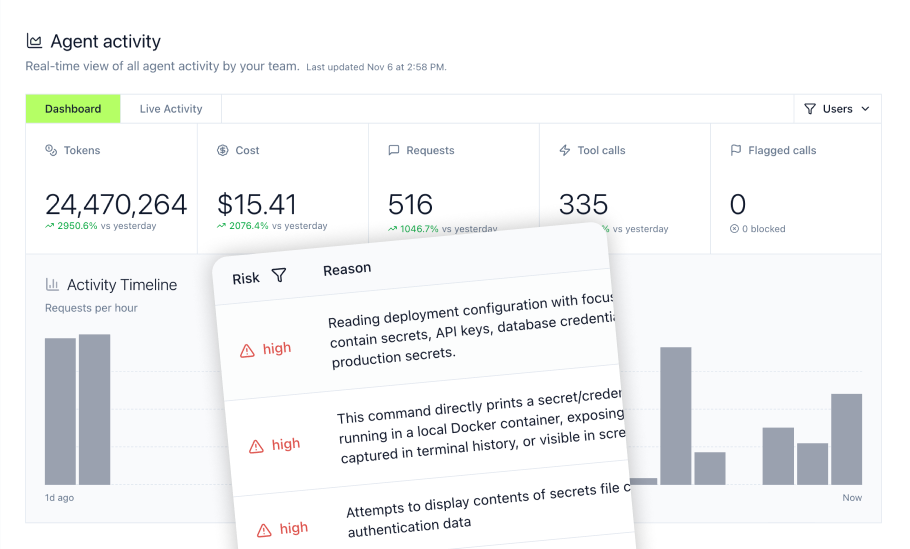
MintMCP Agent Monitor provides security guardrails that block dangerous commands and protect sensitive files in real-time, creating a proactive defense layer against exploitation attempts that patches cannot prevent.
Monitoring and Auditing OpenClaw Interactions
Effective detection requires visibility across multiple layers. The Repello AI guide recommends implementing SIEM alert rules for:
- Unexpected WebSocket connections: Browser processes initiating WebSocket to non-approved domains
- Configuration mutations: Gateway changes without preceding local authentication events
- Rapid token usage: Bearer tokens appearing from external IPs within seconds of creation
- Credential file access: Reads to
~/.openclaw/credentials/or.envfiles - API spend anomalies: Over 100 API calls per hour or sudden cost spikes
Built-in security audit commands:
# Basic audit
openclaw security audit
# Comprehensive deep audit with remediation
openclaw security audit --deep --fix
Organizations requiring enterprise-grade audit capabilities can leverage MintMCP's complete audit trail functionality, which logs every MCP interaction, access request, and configuration change to support SOC 2 evidence needs and privacy/security governance requirements.
Integrating Security Controls with Enterprise AI Governance
The Token Security study found that 22% of monitored organizations have employees running OpenClaw without IT approval. This shadow AI proliferation creates governance gaps that traditional security controls cannot address.
Governance framework alignment:
- **Security governance implication: **Agentic AI environments should be governed with the same rigor organizations apply to other high-impact privileged systems
- NIST AI RMF: Map OpenClaw deployments to Govern, Map, Measure, Manage functions
- OWASP Top 10 for Agentic Applications: OpenClaw exhibits vulnerabilities across all ten categories
Role-based access control requirements:
- Define which teams can use which AI tools
- Restrict data access based on job function
- Enforce approval workflows for high-risk operations
- Maintain complete audit trails for compliance
MintMCP's centralized governance capabilities transform shadow AI into sanctioned AI by providing unified authentication, audit logging, and rate control for all MCP connections.
Best Practices for Rapid Deployment of Secured OpenClaw Infrastructure
The DigitalOcean security guide emphasizes that secure deployment requires addressing both technical configuration and organizational process.
Patch deployment timeline
Urgent (0-24 hours): RCE via social engineering (CVE-2026-25253) — Deploy immediately to all exposed systems
High (24-72 hours): Command injection, sandbox escape (CVE-2026-24763, CVE-2026-27001) — Test and deploy through standard change process
Medium (1 week): Configuration issues and localhost trust vulnerabilities (ClawJacked) — Address via standard change management
Ongoing maintenance requirements
- Weekly: Run
openclaw security audit --deep; review gateway access logs - Monthly: Rotate gateway tokens; audit skills against malicious skill lists
- Quarterly: Rotate all API keys; conduct full security assessment
Organizations seeking rapid deployment with built-in security can leverage MintMCP's one-click deployment capabilities to transform STDIO-based MCP servers into production-ready services with monitoring, logging, and compliance controls in minutes rather than days.
Securing OpenClaw Deployments with MintMCP
While patching individual CVEs addresses known vulnerabilities, enterprise teams need comprehensive governance infrastructure that transforms experimental AI agents into production-ready systems. MintMCP provides the centralized control plane required to operationalize OpenClaw and other MCP-based tools at scale.
The MintMCP Gateway eliminates the most critical configuration vulnerabilities by enforcing OAuth and SSO authentication across all MCP endpoints, preventing the credential sprawl and localhost exposure patterns that lead to compromise. Organizations can deploy STDIO servers on MintMCP's managed service or connect existing remote servers, gaining unified visibility and control without rebuilding infrastructure.
Real-time monitoring through MintMCP Agent Monitor blocks dangerous bash commands, protects sensitive file paths, and creates complete audit trails before threats materialize. This proactive security layer addresses the architectural prompt injection challenges that patches cannot solve, providing defense-in-depth protection aligned with broader enterprise governance best practices for agentic AI.
For teams managing shadow AI proliferation, MintMCP's centralized platform transforms unauthorized deployments into sanctioned, governed infrastructure. Role-based access controls define which teams can use which tools, audit logs provide SOC 2 evidence, and rate limiting prevents API cost overruns—all without requiring individual developers to become security experts. Organizations can move from reactive patching to proactive governance, establishing the AI agent security posture that will scale across hundreds or thousands of autonomous systems in the years ahead.
Frequently Asked Questions
What is the minimum safe version of OpenClaw for enterprise deployment?
Version 2026.2.26 or later represents the current minimum acceptable deployment because it addresses the separate ClawJacked vulnerability disclosed on February 26, 2026. CVE-2026-25253 was a different flaw patched earlier in version 2026.1.29, and exposed systems running versions prior to that should be treated as high risk if they were reachable by untrusted users or networks.
How can security teams detect unauthorized OpenClaw installations across enterprise endpoints?
Network scanning for port 18789 traffic and WebSocket connections provides initial detection. EDR solutions can identify OpenClaw processes and installation artifacts in ~/.openclaw/ directories. mDNS broadcasts on port 5353 with _openclaw-gw._tcp service type indicate active installations. The Shodan/Censys query "OpenClaw Control" port:18789 identifies internet-exposed instances.
Are prompt injection vulnerabilities fixable through patching?
No. Prompt injection represents an architectural limitation where instructions and data share the same token stream. While patches like CVE-2026-27001 address specific injection vectors (workspace path sanitization), the fundamental vulnerability cannot be eliminated while maintaining agent functionality. Organizations must implement defense-in-depth strategies including tool restrictions, human approval workflows, and network segmentation.
What regulatory frameworks apply to OpenClaw deployments?
Organizations should treat agentic AI with the same governance rigor they apply to privileged access management systems. The EU AI Act may classify autonomous agents with real-world action capabilities under high-risk categories. NIST AI RMF provides a structured approach through Govern, Map, Measure, and Manage functions. Organizations in regulated industries should consult compliance teams before deployment.
How does the ClawHub supply chain attack affect existing skill installations?
Organizations should audit all installed skills against published malicious skill lists. Any skill from unknown publishers, particularly those requesting terminal permissions or external downloads during setup, should be removed immediately. The ClawHavoc campaign primarily targeted cryptocurrency tools, YouTube utilities, and auto-updater packages. Skills communicating with 91.92.242[.]30 indicate active compromise.
What incident response steps should follow suspected OpenClaw compromise?
Immediate containment: isolate affected systems and stop gateway services. Assessment phase: review logs for unauthorized WebSocket connections, configuration changes, and connected service access. Credential rotation: revoke all API keys, OAuth tokens, SSH keys, and passwords for connected services. Recovery: rebuild from known-good backup with hardened configuration running version 2026.2.26 or later.