OpenClaw reached 200,000 GitHub stars in 84 days, an unusually fast adoption curve for an open-source AI project. Then came the security incidents—first tens of thousands of exposed instances, later rising above 135,000 in subsequent internet-wide scans, alongside a CVSS 8.8 vulnerability enabling one-click remote code execution, and enterprise restrictions, including documented internal bans at Meta and other firms. This wasn't just a product failure; it was an unintentional stress test exposing fundamental gaps in how organizations govern autonomous AI agents. For enterprises deploying AI tools like Claude Code and Cursor, OpenClaw's trajectory offers critical lessons about the infrastructure needed to scale agents safely. Solutions like MCP Gateway address these gaps by providing centralized governance, authentication, and audit capabilities that transform local agent deployments into production-ready infrastructure.
Key Takeaways
- OpenClaw's viral adoption—200K stars in 84 days—outpaced security maturation, with later security reporting describing a late-January audit that identified hundreds of vulnerabilities, while internet-wide scans found 135,000+ exposed instances
- UpGuard reports that more than 80% of employees use unapproved AI tools at work; bans prove ineffective—sanctioned alternatives with governance infrastructure succeed
- The agentic AI market grows while the AI governance market is also expanding rapidly—MarketsandMarkets projects 45.3% CAGR from 2024 to 2029—showing that governance demand is growing almost as quickly as the agent market itself
- Singapore's IMDA framework, published in January 2026, introduced a first-of-its-kind government framework and enterprise guide for deploying agentic AI responsibly
- Enterprise readiness requires identity-first governance: AI agents should be treated like employees with provisioned identities, credential management, and continuous monitoring
- McKinsey reported in 2024 that only 18% of organizations had an enterprise-wide council or board authorized to make responsible AI governance decisions, even as 71% reported regular generative AI use in 2025 survey data
Understanding AI Agents and Why Governance Matters
AI agents differ fundamentally from traditional chatbots. Where ChatGPT answers questions, OpenClaw executes tasks—sending emails, modifying code, accessing production systems through messaging platforms. This shift from advisory to operational AI creates new risk categories that existing security tools weren't designed to address.
The appeal is clear. Knowledge workers gained zero-friction automation for repetitive tasks. Adoption exploded because OpenClaw eliminated the technical barriers between intent and execution. But autonomous capability without governance infrastructure creates what Prof. Hung-Yi Chen calls "the governance trilemma": organizations cannot simultaneously maximize agent capability, maintain security, and preserve compliance.
Why traditional security fails for agents:
- Agents make runtime decisions across multiple trust boundaries—deterministic rule sets cannot anticipate all execution paths
- Tool invocation patterns vary based on context, making static allowlists insufficient
- Credential access requirements expand as agents integrate with more systems
- Non-deterministic behavior means the same prompt can produce different actions
McKinsey reported in 2024 that only 18% of organizations had an enterprise-wide council or board authorized to make responsible AI governance decisions, even as 71% reported regular generative AI use in 2025 survey data. This gap between adoption and governance explains why OpenClaw's security failures had such widespread impact—most organizations lacked the infrastructure to detect, assess, or respond to agent-specific risks.
The OpenClaw Crisis: A Governance Stress Test
OpenClaw's security timeline reveals systemic vulnerabilities in how autonomous agents interact with enterprise systems.
Critical incidents:
- January 26, 2026: Single-day record of 25,310 new GitHub stars; community enthusiasm eclipsed security review
- January 30, 2026: Wiz researchers disclosed a Moltbook database exposure involving 1.5 million API tokens and roughly 35,000 email addresses
- January 30, 2026: CVE-2026-25253 disclosed with CVSS 8.8 severity, enabling one-click remote code execution through malicious links
- February 1, 2026: SecurityScorecard identified 42,665 exposed instances, with 93.4% exhibiting critical authentication bypass vulnerabilities
- February 9, 2026: Koi Security reported that 341 of 2,857 ClawHub marketplace skills (about 12%) were malicious
The localhost trust model—OpenClaw's core privacy claim—broke under real-world conditions. Local deployment didn't mean secure deployment. Prompt injection persisted regardless of where the agent ran. Credential exposure became inherent to any integration that required authentication.
Enterprise response was immediate but reactive. Meta and other firms issued internal restrictions and removal directives. Token Security research found 22% of monitored enterprises had OpenClaw installed on employee devices—most without IT awareness or approval. The shadow AI problem had escalated from inconvenience to security emergency.
Three Governance Frameworks Emerge
Regulatory bodies and industry groups responded to the OpenClaw crisis with distinct approaches to agent governance.
Singapore's IMDA Model
Singapore's Infocomm Media Development Authority released the first government framework specifically for agentic AI in January 2026. The principle-based approach includes:
- Pre-deployment risk assessment and action-space bounding
- Human accountability with human-in-the-loop checkpoints for high-risk operations
- Technical controls including sandbox isolation, least privilege enforcement, and behavioral logging
- End-user responsibility for agent behavior post-deployment
This framework prioritizes flexibility over prescription, allowing organizations to adapt controls to their specific risk profiles while maintaining accountability chains.
EU AI Act Requirements
The EU AI Act reaches full enforcement August 2, 2026, with penalties up to €35 million for violations. The rules-based approach classifies AI systems by risk tier, requiring:
- Transparency documentation for all AI deployments
- Human oversight mechanisms for high-risk applications
- Technical documentation and conformity assessments
- Registration in EU databases for certain AI system categories
The static risk classification presents challenges for autonomous agents, whose risk profiles change based on granted permissions and integration scope.
Enterprise IAM Framework
Identity Automation's Bryan Christ proposes treating AI agents like employees, applying proven IAM lifecycle principles:
- Provisioned identity: Sponsored accounts, directory integration, policy enforcement, SIEM logging
- Resource boundaries: Dedicated service accounts, scoped permissions, network isolation
- Credential governance: Secrets vault integration, short-lived tokens, automated rotation
- Continuous monitoring: Activity logging, anomaly alerts, access certifications
This approach resonates with security teams because it extends existing infrastructure rather than requiring new tooling categories.
For organizations navigating multiple frameworks, the operational challenge is translating governance principles into enforceable controls across real agent workflows. MCP gateways are emerging as that control layer by centralizing identity, policy enforcement, and auditability around agent-accessible tools.
Five Lessons for Enterprise AI Agent Governance
Lesson 1: Shadow AI Requires Sanctioned Alternatives, Not Bans
UpGuard reports that more than 80% of employees use unapproved AI tools at work. Blanket prohibitions drive experimentation underground—employees who need productivity gains will find workarounds. Effective governance provides visibility into shadow deployments plus migration paths to sanctioned alternatives.
MintMCP addresses this by giving security teams visibility into agent-accessible tools, enforcing identity and policy controls at the gateway layer, and recording tool activity for review and response. Security teams gain visibility into which tools employees actually use, enabling informed decisions about which to sanction versus block.
Lesson 2: Local Deployment Does Not Equal Security
OpenClaw's architecture promised privacy through local execution. Reality proved different:
- Localhost trust models broke when agents processed external content
- Prompt injection attacks succeeded regardless of deployment location
- Credential exposure became inevitable with any production integration
- Network-accessible instances created attack surface despite "local" designation
Security requires governance layers independent of deployment topology. Architecture alone cannot substitute for authentication, authorization, and audit infrastructure.
Lesson 3: Observability Without Intervention Is Incomplete
Most enterprises can log agent activity. Few can stop harmful actions in real-time. The gap between observation and intervention defines governance maturity. Platforms that only alert after incidents provide audit trails for post-mortems. Platforms that block dangerous operations in real-time prevent incidents from occurring.
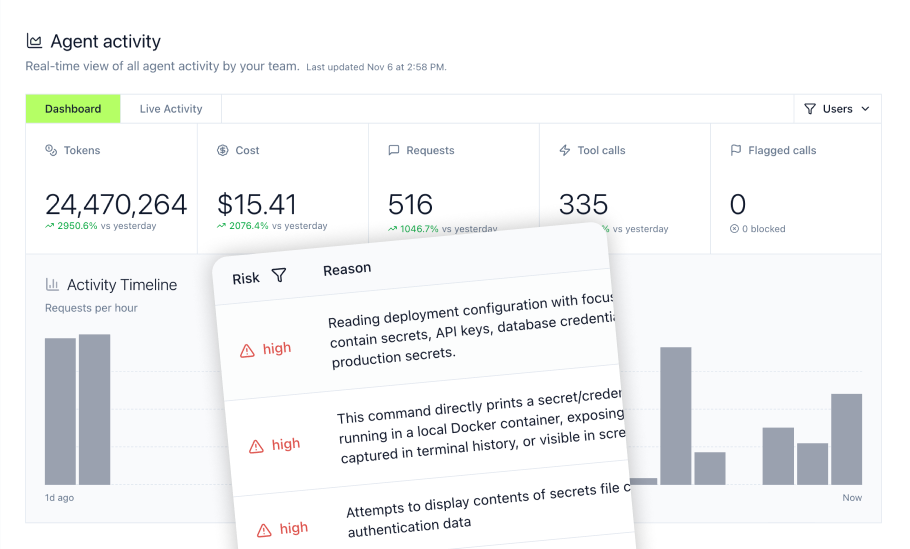
MintMCP enforces policy at the control layer before risky actions complete, allowing teams to block sensitive file access, dangerous command execution, and other high-risk tool behaviors in real time while preserving a full audit trail.
Lesson 4: Agents Need Identity-First Governance
Traditional application security assumes deterministic behavior. AI agents make runtime decisions that vary based on context, prompt content, and available tools. Identity-first governance addresses this through:
- OAuth and SAML enforcement for all agent endpoints
- Role-based tool access restricting operations by user permission level
- Credential centralization eliminating scattered API keys
- Session management with appropriate token lifetimes
Audit observability provides the visibility layer required for identity governance.
Lesson 5: Governance Infrastructure Is Now Critical Path
78% of organizations plan to put agents in production, yet governance gaps block deployment. Forrester predicts 50% of ERP vendors will launch autonomous governance modules in 2026—recognizing that governance infrastructure, not agent capability, determines who scales AI successfully.
The agentic AI market reaches $7.84 billion in 2025, projected to $52.62 billion by 2030 at 46.3% CAGR. MarketsandMarkets projects the AI governance market will grow at 45.3% CAGR from 2024 to 2029, showing that governance demand is growing almost as quickly as the agent market itself.
The 2026 Inflection Point: Why Governance Determines Who Scales
Gartner predicts 40% of enterprise applications will embed AI agent capabilities by 2026. KPMG research shows 75% of leaders prioritize security and compliance for agent deployment. Yet Cisco's AI Readiness Index shows only 31% of organizations feel fully capable of securing agentic AI systems.
This readiness gap creates two organizational trajectories:
Governance-first organizations deploy agents with appropriate controls, scale safely, and capture productivity gains. They treat governance as enablement infrastructure, not compliance overhead.
Governance-after organizations remain stuck in pilot purgatory—testing agents that never reach production because security teams lack visibility and control mechanisms. Each incident reinforces risk aversion, delaying value realization.
The regulatory timeline adds urgency. EU AI Act enforcement begins August 2026. US state laws in Illinois, Colorado, and California introduce agent-specific requirements through 2027. China's Cybersecurity Law applies to agents accessing PRC data. Organizations without multi-framework governance capability face compliance exposure across every jurisdiction where they operate.
AI agent productivity improvements are measurable when deployed with appropriate governance. The question isn't whether to adopt agents—it's whether to build governance infrastructure proactively or reactively manage incidents.
Building Production-Ready Agent Infrastructure with MintMCP
OpenClaw's rapid rise and subsequent security crisis demonstrated that agent capability alone doesn't determine enterprise value—governance infrastructure does. Organizations that waited to address authentication, policy enforcement, and audit trails found themselves locked out of production deployment, regardless of how powerful their agents were.
MintMCP was built to address these deployment and governance challenges. Rather than requiring enterprises to build custom governance layers from scratch, MintMCP provides production-ready infrastructure that wraps agent deployments in enterprise identity, policy enforcement, and auditability controls.
The platform addresses the five critical governance gaps OpenClaw exposed. First, centralized authentication replaces scattered API keys with OAuth and SAML enforcement, treating agents like any other enterprise identity. Second, real-time policy enforcement blocks dangerous operations—sensitive file access, credential exposure, destructive commands—before they execute, not after. Third, detailed audit records capture tool invocations with user attribution, supporting internal security reviews and evidence collection for regulated environments. Fourth, role-based access control ensures agents only invoke tools appropriate to the user's permission level. Fifth, the architecture supports both STDIO servers deployed on MintMCP's managed service and other deployable or remote servers organizations already run.
For security teams migrating shadow AI to sanctioned alternatives, MintMCP provides the visibility and control infrastructure that makes production agent deployment possible. Organizations gain measurable productivity improvements without the governance debt that delayed OpenClaw users. The AI governance trends shaping 2026 all point toward the same conclusion: governance infrastructure isn't optional for agent deployment—it's prerequisite.
Frequently Asked Questions
How does agent governance differ from traditional AI model governance?
Traditional AI governance focuses on model training, bias detection, and output quality. Agent governance addresses execution risk—what happens when AI takes actions rather than providing recommendations. This includes credential management for system access, tool invocation controls, real-time behavioral monitoring, and intervention capabilities. Model governance asks "Is this output appropriate?" Agent governance asks "Should this action be permitted?"
What security attestations and compliance capabilities should enterprises require from agent governance platforms?
SOC 2 Type II attestation helps validate security controls and operating effectiveness. For healthcare-related use cases, enterprises should verify the platform's contractual, access-control, logging, and deployment posture for handling regulated data rather than assuming HIPAA certification. For EU use cases, review auditability, access controls, retention settings, privacy terms, and available documentation. Enterprises should also verify audit log retention, third-party security assessments, and how identity and policy controls are enforced in production.
How do multi-agent systems change governance requirements?
When agents coordinate—as demonstrated by Moltbook's agent social network—governance complexity multiplies. Single-agent governance tracks one execution path. Multi-agent governance must address: inter-agent communication protocols, permission inheritance when agents invoke other agents, aggregate action effects that exceed individual agent permissions, and accountability attribution when multiple agents contribute to outcomes. Current frameworks largely address single-agent scenarios; multi-agent governance standards remain nascent.
What indicators suggest an organization is ready to move from isolated agent pilots to broader production deployment?
Organizations typically expand into production deployment when agent usage patterns stabilize, security teams have enough visibility to define baselines and policies, compliance requirements for target workflows are understood, and the business is ready to operationalize identity, monitoring, and intervention controls around agent-accessible tools.
How should enterprises approach agent governance for contractors versus employees?
Contractor agent access requires additional controls: time-bounded permissions that expire with contract terms, project-scoped tool access rather than broad organizational access, separate audit trails for compliance documentation, and clear data handling requirements in contractor agreements. The principle of least privilege applies more strictly—contractors receive minimum permissions for specific deliverables rather than general-purpose agent access.