Selecting the right MCP gateway for enterprise AI deployment requires evaluating security posture, deployment speed, integration capabilities, and compliance requirements. MintMCP's MCP Gateway is a data-permissions-first platform with one-click deployment, while RunLayer focuses on MCP security governance and Composio emphasizes developer experience with extensive pre-built integrations. This comparison examines all three platforms to help engineering leaders determine which approach aligns with their enterprise AI infrastructure priorities.
Key Takeaways
- MintMCP offers one-click deployment in minutes compared to more vendor-led enterprise rollout processes
- RunLayer focuses on MCP security governance, threat detection, observability, and access controls for internal employee and agent governance
- Composio provides hundreds of pre-built integrations with managed authentication for developer and AI engineering teams
- MintMCP's Virtual MCP Bundles enable per-use-case endpoints with SCIM-driven membership, a capability not documented in RunLayer or Composio
- MintMCP offers Gateway + Agent Monitor two-layer governance for MCP traffic and local coding agent activity across Claude, Cursor, ChatGPT, Gemini, and Copilot
- RunLayer provides a server catalog for extensive MCP ecosystem coverage
MintMCP vs RunLayer vs Composio: Understanding the MCP Gateway Market
The MCP gateway market has expanded rapidly as enterprises seek secure ways to connect AI assistants with internal data and tools. MCP (Model Context Protocol) has become an industry standard supported across the major AI ecosystem, but deploying MCP servers at scale introduces challenges around deployment, security, and governance.
According to NIST's AI Risk Management Framework, organizations adopting AI systems must establish comprehensive governance controls covering authentication, access management, and audit capabilities. This framework helps explain why enterprises prioritize governance controls such as authentication, access management, and auditability when evaluating AI infrastructure.
MintMCP takes a data-permissions-first approach, providing SOC 2 Type II audited controls, compliant with HIPAA standards, penetration testing, one-click STDIO server deployment, OAuth brokering, real-time monitoring, and enterprise SSO. The platform transforms local MCP servers into production-ready services with hosted MCP connectors, credential management, centralized observability, and rule-based policy.
RunLayer focuses on MCP security governance, observability, access controls, and threat detection for internal employee and agent governance. The platform emphasizes detection and control for MCP-specific risks such as tool poisoning, command injection, and untrusted MCP servers.
Composio took a different path, building an integration-first platform with hundreds of pre-built integrations and managed OAuth authentication. Their Tool Router technology enables agents to dynamically discover and use appropriate tools from the broader catalog.
Understanding these fundamental differences helps clarify which platform better matches specific enterprise requirements.
Who Benefits from MCP Gateways?
Enterprise teams evaluating MCP gateways typically prioritize:
- Speed to production: Deploying MCP servers without weeks of infrastructure setup
- Compliance readiness: Meeting SOC 2, HIPAA, and GDPR audit requirements
- Centralized governance: Managing authentication, permissions, and audit trails across all MCP connections
- Developer experience: Enabling teams to access AI tools without infrastructure overhead
- Cost predictability: Understanding pricing tied to users, usage, or enterprise agreements before deployment
Research on AI agent governance reinforces the importance of centralized policy enforcement and auditability when organizations deploy AI systems at scale. This architectural principle informs modern MCP gateway design.
All three platforms address these needs through distinct models. MintMCP's one-click deployment approach enables production-ready MCP servers in minutes. RunLayer emphasizes enterprise security configuration and governance controls. Composio's managed SaaS model offers immediate access to pre-built integrations.
What Makes MintMCP Unique? Compliance, Speed, and Governance
MintMCP's approach to enterprise MCP deployment centers on three pillars: compliance verification, deployment velocity, and granular governance.
SOC 2 Type II Audited for Enterprise Procurement
For regulated industries, vendor security verification can delay production deployments by weeks or months. MintMCP is SOC 2 Type II audited, compliant with HIPAA standards, penetration tested, and provides security controls covering auditability, encryption in transit and at rest, data residency options, and uptime SLA commitments.
This security posture streamlines enterprise procurement by allowing auditors and security teams to review existing documentation rather than requiring independent validation of MCP infrastructure from scratch. Organizations in finance, healthcare, government, and other security-conscious sectors particularly benefit from this compliance readiness.
One-Click Deployment: Minutes vs Extended Timelines
Most MCP servers are STDIO-based and traditionally difficult to deploy in production environments. MintMCP provides one-click deployment that transforms local STDIO servers into OAuth-protected production services in minutes.
This deployment speed advantage compounds across organizations managing dozens or hundreds of MCP servers. Rather than requiring extended configuration for each server, teams can deploy new MCP capabilities the same day they identify a need.
Virtual MCP Bundles for Least Privilege
MintMCP's Virtual MCP architecture creates per-use-case endpoints that expose only the minimum required tools to each team, user, or agent. Virtual MCP Bundles support SCIM-driven membership, curated tool lists, and per-bundle access policy. This principle of least privilege at the gateway level means:
- Sales teams can access CRM tools without seeing HR database capabilities
- Finance teams can run reports without accessing production system write operations
- Developers can test integrations in isolated environments
This capability addresses a fundamental enterprise security requirement: ensuring users can only access tools appropriate for their role, even when multiple MCP servers are available.
MintMCP Product Portfolio: Gateway and Agent Monitor
MintMCP offers two complementary layers addressing different aspects of enterprise AI tool governance.
MCP Gateway: Centralized MCP Infrastructure
The MCP Gateway provides centralized governance for all MCP connections with:
- STDIO server support: Deploy and manage STDIO-based MCP servers with automatic hosting and lifecycle management
- Hosted MCP connectors: MintMCP runs hosted MCP connectors with managed runtime, scaling, and isolation
- OAuth brokering: Broker OAuth for stdio and hosted MCP servers, reducing manual authentication configuration
- SSO and SCIM-driven RBAC: Enterprise authentication and group-based access control across MCP servers and Virtual MCP Bundles
- Tool-level policy: Tool allowlisting, rule-based policy, and tool-update controls for upstream capability changes
- Credential management: Centralized handling of credentials across MCP servers and connectors
- Audit logs: Complete audit trail of every MCP interaction, access request, and configuration change
- Real-time monitoring: Live dashboards for server health, usage patterns, and security alerts
The gateway supports connections to enterprise data sources including Snowflake for data warehouse analytics, Elasticsearch for search and knowledge bases, and Gmail for AI-driven email workflows.
Agent Monitor: Coding Agent Governance
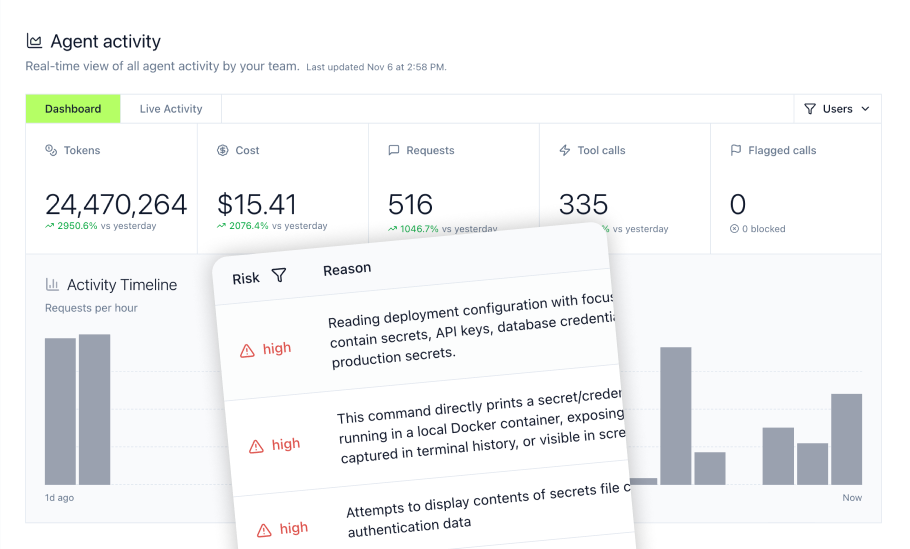
Coding agents like Cursor and Claude Code operate with extensive system access, reading files, executing commands, and accessing production systems through MCP tools. MintMCP's Agent Monitor layer provides essential visibility and control over agent behavior:
- Tool call tracking: Monitor every MCP tool invocation, bash command, and file operation from coding agents
- MCP inventory: Complete visibility into installed MCPs, their permissions, and usage patterns across teams
- Security guardrails: Block dangerous commands, restrict file access, and control MCP permissions in real-time
- Sensitive file protection: Prevent access to .env files, SSH keys, credentials, and other sensitive configuration
- Command history: Complete audit trail of every bash command, file access, and tool call for security review
This dedicated layer for coding agent monitoring addresses the specific risks introduced when AI assistants have system-level access in development environments.
Feature Comparison: MintMCP vs RunLayer vs Composio
Each platform brings distinct strengths to enterprise MCP deployment. This comparison examines core capabilities across security, deployment, and integration dimensions.
Security and Compliance Features
MintMCP provides:
- SOC 2 Type II audited controls with complete audit trails
- Compliant with HIPAA standards, with HIPAA documentation and BAAs available for customers handling protected health information
- Enterprise SSO and SCIM-driven RBAC across MCP servers and Virtual MCP Bundles
- Tool-level allowlisting, rule-based policy, and tool-update policy
- Credential management and centralized observability
- External DLP and guardrails integrations through JavaScript Gateway Middleware in a JS sandbox
RunLayer offers:
- Custom threat detection models for MCP-specific attacks
- Okta and Entra identity integration
- Governance and observability for MCP access
- Focus on tool poisoning, command injection, and untrusted MCP server threats
Composio includes:
- Managed OAuth for a large app catalog
- SOC 2 Type II support for enterprise procurement
- Logging and tracing capabilities
Deployment Speed and Model
MintMCP enables:
- One-click deployment in minutes for STDIO servers
- OAuth brokering for stdio and hosted MCP servers
- Managed SaaS-first deployment in US and EU, with VPC or self-hosted deployment available on request
RunLayer requires:
- Vendor-led setup and security configuration
- Managed SaaS plus self-hosted deployment options
- Dedicated configuration for threat detection models
Composio provides:
- Managed SaaS with immediate access
- Enterprise engagement for advanced deployment needs
- VPC or on-prem deployment on Enterprise tier
Integration Ecosystem
MintMCP supports:
- Pre-built enterprise connectors (Snowflake, Elasticsearch, Gmail, Outlook, Linear, Notion)
- Hosted MCP connectors run by MintMCP, with managed runtime and scaling
- Custom server deployment plus managed connectors for common enterprise tools
- Custom server deployment with OAuth brokering
RunLayer provides:
- MCP server catalog for discovery and governance
- Community and curated server options
- Catalog browsing and security controls
Composio offers:
- Hundreds of pre-built integrations with managed authentication
- Tool Router for dynamic tool discovery
- Strong framework support (LangChain, CrewAI, AutoGen)
Use Case Mapping: Which Platform Fits Your Needs?
Different organizational priorities map to different platform strengths.
Choose MintMCP When You Need:
- Regulated industry compliance: SOC 2 Type II audited controls, compliance with HIPAA standards, penetration testing, and complete audit trails streamline procurement in finance, healthcare, government, and security-conscious sectors
- Fastest deployment to production: One-click deployment transforms local STDIO servers to production services in minutes
- Role-based and use-case-based access control: Virtual MCP Bundles expose different tools to different teams, users, and agents based on SCIM-driven membership and policy
- Complete audit trails: Uptime SLA commitments and comprehensive logging for mission-critical AI deployments
- Coding agent monitoring: Agent Monitor tracks tool calls, bash commands, and file access from AI coding assistants across Claude, Cursor, ChatGPT, Gemini, and Copilot
Integration Ecosystem Deep Dive
Understanding each platform's integration approach helps match capabilities to specific data source and tool requirements.
MintMCP Enterprise Connectors
MintMCP provides pre-built connectors for common enterprise data sources and workflows:
Data Warehouse Integration: The Snowflake connector enables natural language queries against data warehouses with tools for Cortex Agent, Cortex Analyst, semantic views, and SQL execution. Product, finance, and executive teams can generate insights without SQL expertise.
Search Integration: The Elasticsearch connector provides search, ES|QL queries, index listing, mapping retrieval, and shard information. HR teams can build AI-accessible knowledge bases, while support teams can search historical tickets and resolution patterns.
Email Integration: The Gmail connector enables search, retrieval, drafting, and sending of emails through AI assistants with complete security oversight.
Beyond pre-built connectors, MintMCP's one-click STDIO deployment transforms local MCP servers into production services, while hosted MCP connectors run by MintMCP reduce customer infrastructure overhead.
RunLayer Server Catalog
RunLayer provides a server catalog for MCP discovery and governance, including:
- Community-contributed servers
- Curated enterprise servers
- Custom server validation and security scanning
The catalog approach supports discovery of existing MCP capabilities.
Composio Tool Router
Composio's Tool Router creates a single MCP endpoint that dynamically discovers and uses appropriate tools from its broader integration catalog. Agents automatically find and invoke the right tools without manual configuration for each integration.
This approach simplifies agent development when broad integration coverage matters more than deep customization of specific tools.
Migration and Switching Considerations
Enterprise platform decisions involve long-term commitment. Understanding migration paths helps evaluate switching costs.
Migrating to MintMCP
Teams migrating from RunLayer or Composio can leverage MCP protocol compatibility for relatively straightforward transitions. MintMCP documentation recommends a staged approach:
- Deploy MintMCP alongside existing setups
- Move a subset of MCP servers first
- Validate authentication, logging, and runtime behavior under real workloads
- Complete incremental cutover once validation passes
This structured migration approach reduces risk while enabling parallel operation during transition.
Migration Difficulty Estimates
Based on MCP protocol compatibility and platform architectures, migration effort will vary based on authentication setup, tool mappings, and workflow differences between platforms.
Standard MCP protocol compliance enables portability across all platforms, reducing vendor lock-in concerns.
Conclusion: MintMCP for Enterprise MCP Deployment
Enterprise AI infrastructure demands proven compliance, rapid deployment, and governance that scales with organizational complexity. MintMCP addresses these requirements through a purpose-built platform combining SOC 2 Type II audited controls, compliance with HIPAA standards, one-click STDIO deployment, and Virtual MCP Bundles for role-based and use-case-based access control.
The platform transforms what traditionally requires extensive configuration into minutes of setup time. For organizations in finance, healthcare, government, and other security-conscious sectors, MintMCP's compliance-first approach can reduce vendor security review during procurement cycles. SOC 2 Type II audited controls, penetration testing, encryption in transit and at rest, data residency options, uptime SLA commitments, and complete audit trails give security teams documentation they can review through the Trust Center.
MintMCP's Virtual MCP Bundles deliver granular governance at the gateway layer, ensuring teams access only the tools appropriate for their role or use case. Sales teams interact with CRM capabilities without visibility into HR systems, finance teams run reports without production write access, and developers test in isolated environments. This principle of least privilege addresses fundamental enterprise security requirements that catalog-based approaches do not directly support.
The Agent Monitor layer extends governance to coding agents like Cursor and Claude Code, tracking every tool call, bash command, and file operation. This visibility becomes essential as AI assistants gain system-level access in development environments, providing security teams with complete audit trails for review.
Engineering leaders seeking production-ready MCP infrastructure with enterprise-grade security can explore MintMCP's Gateway or contact the team to evaluate the platform against specific requirements.
Frequently Asked Questions
How does MintMCP's deployment speed compare?
MintMCP offers one-click deployment in minutes for STDIO-based MCP servers. RunLayer generally involves vendor-led setup and security configuration before production deployment. Composio provides immediate access through its managed SaaS model, though custom MCP server deployment requires vendor coordination. For organizations prioritizing rapid production deployment, MintMCP's one-click approach provides the fastest path from local development to governed production services.
Does MintMCP support role-based access control?
Yes. MintMCP's Virtual MCP architecture creates per-use-case endpoints that expose only the minimum required tools to each team, user, or agent. Virtual MCP Bundles support SCIM-driven membership, curated tool lists, and per-bundle access policy. Sales teams can access CRM tools without seeing HR database capabilities, and finance teams can run reports without production write access. This principle of least privilege at the gateway level addresses enterprise security requirements that catalog-based approaches do not directly support.
What compliance attestations does MintMCP hold?
MintMCP is SOC 2 Type II audited, compliant with HIPAA standards, penetration tested, and provides continuous compliance monitoring via Drata. Enterprise SSO, complete audit trails, PII detection, role-based access control, encryption in transit and at rest, data residency options, and uptime SLA commitments are built into the platform. Customers handling protected health information can request HIPAA documentation, and MintMCP signs BAAs.
Can I monitor coding agents with MintMCP?
Yes. MintMCP's Agent Monitor layer is designed to monitor coding agents. It tracks every tool call, bash command, and file operation from AI coding assistants. The monitor blocks dangerous commands in real-time, helps prevent access to sensitive files like .env and SSH keys, and provides complete audit trails for security review. This dedicated layer addresses the specific risks introduced when AI assistants have system-level access.
How does MintMCP pricing compare to usage-based models?
MintMCP uses custom enterprise quotes, providing pricing aligned to team size, deployment scope, and governance requirements rather than only raw tool-call volume. Composio offers usage-based pricing for teams building agentic applications. The optimal model depends on usage patterns: high-volume tool calling may favor usage-based pricing, while teams prioritizing compliance, SSO and SCIM-driven RBAC, auditability, and internal-agent governance may find MintMCP's enterprise approach provides better total value.