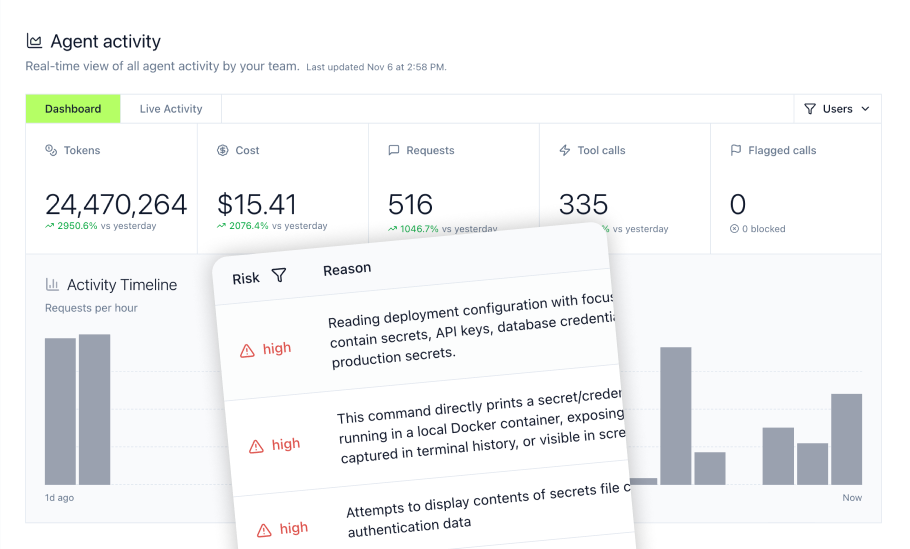
Selecting the right MCP gateway for enterprise AI deployments requires evaluating deployment speed, security posture, compliance readiness, and governance capabilities. MintMCP, Portkey, and Composio each approach the Model Context Protocol infrastructure challenge differently. MintMCP's Gateway specializes in transforming local MCP servers into production-ready services with one-click deployment and enterprise-grade governance. Portkey operates as a unified LLM and MCP platform with broad model routing capabilities. Composio focuses on managed integrations with a pre-built connector library. This comparison examines all three platforms to help engineering teams determine which approach aligns with their enterprise requirements.
Key Takeaways
- MintMCP offers one-click STDIO deployment that transforms local servers into production services in minutes, while self-hosted alternatives generally require more setup and platform-style deployments can take substantially longer
- MintMCP's Virtual MCP Bundles enable per-use-case endpoints with SCIM-driven membership and curated tool access, a capability not available across the field in Portkey or Composio
- MintMCP holds official Cursor Hooks partner status, supporting its positioning for AI coding assistant governance
- Portkey provides LLM observability, routing, and cost controls, making it a strong choice for teams needing unified LLM and MCP management
- Composio offers a pre-built integration library with unified authentication, serving teams prioritizing rapid prototyping over custom server governance
- MintMCP supports Claude, Cursor, ChatGPT, Gemini, and Copilot governance, with deployment workflows designed to reduce time to production
Understanding MCP Gateways: What They Are and Why They Matter for Enterprise AI
The Model Context Protocol has emerged as the industry standard for connecting AI clients to enterprise tools and data sources. Supported by Anthropic, OpenAI, Google, and Microsoft, MCP enables AI assistants like Claude, ChatGPT, Gemini, Copilot, and Cursor to interact with databases, APIs, and internal systems through a standardized interface.
However, MCP adoption introduces significant challenges around deployment, security, and governance that organizations must address before scaling AI tool access.
Defining MCP Gateways: Bridging AI Tools and Enterprise Systems
An MCP gateway sits between AI clients and MCP servers, providing centralized control over authentication, authorization, monitoring, and compliance. Without a gateway layer, organizations face:
- Zero telemetry into what AI tools access and when
- No request history for audit and compliance purposes
- Uncontrolled access to sensitive enterprise data
- Scattered credentials across individual developer machines
MCP gateways solve these problems by routing all tool interactions through a governed control plane. Enterprise interest in MCP gateways continues to rise as organizations look for secure ways to connect AI clients to internal tools and data, with growing attention from both security and operations teams.
The Critical Role of Gateways in Securing and Governing AI
Enterprise AI deployments require more than functional connectivity. Security teams need visibility into every tool call. Compliance teams need audit trails that satisfy regulatory requirements. IT teams need centralized credential management rather than API keys scattered across developer laptops.
According to NIST's AI Risk Management Framework, governance mechanisms like centralized gateways help organizations manage AI system risks while maintaining operational agility. The API management market is growing as organizations invest more heavily in governance for AI-to-data integrations at scale.
Addressing Shadow AI with Centralized Gateway Solutions
Shadow AI, where employees use AI tools without IT oversight, continues to grow in many organizations. MCP gateways transform shadow AI into sanctioned AI by providing:
- Visibility into which tools teams use
- Policy enforcement without blocking productivity
- Audit trails that satisfy compliance requirements
- Centralized authentication that eliminates credential sprawl
MintMCP: Enterprise-Grade MCP Deployment, Security, and Governance
MintMCP approaches MCP infrastructure with a focus on transforming the complexity of enterprise MCP deployment into a streamlined, compliant, production-ready experience. MintMCP serves organizations that need AI tool access without sacrificing security or spending months on infrastructure.
Key Features of MintMCP's Gateway Architecture
MintMCP's MCP Gateway provides comprehensive capabilities for enterprise deployment:
Deployment and Enablement:
- One-click STDIO deployment that hosts MCP servers without local installations
- MCP registry with one-click installation and configuration for available servers
- Virtual MCP Bundles that create per-use-case endpoints with SCIM-driven membership and curated tool sets
- OAuth brokering for stdio and hosted MCP servers that adds enterprise authentication to MCP deployments
Security and Governance:
- OAuth 2.0, SAML, SSO, and SCIM-driven RBAC for enterprise identity management
- Complete audit trails of every MCP interaction, access request, and configuration change
- Real-time monitoring dashboards for server health, usage patterns, and security alerts
- Granular tool access control with tool-level allowlisting and rule-based policy
Infrastructure:
- Managed SaaS-first deployment with US and EU availability, plus VPC and self-hosted options on request
- Hosted MCP connectors run by MintMCP for centralized MCP deployment
- Containerized server hosting that eliminates local installation requirements
Ensuring Compliance and Security with MintMCP
MintMCP is SOC 2 Type II audited, compliant with HIPAA standards, pen tested, and provides enterprise trust and verification. This approach addresses a common procurement challenge where security questionnaires delay AI tool adoption.
According to customer feedback, organizations using MintMCP reduced security questionnaire preparation from 80+ hours to 1-hour audit exports, shortening enterprise sales cycles by approximately 30%.
MintMCP also offers:
- Enterprise security controls such as encryption in transit and at rest, access controls, and audit logging
- GDPR-supporting audit trails with detailed activity records
- HIPAA documentation and BAAs for customers handling protected health information
Seamless Deployment and Management with MintMCP
MintMCP's deployment approach delivers:
- Production-ready services in minutes rather than weeks
- No infrastructure overhead for development teams
- Automatic credential management through centralized configuration
- Seamless integration with existing identity providers
Portkey MCP Gateway: Features and How It Compares
Portkey operates as a unified platform combining LLM routing with MCP gateway capabilities. The platform provides LLM observability, routing, and cost controls for teams managing model operations and tool calls in one environment.
Portkey's Core Capabilities for LLM Operations
Portkey's architecture routes both model calls and tool invocations through the same observability and policy layer. Key capabilities include:
- Broad model and provider coverage across major platforms including OpenAI, Anthropic, Google, and AWS Bedrock
- OpenAI-compatible API with SDKs for Python, JavaScript, and TypeScript
- Unified dashboard for model routing and MCP tool governance
- Open-source core for teams that want gateway transparency and self-hosted options
Performance and Scalability Aspects of Portkey Gateway
Portkey introduces an additional gateway layer for routing, logging, and guardrails, so teams should validate latency impact in their own environment, especially when enabling more policies and routing logic. The platform supports:
- Real-time observability for LLM and MCP interactions
- Rate limiting and caching for cost optimization
- Load balancing across model providers
- Request routing based on latency, cost, or capability
Comparing Portkey's Developer and Enterprise Focus
Portkey serves teams that need unified LLM and MCP management in a single platform. The open-source foundation provides transparency, though teams evaluating Portkey for internal employee and internal-agent governance should also validate whether they need MCP-specific primitives such as Virtual MCP Bundles, Agent Bundles with M2M auth, tool-update policy, and stdio or hosted-server OAuth brokering.
According to IEEE research on API gateway architectures, unified observability platforms offer advantages for teams managing multiple integration types, though implementation complexity should be carefully evaluated.
Composio: Automation and Integration Beyond the Gateway
Composio approaches the AI tool connectivity challenge through a managed integration library rather than a governance layer for custom MCP servers. The platform offers a pre-built integration library covering SaaS applications.
Composio's Approach to AI-Powered Workflow Automation
Composio's model emphasizes rapid deployment through pre-built connectors:
- Unified authentication handling across all integrations
- No custom MCP server development required for supported applications
- Managed tool routing and authentication for faster setup
- Pre-built actions for Slack, Jira, Notion, Linear, and other common tools
Integrating Diverse Applications with Composio
For teams prioritizing breadth of integrations over custom server governance, Composio provides:
- Quick setup for common SaaS tool connectivity
- Managed authentication flows that handle OAuth complexity
- Support for Claude Desktop, Cursor, VS Code, and Windsurf
- Developer-oriented workflows for building agentic applications
When to Consider Alternatives to Composio
Composio functions as a managed integration platform with an MCP surface, not a governance plane for arbitrary MCP servers. This distinction matters for organizations that need:
- Custom MCP server support beyond Composio's catalog
- Governance over proprietary internal tools
- Per-use-case tool curation through Virtual MCP Bundles
- Enterprise compliance controls for regulated industries
Ensuring Compliance in AI Deployments: GDPR and SOC 2
Enterprise AI adoption requires compliance frameworks that satisfy regulatory requirements without blocking innovation. MCP gateways play a critical role in providing the audit trails, access controls, and data governance that compliance teams require.
Meeting GDPR Mandates with Comprehensive Audit Logs
GDPR requires organizations to document how personal data is accessed and processed. MintMCP's complete audit trails capture:
- Every MCP tool invocation with timestamps
- User identity and authorization context
- Data access patterns and request history
- Configuration changes and access requests
These logs enable organizations to respond to data subject requests and demonstrate compliance during audits.
SOC 2 Type II: An Important Security Benchmark
SOC 2 Type II audited status verifies that a platform maintains effective controls over security, availability, processing integrity, confidentiality, and privacy. MintMCP is SOC 2 Type II audited, which can help accelerate security reviews for enterprise buyers.
For organizations with compliance requirements, MintMCP's 1-hour audit export generation accelerates the procurement process by providing ready documentation for security questionnaires.
Real-time Monitoring and Observability for AI Agents: A Gateway Necessity
Without monitoring, AI tools operate as black boxes with significant security and operational risks. Organizations cannot see what agents access, control their actions, or optimize costs without comprehensive observability.
Tracking LLM Tool Invocations and Usage Patterns
MintMCP's MCP Gateway provides real-time dashboards that track:
- Tool call frequency across teams and projects
- Usage patterns that reveal adoption trends
- Performance metrics including response times and error rates
- Cost allocation by team, project, and tool
For coding agents specifically, MintMCP's LLM Proxy monitors every MCP tool invocation, bash command, and file operation. This visibility is essential for organizations deploying AI coding assistants like Cursor and Claude Code.
Detecting Anomalies and Security Threats in Real-Time
Effective monitoring goes beyond usage tracking to identify potential security incidents:
- Unusual access patterns that may indicate compromised credentials
- Tool invocations outside normal business hours
- Attempts to access restricted resources
- Rate anomalies that suggest automated misuse
MintMCP's security alerts notify administrators when monitoring detects patterns that warrant investigation.
Optimizing Costs and Performance with Observability
Enterprise AI deployments require cost visibility to manage budgets effectively. MintMCP's cost analytics provide:
- Spending breakdowns by team, project, and tool
- Trend analysis for budget forecasting
- Performance metrics that identify optimization opportunities
- Usage reports that inform capacity planning
Securing AI Coding Agents: Protecting Sensitive Data and Preventing Risky Commands
Coding agents like Cursor and Claude Code operate with extensive system access, reading files, executing commands, and accessing production systems through MCP tools. Without monitoring, organizations cannot see what agents access or control their actions.
The Risks of Unmonitored AI Agent Access
AI coding assistants can:
- Read environment files containing API keys and secrets
- Execute bash commands with developer permissions
- Access SSH keys and credential stores
- Interact with production databases and systems
These capabilities deliver productivity benefits but introduce security risks that require governance.
Implementing Guardrails for File and Command Execution
MintMCP's LLM Proxy provides security guardrails that:
- Block dangerous commands before execution
- Restrict file access to prevent credential exposure
- Control MCP permissions based on role and context
- Protect sensitive files including .env files, SSH keys, and configuration
The proxy sits between the LLM client and the model, forwarding and monitoring requests to provide observability into how employees use LLM clients.
Auditing and Controlling Agent Behavior for Enterprise Security
Complete audit trails capture every bash command, file access, and tool call for security review. MintMCP's approach enables organizations to:
- Review agent behavior during incident investigation
- Demonstrate compliance with security policies
- Identify patterns that warrant policy updates
- Maintain visibility without disrupting developer workflows
MintMCP's official Cursor Hooks partnership supports this architecture for AI coding assistant governance.
Bridging Enterprise Data: Connecting AI to Snowflake, Elasticsearch, and Gmail Securely
MCP gateways enable AI assistants to interact with enterprise data sources while maintaining security and governance controls. MintMCP provides pre-built connectors for critical enterprise systems with full audit trail support.
AI-Powered Data Analysis with Snowflake Integration
MintMCP's Snowflake MCP Server enables AI agents to:
- Execute natural language queries against data warehouses
- Automate financial reporting and variance analysis
- Generate business intelligence dashboards without SQL expertise
- Access semantic views with governed data models
Product management teams use Snowflake integration for AI-driven product analytics. Finance teams automate reporting workflows. Executive teams gain real-time business intelligence through natural language interfaces.
Enhancing Customer Support and HR with Elasticsearch Knowledge Bases
MintMCP's Elasticsearch MCP Server supports:
- AI-powered knowledge base search for instant employee assistance
- Historical support ticket analysis for faster issue resolution
- Log analysis and semantic search for troubleshooting
- Product documentation search for customer-facing help systems
HR teams build AI-accessible knowledge bases from company documentation. Support teams search resolution patterns across historical tickets. Product teams enable contextual help systems using Elasticsearch-indexed content.
Automating Communications and Workflows with Gmail Integration
MintMCP's Gmail MCP Server enables AI assistants to:
- Search Gmail messages using advanced query syntax
- Draft and reply to emails within approved workflows
- Aggregate product feedback from incoming messages
- Analyze communication patterns for operational intelligence
All Gmail interactions flow through MintMCP's governance layer, providing complete audit trails and security oversight.
Cost Control and Performance Optimization for Enterprise AI
Enterprise AI deployments require visibility into costs and performance to manage budgets and ensure acceptable user experience.
Understanding AI Spending Across Teams and Projects
MintMCP's cost analytics track spending with detailed breakdowns:
- Per-team allocation that enables chargeback models
- Per-project tracking for budget management
- Per-tool visibility that identifies cost drivers
- Trend analysis for forecasting and planning
Measuring and Improving AI Model Performance
Performance metrics help teams optimize AI tool deployments:
- Response time tracking across tools and providers
- Error rate monitoring for reliability management
- Usage pattern analysis for capacity planning
- SLA compliance reporting for governance
Strategies for Optimizing Enterprise AI Costs
Organizations using MintMCP can optimize costs through:
- Centralized credential management that eliminates duplicate subscriptions
- Usage visibility that identifies underutilized tools
- Role-based access that prevents unnecessary tool proliferation
- Performance monitoring that identifies inefficient patterns
Choosing the Right MCP Gateway: A Decision Framework for Enterprises
Selecting an MCP gateway requires evaluating how each platform's strengths align with organizational priorities.
Assessing Security and Compliance Capabilities
Choose MintMCP when:
- SOC 2 Type II audited status is required for security reviews
- Complete audit trails must satisfy GDPR requirements
- HIPAA documentation and BAAs are needed for protected health information workflows
- Detailed audit logging and access controls are mandatory
MintMCP's compliance-first approach helps reduce procurement friction for security-conscious teams.
Evaluating Ease of Deployment and Management
Choose MintMCP when:
- One-click deployment speed is a priority over custom infrastructure
- Virtual MCP Bundles are needed for per-use-case tool governance
- Teams need production-ready services without DevOps overhead
- OAuth brokering must secure stdio and hosted MCP servers
MintMCP's deployment model delivers production services in minutes rather than weeks.
Considering Long-Term Scalability and Vendor Support
Choose MintMCP when:
- Managed SaaS-first deployment with VPC and self-hosted options on request is required
- Centralized deployment and governance are necessary
- Official partnerships (Cursor Hooks) validate architecture
- Internal employee and internal-agent governance are priority use cases
Deploy Enterprise MCP Infrastructure with MintMCP
For engineering leaders building AI systems at scale, selecting the right MCP gateway determines whether deployments take days or months. MintMCP transforms enterprise MCP infrastructure from a complex deployment challenge into a streamlined, production-ready experience through three core capabilities.
First, one-click STDIO deployment eliminates weeks of Kubernetes configuration and infrastructure overhead. Engineering teams can transform local MCP servers into production services in minutes, without requiring dedicated DevOps resources. This deployment velocity matters when security reviews, compliance questionnaires, and procurement cycles already extend AI project timelines.
Second, SOC 2 Type II audited status and comprehensive audit trails address the compliance barriers that delay enterprise AI adoption. Security teams gain complete visibility into every tool invocation, access request, and configuration change. Compliance teams receive audit-ready documentation that satisfies GDPR requirements and accelerates security questionnaire completion from 80+ hours to 1-hour exports.
Third, Virtual MCP Bundles enable per-use-case governance that reduces attack surface while maintaining developer productivity. Organizations can expose only minimum required capabilities per team, eliminating the all-or-nothing access model that forces security teams to block AI tool adoption entirely. This granular control matters for regulated industries where data access must follow least-privilege principles.
MintMCP's official Cursor Hooks partnership supports its positioning for AI coding assistant governance. Pre-built connectors for Snowflake, Elasticsearch, and Gmail accelerate time-to-value for common enterprise use cases, providing governed data access without custom development.
For organizations evaluating MCP gateway options, MintMCP offers the combination of deployment speed, compliance readiness, and governance depth that enterprise AI deployments require. Book a demo to see how MintMCP can transform MCP infrastructure from local development to enterprise production.
Frequently Asked Questions
What is the primary function of an MCP Gateway?
An MCP gateway provides centralized control over how AI clients interact with enterprise tools and data. It handles authentication, authorization, monitoring, and compliance for all MCP connections. Without a gateway, organizations face zero telemetry into AI tool usage, scattered credentials across developer machines, and no audit trails for compliance. MintMCP's MCP Gateway transforms local MCP servers into production-ready services with enterprise security, one-click deployment, and complete governance capabilities.
How does MintMCP ensure compliance with regulations?
MintMCP is SOC 2 Type II audited, compliant with HIPAA standards, pen tested, and provides complete audit trails that capture every MCP interaction, enabling organizations to respond to data subject requests and demonstrate GDPR compliance during audits. MintMCP provides encryption in transit and at rest, access controls, detailed audit logging, HIPAA documentation, and BAAs for customers handling protected health information. MintMCP's 1-hour audit export generation accelerates security questionnaire completion.
What AI clients work with MintMCP?
MintMCP supports major AI clients including Claude (Desktop and Web), ChatGPT (via Custom GPTs and Actions), Microsoft Copilot, Cursor, Gemini, Goose, LibreChat, Open WebUI, Windsurf, and custom MCP-compatible agents. MintMCP's official Cursor Hooks partnership supports its integration story for AI coding assistant governance. The platform's LLM Proxy monitors tool invocations, bash commands, and file operations across these clients.
How does MintMCP manage enterprise data source access?
MintMCP provides pre-built MCP servers for Snowflake, Elasticsearch, and other enterprise data sources with governance built in. All data access flows through MintMCP's gateway, creating complete audit trails of every query and interaction. Granular tool access control configures which operations each role can perform, such as enabling read-only operations while excluding write tools. Virtual MCP Bundles expose only minimum required capabilities per team, reducing attack surface while maintaining productivity.
How do MCP gateways differ from integration platforms?
An MCP gateway like MintMCP provides governance over arbitrary MCP servers, including custom and proprietary tools, with role-based access control, audit trails, and compliance features. Integration platforms offer pre-built connectors but do not provide governance over custom servers. MintMCP's Virtual MCP Bundles and one-click STDIO deployment address use cases where organizations need to govern their specific enterprise systems rather than connecting to a pre-built integration catalog.