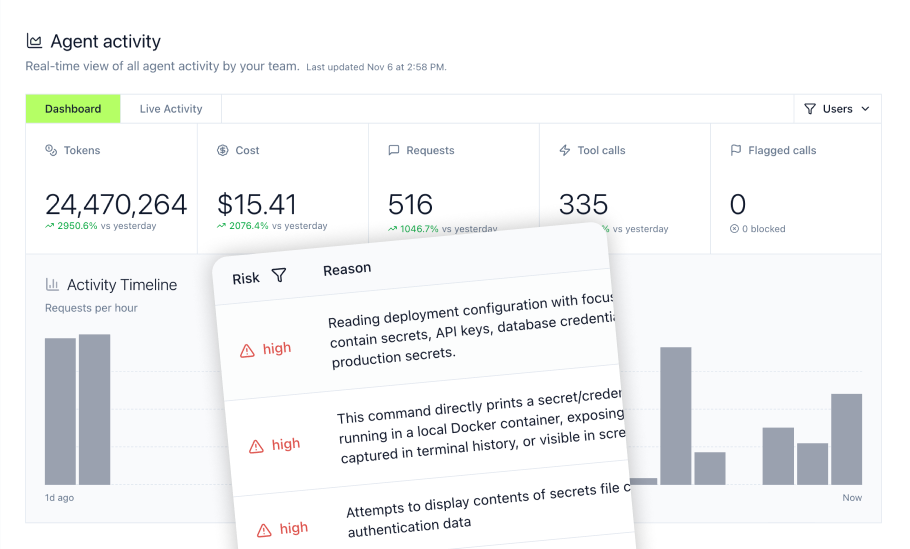
Machine learning teams deploying AI agents face a critical infrastructure bottleneck: securely connecting models to data sources, notebooks, and ML platforms at production scale. Without proper governance, agent deployments can fail security reviews, expose credentials, or create operational blind spots. An MCP gateway bridges this gap by centralizing authentication, audit trails, and tool access control for all MCP servers.
Model Context Protocol (introduced by Anthropic in November 2024) is rapidly becoming an industry standard, with growing support across major AI ecosystems. The protocol has gained widespread adoption, but MCP alone doesn't solve production challenges. ML teams need infrastructure that handles high-volume inference, protects sensitive training data, and maintains governance across complex pipelines.
Analysis of 45+ MCP gateway solutions across performance benchmarks, security controls, integration breadth, and ML-specific capabilities shows the following options purpose-built for machine learning teams managing real-time predictions, sensitive datasets, and enterprise-scale MLOps.
Key Takeaways
- MCP gateways solve critical infrastructure gaps for ML teams deploying AI agents at scale, providing security, governance, and tool connectivity that raw MCP servers lack
- Gartner’s 2025 Software Engineering Survey projects that by 2026, roughly 75% of API gateway vendors may add MCP features, signaling that gateway selection is becoming a strategic decision
- Performance requirements vary dramatically: from about 11 microseconds of gateway overhead for lightweight self-hosted options to 100-250ms for deep security inspection deployments
- SOC 2 Type II audited status matters for regulated ML environments, but it should be treated as a baseline requirement rather than a unique differentiator
- Open-source options provide cost control and customization, while managed platforms eliminate infrastructure overhead
- ML teams report 35-40% productivity gains in the first six months after implementing proper MCP infrastructure
1. MintMCP Gateway
MintMCP Gateway is built for ML teams that need governed MCP access across internal tools, data sources, and AI clients. The platform is SOC 2 Type II audited, compliant with HIPAA standards, penetration tested, and designed around complete audit trails for regulated environments.
What Makes MintMCP Different
The platform transforms local STDIO-based MCP servers into governed production services with one-click deployment, OAuth brokering, SSO and SCIM-driven RBAC, tool-level policy, and centralized observability. Instead of spending weeks configuring authentication and audit trails, ML engineers can deploy governed MCP access in minutes. Hosted MCP connectors run by MintMCP, including Snowflake and Elasticsearch, enable AI agents to query data warehouses and search indexes without custom integration work.
Core Capabilities
- Data-permissions-first architecture for governed agent access
- SSO and SCIM-driven RBAC for team and IdP group-based access
- Tool-level allowlisting and rule-based policy
- Complete audit logs and centralized observability
- Credential management and OAuth brokering for stdio and hosted MCP servers
- Virtual MCP Bundles: per-use-case endpoints with SCIM-driven membership
- Agent Bundles with M2M auth and “act as agent” flow
- Hosted MCP connectors run by MintMCP
- JavaScript Gateway Middleware in a JS sandbox for inline policy and guardrail integrations
- Official Cursor Hooks partner for coding agent governance
Enterprise Validation
MintMCP is designed for IT, Security, AI Operations, and ML platform teams that need internal employee and internal-agent governance across Claude, Cursor, ChatGPT, Gemini, and Copilot. Its Gateway + Agent Monitor model gives teams two layers of governance: MCP traffic through the gateway, and local non-MCP coding-agent activity such as bash commands, file reads, file writes, and prompt submissions.
Best For: ML teams in regulated industries (healthcare AI, financial modeling, government applications) requiring governed authentication, tool-level access control, credential management, audit logs, and agent governance before production deployment.
- Deployment: Managed SaaS-first (US + EU), with VPC/self-hosted on request
- Website: mintmcp.com
2. TrueFoundry MCP Gateway
TrueFoundry delivers managed gateway performance for ML platform teams, with public references commonly citing approximately 3-4ms latency and 350+ requests per second on a single vCPU. For ML teams running real-time inference workloads where every millisecond impacts user experience, this performance profile matters, though actual latency depends on deployment configuration and workload.
Performance Architecture
The platform unifies LLM routing and MCP tool orchestration in a single control plane. This can reduce the overhead of managing separate systems for model serving and tool calls. Virtual MCP Server abstraction helps address the N×M integration problem, connecting N agents to M tools without exponential configuration complexity.
Key Features
- Low-millisecond latency references for production workloads
- OAuth 2.0 Identity Injection with On-Behalf-Of authentication
- Hybrid deployment options, including managed SaaS and self-hosted control plane
- Federated SSO with Okta and Azure AD
- Integrated LLMOps, model serving, and distributed tracing
Enterprise Adoption
TrueFoundry positions for platform engineering and ML platform teams that want MCP governance alongside broader model serving and LLM routing workflows.
Tradeoffs to consider
TrueFoundry’s broader ML platform approach can be useful for teams standardizing on one AI control plane, but ML teams should evaluate whether they also need MintMCP-specific governance primitives such as SCIM-driven Virtual MCP Bundles, Agent Bundles with M2M auth, hosted MCP connectors, tool-update policy, and OAuth brokering for stdio and hosted MCP servers.
Best For: ML teams with high-volume real-time inference requirements where latency directly impacts business metrics.
- Deployment: Managed, VPC, or self-hosted
3. Bifrost by Maxim AI
Bifrost sets a performance benchmark for open-source gateways, with public benchmarks citing about 11 microseconds of overhead while handling high request volumes. For ML teams with latency-sensitive real-time applications and no budget for managed services, Bifrost offers a self-hosted path focused on speed and control.
Technical Architecture
Built in Go for efficiency, Bifrost operates as a dual MCP client/server, connecting upstream to MCP servers while exposing downstream endpoints to AI clients. Public benchmarks emphasize lower latency, lower memory usage, and higher throughput than some LLM gateway alternatives, though teams should validate results against their own workloads.
Core Capabilities
- Apache 2.0 open-source license with optional enterprise add-ons
- Go binary or Docker-based self-hosted deployment
- Support for multiple LLM providers, including OpenAI, Anthropic, AWS Bedrock, and Google Vertex
- Unified AI gateway handling both LLM routing and MCP orchestration
- Performance-oriented architecture for latency-sensitive workloads
Community Recognition
Bifrost has developer traction among teams seeking performance-focused, self-hosted AI gateway infrastructure.
Tradeoffs to consider
Bifrost’s self-hosted approach gives teams control, but it also means customers operate the gateway, connector runtime, scaling, and production infrastructure themselves. ML teams that want managed SaaS-first deployment, hosted MCP connectors, SCIM-driven RBAC, Virtual MCP Bundles, and centralized audit controls may prefer MintMCP.
Best For: ML teams with real-time inference requirements, strong DevOps capabilities, and cost sensitivity.
- Pricing: Free (Apache 2.0); Enterprise edition available
- Deployment: Self-hosted
4. Composio
Composio eliminates integration development time with 500+ managed integrations and unified authentication handling. For ML teams needing rapid connectivity to data sources, notebooks, and MLOps tools without building custom integrations, Composio offers a fast path to production.
Integration Ecosystem
The platform provides managed OAuth and API key authentication across integrations, so ML engineers focus on agent logic rather than credential plumbing. Native support for LangChain, CrewAI, and LlamaIndex means existing ML workflows can integrate with familiar frameworks.
Platform Metrics
- Broad integration catalog across SaaS and developer tools
- Developer-focused platform for agentic app builders
- SOC 2 Type II audited status for enterprise security reviews
- Authentication support across managed integrations
Key Features
- Unified authentication layer across 500+ tools
- Framework-native integration (LangChain, CrewAI, LlamaIndex)
- Team workspaces with environment isolation
- RBAC controls for enterprise governance
Value Proposition
The platform reduces integration time from weeks to minutes. For ML teams that need broad connectivity fast, this time savings compounds quickly.
Tradeoffs to consider
Composio is strongest for developer and AI engineering teams building agentic applications, especially customer-facing products. ML teams focused on internal employee and internal-agent governance should evaluate whether they need MintMCP capabilities such as SCIM-driven Virtual MCP Bundles, tool-level allowlisting, centralized audit logs, hosted MCP connectors, and Agent Bundles with M2M auth.
Best For: ML teams prioritizing rapid prototyping and broad tool connectivity over maximum customization.
- Pricing: Free tier available; paid plans for enterprise
- Deployment: Managed SaaS
5. Docker MCP Gateway
Docker MCP Gateway brings container isolation principles to MCP infrastructure, making it a natural choice for ML teams already using Docker for model deployment and MLOps workflows. Security through containerization protects against resource exhaustion attacks and provides familiar DevOps patterns.
Security Model
Container isolation with CPU and memory limits helps prevent runaway MCP servers from affecting other workloads. Cryptographically signed container images support verified code execution. This architecture helps reduce blast radius for MCP server risk, but CVE-2025-6514 specifically affected the mcp-remote npm package and was patched in mcp-remote v0.1.16.
Core Capabilities
- Deep integration with Docker Desktop 4.48+ and Docker Compose
- Container-based resource limits and isolation
- Compose-first orchestration approach
- Catalog access for discovering MCP servers
- Native fit with existing CI/CD pipelines
Deployment Experience
For teams with Docker expertise, deployment follows familiar patterns. Define MCP servers in Compose files, set resource constraints, and deploy with existing tooling. No new infrastructure paradigms to learn.
Tradeoffs to consider
Docker MCP Gateway fits teams that want containerized local or self-hosted control, but it does not remove the need to manage MCP server packaging, runtime operations, and governance design. ML teams that want managed SaaS-first deployment, hosted connectors, SSO and SCIM-driven RBAC, Virtual MCP Bundles, and audit-ready centralized observability may prefer MintMCP.
Best For: ML teams with existing Docker infrastructure seeking security through containerization.
- Pricing: Free (open-source)
- Deployment: Self-hosted via Docker Desktop
6. IBM ContextForge
IBM ContextForge introduces federated gateway architecture, enabling distributed ML teams across regions or departments to share MCP registries while maintaining local control. It's an open-source option for complex organizational structures.
Federation Capabilities
Multiple gateway instances can share tool registries across distributed environments. Teams in different regions can operate independently while benefiting from organization-wide tool catalogs. Protocol bridging can wrap legacy REST and gRPC APIs as MCP endpoints without rewriting existing services.
Technical Features
- Virtual MCP servers for exposing REST/gRPC APIs as MCP
- Support for HTTP(S), SSE, and stdio transports
- OpenTelemetry observability with Phoenix, Jaeger, Zipkin
- Self-hosted with PostgreSQL, MySQL, or SQLite backends
- Plugin architecture for custom extensions
Enterprise Consideration
ContextForge is a self-hosted open-source project. Teams should evaluate operational readiness, support needs, and production hardening requirements for their specific environment.
Tradeoffs to consider
ContextForge can fit teams that want federation and protocol bridging, but self-hosting means the customer is responsible for operations, scaling, connector runtime management, and governance implementation. MintMCP addresses this with managed SaaS-first deployment, hosted MCP connectors, SSO and SCIM-driven RBAC, tool-level policy, Virtual MCP Bundles, and centralized audit logs.
Best For: Distributed ML teams needing federation across regions, or organizations with significant legacy API infrastructure requiring MCP bridging.
- Pricing: Free (Apache 2.0)
- Deployment: Self-hosted
7. Lasso Security MCP Gateway
Lasso Security brings dedicated threat detection to MCP traffic. For ML teams deploying agents in adversarial environments or handling inputs from untrusted sources, Lasso provides a security-focused approach to MCP gateway traffic.
Security Architecture
The triple-gate security pattern applies protection at AI, MCP, and API layers simultaneously. Real-time inspection can detect and block prompt injection attacks before they reach agents. MCP server reputation scoring can help limit communication with compromised or suspicious servers.
Protection Features
- Real-time prompt injection detection and blocking
- PII masking and automatic redaction
- Server reputation scoring with automatic blocking
- Plugin-based architecture for custom security rules
- Available on AWS Marketplace and Azure
Performance Consideration
Deep security scanning adds 100-250ms latency overhead. This tradeoff makes sense for high-security workloads but not latency-sensitive inference.
Tradeoffs to consider
A security-focused MCP gateway can help with threat detection, but ML teams should also evaluate identity and data-permission governance. MintMCP complements this control-plane need with SSO and SCIM-driven RBAC, tool-level allowlisting, Virtual MCP Bundles, Agent Bundles, audit logs, credential management, and external DLP or guardrails integrations.
Best For: ML teams in adversarial environments, applications processing untrusted inputs, or organizations with strict security requirements.
- Pricing: Open-source (MIT); commercial platform available
- Deployment: Self-hosted or cloud marketplaces
8. Lunar.dev MCPX
Lunar.dev MCPX delivers granular role-based access control in the MCP gateway space, with permissions configurable at global, service, and individual tool levels. For ML teams managing multi-tenant platforms or complex organizational hierarchies, this granularity helps prevent over-permissioning.
Access Control Hierarchy
Three-level RBAC means a data science team can access Snowflake query tools while being blocked from administrative functions. Individual tools within an MCP server can have different permission requirements. Immutable audit trails track every action for compliance review.
Platform Capabilities
- Low-millisecond p99 latency references
- Tool description customization improves LLM tool selection accuracy
- Integration with Lunar AI Gateway for end-to-end API + MCP coverage
- Comprehensive audit logs with immutable storage
Governance Focus
Lunar.dev emphasizes security and auditability over raw integration count. Teams choose it for governance controls, not breadth of pre-built connectors.
Tradeoffs to consider
Lunar.dev MCPX is a governance-focused gateway, but teams should evaluate whether it supports MintMCP-style data-permissions-first workflows such as SCIM-driven Virtual MCP Bundles, Agent Bundles with M2M auth, hosted MCP connectors, OAuth brokering for stdio and hosted MCP servers, and tool-update policy.
Best For: ML teams managing multi-tenant environments, complex permissions hierarchies, or strict tool-level access requirements.
- Pricing: Managed SaaS with free tier
- Deployment: Managed SaaS
9. Obot Platform
Obot packages gateway, catalog, chat client, and agent orchestration into a complete open-source platform. It offers a comprehensive self-hosted alternative to managed platforms for teams wanting full infrastructure control.
Platform Components
The built-in MCP Catalog provides discovery and documentation for available tools. Enterprise IdP support (Okta, Microsoft Entra) enables SSO without additional configuration. The Nanobot framework handles agent orchestration natively, reducing the number of systems to manage.
Kubernetes-Native Design
Built for Kubernetes from the ground up, Obot fits naturally into existing cloud-native infrastructure. Teams with Kubernetes expertise can deploy using familiar orchestration patterns.
Key Features
- Complete control over data and security
- Built-in MCP server discovery and documentation
- Enterprise identity provider integration
- Agent orchestration framework included
- Enterprise edition available for support
Tradeoffs to consider
Obot’s OSS-first model suits Kubernetes-fluent teams, but it requires customers to operate the gateway, catalog, agent runtime, and production infrastructure. ML teams that want managed SaaS-first deployment, hosted MCP connectors, SCIM-driven RBAC, Virtual MCP Bundles, Agent Bundles, and centralized audit controls may prefer MintMCP.
Best For: ML teams with Kubernetes infrastructure wanting complete self-hosted control and no vendor dependencies.
- Pricing: Free (open-source); Enterprise edition available
- Deployment: Self-hosted on Kubernetes
10. Kong AI Gateway
Kong AI Gateway 3.12 added MCP support in October 2025, enabling teams already using Kong for API management to add AI agent capabilities without deploying separate infrastructure. The platform can expose existing REST APIs as MCP tools, turning integration work into configuration changes for teams already standardized on Kong.
API-to-MCP Transformation
MCP server generation from REST APIs means existing ML model endpoints can become MCP tools without large code changes. Centralized OAuth 2.1 handles authentication across generated servers. LLM-as-a-Judge policy validation adds AI-powered governance to tool access.
Enterprise Validation
The platform provides observability metrics and audit trails built on Kong infrastructure. This can be attractive for teams that already use Kong as their API gateway standard.
Key Features
- Generate MCP servers from REST APIs
- Centralized OAuth 2.1 for MCP servers
- LLM-as-a-Judge policy validation
- Built on Kong API gateway infrastructure
- Enterprise observability and traffic controls
Tradeoffs to consider
Kong AI Gateway is a strong fit for teams already standardized on Kong, especially when exposing REST APIs as MCP tools. ML teams should evaluate whether an API gateway extension provides MCP-specific primitives such as Virtual MCP Bundles, Agent Bundles, hosted MCP connectors, stdio and hosted-server OAuth brokering, tool-update policy, and Gateway + Agent Monitor two-layer governance.
Best For: ML teams already using Kong for API management seeking unified infrastructure.
- Deployment: Existing Kong infrastructure
11. Peta (Agent Vault)
Peta approaches MCP security through credential management, functioning as "1Password for AI Agents." For ML teams where agents access production databases, model registries, or PII, Peta helps ensure credentials do not leak through prompts, logs, or agent memory.
Zero-Trust Architecture
Server-side encrypted vault stores API keys and credentials. Agents receive scoped, time-limited tokens rather than raw secrets. Human-in-the-loop approval workflows require explicit authorization for sensitive operations via Slack or Teams integration.
Three-Component System
- Peta Core: Encrypted credential vault and token issuance
- Peta Console: Administrative interface for policy management
- Peta Desk: Real-time approval interface via Slack/Teams
Security Model
Agents do not see raw API keys, reducing leak risk in prompts, logs, or memory. Dynamic provisioning auto-scales MCP servers with health checks, maintaining security at scale.
Tradeoffs to consider
Peta’s credential-vault focus can be useful for sensitive operations, but teams may still need a broader MCP governance layer for SSO and SCIM-driven RBAC, tool-level allowlisting, Virtual MCP Bundles, Agent Bundles, hosted connectors, audit logs, and rule-based policy. MintMCP includes credential management as part of the gateway governance model rather than as a standalone control.
Best For: ML teams requiring human oversight for sensitive operations or zero-trust credential policies.
- Deployment: Managed platform
12. Traefik Hub MCP Gateway
Traefik Hub extends cloud-native proxy infrastructure with MCP capabilities, bringing layered security to teams already routing traffic through Traefik. The middleware approach treats MCP as another security layer rather than a separate system.
Defense-in-Depth Architecture
Protection at AI, MCP, and API layers provides redundant security. On-Behalf-Of (OBO) Authentication with OAuth 2.0 maintains user identity through the request chain. Task-Based Access Control (TBAC) grants permissions based on what agents are trying to accomplish.
Integration Benefits
For teams already using Traefik, adding MCP capabilities requires minimal infrastructure changes. OpenTelemetry metrics and traces plug into existing observability stacks.
Key Features
- Triple Gate Pattern (AI, MCP, API security layers)
- On-Behalf-Of OAuth 2.0 authentication
- Task-Based Access Control
- OpenTelemetry observability integration
- Cloud-native middleware design
Tradeoffs to consider
Traefik Hub MCP Gateway can fit teams already standardized on Traefik, but ML teams should evaluate whether it provides MCP-specific governance primitives such as SCIM-driven Virtual MCP Bundles, Agent Bundles with M2M auth, hosted MCP connectors, OAuth brokering for stdio and hosted MCP servers, tool-update policy, and centralized agent activity monitoring.
Best For: ML teams with existing Traefik infrastructure seeking defense-in-depth security without new systems.
- Deployment: Existing Traefik infrastructure
Making Your Choice: Decision Framework for ML Teams
Performance vs. Governance Trade-offs
The fastest gateways, such as Bifrost at about 11µs of overhead and TrueFoundry with low-millisecond public latency references, prioritize speed and platform fit. Security-focused options like Lasso add 100-250ms latency for deep inspection. Match choices to workload requirements: real-time inference demands low overhead, while batch processing can tolerate more security inspection.
Compliance Requirements
Over 40% of agentic AI projects could be scrapped by 2027 due to governance failures. For regulated industries, SOC 2 Type II audited status is a common baseline for production deployment. Consider compliance requirements before performance optimization.
Build vs. Buy
Open-source gateways like Bifrost, ContextForge, and Obot eliminate licensing costs but require DevOps investment. Managed platforms like MintMCP and TrueFoundry trade subscription fees for operational simplicity. Factor in total cost including infrastructure, maintenance, and opportunity cost of engineering time.
Integration Approach
Platforms with large pre-built integration catalogs accelerate time-to-production but may limit customization. Bring-your-own-server approaches offer more control at higher development cost. For understanding MCP gateways, evaluate whether teams prioritize speed or control.
Conclusion
ML teams deploying AI agents at production scale need infrastructure that solves the critical gap between MCP protocol support and enterprise requirements. MintMCP Gateway delivers a managed SaaS-first path from pilot to production with governed deployment, SOC 2 Type II audited controls, and hosted connectors for enterprise data sources like Snowflake and Elasticsearch.
The platform transforms authentication, credential management, tool-level access control, and audit configuration into a centralized governance layer. As an official Cursor Hooks partner, MintMCP provides the governance and visibility that regulated industries require before deploying AI agents to production.
Whether securing access to data warehouses, knowledge bases, or custom enterprise tools, MintMCP provides the infrastructure that makes AI deployment practical, compliant, and secure for machine learning teams.
Ready to transform ML infrastructure? Visit mintmcp.com to schedule a demo and see how MintMCP Gateway accelerates enterprise AI deployment.
Frequently Asked Questions
How do MCP gateways integrate with ML platforms like Databricks and SageMaker?
MCP gateways typically connect to ML platforms through API-based integrations or pre-built connectors. Platforms like MintMCP offer direct Snowflake and Elasticsearch connectors, while others can generate MCP servers from existing REST APIs. For platforms without direct connectors, protocol bridging (available in ContextForge) wraps existing APIs as MCP endpoints without code changes.
What performance benchmarks matter most for ML inference workloads?
For real-time inference, focus on p99 latency, not average latency. This captures worst-case performance that affects user experience. Production workloads often require low gateway overhead, but requirements depend on whether the gateway is handling lightweight routing, policy evaluation, or deep security inspection. High-volume batch inference prioritizes throughput (requests per second), while regulated workflows may prioritize auditability and policy enforcement.
How do I choose between managed and open-source gateways for my ML team?
Managed platforms make sense when: (1) audited security controls are required, (2) DevOps capacity is limited, or (3) time-to-production matters more than customization. Open-source works when: (1) Kubernetes expertise exists, (2) cost control is critical, or (3) deep customization is needed. ML teams should compare total cost across licensing, infrastructure, maintenance, security review, and engineering time.
What security features are essential for ML agents accessing training data?
Minimum requirements include: OAuth/SAML authentication (prevent unauthorized access), complete audit trails (track what agents accessed), role-based access control (limit tools by team), and credential management (never expose raw API keys). For sensitive data, add PII redaction, human-in-the-loop approvals, and real-time threat detection. The LLM Proxy approach provides visibility into exactly what files and commands agents access.
How do MCP gateways support cost attribution across ML projects?
Leading gateways provide usage tracking per team, project, and tool. MintMCP's real-time usage tracking monitors AI tool interactions with cost analytics broken down by team and project. This visibility is critical for ML teams where compute costs can escalate quickly, especially when agents make frequent tool calls during training or experimentation phases.