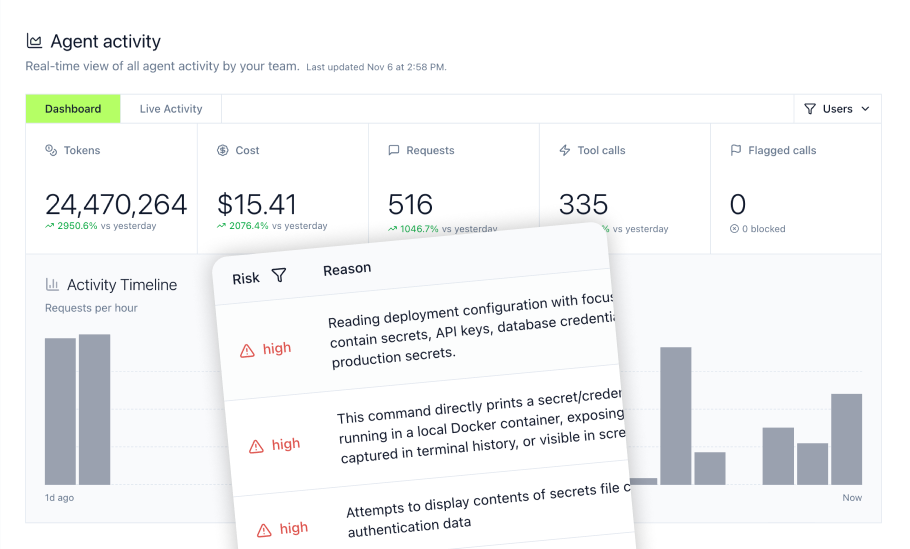
Connecting AI assistants like Claude, ChatGPT, and Cursor to internal databases, APIs, and business tools creates immediate productivity gains. But without proper governance infrastructure, those same AI agents become security blind spots, executing commands, accessing files, and querying production systems with limited auditability.
According to NIST's AI Risk Management Framework, organizations deploying AI systems must establish governance controls that ensure transparency, accountability, and security throughout the AI lifecycle. For AI agents accessing internal tools, this governance challenge is particularly acute: many organizations are moving agents onto roadmaps, but still lack the infrastructure to enforce purpose limitations or audit what those agents actually do.
MCP Gateways solve this by acting as a centralized control layer between AI clients and internal MCP servers. They handle authentication, permissions, and audit trails that enterprises need to deploy MCP at scale. Instead of managing individual connections for every agent-to-tool pairing, organizations route all traffic through one governed endpoint.
The stakes are real: AI coding agents can read every file, execute commands, and access production databases when controls are not properly scoped. The question isn't whether to implement gateway infrastructure, it's which platform fits compliance requirements, performance needs, and deployment timeline.
Key Takeaways
- MCP Gateways centralize authentication, governance, credential management, and monitoring for AI agents connecting to internal tools, solving the challenge where every agent otherwise needs individual connections and credentials for every system
- Gateway infrastructure can reduce custom development work for authentication, RBAC, credential management, and audit logging
- Integration breadth varies dramatically: some platforms offer broad pre-built connector catalogs, while performance-focused platforms prioritize low gateway overhead over connector count
- Academic security research has identified systemic vulnerabilities in MCP implementations, including command injection, unrestricted network access, and file leakage risks, making gateway-level controls essential for production deployments
1. MintMCP Gateway: Enterprise-Grade Compliance and One-Click Deployment
MintMCP has established itself as a compliance-forward choice for organizations where governance isn't optional. The platform addresses the security and audit requirements that healthcare, finance, and government organizations face when deploying AI agents to production.
What Makes MintMCP Different
The platform transforms local STDIO-based MCP servers into production-ready services with OAuth brokering, SSO-fronted access, and hosted connector runtime support. Where traditional deployments demand weeks of security engineering, MintMCP delivers one-click deployment with enterprise monitoring built in. The gateway is data-permissions-first, starting with SSO, SCIM-driven RBAC, IdP groups, Virtual MCP Bundles, tool-level policy, and audit logs before enabling agents on top.
Core Capabilities
- Virtual MCP Bundles: Create per-use-case endpoints with SCIM-driven membership and curated toolsets per team, role, or agent identity, preventing tool overload that degrades LLM selection quality
- Pre-Built Connectors: Hosted MCP connectors run by MintMCP for Elasticsearch, Snowflake, Gmail, and databases including PostgreSQL, MySQL, and MongoDB
- Authentication: SSO, SCIM-driven RBAC, OAuth brokering for stdio and hosted MCP servers, and tool-level allowlisting with rule-based policy
- Monitoring: Centralized observability and audit logs for MCP traffic, plus Gateway and Agent Monitor coverage for Claude, Cursor, ChatGPT, Gemini, and Copilot activity through the LLM Proxy
- Agent Governance: Agent Bundles with M2M authentication, per-agent identity, scoped tools, credential rotation, and an “act as agent” flow for connectors that require per-agent OAuth
- Policy Extensions: JavaScript Gateway Middleware in a JS sandbox, external DLP and guardrails integrations, Admin MCP, and tool-update policy controls
Compliance Coverage
- SOC 2 Type II audited controls and governance features including identity, RBAC, audit trails, and centralized observability
- Compliant with HIPAA standards, with HIPAA documentation available for customers handling protected health information
- Penetration tested, with data encrypted in transit and at rest
- Complete audit trails for regulatory documentation
- Enterprise SSO, PII detection, role-based access control, and BAAs available for customers that require them
Deployment and Pricing
Deployment Timeline: Minutes to a first working endpoint; production rollout timelines vary based on SSO, SCIM, network controls, and audit log requirements.
Pricing: Contact for enterprise pricing (enterprise SLAs and dedicated support available)
Best For: Regulated industries requiring SOC 2 Type II audited controls, organizations prioritizing rapid deployment without sacrificing security, teams needing centralized governance across Claude, Cursor, ChatGPT, Gemini, Copilot, and custom agents
2. Composio
Composio targets teams that need immediate access to a wide range of internal tools. With 500+ managed integrations covering Slack, GitHub, Jira, CRMs, and productivity apps, the platform reduces integration development that typically consumes engineering resources.
Where Composio Fits
The unified authentication layer handles OAuth flows for connected tools automatically. AI agents connect through Composio rather than managing credentials for each service individually. This approach accelerates integration development compared to building custom API connections.
Core Capabilities
- Pre-Built Connectors: 500+ integrations with automatic authentication management
- Authentication: Unified OAuth layer handling credentials across all connected services
- Agent Framework Support: Native compatibility with LangChain, CrewAI, and other orchestration platforms
- Free Tier: Available for testing and small-scale deployments
Technical Details
- Setup time: 5 minutes for initial deployment
- Low latency for most operations
- SOC 2 Type II audited status and report scope should be validated during procurement for regulated deployments
- Managed SaaS-first, with VPC or on-prem options available on Enterprise tier
Limitations
- Free tier caps server count
- Less granular RBAC compared to some enterprise platforms
- Primarily developer and AI engineering focused, so teams should evaluate fit for SCIM-driven RBAC, per-use-case tool bundles, and internal-agent governance
Best For
Development teams prioritizing integration breadth, startups building AI-powered features rapidly, organizations with extensive SaaS tool stacks
3. TrueFoundry
TrueFoundry focuses on performance and platform control for organizations where latency directly impacts user experience. The platform is often positioned around low gateway overhead in published references, but teams should validate end-to-end p95 latency in their own environment.
Where TrueFoundry Fits
Rather than providing hundreds of pre-built connectors, TrueFoundry optimizes for teams bringing their own MCP servers. The platform handles hosting, scaling, and monitoring while organizations maintain control over which tools agents access.
Core Capabilities
- Performance: Low gateway overhead for time-sensitive applications, with actual latency depending on deployment model and workload
- Self-Hosted Option: Air-gapped deployments for organizations requiring on-premise infrastructure
- Enterprise Support: SLA guarantees with dedicated technical support
- Custom Servers: Bring-your-own MCP servers with optimized hosting
Technical Details
- Setup time depends on deployment model, infrastructure requirements, and existing platform maturity
- Certification scope varies by deployment model; confirm SOC 2 report coverage for chosen architecture
- Self-hosted and cloud deployment options
- Requires dedicated platform team for optimal operation
Limitations
- Fewer pre-built integrations than some platforms
- Requires more technical expertise to configure
- Teams should evaluate whether they need MintMCP-style Virtual MCP Bundles, Agent Bundles, hosted MCP connectors, and SCIM-driven membership for internal employee and agent governance
Best For
Organizations where low gateway overhead is critical, teams with existing MCP servers needing optimized hosting, enterprises with dedicated platform engineering resources
4. Obot
Obot provides gateway functionality as an open-source solution, suitable for organizations with strong DevOps capabilities who prioritize data control over deployment speed.
Where Obot Fits
As an open-source solution, Obot runs entirely on organizational infrastructure. Teams control data residency, network policies, and security configurations. The Kubernetes-native architecture integrates with existing cloud-native toolchains for organizations already invested in container orchestration.
Core Capabilities
- Open-Source: No licensing fees; full source code access
- Kubernetes-Native: Helm chart deployment with horizontal pod autoscaling
- OIDC/SAML: Enterprise identity integration with Okta, Microsoft Entra
Deployment Requirements
- Kubernetes cluster (EKS, GKE, AKS, or self-managed)
- PostgreSQL, MySQL, or SQLite database
- 30 minutes for initial deployment
- Ongoing maintenance requires dedicated operations resources
Cost Structure
- Platform: $0 (open-source)
- Cloud infrastructure costs for compute and storage
- Engineering maintenance in loaded personnel costs
Limitations
- Production rollout timeline depends on Kubernetes readiness, security review, and connector operations
- Compliance documentation and audit controls depend on customer implementation
- No managed SaaS surfaced in the latest reference material
- Variable latency depending on infrastructure configuration
- Teams that want MintMCP-style managed SaaS-first deployment, hosted MCP connectors, Virtual MCP Bundles, and centralized audit observability may need to build or operate more of that stack themselves
Best For
Organizations requiring full data control, teams with strong Kubernetes expertise, cost-conscious enterprises with available DevOps resources
5. Docker MCP Gateway
Docker MCP Gateway targets teams already working within Docker/Compose workflows who want gateway functionality without learning new tooling.
Where Docker MCP Gateway Fits
The Docker MCP Catalog provides pre-built containerized MCP servers. Teams pull images, configure credentials, and deploy using the same Docker commands already familiar to development teams.
Core Capabilities
- Docker Catalog: Pre-built MCP server containers
- Familiar Tooling: Standard Docker/Compose workflows
- Local Development: Easy setup for testing before production deployment
- Container Isolation: Each MCP server runs in isolated container
Technical Details
- Setup time depends on environment, credential configuration, and production hardening requirements
- Latency depends on infrastructure configuration
- Enterprise SSO and policy controls may require additional configuration
- Community and ecosystem maturity should be evaluated during procurement
Limitations
- Production latency depends on deployment architecture
- Compliance certifications are not provided out of the box
- Requires infrastructure management
- Enterprise features such as RBAC, audit logging, SCIM-driven membership, and tool-level policy may require additional implementation
Best For
Development teams familiar with Docker, organizations testing MCP before production rollout, scenarios where latency isn't critical
6. Zapier MCP
Zapier MCP extends the Zapier workflow automation platform to AI agents, providing access to thousands of app integrations through a single MCP endpoint.
Where Zapier MCP Fits
Organizations already using Zapier for workflow automation gain immediate access to connected apps through the MCP gateway. AI agents inherit the authentication and permissions already configured in Zapier workflows.
Core Capabilities
- App Ecosystem: Broad integrations inherited from Zapier platform
- Existing Workflows: Leverage Zapier automations as MCP tools
- Authentication: Unified credential management across apps
- No-Code Configuration: Visual workflow builder for tool creation
Pricing Model
- Task-based pricing: Each tool call counts as tasks
- Requires existing Zapier subscription
Limitations
- Usage-based costs can scale with frequent tool calls
- Dependent on Zapier platform availability
- Less optimized for high-frequency, low-latency use cases
- Teams should evaluate whether workflow automation permissions are granular enough for internal MCP governance, SCIM-driven RBAC, and per-agent tool access
Best For
Organizations with existing Zapier investments, teams needing broad app coverage without engineering resources, low-frequency tool call scenarios
7. Workato MCP
Workato MCP brings an extensive enterprise integration catalog to AI agents, targeting large organizations with complex integration requirements.
Where Workato MCP Fits
The platform excels at enterprise integrations with ERP systems, legacy databases, and custom applications. Organizations already using Workato can enable AI agents to leverage existing integration infrastructure.
Core Capabilities
- Enterprise Connectors: Extensive app integrations including SAP, Oracle, Salesforce
- Recipe Builder: Visual interface for creating complex multi-step workflows
- Governance: Enterprise access controls and audit logging
- Existing Infrastructure: Leverage current Workato investments
Technical Requirements
- Existing Workato subscription required
- Medium setup difficulty
Limitations
- Requires prior Workato investment
- Higher complexity than simpler gateway solutions
- Teams should evaluate whether an integration automation platform provides MCP-specific primitives such as Virtual MCP Bundles, Agent Bundles, tool-update policy, and stdio or hosted-server OAuth brokering
Best For
Large enterprises with existing Workato deployments, organizations requiring complex ERP and legacy system integrations
8. IBM ContextForge
IBM ContextForge addresses a specific challenge: connecting AI agents to legacy systems that don't speak MCP natively. The open-source platform wraps REST, SOAP, and gRPC APIs as MCP-compatible tools.
Where IBM ContextForge Fits
Healthcare, finance, and manufacturing organizations often operate legacy systems that can't be easily replaced. ContextForge creates a translation layer, enabling AI agents to interact with these systems through standardized MCP calls.
Core Capabilities
- Protocol Bridging: Convert REST/gRPC/SOAP APIs to MCP format
- Federated Deployment: Multi-location installations for distributed organizations
- Open-Source: Full source code access under the Apache 2.0 license
- Enterprise Legacy Support: Purpose-built for complex integration scenarios
Deployment Timeline
- 3-4 weeks for protocol bridging configuration
- Requires dedicated integration engineering resources
Limitations
- Longer deployment timeline than managed alternatives
- Requires significant integration expertise
- Teams should evaluate whether they need MintMCP-style managed SaaS deployment, hosted MCP connectors, OAuth brokering, SCIM-driven RBAC, and centralized agent governance rather than primarily protocol translation
Best For
Healthcare organizations connecting to HL7 FHIR systems, enterprises with extensive SOAP/REST legacy APIs, organizations requiring federated multi-location deployments
Deploy Enterprise AI with MintMCP Gateway
The Model Context Protocol has fundamentally changed how enterprises connect AI assistants to internal data and tools. But deploying MCP at scale requires more than protocol support, it demands enterprise-grade security, governance, and monitoring that transforms experimental AI into production-ready infrastructure.
MintMCP Gateway provides a fast path from pilot to production, offering one-click deployment that reduces configuration work. With SOC 2 Type II audited controls, hosted connectors for enterprise data sources, SSO and SCIM-driven RBAC, Virtual MCP Bundles, Agent Bundles, and comprehensive audit logging, MintMCP removes technical barriers that keep organizations stuck in AI pilot programs.
Whether securing access to Snowflake data warehouses, Elasticsearch knowledge bases, or custom enterprise tools, MintMCP provides the governance infrastructure that makes AI deployment practical, compliant, and secure.
For a deeper understanding of MCP gateway architecture, see the guide to understanding MCP gateways.
Ready to transform AI infrastructure? Visit mintmcp.com to schedule a demo and see how MintMCP Gateway can accelerate enterprise AI deployment.
Frequently Asked Questions
What is an MCP Gateway and why is it critical for internal tool integration in 2026?
An MCP Gateway acts as a centralized control layer between AI agents (Claude, ChatGPT, Cursor) and internal MCP servers. Instead of each agent connecting directly to dozens of internal systems, each requiring separate credentials and policies, traffic routes through one governed endpoint. The gateway handles authentication, access control, monitoring, credential management, and audit logging. This architecture solves the "N×M integration problem" where every agent would otherwise need individual connections for every tool, while providing the compliance documentation enterprises require.
How do MCP Gateways ensure data security and compliance for enterprise internal tools?
Leading gateways implement multiple security layers: OAuth 2.0/SSO for authentication, SCIM-driven RBAC to limit which teams access which tools, tool-level allowlisting, rule-based policy, credential management, and complete audit trails logging every interaction. Platforms with SOC 2 Type II audited controls provide external validation of these security measures, which is important for healthcare, finance, and government deployments. The LLM Proxy component specifically monitors coding agents, helping teams govern tool calls, bash commands, and file access across Claude, Cursor, ChatGPT, Gemini, and Copilot environments.
Can MintMCP Gateway integrate with existing internal data sources like Snowflake or Elasticsearch?
Yes. MintMCP provides pre-built connectors for common enterprise data sources including Snowflake (natural language to SQL queries, semantic views, Cortex Agent integration), Elasticsearch (search, ES|QL queries, index management), and Gmail (search, draft, send with security oversight). Database connectors cover PostgreSQL, MySQL, MongoDB, and others. Each connector inherits the gateway's authentication and audit logging, so access is configured once at the gateway level rather than per-tool.
What are the deployment options for MintMCP Gateway solutions?
MintMCP currently offers cloud deployment as a managed service with enterprise SLA guarantees, automatic failover, and centralized governance controls. MintMCP is managed SaaS-first in the US and EU, with VPC or self-hosted deployment available on request for organizations that require additional infrastructure control. The managed approach reduces the operational overhead that open-source alternatives require.
How does a robust API management strategy enhance the value of an MCP Gateway?
API management principles, centralized credentials, rate limiting, access logging, and policy enforcement, translate directly to MCP governance. The gateway centralizes API keys and tokens that would otherwise scatter across developer machines and agent configurations. The unified approach also enables cost analytics and auditability, tracking spending per team, project, and tool with detailed breakdowns that are difficult to maintain when connections are decentralized.