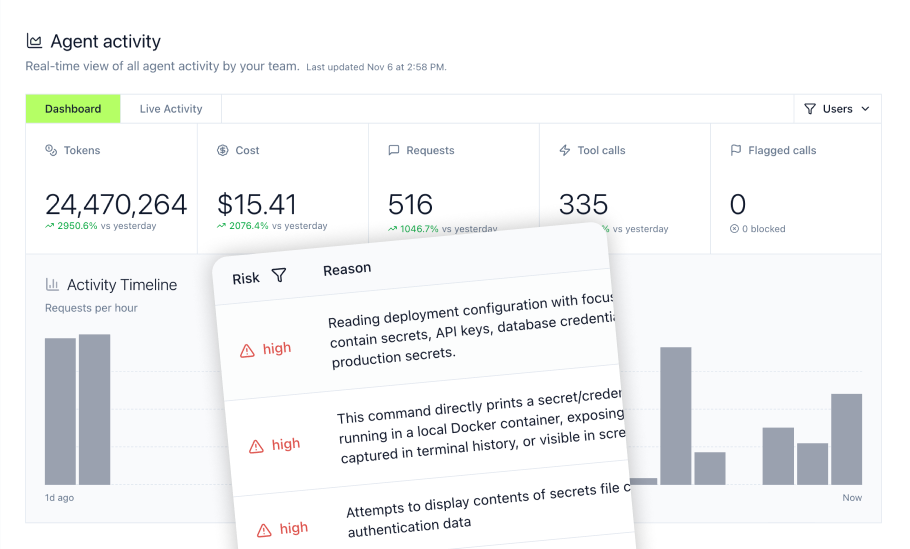
Data engineering teams face a critical infrastructure decision in 2026: how do you safely connect AI agents to Snowflake data warehouses, real-time streaming pipelines, and production databases without creating security chaos? The MCP Gateway category has emerged as the solution, providing centralized governance, authentication, and observability for AI-to-data connections.
Model Context Protocol (MCP) has quickly become a leading open standard for connecting AI clients to enterprise data, supported by major ecosystem players including Anthropic, OpenAI, Google, and Microsoft. But deploying MCP servers at scale introduces challenges around authentication, compliance, and monitoring that raw protocol implementations don't address. The governance gap is substantial: Kiteworks forecasts that 100% of enterprises have AI agents on their roadmap, yet 63% cannot enforce purpose limitations on what those agents are allowed to do.
MCP gateways solve three specific problems for data engineering teams: tool organization (managing multiple MCP servers across teams), protocol translation (normalizing access across STDIO, HTTP-streamable, and SSE transports), and security control (enforcing authentication, RBAC, and audit logging). Without a gateway layer, each AI-to-data connection requires custom authentication, manual credential management, and fragmented observability, creating unacceptable risk for teams handling sensitive datasets.
This guide evaluates the 10 leading MCP gateway solutions for data engineering teams, ranking them by data warehouse integration, latency performance, compliance posture, and deployment flexibility.
Key Takeaways
- MCP gateways provide the missing infrastructure layer for secure, governed AI agent access to enterprise data sources including data warehouses, streaming pipelines, and production databases
- Performance varies dramatically across solutions: some vendor claims cite roughly 3-5ms added latency for real-time applications, while security-focused alternatives may add higher overhead for deep inspection
- Open-source alternatives offer zero licensing costs but require self-hosting infrastructure and DevOps expertise
- Data engineering teams should prioritize gateways with native data warehouse connectors, low latency for real-time applications, tool-level policy, audit logs, and compliance-ready controls for regulated environments
1. MintMCP Gateway: Enterprise Data Governance and Data Warehouse Integration
MintMCP is a data-permissions-first MCP gateway for enterprise data engineering teams, offering SOC 2 Type II audited governance with native data warehouse connectors. The platform transforms local MCP servers into production-ready services with one-click deployment, OAuth brokering, credential management, tool-level access control, and real-time monitoring.
What Makes MintMCP Different
MintMCP provides pre-built connectors for critical data infrastructure, including Snowflake for data warehouse queries and Elasticsearch for knowledge base search. The Snowflake MCP Server supports natural language queries via Cortex Analyst, enabling AI agents to generate reports from data warehouses without SQL expertise.
The platform's Virtual MCP Bundles expose only the minimum required tools, not entire MCP servers, which is critical for data access governance when teams need different permission levels. SCIM-driven membership, tool-level allowlisting, rule-based policy, and audit logs help data teams govern which employees and agents can access specific data tools. One-click STDIO deployment and hosted MCP connectors can significantly reduce the infrastructure work required to move MCP servers into production.
Key Features for Data Engineers
- Native Snowflake integration with Cortex Analyst for natural language data queries
- Elasticsearch connector for AI-powered knowledge base search and log analysis
- SOC 2 Type II audited with complete audit trails for compliance reporting
- SSO and SCIM-driven RBAC, tool-level allowlisting, rule-based policy, and credential management
- Virtual MCP Bundles for per-use-case endpoints with SCIM-driven membership
- OAuth brokering for stdio and hosted MCP servers, plus hosted MCP connectors run by MintMCP
- Official Cursor Hooks partner for coding agent governance
Customer Validation
MintMCP is designed for teams that need a managed MCP gateway to host connectors, manage credentials, and let employees connect governed tools to AI clients such as Claude, Cursor, ChatGPT, Gemini, and Copilot.
Data Engineering Use Cases
- Secure AI agent access to Snowflake data warehouses for analytics queries
- Governed data pipeline automation through AI coding assistants
- Compliance-ready audit trails for regulated data access in ETL workflows
- Real-time data access monitoring for teams using sensitive datasets
Pricing: Enterprise (contact sales)
Learn More: mintmcp.com/mcp-gateway
2. Composio
Composio addresses integration complexity for teams connecting AI agents to diverse data sources, databases, APIs, and SaaS applications. The platform provides hundreds of pre-built managed integrations with unified authentication handling OAuth, API keys, and credential management across connected tools.
Core Capabilities
- Hundreds of managed integrations including major databases (PostgreSQL, MySQL, MongoDB)
- Unified authentication layer abstracting OAuth, API keys, and credential management
- Native SDKs for LangChain, CrewAI, and LlamaIndex frameworks
- Production-grade RBAC and PII controls
- Low-latency performance optimized for responsive agent interactions
Tradeoffs to consider
Composio is a strong fit for developer and AI engineering teams building customer-facing agentic products. Data engineering teams should also evaluate whether they need data-permissions-first controls such as SCIM-driven RBAC, per-use-case Virtual MCP Bundles, tool-level policy, and centralized audit logs for internal employee and internal-agent governance.
Best For: Data engineering teams needing rapid connectivity to diverse data sources without building custom connectors
Pricing: Managed SaaS with free tier available
3. TrueFoundry MCP Gateway
TrueFoundry delivers MCP gateway capabilities, with public references often citing 3-5ms added latency and throughput of hundreds of requests per second on a single vCPU. Actual latency depends on deployment configuration, workload, and inspection requirements, which matters for data engineering teams running real-time analytics and streaming applications.
Architecture for Real-Time Data
The platform's unified LLM + MCP gateway consolidates AI infrastructure into a single control plane. Its low-latency architecture can suit latency-sensitive data operations, especially for teams already operating ML platform infrastructure.
Core Capabilities
- Public references often cite 3-5ms added latency overhead for performance-critical applications
- High throughput, with references commonly citing 350+ RPS on a single vCPU
- Unified billing tracking LLM and tool usage costs
- Server Groups for logical isolation across dev, staging, and prod environments
- Virtual MCP Server abstraction for N×M integration management
Tradeoffs to consider
TrueFoundry fits platform engineering and ML platform teams that want a broader AI infrastructure control plane. Teams focused primarily on internal employee and agent governance should compare its model with MintMCP's managed SaaS-first approach, SCIM-driven Virtual MCP Bundles, Agent Bundles with M2M auth, hosted MCP connectors, and gateway plus Agent Monitor coverage.
Best For: Real-time analytics dashboards, streaming data processing, high-frequency data pipeline monitoring
Pricing: Enterprise managed SaaS
4. Bifrost (Maxim AI)
Bifrost positions itself as a low-overhead, open-source gateway with MCP gateway capabilities available, especially in enterprise deployments. Public Bifrost materials cite about 11µs gateway overhead and high throughput, while actual end-to-end latency depends on deployment architecture, routing, and downstream tool behavior.
Dual Architecture Benefits
Bifrost's dual client/server architecture enables advanced routing patterns while its Go-based implementation supports resource efficiency. Setup is designed for teams that prefer operating an open-source Go binary or Docker-based deployment.
Core Capabilities
- About 11µs gateway overhead in public Bifrost materials
- High-throughput design for data-intensive operations
- Dual MCP server/client functionality for advanced routing patterns
- Intelligent routing, caching, and access control
- Apache 2.0 license (free and open-source)
Tradeoffs to consider
Bifrost is well suited to developer, platform engineering, and AI/ML teams that want an OSS-first or self-hosted-first gateway. Data teams that want a managed SaaS-first MCP control plane should compare the operational work of running gateway infrastructure with MintMCP's hosted MCP connectors, credential management, SSO and SCIM-driven RBAC, and centralized observability.
Best For: Cost-conscious teams with latency requirements, edge computing scenarios, resource-constrained environments
Pricing: Free and open-source
5. Docker MCP Gateway
Docker MCP Gateway brings container-first security to MCP deployment, leveraging Docker Compose workflows and Kubernetes integration that data engineering teams already know. MCP servers can run in isolated containers with signed images, resource limits, and constrained host access.
Security Through Isolation
Container isolation addresses multi-tenant data access scenarios by providing process-level separation, resource constraints, and network segmentation options.
Core Capabilities
- Docker Compose-first workflow with familiar CLI
- Container isolation for multi-tenant data access
- Kubernetes integration for existing data platform infrastructure (Airflow, Spark)
- Secret management without host exposure
- Open-source deployment model
Tradeoffs to consider
Docker MCP Gateway can fit teams that already standardize on Docker and Kubernetes. The tradeoff is operational: teams may still need to manage connector runtimes, scaling, policy design, and observability. MintMCP addresses those gaps with managed SaaS-first deployment, hosted MCP connectors, OAuth brokering, tool-level allowlisting, audit logs, and SCIM-driven access control.
Performance Trade-off: Container-based deployments may add overhead due to container management, which can be acceptable for batch processing and less ideal for real-time operations.
Best For: Teams with existing Docker/Kubernetes infrastructure, multi-tenant data access scenarios
Pricing: Free and open-source
6. Lunar.dev MCPX
Lunar.dev MCPX is positioned around policy enforcement, RBAC, auditability, and performance for teams that want enterprise governance without fully relying on a managed gateway.
Core Capabilities
- Low-latency gateway architecture for performance-sensitive workflows
- Granular RBAC with immutable audit logs
- Token and cost monitoring per team/project
- Centralized secret management for data source credentials
- Self-hosted with optional SaaS control plane
Tradeoffs to consider
Lunar.dev MCPX can appeal to teams that want self-hosted control with optional SaaS dashboards. Data teams should compare that model with MintMCP's managed SaaS-first deployment, Virtual MCP Bundles with SCIM-driven membership, hosted connector runtime, and two-layer gateway plus Agent Monitor governance.
Best For: Multi-team data platforms requiring cost tracking and access controls without SaaS lock-in
Pricing: Self-hosted with optional SaaS dashboards
7. Lasso Security MCP Gateway
Lasso Security provides specialized threat detection capabilities including prompt injection blocking, PII masking, and tool poisoning protection. The platform scans MCP servers before loading and can block risky tools automatically.
Advanced Security Features
Lasso monitors for data exfiltration attempts and encrypts credentials with dedicated secret management. Its security-focused approach may introduce additional latency compared with lightweight routing-focused gateways because it performs deeper inspection.
Core Capabilities
- Real-time prompt injection detection and blocking
- Automatic PII masking and credential redaction
- Tool reputation analysis and server scoring
- Data exfiltration prevention monitoring
- Plugin-based architecture for extensibility
Tradeoffs to consider
Lasso is a fit for teams prioritizing MCP threat detection. Data engineering teams should also evaluate whether they need broader governance primitives such as SCIM-driven RBAC, Virtual MCP Bundles, Agent Bundles with M2M auth, hosted connectors, audit logs, and gateway plus Agent Monitor coverage for internal employees and agents.
Best For: Healthcare data pipelines, financial data analysis, regulated industries with mandatory threat detection requirements
Pricing: Managed SaaS with enterprise SLA
8. Obot Platform
Obot provides a comprehensive open-source platform covering gateway, catalog, hosting, and chat client capabilities. The platform offers Kubernetes-native deployment for data platform integration with built-in MCP catalog features for documentation and discovery.
Core Capabilities
- Kubernetes-native deployment for data platform integration
- Built-in MCP catalog with auto-documentation and discovery
- Nanobot framework for advanced agent orchestration
- Identity integration (Google, GitHub, Okta, Entra)
- Full data control with self-hosted deployment
Tradeoffs to consider
Obot is a fit for Kubernetes-fluent teams that want full infrastructure ownership. That ownership can also mean more operational responsibility for runtime management, scaling, connector hosting, and deployment workflows. MintMCP addresses those areas with managed SaaS-first deployment, hosted MCP connectors, centralized credential management, SCIM-driven RBAC, and audit logging.
Best For: On-premise data platforms with strict data residency requirements, teams wanting full infrastructure ownership
Pricing: Free (open-source core) with enterprise edition available
9. Microsoft MCP Gateway
Microsoft MCP Gateway offers Azure ecosystem integration with Entra ID authentication, Azure Monitor observability, and AKS deployment options. The solution provides routing options for multi-tenant deployments.
Core Capabilities
- Native Microsoft Entra ID integration for enterprise authentication
- Azure Monitor and App Insights for centralized logging
- Routing options for multi-tenant deployments
- AKS (Kubernetes) or Azure API Management deployment options
- Dual options: open-source K8s gateway or managed APIM
Tradeoffs to consider
Microsoft MCP Gateway is a natural fit for Azure-committed teams. Organizations running multiple AI clients and data environments should compare Azure-native deployment with MintMCP's vendor-neutral governance across Claude, Cursor, ChatGPT, Gemini, and Copilot, plus Virtual MCP Bundles, OAuth brokering, hosted connectors, and centralized audit logs.
Performance: Latency depends on Azure deployment architecture, concurrency limits, and downstream service configuration.
Best For: Azure-committed teams using Azure Synapse, Azure Databricks, or Azure Data Factory
Pricing: Free (open-source) or Azure APIM commercial pricing
10. IBM ContextForge
IBM ContextForge addresses enterprise-scale requirements with federation support across multiple gateway deployments and protocol flexibility across HTTP(S), SSE, and stdio transport patterns.
Core Capabilities
- Federation support for multi-gateway deployments (Redis-backed federation and caching)
- PostgreSQL, MySQL, and SQLite integration
- Virtual servers wrapping REST/gRPC APIs as MCP tools
- JWT, Basic Auth, and custom headers with AES encryption
- Plugin architecture for customization
Tradeoffs to consider
ContextForge is best suited to teams comfortable operating an open-source gateway and federation layer. Data engineering teams should compare that operational model with MintMCP's managed SaaS-first approach, hosted MCP connectors, Virtual MCP Bundles, Agent Bundles, tool-update policy, and centralized observability.
Important Caveat: ContextForge is still maturing, but IBM offers optional Elite Support for organizations that want production backing. Best suited for teams comfortable operating an open-source gateway.
Performance: Latency depends on federation, caching, deployment architecture, and downstream tools.
Best For: Very large organizations (10,000+ employees) with federated data infrastructure across regions
Pricing: Free and open-source
Making Your Choice: Recommendations for Data Engineering Teams
For data engineering teams, the right MCP gateway depends on your primary requirements and constraints:
Compliance-first organizations should prioritize MintMCP as a SOC 2 Type II audited option with audit trails, SSO and SCIM-driven RBAC, tool-level policy, credential management, and exportable logs for compliance review.
Teams requiring extensive integrations across diverse data sources benefit from solutions offering hundreds of pre-built connectors with unified authentication, eliminating weeks of custom connector development.
Performance-critical deployments running real-time analytics or streaming data processing need gateways with low added latency and sufficient throughput to avoid degrading user experience when agents make hundreds of tool calls per conversation.
Cost-conscious teams with DevOps expertise can leverage open-source options offering zero licensing costs, though these require self-hosting infrastructure and ongoing maintenance.
Security-critical environments handling healthcare data, financial information, or other regulated datasets may require specialized threat detection capabilities including PII masking and data exfiltration prevention, accepting higher latency overhead for comprehensive security scanning.
Azure-native organizations already invested in Azure Synapse, Databricks, or Data Factory can streamline deployment through native Entra ID integration and Azure Monitor observability.
For most data engineering teams, MintMCP offers the fastest path to production-ready MCP infrastructure, combining SOC 2 Type II audited controls, native data warehouse connectors, data-permissions-first governance, and one-click deployment. Teams can explore the deployment guide to understand implementation requirements.
Frequently Asked Questions
What is an MCP Gateway and why is it crucial for data engineering teams?
An MCP Gateway provides centralized governance, authentication, and monitoring for Model Context Protocol connections between AI agents and enterprise data. For data engineering teams, gateways solve three critical problems: tool organization (managing multiple MCP servers across teams), protocol translation (normalizing access across transport mechanisms like STDIO, HTTP-streamable, and SSE), and security control (enforcing access policies and audit logging). Without a gateway, each AI-to-data connection requires custom authentication and lacks audit visibility, creating compliance risk for regulated data environments.
How do MCP Gateways ensure data security and compliance for sensitive enterprise data?
Production-grade MCP gateways enforce security through SSO, OAuth, role-based access control, tool-level policy, credential management, and complete audit trails. For compliance-critical environments, look for SOC 2 Type II audited vendors, enterprise SSO, RBAC, audit logging, encryption in transit and at rest, and clear documentation for regulated data workflows. Security-focused gateways may add PII masking and data exfiltration prevention for highly sensitive datasets, though these capabilities can introduce additional latency overhead for deep security scanning.
Can MCP Gateways integrate with existing data warehouses like Snowflake or Elasticsearch?
Integration depth varies significantly across solutions. MintMCP provides native Snowflake connectors with Cortex Analyst support for natural language queries, plus Elasticsearch integration for knowledge base search. Other platforms offer database connectors within broader integration libraries. Solutions without pre-built connectors require building custom integrations, adding development time but providing flexibility for proprietary data sources.
How does an MCP Gateway simplify deployment for data engineers?
Managed platforms like MintMCP offer one-click deployment of STDIO-based MCP servers with OAuth brokering and hosted MCP connectors, reducing infrastructure setup. Self-hosted options integrate with existing Kubernetes deployments for teams preferring infrastructure control. The LLM Proxy component provides additional monitoring for coding agents accessing data systems, offering visibility into agent behavior and data access patterns.
What role do monitoring and observability play in MCP Gateways for data engineering?
Real-time monitoring tracks every tool call, query execution, and data access event, providing visibility into AI agent behavior. This observability enables cost tracking per team or project, performance optimization through identifying slow queries, and security alerting by detecting unusual access patterns. For data engineering teams, audit trails support security reviews, regulated data access investigations, and compliance reporting. Customers handling protected health information should review vendor HIPAA documentation and BAA availability where required.
What is the difference between an MCP Gateway and traditional ETL tools for data integration?
MCP gateways and ETL tools serve complementary roles in data infrastructure. ETL tools (like Fivetran, Airbyte, and dbt) move and transform data between systems on scheduled or triggered workflows, handling batch data movement and transformation pipelines. MCP gateways enable AI agents to query data sources directly in real-time through natural language interfaces, providing governed access for interactive AI applications. Think of gateways as the governance layer for AI-to-data access, while ETL handles the underlying data movement and transformation. Many teams use both: ETL for data pipelines, MCP gateways for AI agent access to those pipelines and resulting datasets.