The Model Context Protocol gained broad adoption momentum in 2025 as major AI ecosystems began standardizing around it, backed by Anthropic, OpenAI, Google, and Microsoft. But connecting AI agents to enterprise systems safely remains the primary bottleneck for developer tool companies building products in 2026. An MCP gateway sits between your AI clients and backend tools, handling authentication, rate limiting, observability, and compliance, transforming local MCP servers into production-ready infrastructure.
For developer tool companies specifically, the stakes are higher. Your customers expect enterprise-grade security, your compliance team demands audit trails, and your engineering team needs low latency. These 12 production-ready solutions are each optimized for different use cases.
Key Takeaways
- Performance varies 1000x: Gateway overhead ranges from microseconds in high-performance proxies to hundreds of milliseconds in federation/security-heavy setups. Your choice depends on whether you prioritize speed, security scanning, or federation capabilities
- Integration breadth vs. governance depth: Composio offers 500+ integrations while MintMCP focuses on data-permissions-first governance, SSO and SCIM-driven RBAC, Virtual MCP Bundles, Agent Bundles, and tool-level policy. Developer tool companies need to decide which matters more for their customers
- Open-source options exist: Docker, IBM ContextForge, Lasso Security, and Obot provide free alternatives for teams willing to manage their own infrastructure
- The market is maturing rapidly: Gartner’s 2025 Software Engineering Survey projects that 75% of API vendors will have MCP features by the end of 2026, making early platform selection critical
1. MintMCP Gateway: Enterprise Compliance for Developer Tool Companies
MintMCP Gateway is a compliance-focused choice for developer tool companies selling into regulated industries. As a SOC 2 Type II audited MCP platform that is compliant with HIPAA standards, MintMCP addresses the governance gap that prevents many AI-powered developer tools from closing enterprise deals.
What Makes MintMCP Different:
MintMCP's approach centers on data-permissions-first governance for production MCP. Rather than requiring teams to build authentication infrastructure, the platform supports SSO and SCIM-driven RBAC, OAuth brokering for stdio and hosted MCP servers, credential management, and tool-level allowlisting. Virtual MCP Bundles create per-use-case endpoints with SCIM-driven membership and curated tool access, while Agent Bundles give agents their own identity with M2M auth and an “act as agent” flow for scoped access.
Key Capabilities:
- SOC 2 Type II audited platform for enterprise security reviews
- Compliant with HIPAA standards, penetration tested, and supported by complete audit trails
- SSO and SCIM-driven RBAC with granular tool-level access control
- Virtual MCP Bundles with per-use-case endpoints and SCIM-driven membership
- Agent Bundles with M2M auth and “act as agent” flow
- OAuth brokering for stdio and hosted MCP servers
- Hosted MCP connectors run by MintMCP, including enterprise connectors for Snowflake, Elasticsearch, and Gmail
- JavaScript Gateway Middleware in a JS sandbox for inline policy, DLP, and guardrails integrations
- Official Cursor Hooks partner for coding agent governance
- Gateway and Agent Monitor coverage for Claude, Cursor, ChatGPT, Gemini, and Copilot governance
Best For: Developer tool companies that need to pass enterprise security reviews and sell into regulated industries (healthcare, finance, government).
Pricing: Enterprise pricing (contact sales)
2. Bifrost (Maxim AI)
Bifrost is a high-performance MCP gateway option, with public materials citing about 11µs gateway overhead. Built in Go rather than Python, it's positioned for developer tools requiring low-latency response times.
Primary Focus:
The dual client/server architecture allows Bifrost to act as both MCP server and client simultaneously. This stateless security model keeps control over tool execution on the client side while the gateway handles routing and monitoring. Zero-configuration deployment means teams can start in seconds.
Key Capabilities:
- About 11µs gateway overhead in public benchmark materials
- Unified interface to 15+ LLM providers plus native MCP support
- Apache 2.0 open-source license for transparency
- Stateless architecture with client-side tool execution control
- Enterprise tier available with 14-day free trial
Best For: Developer tool companies building real-time AI applications where latency directly impacts user experience (coding assistants, live collaboration tools).
Pricing: Free (open-source) with enterprise tier available
3. TrueFoundry MCP Gateway
TrueFoundry combines MCP gateway capabilities with broader AI infrastructure management, with public references often citing best-case overhead around a few milliseconds and throughput around 350+ RPS per core. Actual latency depends on deployment configuration, workload, and policy setup. The unified control plane manages both LLM serving and tool orchestration, reducing operational complexity for teams running multiple AI workloads.
Where TrueFoundry Fits Best:
The Virtual MCP Server abstraction solves the N×M integration problem that plagues developer tool companies managing multiple tools across multiple clients. OAuth 2.0 Identity Injection enables On-Behalf-Of authentication, ensuring tool calls execute with the end user's permissions rather than service account credentials. In-memory authentication and rate limiting minimize overhead.
Key Capabilities:
- Low-latency architecture, with published references often citing best-case overhead around a few milliseconds
- Virtual MCP Server abstraction for N×M integration management
- OAuth 2.0 OBO authentication for proper permission delegation
- Hybrid deployment supporting on-premise and cloud environments
- Unified control plane for model serving and tool orchestration
Best For: Developer tool companies that need to manage both LLM infrastructure and MCP tool access in one platform, particularly those with hybrid deployment requirements.
Pricing: Free tier available; enterprise pricing on contact
4. Composio
Composio offers 500+ pre-built integrations with unified authentication. For developer tool companies that need rapid integration without building custom connectors, this breadth can save development time.
Integration Library Approach:
The unified authentication layer abstracts OAuth flows, API key management, and token refresh across all 500+ integrations. Developer tool companies can add new tool connections to their products without implementing authentication for each service individually. Low latency performance ensures this integration breadth doesn't sacrifice speed.
Key Capabilities:
- 500+ managed integrations with unified auth layer
- SOC 2 Type II audited with role-based access control
- Developer-first experience with fast idea-to-production path
- Competitive latency despite integration breadth
- Abstracts OAuth, API keys, and token management
Best For: Developer tool companies that need to offer extensive third-party integrations quickly without building authentication flows for each service.
Pricing: Free tier available; paid plans for scaling
5. Lunar.dev MCPX
Lunar.dev MCPX provides granular access control capabilities, featuring multi-tier RBAC for global, service-level, and individual tool-level permissions, which is useful for developer tool companies with complex organizational hierarchies.
Governance-Focused Design:
Tool customization goes beyond access control. Administrators can rewrite tool descriptions and lock parameters, shaping how AI agents interact with underlying services. Prometheus-compatible metrics and comprehensive audit trails support enterprise observability requirements. On-premises deployment options address data sovereignty concerns.
Key Capabilities:
- Multi-tier RBAC at global, service, and tool levels
- Tool description rewriting and parameter locking
- Low-latency gateway design, with actual performance depending on deployment and policy configuration
- Prometheus-compatible metrics and audit trails
- On-premises deployment for data sovereignty
- AI Gateway integration for end-to-end policy enforcement
Best For: Developer tool companies with multi-tenant products or complex organizational structures requiring fine-grained permission management.
Pricing: Free tier available; commercial pricing on request
6. Docker MCP Gateway
Docker MCP Gateway brings MCP infrastructure to teams already invested in container ecosystems. Container isolation with CPU and memory limits for each MCP server provides security boundaries familiar to DevOps teams.
Container-Native Approach:
Cryptographically signed images address supply chain security concerns that enterprise customers increasingly prioritize. Docker Compose integration means deployment fits existing CI/CD pipelines without workflow changes. The trade-off is additional latency overhead from container management, which may be acceptable for many use cases but not for real-time applications.
Key Capabilities:
- Container isolation with resource limits per MCP server
- Cryptographically signed images for supply chain security
- Docker Compose integration for familiar deployment
- Deep integration with Docker Desktop and CLI
- Free and open-source
Best For: Developer tool companies with existing Docker infrastructure wanting zero learning curve and familiar deployment patterns.
Pricing: Free and open-source
7. Kong AI Gateway
Kong AI Gateway extends one of the most established API gateway platforms to support MCP. Recent releases added OAuth 2.1 implementation with LLM-as-a-Judge validation alongside the ability to auto-generate MCP servers from existing REST APIs.
API Gateway Heritage:
For developer tool companies already using Kong for API management, adding MCP capabilities requires no new infrastructure. The plugin ecosystem provides extensible security and governance options. Converting existing REST APIs to MCP servers happens without manual code, reducing migration effort for legacy systems.
Key Capabilities:
- Auto-generate MCP servers from REST APIs without manual coding
- OAuth 2.1 with LLM-as-a-Judge validation
- Unified API and MCP traffic management
- Mature plugin ecosystem for extensible governance
- Enterprise reliability and support
Best For: Developer tool companies already running Kong for API management wanting unified governance across traditional APIs and AI tool access.
Pricing: Enterprise pricing (contact sales)
8. IBM ContextForge
IBM ContextForge offers federation capabilities enabling auto-discovery across multiple gateway instances. Protocol bridging wraps legacy REST and gRPC APIs as MCP endpoints, supporting gradual migration strategies.
Federation Architecture:
The federation architecture suits developer tool companies with distributed teams across regions or business units. Redis-backed federation and caching, health monitoring, and capability merging create a unified view of tools across gateway instances.
Key Capabilities:
- Federation with auto-discovery across gateway instances
- Protocol bridging for REST/gRPC to MCP conversion
- Multi-database support (PostgreSQL, MySQL, SQLite)
- Virtual MCP servers for gradual legacy migration
- Open-source (Apache-2.0 license)
Best For: Large developer tool companies with distributed infrastructure requiring federated tool discovery and access.
Pricing: Free and open-source
Latency: Configuration dependent
9. Lasso Security
Lasso Security focuses on security threats rather than general governance, featuring dedicated real-time threat detection for prompt injection and command injection.
Security-Specialized Approach:
MCP server reputation scoring evaluates servers before loading, blocking risky tools automatically. PII masking through Presidio integration prevents sensitive data from reaching AI models. The trade-off is added latency overhead from security scanning, which can be significant compared with low-latency performance gateways.
Key Capabilities:
- Real-time prompt injection and command injection detection
- MCP server reputation scoring before loading
- PII masking and redaction via Presidio
- Plugin architecture for extensible security controls
- Open-source (MIT license)
Best For: Developer tool companies handling sensitive data or operating in high-security environments where threat detection outweighs latency concerns.
Pricing: Free and open-source
10. Portkey
Portkey expands beyond MCP gateway functionality to provide a complete AI infrastructure platform accessing 1,600+ language models through a single API. Built-in observability, guardrails, and prompt management consolidate multiple tools into one platform.
Unified AI Platform:
Developer tool companies can route across multiple LLM providers and manage MCP tool access from one interface. High uptime reliability with caching ensures production-grade performance. The platform approach means fewer integration points and simplified operations.
Key Capabilities:
- Access to 1,600+ LLMs alongside MCP gateway
- Built-in observability and guardrails
- Prompt management and versioning
- High availability with caching
- Unified billing and analytics
- SOC 2 Type II audited
Best For: Developer tool companies wanting consolidated AI infrastructure beyond MCP, including model routing, observability, and tool orchestration in one platform.
Pricing: Free tier available; paid plans on request
11. Obot Platform
Obot provides a complete open-source package: gateway, catalog, chat client, and orchestration framework in one Kubernetes-native platform. The Nanobot framework enables advanced agent orchestration beyond basic MCP connectivity.
Complete Open-Source Solution:
The built-in MCP Catalog includes auto-documentation and discovery, reducing integration friction. Enterprise identity support for Okta and Microsoft Entra addresses authentication requirements. Kubernetes-native design provides maximum customization for teams with container orchestration expertise.
Key Capabilities:
- Complete platform (gateway + catalog + client + orchestration)
- Kubernetes-native with data control
- MCP Catalog with auto-documentation
- Nanobot framework for advanced orchestration
- Enterprise IdP support (Okta, Entra)
Best For: Developer tool companies with Kubernetes expertise wanting full open-source control without vendor lock-in.
Pricing: Free and open-source; enterprise edition available
12. Traefik Hub MCP Gateway
Traefik Hub implements a Triple Gate Pattern that protects AI, MCP, and API layers simultaneously. Task-Based Access Control (TBAC) provides context-aware authorization that adjusts based on the specific task being performed.
Defense-in-Depth Security:
The On-Behalf-Of Authentication with OAuth 2.0 token exchange ensures AI agents act with appropriate user permissions. Cloud-native design leverages existing Traefik infrastructure for teams already using the proxy. The defense-in-depth approach provides multiple security layers rather than relying on a single checkpoint.
Key Capabilities:
- Triple Gate Pattern (AI, MCP, API layer protection)
- Task-Based Access Control for dynamic authorization
- OAuth 2.0 OBO token exchange
- Cloud-native architecture
- Integrated with existing Traefik infrastructure
Best For: Developer tool companies already using Traefik wanting unified gateway infrastructure with layered security architecture.
Pricing: Commercial product (contact for pricing)
Making Your Choice: Key Considerations for Developer Tool Companies
Compliance Requirements Drive Selection: If your customers require SOC 2 Type II audited platforms and security documentation before procurement, MintMCP is a strong fit for MCP-focused governance, audit trails, and enterprise access control. Composio and Portkey also hold SOC 2 Type II, so teams should evaluate the full control model, including RBAC, audit depth, credential management, and agent governance.
Latency Tolerance Varies by Use Case: Real-time coding assistants need low-latency response times (Bifrost, TrueFoundry), while batch processing workflows can tolerate more overhead from security scanning or federation-heavy setups (Lasso, ContextForge). Map your product's UX requirements to gateway performance characteristics.
Integration Strategy Matters: Composio's 500+ managed integrations accelerate time-to-market but create dependency. MintMCP's managed connector runtime, hosted MCP connectors, Virtual MCP Bundles, and OAuth brokering provide governed access to specific enterprise tools while reducing connector operations for customers. Consider your integration roadmap.
Deployment Model Aligns with Operations: Managed SaaS (MintMCP, Composio, Portkey) reduces operational burden. Open-source options (Docker, ContextForge, Lasso, Obot) require infrastructure expertise but eliminate vendor lock-in. Match your team's capabilities.
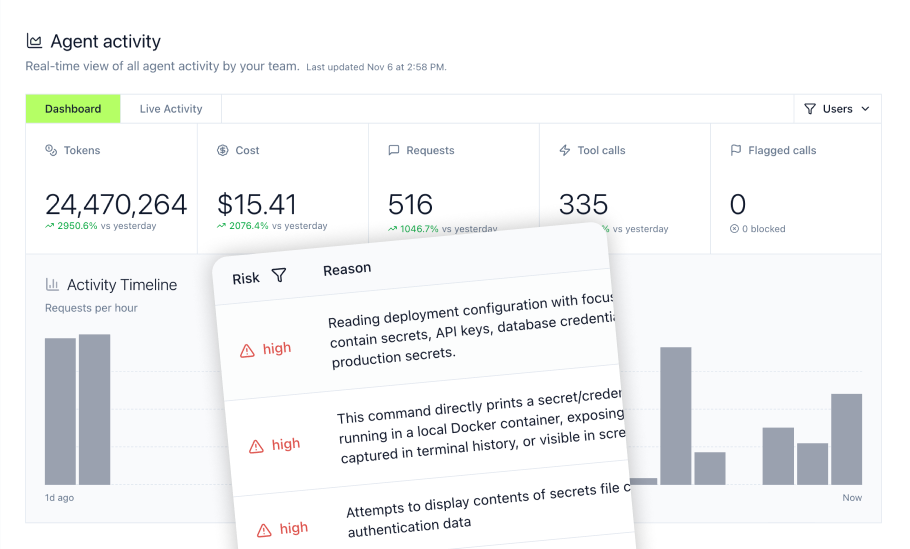
For developer tool companies specifically, consider how your customers will evaluate your security posture. An LLM proxy that monitors every tool call, bash command, and file operation provides the observability audit teams expect. Understanding MCP gateway architecture helps you communicate your security story to enterprise buyers.
Conclusion: Deploy Enterprise MCP with Confidence
The Model Context Protocol has fundamentally changed how enterprises connect AI assistants to their data and tools. But as this analysis demonstrates, deploying MCP at scale requires more than just protocol support. It demands enterprise-grade security, governance, and monitoring that transforms experimental AI into production-ready infrastructure.
MintMCP Gateway stands out as a fast path from pilot to production, offering managed deployment with a SOC 2 Type II audited platform, compliance with HIPAA standards, and complete audit trails. With hosted MCP connectors for enterprise data sources like Snowflake and Elasticsearch, Virtual MCP Bundles, Agent Bundles, and an official Cursor Hooks partnership, MintMCP removes the technical barriers that keep organizations stuck in AI pilot purgatory.
Whether you're securing access to data warehouses, knowledge bases, or custom enterprise tools, MintMCP provides the infrastructure that makes AI deployment practical, auditable, and secure. For a deeper understanding of MCP gateway architecture, see our guide to understanding MCP gateways.
Ready to transform your AI infrastructure? Visit mintmcp.com to schedule a demo and see how MintMCP Gateway can accelerate your enterprise AI deployment.
Frequently Asked Questions
What is an MCP gateway and why do developer tool companies need one?
An MCP gateway sits between AI clients (Claude, ChatGPT, Cursor) and your backend tools, handling authentication, rate limiting, observability, and compliance. Developer tool companies need gateways because enterprise customers require audit trails, access controls, and security documentation before deploying AI-powered tools. Without a gateway, each tool connection requires custom security implementation. Gateways centralize this into managed infrastructure.
How do MCP Gateways ensure compliance for AI-driven development workflows?
Compliance-focused gateways like MintMCP provide complete audit logs for SOC 2, HIPAA, and GDPR-aligned requirements. This includes recording every tool invocation, tracking which users accessed which data, and maintaining audit trails for security reviews. MintMCP is SOC 2 Type II audited, compliant with HIPAA standards, penetration tested, and supports enterprise SSO, role-based access control, PII detection, and complete audit trails.
What performance should developer tool companies expect from MCP Gateways?
Performance varies dramatically by gateway type. High-performance options like Bifrost cite about 11µs gateway overhead, while security-focused gateways like Lasso add overhead for threat scanning. Production gateways such as TrueFoundry and Lunar.dev often target low-latency operation, but actual performance depends on deployment configuration, policy checks, workload, and network path. Developer tool companies should benchmark against their specific UX requirements rather than optimizing for numbers alone.
Should developer tool companies choose managed or open-source MCP Gateways?
Managed options (MintMCP, Composio, Portkey) reduce operational overhead and provide security documentation out of the box. Open-source options (Docker, ContextForge, Obot) require infrastructure expertise but eliminate vendor dependency. The decision often comes down to team capacity: startups with limited DevOps resources benefit from managed services, while larger teams with Kubernetes expertise may prefer open-source control.
How do MCP Gateways handle multi-tenant environments?
Multi-tenancy support varies by gateway. Lunar.dev provides multi-tier RBAC at global, service, and tool levels, allowing developer tool companies to isolate customer environments with granular permissions. MintMCP's Virtual MCP Bundles create per-use-case endpoints with SCIM-driven membership, curated tool access, and policy controls, while Agent Bundles give agents their own scoped identities. Developer tool companies building SaaS products should prioritize gateways with native multi-tenancy rather than implementing isolation only at the application layer.