Deploying Claude agents across your organization requires more than connecting a few MCP servers. As Model Context Protocol adoption accelerates across enterprises, organizations face a critical infrastructure decision: how to provide AI agents with secure, governed access to internal systems without creating a security nightmare. The right MCP gateway transforms fragmented point-to-point connections into centralized, auditable infrastructure that security teams can actually approve.
As more enterprise AI teams move MCP-backed agents into production, choosing a gateway that provides enterprise authentication, real-time monitoring, and compliance-ready audit trails has become essential for any organization serious about AI agent deployment.
Key Takeaways
- MintMCP Gateway provides enterprise MCP infrastructure with data-permissions-first architecture, SSO and SCIM-driven RBAC, tool-level policy, Virtual MCP Bundles, Agent Bundles with M2M auth, hosted MCP connectors, and a 10,000+ server catalog
- MCP gateways help enterprises centralize authentication, authorization, and observability across agent-to-tool connections
- Gateway architecture reduces fragmented point-to-point MCP deployments by giving teams a single control plane for governed access
- Tool-level access control is essential for limiting which users, teams, and agents can invoke sensitive read or write actions
- Audit logs and real-time monitoring help security teams understand which agents accessed which tools, when, and how often
- Deployment models vary across managed SaaS, self-hosted open source, cloud-native services, and API gateway extensions
1. MintMCP Gateway: enterprise MCP infrastructure with data-permissions-first architecture
MintMCP Gateway provides enterprise infrastructure for Model Context Protocol focused on authentication, tool-level access control, credential management, logging, rule-based policy, and agent governance. The platform's data-permissions-first architecture starts with SSO, SCIM-driven RBAC, IdP groups, Virtual MCP Bundles, tool-level policy, and audit logs, then enables agents on top.
Unlike approaches that require weeks of infrastructure setup, MintMCP helps teams turn MCP servers and hosted connectors into governed production services with centralized observability and enterprise authentication.
What makes MintMCP Gateway different
MintMCP addresses the fundamental challenge enterprises face when connecting Claude agents to multiple data sources. The platform's architecture wraps stdio, hosted, HTTP-streamable, and SSE MCP servers behind SSO-fronted remote MCP endpoints with OAuth brokering, SCIM-driven membership, and rule-based policy. This reduces fragmented security policies and visibility gaps that create operational complexity when managing point-to-point connections between AI agents and tools.
Core capabilities
- Hosted MCP Connectors: MintMCP runs connector instances with auto-scaling and sandboxed execution per connector, reducing infrastructure overhead
- OAuth Brokering: Add enterprise authentication to local and hosted MCP servers, including OAuth 2.x, bearer tokens, headers, and SSO-fronted access without rebuilding each server
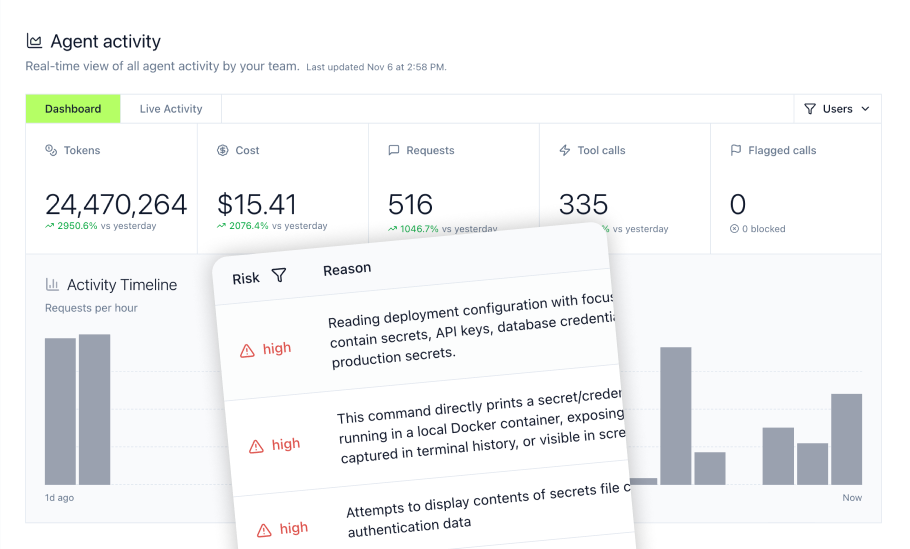
- Real-Time Monitoring: Live dashboards showing server health, usage patterns, tool call tracking, and security alerts
- Granular Access Control: Configure tool access by role with read-only operations for analysts while restricting write tools to authorized administrators
- Virtual MCP Bundles: Create team-specific, per-use-case endpoints that expose minimum required tools with SCIM-driven membership and fine-grained role-based access
- Agent Bundles: Give internal agents first-class identities with M2M auth, scoped tools, independent rotation and revocation
- Custom Gateway Middleware: Runs customer-authored middleware in a JS sandbox with external DLP and guardrails integrations
Security architecture
MintMCP implements defense-in-depth security through centralized governance, SSO enforcement, SCIM-driven RBAC, tool-level policy, credential management, and observability controls. The platform provides visibility into which teams and agents use which tools, when they access data, and how frequently.
Enterprise integrations
- Snowflake data warehouse access with natural language queries
- Elasticsearch knowledge base search for documentation and log analysis
- Gmail integration for AI-driven communication workflows
- Custom MCP server deployment for internal tools and APIs
- Claude, Cursor, ChatGPT, Gemini, and Copilot governance through centralized gateway and Agent Monitor coverage
Compliance
SOC 2 Type II audited, compliant with HIPAA standards, penetration tested, and every agent action audited. Customers handling protected health information can request HIPAA documentation, and MintMCP signs BAAs.
Getting started
Visit mintmcp.com/mcp-gateway for the deployment guide.
2. Obot
Obot provides open-source MCP gateway capabilities as part of a broader AI agent orchestration framework. The platform combines gateway functionality with an end-user catalog featuring trust levels for server discovery, integrated agent orchestration, and infrastructure ownership through self-hosted deployment.
Obot for open-source teams
- End-user catalog with trust levels for MCP server discovery
- Integrated agent platform combining gateway, orchestration, and chat client
- GitOps-ready configuration for infrastructure-as-code workflows
- Kubernetes-native deployment with GitOps support
Where Obot fits
Platform engineering teams with DevOps expertise who require infrastructure ownership and teams prioritizing open-source tools for transparency. The platform bundles gateway, catalog, hosting, and chat client in one deployment.
Deployment
Open-source with self-hosted deployment on Docker for development and Kubernetes for production.
3. TrueFoundry MCP Gateway
TrueFoundry offers an AI platform with an MCP gateway module that emphasizes performance. The gateway features vendor-published latency and throughput benchmarks that demonstrate its optimization for high-frequency tool calling patterns.
TrueFoundry for performance-focused teams
- Vendor-published performance benchmarks under load
- Virtual MCP Server abstraction for N×M integration management
- OAuth 2.0 Identity Injection for On-Behalf-Of authentication
- Unified AI platform combining LLM routing, model serving, and tracing
Where TrueFoundry fits
Teams evaluating high-throughput MCP operations and organizations already using TrueFoundry for broader ML platform needs.
Deployment
Cloud and hybrid options with enterprise pricing model.
4. Bifrost by Maxim AI
Bifrost provides an open-source AI gateway with native MCP support, built in Go for performance. The gateway is positioned around low added gateway overhead, not end-to-end tool-call latency.
Bifrost for latency-sensitive deployments
- Combines LLM gateway and MCP gateway in a single Go binary
- Unified model routing and tool management
- Apache 2.0 open-source license
- Single binary deployment model
Where Bifrost fits
Engineering teams building latency-sensitive AI applications and organizations requiring open-source solutions with code transparency.
Deployment
Open-source with optional enterprise support.
5. Lunar.dev MCPX
Lunar.dev's MCPX provides an MCP gateway that centralizes policy enforcement, access control, and observability. The platform includes a risk evaluation sandbox for pre-production MCP server testing.
MCPX for security-conscious teams
- Pre-production risk sandbox for security testing before approval
- Tool customization via description rewriting and parameter locking
- Creates hardened tool variants by constraining behavior without modifying servers
- Positioned for MCP gateway governance and security use cases
Where MCPX fits
Teams requiring pre-production security validation and organizations wanting to constrain tool behavior without modifying upstream servers.
Deployment
Open-source with enterprise options for hosted deployment and support.
6. Kong AI Gateway
Kong extends its API gateway platform with MCP support through the AI MCP Proxy plugin. The solution exposes existing REST APIs as MCP tools without requiring custom server development.
Kong for API-first organizations
- Protocol translation between MCP and HTTP
- Exposes existing REST APIs as MCP tools
- Mature operational patterns including rate limiting, circuit breaking, and retries
- Multi-region deployment with OpenTelemetry observability
Where Kong fits
Organizations already standardized on Kong for API management and teams wanting to expose existing REST APIs to Claude agents without building custom MCP servers.
Deployment
Enterprise pricing with hybrid deployment options.
7. AWS AgentCore Gateway
AWS AgentCore Gateway provides a managed MCP gateway service within the Bedrock platform. The gateway supports semantic search across tool definitions and federated gateway architecture.
AgentCore for AWS-committed organizations
- Serverless, consumption-based pricing for gateway operations
- Aggregates MCP, REST APIs, OpenAPI specs, and Lambda functions behind a single interface
- Federated gateway model where one gateway can act as target for another
- Deep integration with IAM, Cognito, and CloudTrail
Where AgentCore fits
AWS-native organizations seeking managed infrastructure and teams wanting consumption-based pricing without capacity planning.
Deployment
Managed AWS service with consumption-based pricing.
8. Composio
Composio provides a managed integration platform with a large catalog of pre-built app integrations including Slack, GitHub, Jira, Salesforce, and HubSpot. The platform abstracts OAuth and API key management across connectors.
Composio for rapid SaaS integration
- Unified authentication layer across a large connector catalog
- Framework-agnostic support for LangChain, CrewAI, and AutoGen
- SOC 2 Type II and ISO 27001 security posture with action-level RBAC
- Transparent pricing with free tier available
Where Composio fits
Teams needing to connect Claude agents to dozens of SaaS applications quickly and organizations without resources for custom MCP server development.
Deployment
Managed SaaS with enterprise pricing. VPC deployment available on Enterprise tier.
9. Docker MCP Gateway
Docker's MCP Gateway brings container orchestration to MCP server management. The solution provides container isolation for each MCP server with controlled runtime boundaries, credential handling, and centralized routing through Docker MCP tooling.
Docker for container-native teams
- Container isolation prevents lateral movement between MCP servers
- Credential handling and centralized routing through Docker MCP Gateway
- Network restrictions for zero-trust-style local execution
- Available through Docker Desktop MCP tooling
Where Docker fits
Developers running MCP servers locally and organizations with existing Docker environments seeking container-based isolation.
Deployment
Available through Docker Desktop and Docker MCP tooling. Infrastructure costs vary for production deployments.
10. Portkey
Portkey provides an LLM gateway with a dedicated MCP Gateway module. The gateway supports OAuth flows, API keys, and access controls for MCP server invocation.
Portkey for LLM-centric teams
- Dedicated MCP Gateway plus Registry for routing, auth, and observability
- Team Provisioning and Tool Provisioning for organizational management
- OAuth 2.1 support for Cursor and Claude Desktop integration
- Full request/response logging with tool-call monitoring
Where Portkey fits
Teams already using Portkey for LLM routing who want to add MCP gateway functionality.
Deployment
Enterprise pricing model with cloud deployment.
11. IBM ContextForge
IBM ContextForge provides an open-source multi-protocol gateway supporting MCP, A2A, and REST-to-MCP translation. The platform includes plugins for transports, integrations, and custom workflows.
ContextForge for multi-protocol environments
- Native Agent-to-Agent (A2A) protocol support alongside MCP
- Multi-cluster federation with automatic tool registry discovery
- gRPC-to-MCP translation capabilities
- Apache 2.0 open-source license
Where ContextForge fits
Organizations requiring multi-protocol support and large enterprises needing federated gateway coordination across multiple clusters.
Deployment
Free and open-source with self-hosted deployment.
12. Microsoft Azure MCP Gateway
Microsoft provides Azure-native MCP gateway capabilities through Azure API Management integration. The solution features deep Entra ID integration for enterprise identity.
Azure for Microsoft-committed organizations
- Native Entra ID integration for OAuth 2.0 with Microsoft accounts
- Azure Monitor and App Insights for observability
- Azure API Management can act as OAuth 2.0 gateway for remote MCP servers
- Kubernetes implementation patterns available for AKS
Where Azure fits
Organizations committed to the Azure ecosystem and teams requiring Entra ID integration for Microsoft 365 environments.
Deployment
Azure API Management integration and Azure-native deployment patterns.
13. Cloudflare MCP Server Portals
Cloudflare provides MCP Server Portals as part of Cloudflare One, aggregating multiple MCP servers onto a single HTTP endpoint secured by Cloudflare's Zero Trust platform.
Cloudflare for Zero Trust environments
- Zero Trust security model for all MCP traffic
- Global edge network for low-latency access worldwide
- Multiple MCP servers centralized behind one HTTP endpoint
- Full stack on Cloudflare when MCP servers are hosted on Workers
Where Cloudflare fits
Teams already on Cloudflare infrastructure and organizations requiring Zero Trust security for distributed teams.
Deployment
Available through Cloudflare One access controls, with availability and packaging subject to Cloudflare's current plan terms.
Deploy Claude agents with enterprise governance
As MCP adoption accelerates across enterprises, the infrastructure layer becomes critical for security, compliance, and operational efficiency. MintMCP Gateway addresses these requirements through its data-permissions-first architecture, providing the SSO enforcement, SCIM-driven RBAC, tool-level access controls, and comprehensive audit trails that security teams require.
With hosted MCP connectors, Virtual MCP Bundles for per-use-case endpoints, and Agent Bundles for per-agent identity with M2M auth, MintMCP helps teams move from prototype to production without months of infrastructure work. The platform's support for Claude, Cursor, ChatGPT, Gemini, and Copilot through centralized gateway and Agent Monitor coverage provides unified governance across your AI tool stack.
Start your deployment at mintmcp.com/mcp-gateway.
Frequently asked questions
What is an MCP gateway and why do I need one for Claude agents?
An MCP gateway centralizes authentication, authorization, and observability for Model Context Protocol connections between AI agents and tools. Without a gateway, organizations face fragmented security policies across individual MCP servers, zero visibility into which agents access which tools, and duplicated authentication logic. Gateways transform the complex N-to-N mesh of agent-to-tool connections into a manageable hub-and-spoke model with unified audit trails.
How do MCP gateways handle authentication for Claude Desktop and Claude Code?
MCP gateways support multiple authentication methods including OAuth 2.x, SAML for enterprise SSO integration, OpenID Connect for modern identity providers, and bearer tokens for service accounts. Leading implementations provide shared service accounts, per-user OAuth flows, and per-agent identity models. This flexibility addresses authorization challenges when internal practices require specific authentication patterns.
Can MCP gateways detect AI agent activity outside the primary gateway?
Specialized governance layers like MintMCP's Agent Monitor can track MCP tool invocations, bash commands, file operations, and prompt submissions from Cursor, Claude Code, and other coding agents. This creates two-layer governance: the gateway covers MCP traffic, while Agent Monitor covers local non-MCP agent activity. This addresses security challenges of coding agents operating with extensive system access.
What compliance evidence should I look for in an MCP gateway?
For regulated industries, look for SOC 2 Type II attestation or audited controls, HIPAA standards support, HIPAA documentation, BAA availability where applicable, penetration testing, and complete audit trails. Gateways should provide visibility into which teams and agents use which tools, when they access data, and how frequently. Enterprise gateways should also support data encryption in transit and at rest, SSO enforcement, and SCIM-driven role-based access control.
How quickly can I deploy an MCP gateway for my organization?
Deployment speed varies by approach. Managed services can accelerate deployment with hosted MCP connectors and pre-configured governance controls. Self-hosted open-source solutions often require additional time for infrastructure setup, authentication integration, and security configuration. Consider whether you need production deployment quickly or can invest time building and operating custom infrastructure.