Configuration drift in MCP deployments represents one of the most underestimated security vulnerabilities facing enterprises today. Unlike traditional infrastructure drift that affects individual servers, MCP configuration drift can cascade across tool definitions, permission scopes, authentication tokens, and model behavior simultaneously. Organizations deploying AI agents through Claude, Cursor, ChatGPT, Gemini, and Copilot need centralized MCP gateway infrastructure to detect unauthorized changes before they become breach vectors.
This article outlines how configuration drift occurs in MCP environments, the security incidents it enables, and practical strategies for detection, prevention, and remediation across enterprise AI deployments.
Key Takeaways
- Configuration drift in MCP occurs across multiple layers simultaneously: server metadata, tool descriptions, permission scopes, and authentication tokens, creating cascading security failures that traditional monitoring cannot detect
- The Smithery path traversal vulnerability disclosed in 2025 exposed a Fly.io token with access to 3,000+ hosted applications, showing how one MCP hosting flaw can create broad supply chain risk
- Tool poisoning attacks embed hidden instructions in tool descriptions that remain invisible to users while manipulating agent behavior
- Detection requires cryptographic verification of tool descriptions against approved baselines at session establishment, not just periodic scanning
- Effective remediation combines automated policy enforcement with graded response capabilities that can block destructive operations while allowing reads
Understanding MCP Configuration Drift: A Hidden Security Vulnerability
What is MCP Configuration Drift?
MCP configuration drift refers to the unauthorized or untracked deviation between your intended MCP security configuration and the actual running state. The NSA security guidance emphasizes trust boundaries, data classification, parameter validation, sandboxed execution, and message verification for production MCP environments.
Unlike traditional infrastructure drift that affects config files on individual servers, MCP drift occurs at multiple semantic layers:
- Server metadata changes: Modifications to MCP server registration details without approval workflows
- Tool description mutations: Silent updates to tool capabilities that expand attack surface
- Permission scope creep: Gradual expansion of access rights beyond original authorization
- Authentication token persistence: Revoked credentials remaining valid after policy changes
- Behavioral drift: Changes in how tools execute that deviate from security baselines
Why Configuration Drift Matters for AI Agent Security
The Cloud Security Alliance framework establishes a four-level security maturity model where configuration management forms the foundation. Organizations at Level 1 maintain basic auth and TLS, while Level 4 requires per-invocation authentication with immutable audit logs. Drift detection becomes progressively more critical as maturity increases.
Enterprise MCP security guidance emphasizes secure-by-default architecture, automation, inventory, and continuous verification. For configuration drift, this means comparing runtime tool definitions against approved baselines before allowing sensitive operations. This continuous verification approach addresses a fundamental weakness in trust-on-first-use security models.
The Dangers of Unmanaged MCP Configuration Changes
From Drift to Breach: The Security Lifecycle
Configuration drift creates exploitable windows that attackers leverage through multiple vectors. Recent MCP security research and incident reporting show how these vulnerabilities translate into real incidents:
- CVE-2025-6514 (2025): Remote code execution in the mcp-remote npm package could expose local credentials when a client connected to an untrusted MCP server. The vulnerability stemmed from crafted input in the authorization_endpoint response URL being passed into command execution.
- Smithery path traversal disclosure: Researchers found a path traversal flaw that exposed builder credentials, including a Fly.io token with access to 3,000+ hosted applications
- Asana cross-tenant leak (June 2025): Access control failure in MCP-enabled integration leaked project and task data across organizations
- GitHub MCP prompt injection (May 2025): Over-privileged personal access tokens combined with untrusted context exposed private repository contents including salary information
- WhatsApp MCP exfiltration (April 2025): Hidden instructions embedded in tool metadata extracted entire message histories
Tool Poisoning and Rug Pull Attacks
The arXiv MCP security analysis identifies tool poisoning as a critical threat where malicious tool descriptions embed adversarial prompts invisible to users. These hidden instructions manipulate agent behavior while appearing legitimate in standard interfaces.
Rug pull attacks present an even more insidious threat pattern. A legitimate MCP server passes security review and approval, then gets silently modified to a malicious version. Without continuous verification against cryptographic baselines, organizations cannot detect these post-approval modifications.
Tool poisoning research demonstrates how attackers exploit the gap between approved configurations and runtime states. One practical mitigation is detecting tool description changes through hash comparison against approved baselines.
Best Practices for MCP Configuration Management
Designing Secure MCP Baselines
The NSA security guidance establishes clear requirements across control domains:
- Design for boundaries: Public tools handle public data; sensitive tools require explicit controls aligned with data classification
- Validate parameters: Schema validation and context verification check malformed inputs, missing fields, and excessive sizes
- Constrain tool execution: OS-level sandboxing through AppArmor or SELinux with explicit filesystem and network deny rules
- Sign and verify messages: Cryptographic signatures in JSON payloads with time-bound validation and replay protection
Establishing baselines requires documenting approved tool definitions, permission scopes, and server metadata with cryptographic hashes at registration. Version-pinning server configurations prevents silent upgrades that introduce vulnerabilities. The MCP data risk guide provides additional context on scoping data access appropriately.
Automating Configuration Enforcement
Manual configuration management fails at enterprise scale. The MCP authorization specification makes authorization optional, but when authorization is implemented for HTTP-based transports, MCP auth implementations use OAuth 2.1 patterns with appropriate security measures, including PKCE for public-client flows.
Effective automation includes:
- Hash tool descriptions at deployment and compare at session establishment
- Short-lived access tokens with documented expiration policies and refresh token rotation
- Automated CVE remediation based on severity, exploitability, and documented internal remediation SLAs
- Policy-as-code for allowlists, consent rules, and egress boundaries versioned in CI
Real-time Monitoring and Detection
Key Indicators of MCP Configuration Drift
The Cloud Security Alliance framework specifies monitoring requirements for drift detection:
- Tool description monitoring: Hash descriptions at registration, compare at each session establishment
- Permission drift tracking: Monitor privilege changes post-update, ensure revocations propagate
- Version monitoring: Alert on rollbacks to vulnerable versions or silent upgrades
- Behavioral anomalies: Unusual tool call volumes, invocations at unexpected hours, or parameters containing injection patterns
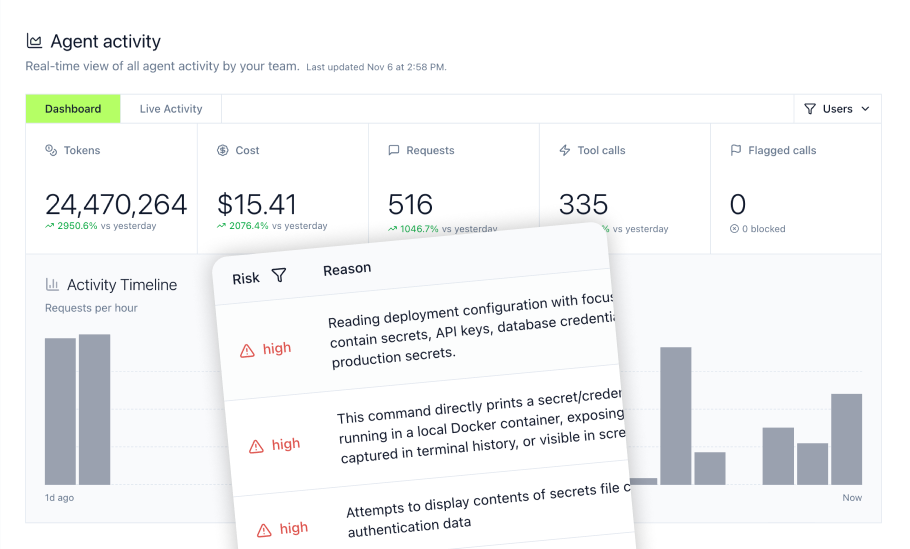
The LLM Proxy monitors every MCP tool invocation, bash command, and file operation from coding agents. This visibility layer identifies deviations from expected agent behavior in real-time, tracking what files agents access and which MCPs are installed across teams.
Setting Up Effective Alerting
Healthy baselines establish thresholds for security alerts:
- Tool call latency (p99): Alert when sustained response times exceed 1000ms, indicating performance degradation or active attack
- Policy violation rate: Sudden spikes above 5% indicate misconfigured applications or attack attempts
- Tool description changes: Any untracked modification triggers immediate investigation
- Unauthorized invocations: Zero tolerance with immediate alerting on any occurrence
Centralized SIEM forwarding enables correlation across MCP traffic, identity events, and network activity. The security documentation details how complete audit trails support incident response requirements.
Automated Remediation: Fixing MCP Configuration Drift Fast
Strategies for Automatic Drift Correction
Production MCP remediation should include kill switches, gateway-level controls, and pre-approved playbooks for graded response. This architecture enables:
- Block destructive operations while allowing read-only access during investigation
- Automatic rollback to last known good configuration when drift exceeds thresholds
- Throttling suspicious activity patterns rather than complete blocking
- Notification workflows to security teams with full context for manual review
Gateway architecture centralizes policy enforcement, enabling coordinated response across all MCP connections. Without this control plane, remediation requires manual intervention at each endpoint.
Designing Rollback and Recovery Plans
Effective rollback requires maintaining cryptographic verification of approved configurations. When drift is detected, systems compare current state against versioned baselines and restore known-good configurations automatically.
Recovery plans should address:
- Credential rotation for any tokens potentially exposed during drift window
- Session invalidation to force re-authentication against current policies
- Forensic preservation of logs and configuration snapshots for incident analysis
- Communication protocols for affected teams and compliance stakeholders
Compliance and Governance: Addressing Drift for Regulations
Audit Trails as Your First Line of Defense
Regulatory frameworks require demonstrable control over system configurations. The OWASP Top 10 for Agentic Applications identifies tool misuse and supply chain vulnerabilities as critical risks requiring documented mitigation.
Complete audit logs must capture:
- All tool invocations with agent identity, tool name, input parameters (sensitive data redacted), timestamp, response status, and duration
- Configuration changes with before and after states, approver identity, and business justification
- Access attempts including denials with full context for security review
- Policy modifications with effective dates and impacted scope
The security documentation details how MintMCP supports auditability with SOC 2 Type II audited controls, compliance with HIPAA standards, enterprise SSO, role-based access control, and complete audit trails.
Data Residency and Configuration Control
Multi-region deployments introduce additional complexity for configuration management. Different jurisdictions may require data to remain within specific geographic boundaries while maintaining consistent security policies.
Effective governance requires:
- Tenant isolation at storage layer with tenant-ID filters enforced
- Namespace segmentation preventing cross-tenant configuration visibility
- Regional policy inheritance ensuring local compliance while maintaining global standards
- Audit log retention meeting jurisdiction-specific requirements
MintMCP Solutions: Bridging the Gap in Enterprise MCP Security
MCP Gateway: Your Central Command for MCP Infrastructure
MintMCP's MCP Gateway provides centralized governance for governed data and tool connections across Claude, Cursor, ChatGPT, Gemini, and Copilot. The platform addresses configuration drift through:
- Real-time monitoring with live dashboards for server health, usage patterns, and security alerts
- OAuth and SSO enforcement automatically wrapping enterprise authentication for MCP endpoints
- Granular tool access control configuring access by role with read-only or write exclusions
- Complete audit trails of every MCP interaction, access request, and configuration change
Virtual MCP Bundles enable per-use-case endpoints with SCIM-driven membership, ensuring permissions align with organizational structure rather than ad-hoc configuration.
LLM Proxy: Visibility and Control for Coding Agents
The LLM Proxy extends governance beyond MCP traffic to local agent activity. Security guardrails block dangerous commands in real-time, protect sensitive files from access, and maintain complete audit trails of all operations.
For drift detection specifically, the proxy identifies:
- Installed MCPs and their usage patterns across teams
- File access patterns indicating unauthorized data exposure
- Command sequences matching known attack patterns
- Tool calls attempting to read environment secrets or execute dangerous operations
Agent Gateway: The Control Layer for Agent Infrastructure
Building on MCP Gateway foundations, MintMCP's Agent Gateway provides identities, permissions, memory, and monitoring for agents working alongside employees, so drift can be tracked at both the connection layer and the agent behavior layer. Agent Bundles deliver per-agent identity with M2M authentication and scoped tool access, ensuring agent permissions remain explicitly defined rather than inherited from shared service accounts.
This two-layer architecture addresses drift at both the MCP connection layer and the agent behavior layer, providing defense in depth against configuration-based attacks.
Take Control of MCP Configuration Drift with MintMCP
Configuration drift represents a fundamental security challenge for enterprise AI deployments. As organizations scale MCP infrastructure across hundreds of agents and thousands of tool connections, manual oversight becomes impossible. The incidents documented in this article demonstrate how quickly unmanaged drift translates into credential exposure, data leakage, and supply chain compromise.
MintMCP's approach to drift management combines three core capabilities. First, centralized visibility through MCP Gateway ensures every tool connection, permission change, and server modification flows through a single control plane with complete audit trails. Second, tool-update policy, approved baselines, and runtime monitoring help teams catch tool poisoning and rug pull patterns before compromised tools become normal agent behavior. Third, automated remediation with graded response enables security teams to contain incidents without disrupting legitimate workflows.
Enterprise teams deploying MintMCP gain defense in depth against configuration drift. Gateway-level controls enforce authentication and authorization policies uniformly across Claude, Cursor, ChatGPT, Gemini, and Copilot. The LLM Proxy extends protection to local agent activity, monitoring bash commands, file operations, and MCP installations that would otherwise remain invisible. Agent Gateway adds per-agent identity and M2M authentication, ensuring permissions stay explicitly scoped rather than inherited from shared accounts.
For security leaders evaluating MCP infrastructure, the decision usually comes down to whether the team wants to build and maintain its own drift detection, monitoring, and remediation stack, or deploy a managed platform purpose-built for governed AI at enterprise scale. MintMCP delivers the latter with SOC 2 Type II audited controls, compliance with HIPAA standards, and production-grade reliability.
Frequently Asked Questions
How does MCP configuration drift differ from traditional infrastructure drift?
Traditional infrastructure drift affects individual servers or configuration files with relatively contained blast radius. MCP configuration drift cascades across semantic layers: tool descriptions, permission scopes, authentication tokens, and model behavior can all drift simultaneously. A single misconfigured MCP server can expose multiple enterprise systems because it serves as a connection point between AI agents and internal data sources. Detection requires cryptographic verification of tool definitions at session establishment, not just periodic configuration scanning.
What authentication standards should enterprises require for MCP servers?
The MCP authorization specification makes authorization optional, but when authorization is implemented for HTTP-based transports, MCP auth implementations use OAuth 2.1 patterns with appropriate security measures, including PKCE for public-client flows. Enterprise deployments should enforce short-lived access tokens, documented expiration policies, and refresh token rotation. Identity providers supporting SAML and OIDC integration enable centralized authentication management. Bearer tokens require secure storage with rotation policies, and shared service accounts should be replaced with per-agent identities enabling granular attribution and revocation.
How quickly can tool poisoning attacks be detected without proper monitoring?
Without continuous verification, tool poisoning attacks can persist indefinitely. The WhatsApp MCP exfiltration attack extracted entire message histories through hidden instructions in tool metadata that remained invisible in standard interfaces. Detection requires comparing tool descriptions against cryptographic baselines at each session establishment, monitoring for behavioral anomalies in agent tool call patterns, and maintaining audit trails that enable forensic analysis when incidents are suspected. Many MCP deployments still lack mature authorization and monitoring controls, leaving organizations exposed when tool access or server behavior changes without review.
What is the cost difference between basic and enterprise-grade MCP security?
The cost difference depends on deployment scope, number of MCP servers, identity integrations, audit requirements, and whether teams self-host or use a managed gateway. Basic programs usually focus on authentication, TLS, inventory, and tool description tracking. Enterprise-grade programs add centralized policy enforcement, behavioral monitoring, audit export, incident response workflows, and stronger isolation for sensitive tools. The practical ROI comes from reducing unmanaged access, shortening investigation time, and avoiding fragmented controls across every MCP endpoint.
Can configuration drift controls work with existing DevSecOps workflows?
Effective MCP security integrates with existing workflows rather than creating parallel processes. Policy-as-code approaches version allowlists, consent rules, and egress boundaries alongside application code for testability in CI pipelines. Pre-commit hooks running drift detection tools can catch tool description changes before deployment. SIEM integration forwards MCP audit logs to existing security monitoring infrastructure. The key success factor is treating MCP as critical infrastructure receiving the same rigor as API gateways and identity providers.