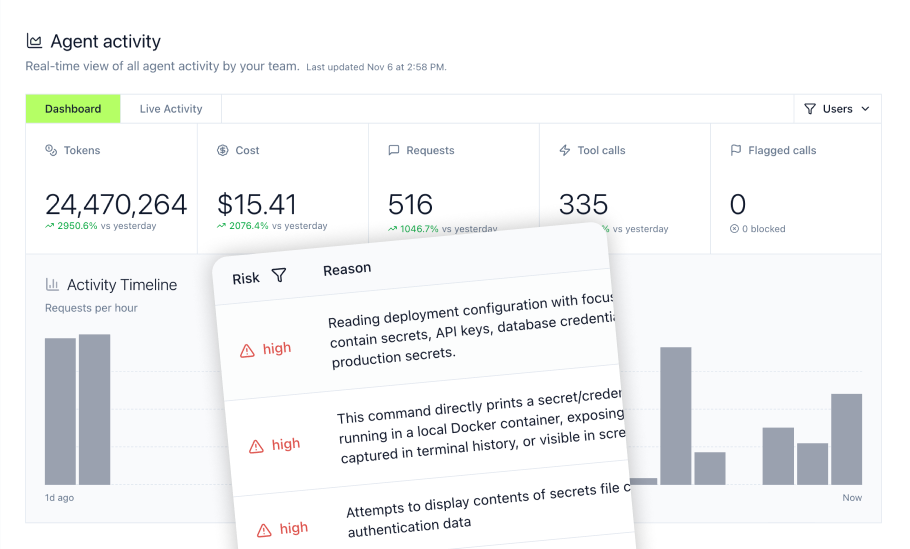
When evaluating Harmonic Security alternatives for enterprise AI governance, the choice depends on whether organizations need MCP-native architecture, per-agent identity management, or comprehensive runtime controls. Harmonic Security delivers strong Shadow AI discovery and browser-level coverage across Chrome, Edge, Firefox, Safari, and Arc, along with desktop client support for Claude Desktop, ChatGPT Desktop, and Cursor. The platform offers intent-aware classification that understands prompt meaning, multi-surface coverage through browser extensions plus an MCP gateway layer, and fast deployment via MDM (Intune, JAMF, Kandji) without proxy redesign.
However, enterprises deploying AI agents across Claude, Cursor, ChatGPT, and Copilot often require deeper MCP governance capabilities that Harmonic Security does not prioritize. This guide examines the top Harmonic Security alternatives, with particular focus on how MintMCP differs for organizations needing governed data and tool connections alongside first-class agent identities. Organizations whose primary need is discovering unsanctioned AI usage across browsers and endpoints may find Harmonic Security meets their requirements, while those deploying governed AI agents through MCP Gateway infrastructure typically require additional capabilities.
Key takeaways
- MintMCP combines MCP governance with first-class agent identity through Virtual MCPs, SCIM-driven access policies, and per-agent credentials with M2M authentication; MintMCP is compliant with HIPAA standards and signs BAAs for customers handling protected health information
- Deployment models vary significantly: MintMCP and TrueFoundry support managed and self-hosted deployment options, while Obot is MIT-licensed open source with both self-hosted editions and an Obot Cloud hosted option
- Per-agent identity becomes critical as enterprises scale from 10 to 100+ autonomous agents and need independent credential rotation, scoped permissions, and attributable audit trails following zero trust principles
- Mint Guard provides managed detection for threats such as prompt injection, secrets, and PII; Rules provide declarative matching and enforcement; and Gateway Middleware provides customer-authored logic and DLP integrations in a JS sandbox
- Pricing transparency varies: TrueFoundry publishes pricing at $499/month Pro and $2,999/month Pro Plus, while most platforms require enterprise quotes
- AI security governance frameworks increasingly require runtime controls that determine whether an action should be allowed, not just visibility into what happened
1. MintMCP: Enterprise MCP governance with per-agent identity
MintMCP provides enterprise infrastructure for governing AI clients and autonomous agents across the Model Context Protocol ecosystem. The platform starts from a data-permissions-first architecture, centralizing tool access, agent identity, credentials, permissions, monitoring, guardrails, and auditability behind governed endpoints.
Why MintMCP differs from Harmonic Security
MintMCP addresses the core enterprise problem: teams adopt Claude, Cursor, ChatGPT, Gemini, and Copilot faster than security and platform teams can govern what those systems access, whose credentials they use, what actions they take, and how those actions are attributed.
Key differences vs. Harmonic Security:
- Broader AI governance focus: Harmonic combines browser, endpoint, desktop, and MCP controls, with MCP Gateway as one component of the broader platform
- Different agent identity model: Harmonic documents governance for authorized users and AI agents, but current public materials do not document MintMCP-style first-class agent identities with independently rotatable credentials
- No documented Virtual MCP equivalent: Current public materials do not document MintMCP-style per-role or per-use-case endpoints with SCIM-driven membership and curated tool surfaces
- Different connector operating model: Harmonic Connectors deploy through a lightweight gateway on Windows, macOS, and Linux, while MintMCP also operates supported hosted connectors for customers
- No public list pricing: Pricing requires direct engagement with Harmonic
MintMCP core capabilities
- Virtual MCP Bundles: Per-role or per-team endpoints with SCIM-driven membership, curated tool lists, and granular access policies. One endpoint per role, team, use case, or agent.
- Agent Gateway with M2M OAuth: Autonomous agents receive first-class non-human identities with their own credentials, scoped permissions, and independent rotation/revocation. Supports bearer keys, OAuth client-credentials, and workload identity federation.
- BAA-backed HIPAA compliance: MintMCP is compliant with HIPAA standards and signs BAAs for customers handling protected health information, with healthcare-specific connectors (EHR/FHIR).
- Hosted MCP connectors: MintMCP operates supported hosted connectors including Snowflake, Elasticsearch, Gmail, GitHub, and Salesforce so customers can centrally deploy and govern connector access without operating the connector runtime themselves.
- Agent Monitor: Two-layer visibility that extends beyond gateway traffic to capture prompts, commands, file access, MCP tool calls, usage, and token costs across supported AI coding agents.
- Three-layer guardrails: Mint Guard for managed detection policies (prompt injection, secrets, PII), declarative Rules, and customer-authored Gateway Middleware in a JS sandbox for DLP integrations.
Pricing structure
- Per-user licensing based on active AI agent users
- Platform fees scale with usage and team size
- Team-size bands shown on the current pricing page: 1-100, 101-1,000, 1,001-9,999, 10,000+
- Flexible deployment options include self-hosted, with enterprise SLAs and dedicated support available
Enterprise security credentials
MintMCP is SOC 2 Type II audited, compliant with HIPAA standards with BAA availability, and penetration tested. Data is encrypted in transit and at rest with data residency options in US and EU.
Organizations including Coursera, Stability AI, Modern Treasury, Deerfield Group, Capital on Tap, Workstream, Flashfood, and Bared Footwear rely on MintMCP for enterprise AI governance.
2. TrueFoundry
TrueFoundry provides an enterprise AI gateway that integrates LLM Gateway, MCP Gateway, and Model Serving capabilities into a single platform. Named Frost & Sullivan's 2026 Global Transformational Innovation Leader, TrueFoundry targets platform engineering and ML platform teams.
Platform capabilities
- Unified AI platform: LLM Gateway, MCP Gateway, Model Serving, and MLOps in one solution
- Published pricing: $499/month Pro, $2,999/month Pro Plus, and custom pricing for Enterprise, providing rare pricing transparency
- Multi-cloud and air-gapped deployment: Complete data sovereignty with VPC, on-prem, and air-gapped options
- Published gateway benchmark: TrueFoundry reports approximately 3-5ms of additional AI Gateway latency and 350+ RPS on 1 vCPU in its own benchmark; these figures should not be treated as typical end-to-end request latency
Additional capabilities include enterprise SSO integration with Google, Azure, and Okta, SCIM directory sync for access management, SOC 2, HIPAA, and GDPR compliance, OpenTelemetry for SIEM export, and agent authentication.
Organizations including Cargill, MAVENIR, Whatfix, Wadhwani AI, Aviso, Aviva, and NetApp use TrueFoundry for AI infrastructure.
Comparison considerations
TrueFoundry's platform breadth requires more setup than point solutions. The MCP Gateway is one module within a larger infrastructure platform rather than the primary focus. Organizations should compare TrueFoundry's current MCP Gateway and Agent Gateway capabilities directly against MintMCP's Virtual MCP and per-agent identity model, particularly around endpoint design, credential scoping, authentication, and audit attribution.
3. Obot AI
Obot provides an open source AI control plane under MIT license. Built for Kubernetes-native deployment, Obot targets platform engineering and infrastructure teams comfortable with self-hosted or cloud-hosted solutions.
Platform capabilities
- Open source: MIT license with complete code transparency and no vendor lock-in
- Flexible deployment: Kubernetes-native self-hosting (Docker for development, Kubernetes for production) plus Obot Cloud hosted option
- Zero licensing cost: Free forever for self-hosted deployment
- Shadow AI discovery: Obot Sentry scans endpoints for unapproved MCP servers
- Enterprise SSO: GitHub, Google, Okta, and Entra ID integration
Additional capabilities include RBAC for tool-level policy enforcement, agent identity support, MCP connector catalog, one-click MCP deployment within the environment, and unlimited users and devices on Enterprise tier.
Comparison considerations
Obot supports both self-hosted deployment and Obot Cloud. Self-hosting places infrastructure operations on the customer, while the hosted option reduces that burden. Obot can also host and govern MCP servers, so the comparison with MintMCP centers on Virtual MCPs, agent identity, access-policy design, and the operating model organizations prefer.
4. Lunar.dev MCPX
Lunar.dev provides an enterprise MCP gateway with a distinctive Skills layer for knowledge and tool composition. Acquired by Boomi in 2026 and recognized as a Gartner Representative Vendor in AI Gateways and MCP Gateways categories, Lunar.dev targets established enterprise buyers.
Platform capabilities
- Skills layer: Knowledge and tool composition with versioning and governance
- Gartner recognition: Representative Vendor status in AI Gateways and MCP Gateways
- Enterprise positioning: Boomi completed its acquisition of Lunar.dev in July 2026 and says Lunar's capabilities will become part of the Boomi Enterprise Platform and Boomi Connect
- Tool groups: Organizes access with dynamic access control and policy enforcement at the tool level
- Deployment options: Self-hosted deployment (Docker/Kubernetes) with Managed Enterprise tier available
The platform is MIT licensed core with Enterprise additions and includes agent identity support.
Organizations including Bilt, BitDam, Cobwebs, HiBob, HiredScore, Life360, Intelligo, and Elementor use Lunar.dev for MCP governance. Buyers should evaluate the current Lunar.dev product and published Boomi integration roadmap when comparing future fit.
5. Lasso Security
Lasso Security focuses specifically on AI security rather than MCP gateway infrastructure. Named a Gartner Cool Vendor in 2024 and winner of multiple cybersecurity awards, Lasso Security targets CISOs and security teams concerned with AI-specific threats.
Security capabilities
- Automated AI red teaming: Static, multi-turn, and high-agency red-team modes using 3,000+ attack types and obfuscation techniques, alongside security controls aligned to frameworks such as OWASP and MITRE
- Intent security benchmark: Lasso currently reports 99.83% threat detection accuracy with under-50ms intent analysis for Intent Deputy
- Security-first positioning: Purpose-built for AI-specific threat detection rather than infrastructure
- Multi-turn agentic attack coverage: Protection against sophisticated attack chains
Additional capabilities include prompt injection detection, runtime protection and enforcement, Shadow AI discovery, integration with existing security stacks, and enterprise SSO support.
Awards and recognition include Gartner Cool Vendor 2024, Hacker News Cybersecurity Stars Award 2026, Allied Defense 100, and Global InfoSec Award Winner 2026. Telit Cinterion uses Lasso Security for AI security governance.
Comparison considerations
Lasso Security focuses primarily on AI security and threat detection, but it also offers an open-source MCP Gateway for inspecting and securing MCP connections. Its broader platform emphasis remains AI security, automated red teaming, intent analysis, and runtime threat detection.
6. Runlayer
Runlayer provides an AI enablement and control platform with the largest MCP catalog at 18,000+ servers. Backed by $30M Series A funding from Felicis and Khosla Ventures, Runlayer targets IT-Security-AIOps teams with a developer experience wedge.
Platform capabilities
- Largest MCP catalog: 18,000+ MCP servers for enterprise tools
- Enterprise traction: Customers include Gusto, Jane, and Homebase
- Well-funded: $30M Series A from top-tier investors
- MCP co-creator involvement: David Soria Parra, co-creator of MCP at Anthropic, is listed by Runlayer as an investor and technical advisor
- Shadow AI discovery: Visibility into unsanctioned MCP usage
Additional capabilities include agent identity support, per-use-case endpoints, tool-level policy enforcement, one-click MCP deployment, and enterprise SSO integration.
Organizations including Gusto, Jane, and Homebase use Runlayer for AI governance.
Comparison considerations
Runlayer supports cloud and self-hosted deployment in customer infrastructure, and its current platform materials document SSO and SCIM. Public list pricing was not verified in the current review, so pricing should be confirmed directly with Runlayer.
Security and compliance capabilities
Enterprise AI governance requires foundations aligned with modern security frameworks. Here's how platforms compare:
MintMCP security:
- SOC 2 Type II audited
- Compliant with HIPAA standards with BAA available
- Penetration tested
- Data encrypted in transit and at rest
- Data residency options (US/EU)
- Tamper-evident audit logs signed at write time
- Operational controls including org-wide kill switch
- SIEM export via OTLP or Splunk HEC
TrueFoundry security:
- SOC 2, HIPAA, GDPR compliance
- OpenTelemetry integration
- VPC and air-gapped deployment options
Obot security:
- Self-hosted or cloud-hosted (customer controls security posture for self-hosted)
- Enterprise SSO integration
- RBAC for tool-level access
Lasso security:
- Security-focused platform design
- 99.83% threat detection accuracy
- Under-50ms analysis latency
- OWASP and MITRE framework coverage
Agent identity and governance depth
As enterprises scale autonomous agent deployment, per-agent identity becomes critical. MintMCP's Agent Gateway provides a first-class non-human identity model with scoped credentials, permissions, and audit attribution:
MintMCP agent identity capabilities:
- Named, org-scoped non-human principals
- Bearer keys with name, expiry, individual revocation
- M2M tokens via OAuth client-credentials exchange
- Workload identity federation (K8s SA, cloud roles, CI job identity)
- Independent credential rotation per agent
- Per-agent audit attribution
- "Act as agent" admin flow for per-agent OAuth where needed
Why this matters:
When organizations run 10 agents, shared credentials feel manageable. At 100+ agents, critical questions emerge: Which agent is acting? What credentials does it use? What tools can it access? How can its access be rotated independently? What actions are attributed to it?
MintMCP's Agent Gateway builds on its MCP Gateway foundation by extending governed data and tool access to first-class agent identities, scoped permissions, memory, and monitoring.
Runtime controls and guardrails
Visibility alone is insufficient. Enterprises need runtime controls that determine whether an action should be allowed. MintMCP provides three coexisting layers:
Mint Guard:
- Managed detection policies for prompt injection, credentials/secrets, PII, and harmful content
- Off / Monitoring / Enforcing modes
- Centrally maintained, no custom authoring required
- Blocks at high confidence for prompt injection
Rules:
- Declarative conditions matching tool names, argument patterns, or content
- Regex-based matching
- Actions: flag, block, ask-user, mask, Slack-notify
Gateway Middleware:
- Customer-authored JavaScript in a JS sandbox
- Transform, redact, rewrite, allow, or block based on custom logic
- DLP integration templates for AWS Bedrock Guardrails, Google Cloud Model Armor, OpenAI moderation
- Fail-closed for policy-critical checks
Guardrails positioning:
Agent Monitor explains what happened. Guardrails determine what can happen.
Why MintMCP for enterprise MCP governance
MintMCP is positioned for organizations prioritizing enterprise MCP and agent governance, combining a data-permissions-first architecture with Virtual MCPs, per-agent identity management, hosted connectors, monitoring, and runtime controls. The platform's SOC 2 Type II attestation and HIPAA compliance position it for regulated industries.
MintMCP provides:
- Virtual MCP Bundles for per-role governance: SCIM-driven membership automatically provisions access based on directory groups, while curated tool lists ensure each role sees only relevant capabilities
- First-class agent identity with independent credentials: Each autonomous agent receives its own identity, scoped permissions, and rotatable credentials through M2M OAuth and workload identity federation
- Hosted connector infrastructure at scale: MintMCP operates supported connectors so organizations avoid managing runtime while maintaining centralized governance
- Two-layer visibility into agent activity: MCP Gateway provides visibility into governed gateway traffic, while Agent Monitor extends visibility into supported off-gateway agent activity; coverage varies by client, agent, and hook phase
- Runtime guardrails with managed detection: Mint Guard provides turnkey protection against prompt injection, credential leakage, and PII exposure without custom policy authoring
The future of enterprise AI governance requires more than Shadow AI discovery. As autonomous agents scale across organizations, the ability to give each agent its own identity, credentials, and audit trail becomes essential.
Start evaluating MintMCP for enterprise AI governance needs by exploring the product documentation or reviewing customer case studies from organizations like Coursera, Stability AI, and Modern Treasury.
Frequently asked questions
What makes MintMCP different from Harmonic Security for MCP governance?
Harmonic Security provides Shadow AI discovery across browsers and desktop apps with intent-aware classification. MintMCP focuses specifically on MCP-native governance with Virtual MCP Bundles for per-role endpoints, per-agent identity with M2M OAuth, hosted connectors, and three-layer guardrails. Organizations needing comprehensive MCP governance typically evaluate MintMCP, while those prioritizing browser-level Shadow AI discovery may evaluate Harmonic Security or consider layering both platforms together.
What should HIPAA-regulated organizations evaluate?
MintMCP is compliant with HIPAA standards and signs BAAs for customers handling protected health information. TrueFoundry also publishes HIPAA-related compliance information, so healthcare organizations should verify each vendor's BAA scope, deployment architecture, and PHI data flows directly.
How long does MCP Gateway deployment take?
Deployment timelines vary by platform architecture. MintMCP offers managed SaaS with one-click deployment workflows for supported hosted connectors, while production timelines depend on connector scope, identity configuration, access policies, security review, and customer deployment requirements. Self-hosted options require infrastructure provisioning and Kubernetes expertise, extending timelines based on team capabilities.
What about organizations running multiple AI vendors?
MintMCP's vendor-neutral architecture provides governance across Claude, Cursor, ChatGPT, Gemini, and Copilot through a single control layer. Organizations do not need to rebuild identity, permissions, audit, monitoring, or data-governance infrastructure when changing AI models or clients. The Virtual MCP abstraction provides consistent governance regardless of which AI client connects.
How should per-agent identity capabilities be evaluated?
Key questions for evaluation include: Can agents receive their own identities separate from human users? What authentication mechanisms are supported (bearer keys, M2M OAuth, workload identity federation)? Can agent credentials be rotated or revoked independently? Are agent actions attributed separately in audit logs? Can different agents have different tool access scopes?
MintMCP's Agent Gateway documentation details how each capability works. Alternative platforms should be evaluated against these same criteria to understand identity architecture and credential lifecycle management.