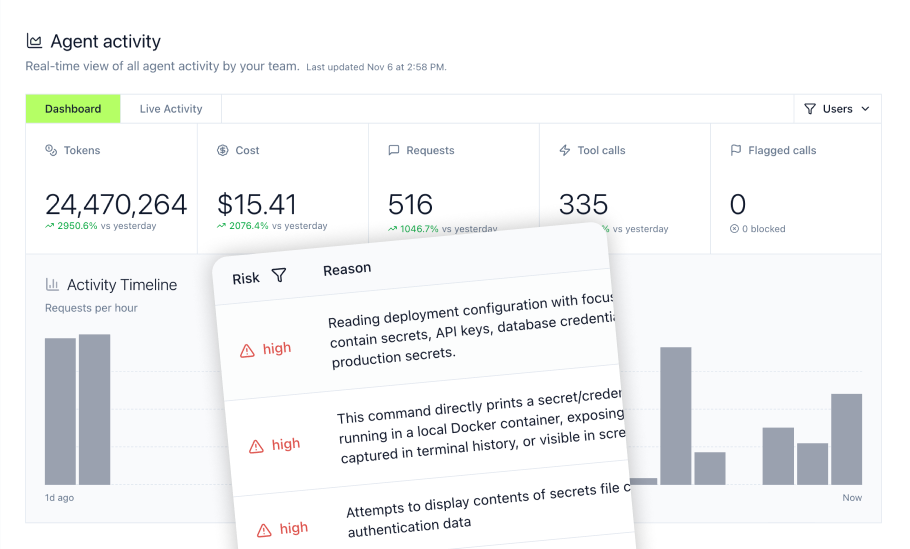

AI agents now run for hours with production access, taking hundreds of actions we can't watch. MintMCP is the governance layer—scoped data access (MCP Gateway) and runtime visibility (Agent Monitor).
When we ask an agent to "fix this bug," we're approving hundreds of actions over the next hour that we'll never see.
These agents have our production credentials. They read files, call external APIs, execute shell commands with elevated permissions, connect to whatever MCP servers are configured. And increasingly, they run in the background while we work on something else.
This is happening today. Engineers are spinning up three or four Claude Code sessions in parallel, coming back when the work is done. OpenClaw hit >100,000 GitHub stars in weeks by letting agents handle tasks autonomously—email, workflows, even negotiating car purchases. The shift to agents that operate without constant supervision is here.
Which means security has to shift too. We can't pre-approve every action an agent might take, and we can't watch every terminal when multiple sessions run in the background. We need infrastructure that gives us visibility and control at runtime.
That's what we built.
The MintMCP platform
MCP Gateway controls what agents can access. Instead of configuring MCP servers directly in each tool, teams route through a gateway with SSO/OIDC and role-based access control. We pioneered Virtual MCPs—an abstraction layer that unifies multiple servers behind a single endpoint with consistent auth, which means thousands of open-source MCP servers can be deployed in minutes, wrapped with enterprise security. And because access flows through the gateway, we establish agent identity—tying actions to the agent, not just the human user.
Agent Monitor shows and guardrails what agents are actually doing. Every tool call, command, and file access across Claude Code, Cursor, and other coding agents. Sensitive data detection catches credential exposure before it leaves the session, and policy enforcement blocks risky operations before they execute. Audit trails for compliance, real-time alerts when something looks wrong.
Our goal: have agents handle the routine work—updating systems, processing documents, running analyses—while we focus on the engaging pieces of work. That only works if we can trust what they're doing with real data: with access tightly scoped, and actions monitored.
What security leaders are saying
"What EDR did for employee laptops, we'll need for AI agents. As enterprises let agents take real actions, security teams need tools to monitor behavior, detect threats, and stop them at runtime."
— Tobias Boelter, Head of Security at Harvey AI
"What stood out was how straightforward the setup was, while still giving us enterprise-grade security. MintMCP's Virtual MCPs helped us abstract away complexity, and routing our auth flows through a central gateway gives us the control we need as we scale."
— Mustafa Furniturewala, CTO at Coursera
"The MintMCP team gets MCP. They've done the hard work to make it work in production."
— Tadas Antanavicius, Founder of PulseMCP
Who we are
Our co-founders architected TensorFlow at Google Brain, created the first machine learning courses online with Andrew Ng, and have spent over a decade watching AI systems go from research to production. We're backed by AI pioneers Andrej Karpathy and Jeff Dean, and by Coatue, Maven Ventures, Hustle Fund, and WVV Capital. We're a Cursor official security partner for MCP governance.
Get started
The shift to agent-native work is happening. We're building the governance layer that lets it happen safely.
For enterprise demos, email enterprise@mintmcp.com
Learn more
- Product tour
- Securing MCP: A Security-First Approach — our research paper on MCP security
- Virtual MCP Servers and Gateways — deep dive on PulseMCP