Enterprise teams deploying AI agents across Claude, Cursor, ChatGPT, and Copilot face governance challenges that traditional infrastructure cannot solve. Docker now provides an open-source MCP Gateway that centralizes MCP server configuration, credentials, routing, authentication, access control, server lifecycle, and tool filtering. Enterprise teams evaluating alternatives should compare Docker's current MCP Gateway capabiccccclities with platforms whose scope extends into agent identity, monitoring, runtime guardrails, and broader enterprise AI governance.
The MCP Gateway category has emerged to provide enterprise infrastructure that makes AI agents deployable, governed, measurable, and swappable. This guide examines Docker MCP Gateway alternatives for 2026, with particular emphasis on how MintMCP approaches internal AI agent governance through Virtual MCPs, first-class agent identities, runtime guardrails, and Agent Monitor.
Key takeaways
- MCP gateways address governance gaps that traditional API gateways and containerization tools cannot solve, including per-agent identity, tool-level RBAC, and credential injection for AI workloads
- MintMCP combines Virtual MCPs and Agent Bundles for role-based endpoints, per-agent identity, and M2M authentication
- MintMCP is SOC 2 Type II audited, compliant with HIPAA standards, and signs BAAs for customers handling protected health information
- Per-agent identity is an important governance capability for autonomous agent deployments, with vendors including MintMCP, TrueFoundry, and Portkey offering agent-specific identity and access controls with different implementations
- Deployment flexibility varies across vendors, with options ranging from managed SaaS to fully self-hosted and air-gapped deployments depending on vendor and compliance requirements
- Open source options exist for teams requiring code transparency, with Obot providing an MIT-licensed platform and Portkey offering an open-source gateway core
Understanding the evolution of MCP gateways in enterprise AI
Docker transformed how organizations package and deploy applications, establishing containerization as the standard for microservices architecture. When AI agents entered the enterprise, teams discovered that container orchestration alone cannot address the governance requirements of systems that autonomously access company data and tools.
The core challenge
AI agents decide which tools to call at runtime. Tools can appear, change, or disappear through MCP's list_tools mechanism. Tool descriptions themselves become potential injection surfaces. This unpredictability creates security and compliance gaps that traditional infrastructure was never designed to handle.
What enterprise teams need:
- Centralized control over which tools each agent or role can access
- Per-agent credentials that can be rotated or revoked independently
- Real-time visibility into what agents are reading, writing, and executing
- Runtime guardrails that screen tool calls before they execute
- Audit trails that satisfy SOC 2, HIPAA, and internal compliance requirements
MCP gateways emerged specifically to address these requirements. Unlike API gateways that focus on traffic routing and rate limiting, MCP gateways govern the relationship between AI clients and enterprise data sources at the tool and identity level.
The shift from API gateways to AI-centric management
Traditional API gateways handle request routing, authentication, and rate limiting for REST endpoints. AI workloads introduce fundamentally different requirements that generic gateways cannot address.
When an autonomous agent calls an MCP server to query a Snowflake instance or update a Salesforce record, the gateway must answer questions that have no equivalent in traditional API management:
- Which agent is making this call? (Not just which user, but which specific autonomous agent operating on behalf of which human or system)
- What tools should this agent see? (The same underlying connector might expose read-only tools to analysts and read-write tools to engineering)
- Whose credentials should be used? (Per-user OAuth, shared service accounts, or agent-specific credentials depending on the connector and use case)
- Should this call be allowed? (Runtime policy evaluation against tool arguments, not just endpoint access)
MintMCP's MCP Gateway provides a governed entrypoint that answers each of these questions through a data-permissions-first architecture. The platform authenticates users through your IdP, curates which tools each role can see, injects the right credentials per call, routes to the appropriate connector, and logs everything.
The Virtual MCP abstraction bundles multiple connectors behind a single governed endpoint called a Virtual MCP. Teams connect once to their designated VMCP instead of configuring each server independently. Directory groups via SCIM drive membership, so access policies update automatically when roles change in your identity provider.
1. MintMCP
Overview
MintMCP provides enterprise infrastructure for governing AI clients and autonomous agents across the MCP ecosystem. The platform's core value proposition centers on a data-permissions-first architecture where governance begins with controlled access to company systems, then extends that foundation to autonomous agents.
Key capabilities
- Virtual MCPs for role-based, use-case-specific, or agent-specific endpoints with SCIM-driven group membership
- Per-agent identity through Agent Gateway with bearer keys, M2M tokens, and workload identity federation
- Runtime guardrails via Mint Guard, declarative Rules, and customer-authored JavaScript middleware
- Two-layer visibility separating gateway governance from broader agent activity monitoring through Agent Monitor
- SOC 2 Type II audited with continuous compliance monitoring
- HIPAA compliance with Business Associate Agreement available for healthcare organizations
Agent identity architecture
MintMCP treats autonomous agents as first-class non-human principals. Each agent can receive:
- Its own identity and credentials
- Scoped MCP access through a dedicated Virtual MCP
- Independent credential rotation and revocation
- An attributable audit trail separate from human users
Authentication options include bearer keys for simple deployments, M2M OAuth tokens for short-lived authentication, and workload identity federation for zero-secret architectures where the agent's own infrastructure mints OIDC tokens.
Guardrails and security
MintMCP's guardrail architecture operates in three complementary layers:
- Mint Guard: Managed detection policies for prompt injection, secrets, PII, and harmful content
- Rules: Declarative matching on tool names, arguments, or content with actions including flag, block, ask, mask, and notify
- Gateway Middleware: Customer-authored JavaScript running in a sandbox for DLP integrations, external classifiers, and custom policy enforcement
2. TrueFoundry
Overview
TrueFoundry positions itself as a unified AI platform combining LLM routing, MCP governance, and model serving in a single control plane.
Key capabilities
- Unified LLM, MCP, and agent control plane for teams wanting a single platform across model serving and tool governance
- Published performance benchmarks with claimed 350+ RPS on 1 vCPU
- Flexible deployment options including managed SaaS, self-hosted control plane, and air-gapped installations
- Per-agent identities with agent-level RBAC and governed access to models and MCP tools
Pricing structure
- Developer: $0, with up to 3 users, 50,000 requests per month, and 5 registered servers
- Pro: $499 per month, with up to 10 users, 1 million requests per month, and 25 registered servers
- Pro Plus: $2,999 per month, with up to 25 users, 1 million requests per month, and 50 registered servers
- Enterprise: Custom pricing
Considerations
TrueFoundry now offers an Agent Gateway with per-agent identities, agent-level RBAC, and governed access to models and MCP tools. The comprehensive platform may introduce complexity for teams only requiring MCP gateway functionality.
3. Obot
Overview
Obot provides an open-source MCP gateway under MIT license. The platform includes a distinctive shadow AI discovery feature through Obot Sentry.
Key capabilities
- Open source (MIT licensed) for complete code audit and transparency
- Shadow AI discovery via Obot Sentry scanning for unauthorized MCP servers and agents
- Kubernetes-native architecture designed for infrastructure teams comfortable with container orchestration
- Both self-hosted and hosted deployment models
Deployment options
Obot offers both self-hosted and hosted deployment models. Obot Community is designed for self-hosting, while Obot Cloud provides a hosted option and Obot Enterprise supports self-hosted enterprise deployments.
Pricing structure
- Community: Free and self-hosted, with up to 100 users and 100 devices
- Cloud: Hosted deployment with pricing available through Obot
- Enterprise: Self-hosted enterprise edition with unlimited users and devices
4. Composio
Overview
Composio focuses on developer teams building agentic applications and offers a large catalog of managed SaaS integrations and toolkits.
Key capabilities
- A large catalog of managed SaaS integrations and toolkits across enterprise applications
- Fast time-to-production through managed authentication and pre-built connectors
- Optional zero data retention through a paid ZDR add-on on Pro and above, while standard configurations may retain tool-call request and response data
- Developer-first experience with SDK and API-centric approach
Pricing structure
- Free tier: 100k tool calls/month
- Enterprise: Custom pricing with VPC and self-hosted options
Considerations
Composio supports authentication and connected-account context scoped per end-user, alongside project and organization controls. Its primary orientation remains developer-facing infrastructure for adding tools and authentication to agentic applications.
5. Portkey
Overview
Portkey began as an LLM gateway for model routing and observability, extending into MCP governance to provide combined capabilities.
Key capabilities
- Combined LLM and MCP gateway for unified observability across model calls and tool usage
- Mature LLM routing with semantic caching, load balancing, and fallback routing
- Open source core with Gateway 2.0 available on GitHub
- Agent-specific governance and workload identity
Deployment options
- Managed SaaS
- Self-hosted via EKS, AKS/ACA, GKE
- AWS Marketplace
- Air-gapped enterprise deployment
Considerations
Portkey spans AI Gateway, MCP Gateway, and Agent Gateway capabilities rather than operating as an MCP-only platform. Palo Alto Networks completed its acquisition of Portkey in May 2026, and Portkey technology now underpins Prisma AIRS AI Gateway while the Portkey product remains active. Portkey also supports agent-specific governance and workload identity.
6. Runlayer
Overview
Runlayer targets IT, Security, and AI Operations buyers with a security-first approach to MCP governance. The platform launched in late 2025 with hybrid deployment options combining managed SaaS with self-hosted components.
Key capabilities
- Security-focused positioning with threat detection and shadow AI discovery
- Hybrid deployment supporting both managed SaaS and customer-hosted infrastructure
- IT/Security buyer alignment with governance-first messaging
Deployment options
- Managed SaaS
- Self-hosted on customer infrastructure
Considerations
Runlayer overlaps in internal MCP and agent governance capabilities, including identity-aware policy, agent accounts, runtime security, Shadow AI discovery, managed MCP hosting, and self-hosted deployment.
Governing AI clients and autonomous agents
MintMCP's architecture reflects a fundamental position: enterprise AI governance should begin with permissions and governed access to company systems, not with autonomous agents granted broad access and restricted afterward.
Why permissions-first matters
When organizations adopt AI tools across Claude, Cursor, ChatGPT, Gemini, and Copilot, they face a governance gap. Each tool may have its own permission model, logs, and security controls. Developers configure MCP servers independently across laptops and AI clients, creating duplicated setup and inconsistent security posture.
The MCP Gateway solves this by centralizing tool access behind governed endpoints. Teams connect to a Virtual MCP once rather than configuring each server. Directory groups drive membership through SCIM integration with enterprise SSO. Access policies apply consistently regardless of which AI client the user chooses.
Agent Gateway extends the foundation
Agent Gateway extends governed data and tool access to first-class agent identities, scoped permissions, credentials, and monitoring. The distinction matters because autonomous agents create different governance questions than human-operated AI clients:
- Which agent is acting?
- What credentials does it use?
- What tools can it access?
- How can its access be rotated or revoked independently?
- How is its activity attributed in audit logs?
Agent Gateway answers each question by treating the agent as a non-human principal with its own identity, credentials, and audit trail.
Visibility and monitoring
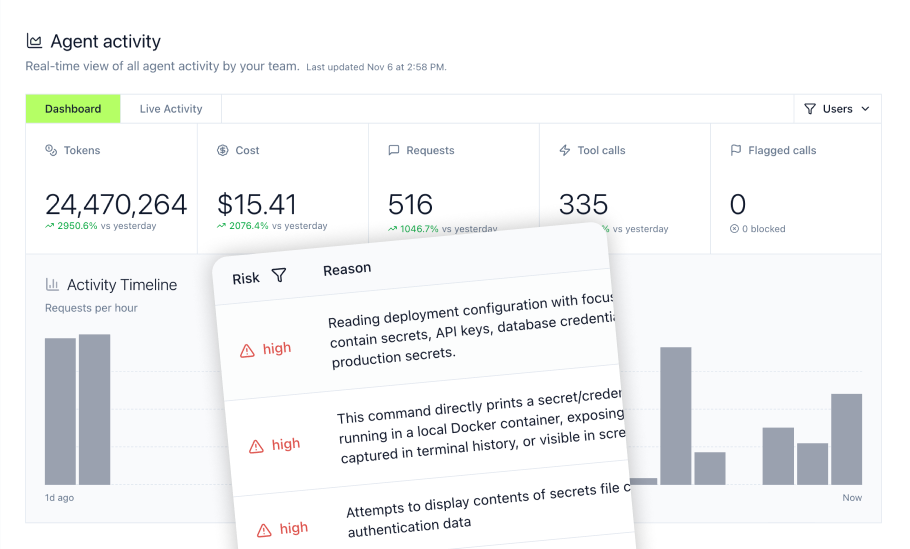
Security teams consistently cite visibility as their top concern when deploying AI agents. MintMCP addresses this through Agent Monitor, which provides organizational visibility into supported AI agent activity.
What Agent Monitor captures
- Prompt submissions
- File access (including
.envfiles and SSH keys) - Commands (bash, package installs, git operations)
- MCP tool calls
- Usage and model/token cost
Gaining insight into agent interactions
Agent Monitor operates beyond gateway traffic to provide visibility into local agent activity from supported coding environments. This distinction matters because agents running Claude Code or Cursor may execute local commands and file operations that never pass through an MCP gateway.
The platform supports SIEM export via OTLP or Splunk HEC, enabling integration with existing security information and event management infrastructure. Tool calls, prompt submissions, gateway requests, and access-policy changes can all be exported to your security operations center.
Agent Monitor includes built-in detection for secrets, prompt injection, and tool permissioning, plus custom rules using tool-argument and regex matching. Supported actions include flag, block, ask-user, mask, and Slack notification depending on the agent and hook phase.
Enterprise security and compliance for AI
Enterprise deployment requires more than feature functionality. Organizations need identity integration, audit trails, and operational controls that align with existing security frameworks.
Integrating with enterprise security
MintMCP's Security & Enterprise capabilities include:
- SSO and SCIM: Okta, Entra ID, and Google integration with directory groups driving both admin roles and tool access
- RBAC: Org-level roles for administrative reach and VMCP access policies for tool reach operating as two independent layers
- Audit and Observability: Every tool call, credential lifecycle event, and access-policy change logged with tamper-evident access-grant history signed at write time
- Operational Controls: Org-wide kill switch, per-VMCP/per-tool disable, connector restart, and credential rotation
- Configuration as Code: Manage gateway configuration and global rules declaratively
The kill switch capability provides immediate incident response when suspected credential compromise or runaway agent activity requires an emergency stop. The control is org-wide, immediate, and audited.
Why MintMCP for enterprise AI agent governance
Organizations governing internal AI clients and autonomous agents require infrastructure purpose-built for MCP governance rather than retrofitted from generic API gateways or containerization platforms.
MintMCP addresses enterprise AI governance through:
- Virtual MCPs that bundle multiple MCP servers behind role-based endpoints with SCIM-driven membership, eliminating duplicated configuration across developer laptops and AI clients
- Agent Gateway treating autonomous agents as first-class non-human principals with independent credentials, scoped access, and attributable audit trails
- Three-layer guardrail architecture combining Mint Guard managed detection, declarative Rules, and Gateway Middleware for custom DLP integration
- Agent Monitor providing visibility into agent activity beyond gateway traffic, including local commands, file access, and tool calls with SIEM export
- Enterprise security controls including enterprise SSO, SCIM, RBAC, tamper-evident audit trails, and org-wide kill switch
- SOC 2 Type II attestation and HIPAA compliance with Business Associate Agreements for healthcare organizations
The platform's data-permissions-first architecture ensures governance begins with controlled access to enterprise systems rather than attempting to retrofit controls onto agents already granted broad access. This foundation extends naturally to autonomous agents through Agent Gateway's per-agent identity model.
For teams deploying AI agents across Claude, Cursor, ChatGPT, Gemini, and Copilot, MintMCP provides the governance layer that makes those systems deployable, governed, measurable, and swappable without slowing down rollout.
Frequently asked questions
What are the main differences between a traditional API Gateway and an AI-centric MCP Gateway?
Traditional API gateways handle request routing, authentication, and rate limiting for REST endpoints. MCP gateways address AI-specific requirements including per-agent identity, tool-level access control (not just endpoint access), credential injection per tool call, runtime guardrails that evaluate tool arguments, and audit trails attributable to specific agents. The fundamental difference is that MCP gateways govern the relationship between AI systems and enterprise data at the tool and identity level rather than the HTTP request level.
How do Virtual MCPs simplify the management of AI tool access for large organizations?
Virtual MCPs bundle multiple connectors behind a single governed endpoint. Instead of configuring each MCP server independently across every developer laptop and AI client, teams connect once to their designated VMCP. Directory groups via SCIM drive membership automatically. The same underlying connector can expose different tool surfaces through separate VMCPs (for example, read-only tools for analysts and read-write tools for engineering) without duplicating connector configuration.
Why is dedicated agent identity crucial for securing autonomous AI agents?
When autonomous agents operate through human credentials or shared service accounts, organizations lose the ability to attribute actions, rotate credentials independently, or revoke access without affecting other systems. Per-agent identity through MintMCP's Agent Gateway means each agent has its own credentials, its own scoped MCP access, and its own audit trail. If one agent is compromised or behaves unexpectedly, its credentials can be revoked without touching human users or other agents.
What role do runtime guardrails play in preventing dangerous AI agent actions?
Runtime guardrails evaluate tool calls before they execute, screening for risks that static policies cannot catch. MintMCP's Mint Guard provides managed detection for prompt injection, credentials, PII, and harmful content. Declarative Rules match tool names, argument patterns, or content via regex. Gateway Middleware enables customer-authored JavaScript for DLP integration and custom policy enforcement. Together, these layers can flag, block, mask, or require approval for specific tool calls based on their content and context.
Can MintMCP integrate with existing enterprise security systems like SIEM?
Yes. MintMCP supports SIEM export via OTLP or Splunk HEC. Tool calls, prompt submissions, gateway requests, and access-policy changes can be exported to existing security information and event management infrastructure. The platform also provides tamper-evident audit trails with access-grant history signed at write time, verifiable offline via published JWKS.