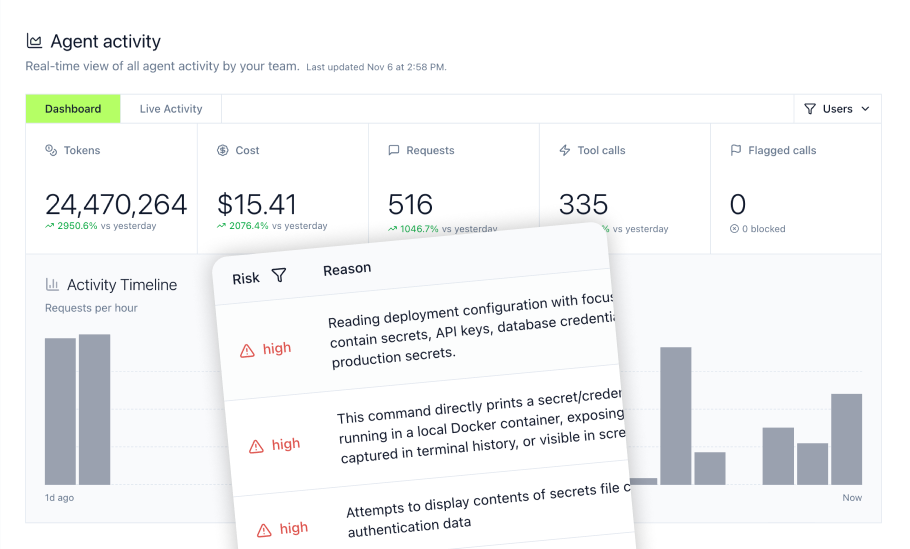
The Figma MCP Server represents a significant shift in how design teams collaborate with AI coding agents. Rather than relying on screenshots or manual specification documents, AI agents can now access structured design data directly from Figma files, including components, variables, layout structures, and design tokens. However, enterprise teams deploying these connections face governance challenges: the base Figma MCP Server provides individual OAuth flows, and organizations requiring centralized security and compliance for AI agent deployments benefit from routing Figma MCP traffic through an MCP gateway that adds SSO, RBAC, and comprehensive logging.
This article covers the complete Figma MCP Server implementation path, from initial setup through enterprise governance, including realistic cost analysis for teams at different maturity levels.
Key Takeaways
- Semantic design understanding replaces screenshot guessing: AI agents receive structured component data, variables, typography, and spacing information directly from Figma, enabling more design-informed code generation that aligns with existing design systems
- Organization or Enterprise licensing required for Code Connect: Code Connect, the feature that maps Figma components to production code, requires Organization or Enterprise plans with a Dev or Full seat, currently $25-90 per seat monthly depending on plan and seat type
- ROI depends on workflow and implementation maturity: In one ServiceNow integration, early results showed more than 80% lower initial UI and data model implementation time, but teams without organized design systems will spend significant time on prerequisites
- Rate limits vary by plan and seat: Starter access and View/Collab seats are limited to 6 read tool calls monthly, while Dev and Full seats receive higher daily limits (up to 200 on Professional/Organization, 600 on Enterprise)
- Additional tooling strengthens governance: Enterprise teams benefit from routing MCP traffic through gateways that add centralized audit trails and policy enforcement
Understanding the Model Context Protocol in Enterprise AI
What is MCP and Why Does It Matter for Design-to-Code Workflows?
The Model Context Protocol (MCP) standardizes how AI agents connect to external data sources and tools. For design workflows, this means AI coding assistants like Claude Code, Cursor, and VS Code Copilot can request specific design information through a structured API rather than interpreting visual screenshots.
When an AI agent accesses a Figma file through MCP, it receives:
- Component metadata: Names, descriptions, variant properties, and constraints
- Design variables: Color tokens, spacing scales, typography definitions
- Layout information: Auto Layout settings, responsive constraints, frame hierarchies
- Code Connect mappings: Direct links between design components and production code imports
This structured access eliminates the guesswork that occurs when AI agents interpret screenshots. Instead of generating generic button code, an MCP-connected agent can generate code that imports your actual Button component with the correct props matching your design system.
Addressing the Last Mile Problem
Enterprise AI deployments face what MintMCP describes as the "last mile problem": connecting AI agents to internal systems and data sources without extensive engineering overhead for each integration. Design files represent one critical data source where this challenge manifests.
Before MCP, connecting AI to Figma required custom API integrations per tool, manual design spec documentation, screenshot-based prompting with inconsistent results, and no standardized authentication or access control.
MCP provides a protocol-level solution, but enterprises still need governance infrastructure to deploy it safely. This is where MCP gateways become essential, adding authentication, access control, and audit logging on top of the base protocol.
Figma MCP Server Capabilities
Core Functionality
The official Figma MCP Server acts as a bridge between Figma design files and AI coding tools. The server exposes:
Read capabilities:
- Extract components, variables, typography, spacing, and layout data
- Pull design token values for consistent code generation
- Access component descriptions explaining purpose and constraints
- Retrieve frame hierarchies and Auto Layout configurations
Write capabilities (remote server only):
- Create and modify Figma content directly from AI agents
- Bring live UI back to Figma through bidirectional workflows
- Update design files based on code changes
Server Types and Deployment Options
Figma offers two MCP server variants with different capabilities:
Remote MCP Server (Recommended)
- Works without the Figma desktop app
- Supports write-to-canvas functionality in supported clients
- Uses OAuth authentication
- Available on all Figma seats and plans, subject to plan and seat rate limits
Desktop MCP Server
- Requires the Figma desktop app running
- Primarily provides local access to design context
- Connects through the local MCP server exposed by the signed-in Figma desktop app
- Available on Dev or Full seats for paid plans
For enterprise deployments, the remote server is strongly preferred. It eliminates desktop app dependencies that complicate MDM deployments and enables the full bidirectional workflow that maximizes productivity gains.
Code Connect Integration
Code Connect maps Figma components directly to production code components. Instead of AI generating generic React code, Code Connect gives the AI direct references to your actual component library and implementation details, improving its ability to reuse the correct components and props.
This feature requires Organization or Enterprise plans and represents the primary differentiator for enterprise value. Teams with mature design systems and Code Connect properly configured report substantial improvements in design system compliance.
Setup and Implementation
Prerequisites
Before configuring the Figma MCP Server, ensure your environment meets these requirements:
Figma account requirements:
- Figma account; the remote MCP server is available on all seats and plans, with usage limits determined by plan and seat type
- Dev or Full seat for higher read-tool rate limits; a Full seat is required to write to Figma files outside drafts
- Organized design system with components and variables
Technical requirements:
- MCP-compatible AI code editor (Cursor, VS Code, Claude Code)
- OAuth 2.0 support for remote server authentication
- Network access to Figma APIs
Step-by-Step Configuration
Step 1: Choose Your Server Type
Evaluate whether remote or desktop server fits your deployment. Remote server is recommended for enterprise teams due to OAuth support and write capabilities.
Step 2: Enable Remote MCP Server
In your AI client, add the Figma MCP server:
- Claude Desktop: Navigate to Customize, then Connectors, add Figma, authenticate via OAuth
- Cursor: Use the add-plugin command, then authenticate
- VS Code: Add MCP server configuration to your mcp.json file
Authentication triggers an OAuth browser flow where you grant the AI client access to your Figma account with scoped permissions.
Step 3: Organize Your Design System
This step consumes the majority of implementation time. Design system preparation requirements include:
- Consistent naming conventions (e.g., "Button/Primary" not "Group 5")
- Variables for colors, spacing, and typography
- Auto Layout for responsive components
- Component descriptions explaining purpose and constraints
Teams with inconsistent naming, variables, components, or layout structures should plan for additional design system preparation before expecting consistently useful MCP output.
Step 4: Configure Code Connect (Enterprise)
For Organization and Enterprise plans, map Figma components to production code:
- Define component mappings in your codebase
- Specify import paths and prop mappings
- Test mappings with sample prompts
Implementation effort varies with the number of components, frameworks, and mappings included in the Code Connect rollout.
Step 5: Test the Integration
Copy a Figma frame link, paste it into your AI client with a prompt like "Implement this design using our component library." Verify the generated code references actual components rather than generating generic implementations.
Common Setup Issues
Server connection failures: Restart both Figma desktop app and your code editor. Verify OAuth tokens remain valid. Consider switching to remote server if desktop server causes persistent issues.
AI generates generic code: Code Connect configuration is likely incomplete. Add a rules file guiding the AI to use specific imports from your component library.
Rate limit errors: Starter access and View/Collab seat limitations of 6 calls monthly are insufficient for active development. Upgrade to a Dev or Full seat on Professional or Organization for up to 200 daily read tool calls, or Enterprise for up to 600 daily.
Enterprise Governance Requirements
Security Considerations in Native Figma MCP
The base Figma MCP Server provides OAuth 2.0 authentication but enterprises deploying at scale may require additional governance features:
- Limited enterprise-managed MCP authorization: Figma currently supports enterprise-managed authorization for Claude through Okta Cross App Access; other MCP connections normally use individual OAuth flows
- Advanced MCP audit logging requires Governance+: The Developer Logs API in Governance+ provides granular logs of REST API and MCP server calls
- No cross-platform visibility: Figma MCP traffic is managed separately from other AI tool activity
- Limited inline policy enforcement: Cannot block or mask sensitive data in MCP responses without additional tooling
Adding Governance Through MCP Gateways
Enterprise teams deploying Figma MCP alongside other AI tools benefit from centralized governance through an MCP gateway. MintMCP provides:
Authentication and access control:
- SSO enforcement through Okta, Azure AD, or Google Workspace
- SCIM-driven group membership determining tool access
- Team and role-based permissions
Audit and compliance:
- Gateway logging of requests, tool calls, and responses, with Agent Monitor extending visibility to prompt submissions and local agent activity
- Per-user attribution for compliance investigations
- Real-time SIEM and observability export through OTLP-compatible endpoints or Splunk HEC
Policy enforcement:
- Tool-level access control enabling specific operations while blocking others
- Custom middleware in a JS sandbox for inline DLP integration
- PII detection and masking before data reaches AI models
For teams using multiple AI clients like Claude, Cursor, ChatGPT, Gemini, and Copilot, MintMCP's Agent Monitor extends visibility beyond MCP traffic to cover local agent activity including file reads, bash commands, and prompt submissions. MintMCP's Agent Gateway builds on the MCP Gateway foundation by adding agent identities, permissions, memory, and monitoring for agents operating alongside users.
Compliance Considerations
Figma has completed a SOC 2 Type II audit and provides enterprise security and governance controls. Healthcare organizations should note that Figma's current Acceptable Use Policy prohibits patient, medical, or other personal health information, including protected health information under HIPAA.
For AI governance specifically, enterprises need audit trails covering which users accessed which design files through AI agents, what prompts were submitted and what code was generated, and whether any sensitive data appeared in MCP responses. Routing traffic through MintMCP adds the audit observability layer that compliance teams expect.
Cost Analysis and ROI
Direct Costs
Platform subscription:
- Professional: $16 monthly per Full seat, $12 monthly per Dev seat
- Organization: $55 monthly per Full seat, $25 monthly per Dev seat
- Enterprise: $90 monthly per Full seat, $35 monthly per Dev seat
Implementation costs: Deployment effort depends on design system maturity, Code Connect scope, supported clients, and how much design-system cleanup is required before rollout.
ROI Indicators
Published productivity results are highly workflow-specific. For example, ServiceNow and Figma reported more than 80% lower initial UI and data model implementation time in their specific Build Agent integration. Teams should calculate ROI using their own implementation hours, seat costs, revision volume, and measured development time rather than relying on generalized Figma MCP break-even benchmarks.
Common Challenges and Solutions
Beta Status Limitations
Figma's write-to-canvas capabilities remain in beta, and Figma notes that agent-generated designs may require manual review and cleanup. Output quality improves significantly with:
- Well-organized design systems using semantic naming
- Code Connect mappings guiding AI to correct imports
- Rules files constraining AI behavior to established patterns
Scaling Across Teams
Multi-team deployments face coordination challenges:
- Different teams may use different AI clients
- Design system updates require Code Connect maintenance
- Rate limits may constrain large teams on lower tiers
Centralizing MCP access through a gateway enables consistent policy application across teams regardless of which AI client they prefer.
Vendor Lock-in Considerations
Deep Figma MCP integration creates switching costs. Code Connect mappings are Figma-specific, design system organization effort is partially portable, and AI workflow training is tool-dependent. Enterprises should evaluate this lock-in against the productivity benefits when planning long-term design tool strategy.
Enterprise Teams Choose MintMCP for Figma MCP Governance
While Figma MCP Server connects design files to AI agents, enterprise teams often need a governance layer that extends across Figma and other internal tools. MintMCP's MCP Gateway provides centralized control for governed data and tool access across Claude, Cursor, ChatGPT, Gemini, and Copilot.
As deployments scale, MintMCP helps security teams centralize:
- Identity and access: SSO enforcement and SCIM-driven permissions
- Auditability: Per-user logging for gateway requests, tool calls, and responses
- Policy enforcement: Tool-level controls and custom middleware running in a JavaScript sandbox
- DLP controls: PII detection and masking before sensitive data reaches AI models
- SIEM integration: Real-time export through OTLP-compatible endpoints or Splunk HEC
For teams operating in regulated environments, these controls provide a consistent governance layer across Figma MCP, finance tools, databases, internal APIs, and other MCP-connected systems.
Beyond tool connections, MintMCP's Agent Gateway builds on the MCP Gateway foundation with governance for long-running agents that work alongside employees. It adds:
- Dedicated agent identities
- Scoped permissions
- Company-owned, governed memory
- Centralized monitoring and auditability
Together, the MCP Gateway governs what tools and data agents can access, while the Agent Gateway governs the agents themselves, giving enterprises a unified control layer for AI tools and agent infrastructure.
Frequently Asked Questions
Can I use Figma MCP Server with multiple AI clients simultaneously?
Yes. The remote MCP server supports OAuth authentication from multiple clients. Each client maintains its own authentication context, and the same Figma account can authorize multiple AI tools. Rate limits depend on the user's plan, seat type, and the Figma resource being accessed. Teams using multiple MCP clients should monitor usage against the limits that apply to the relevant account and files.
How do I handle Figma MCP access for contractors or temporary team members?
Remote MCP access is available across Figma seats and plans, but limits and write permissions differ. Dev and Full seats on paid plans receive higher read-tool limits, while a Full seat is required to write to files outside drafts. View and Collab seats are limited to 6 read tool calls monthly. For short-term engagements, consider whether the MCP productivity gains justify the seat cost.
Does Figma MCP work with design files that use external component libraries?
Partially. MCP can read component instances from shared libraries, but Code Connect mappings must be configured for each library separately. Teams using Figma Community components or third-party design systems need additional configuration work to enable accurate code generation.
What happens when Figma updates components that have Code Connect mappings?
Code Connect mappings connect Figma components to their corresponding code implementations. Teams should keep mappings current when component APIs or implementations change in the codebase, and Figma supports CI/CD workflows that can help keep published Code Connect connections up to date.
How do I prevent AI agents from accessing sensitive design files through MCP?
Native Figma MCP inherits your Figma account permissions, so agents can access any file you can view. For granular control, consider using separate Figma accounts with restricted access for AI workflows, or route MCP traffic through a gateway that enforces additional access policies independent of Figma's permission model.