Choosing the right MCP gateway can determine whether your fintech startup scales securely or faces regulatory roadblocks. With 86% of enterprises requiring tech stack upgrades to deploy AI agents properly, the stakes have never been higher.
Model Context Protocol (MCP) has emerged as a widely adopted standard for connecting AI agents to financial systems, with support across major AI ecosystems. An MCP gateway provides the deployment infrastructure, security controls, and governance features that transform local MCP servers into production-ready services.
For fintech startups, this means connecting AI assistants to payment processing systems, fraud detection databases, and customer support platforms while maintaining the compliance posture that investors and regulators demand. We analyzed 15+ MCP gateway solutions across security compliance, performance benchmarks, fintech-specific integrations, and startup pricing models to identify the 10 best options for fintech startups in 2026.
Key Takeaways
- Compliance is non-negotiable: Fintech startups require SOC 2 Type II attestation, audit trails, and OAuth 2.0 authentication to support GLBA, PCI-DSS, and GDPR requirements
- Performance matters for real-time applications: Trading platforms and fraud detection systems need low-latency infrastructure, and some gateways report as little as 11 microseconds of overhead in published benchmarks
- Integration breadth accelerates time-to-market: Pre-built connectors for financial APIs can reduce development from months to weeks
- Security-first gateways protect sensitive data: Real-time threat detection, PII masking, and credential management help reduce the risk of data exposure
- Open-source options preserve cash runway: Bootstrap startups can evaluate self-hosted MCP infrastructure without upfront licensing costs
1. MintMCP Gateway
MintMCP Gateway has set the standard for enterprise-grade MCP infrastructure with SOC 2 Type II attestation for its MCP gateway and agent governance stack. For fintech startups preparing for enterprise clients or regulated deployments, this can reduce friction during security reviews.
What Makes MintMCP Different
MintMCP turns local STDIO-based and hosted MCP servers into governed production services with SSO, SCIM-driven RBAC, OAuth brokering, credential management, tool-level allowlisting, and rule-based policy. Pre-built connectors for Snowflake and Elasticsearch enable integration with financial data warehouses and search infrastructure.
Key Features for Financial Applications
- SOC 2 Type II audited security controls and compliance with HIPAA standards, with BAA availability: Supports investor due diligence and enterprise client security reviews
- Audit logs and centralized observability: Supports GDPR and GLBA review requirements with detailed logging
- Virtual MCP Bundles: Expose curated tool sets through per-use-case endpoints with SCIM-driven membership, critical for separation of duties in financial operations
- Agent Bundles: Govern internal agents with per-agent identity, M2M authentication, and “act as agent” flows
- Credential management and OAuth brokering: Centralize authentication for stdio and hosted MCP servers
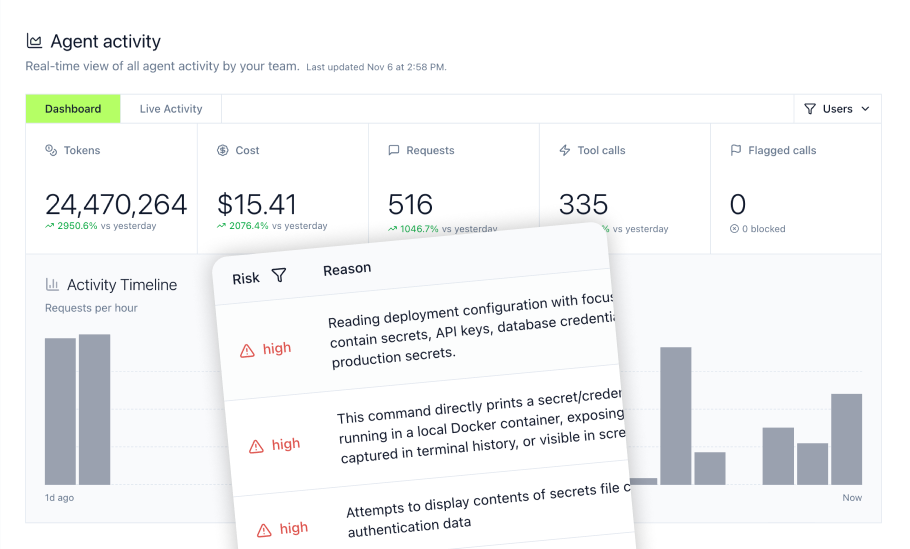
- Real-time monitoring: Track every MCP tool interaction with dashboards for usage patterns and security alerts
Fintech Use Cases
- Fraud detection: Connect AI agents to Elasticsearch for real-time transaction monitoring
- Financial reporting: Automate variance analysis through Snowflake integration
- Compliance automation: Use governed tool access, audit logs, and policy controls to support compliance workflows
Best For: Mid-market and enterprise fintech teams requiring managed SaaS-first MCP governance with compliance from day one
Getting Started: Visit mintmcp.com to book a demo
2. Composio
Composio accelerates fintech development by providing a library of managed MCP integrations. For startups prioritizing time-to-market, the platform's pre-built connectors can reduce custom integration work.
How Composio Fits Fintech Teams
The platform handles authentication complexity automatically, including OAuth flows, API key management, and token refresh cycles that typically consume engineering bandwidth. Every integration is maintained and updated by Composio's team, removing ongoing maintenance burden from lean startup teams.
Key Features for Financial Applications
- Unified authentication layer: Automatic OAuth and API key management across financial API integrations
- Production-grade RBAC: Role-based access control with PII protection built-in
- Low latency performance: Optimized for real-time financial data processing
- Zero-maintenance integrations: Composio team handles connector updates and breaking changes
Tradeoffs to consider
Composio is strongest for developer and AI engineering teams building external customer-facing AI products. Fintech teams that need internal employee and internal-agent governance should also evaluate whether they need SCIM-driven RBAC, Virtual MCP Bundles, Agent Bundles, centralized audit, and rule-based policy across Claude, Cursor, ChatGPT, Gemini, and Copilot.
Best For: Fintech startups needing rapid integration with payment gateways, accounting software, CRM platforms, and banking APIs without building custom connectors
3. Lasso Security
Lasso Security addresses MCP's security challenges with a gateway built specifically for threat detection and data protection. The platform provides fintech startups with protection for customer PII and financial records.
Lasso’s Security Focus
The platform implements a security pattern that protects AI, MCP, and API layers simultaneously. Real-time detection helps block prompt injection attacks, credential theft attempts, and tool poisoning before they reach production systems.
Key Features for Financial Applications
- Real-time prompt injection blocking: Prevents malicious inputs from compromising financial systems
- PII masking: Automatic detection and redaction of sensitive customer data in MCP traffic
- Tool reputation analysis: Risk scoring for community MCP servers before integration
- Plugin architecture: Extensible security scanning for custom compliance requirements
Tradeoffs to consider
A security-focused MCP gateway can help with threat detection, but fintech teams should also evaluate whether it supports the governance primitives required for internal rollout, including SSO, SCIM-driven RBAC, per-use-case tool bundles, credential management, audit logs, and agent identity governance.
Performance Trade-off: Security scanning may add latency, so fintech teams should benchmark the gateway in their own environment for latency-sensitive applications.
Best For: Fintech startups handling customer PII, payment credentials, or regulated financial data requiring real-time threat detection
4. TrueFoundry MCP Gateway
TrueFoundry emphasizes performance, citing sub-10ms latency and 350+ requests per second on a single vCPU in published benchmarks. For fintech startups building real-time fraud detection or latency-sensitive payment workflows, this performance focus can be valuable.
TrueFoundry’s Performance Angle
The platform provides a unified control plane for both LLM calls and MCP tool invocations, simplifying infrastructure management for AI-heavy fintech applications. OAuth 2.0 Identity Injection enables On-Behalf-Of authentication without custom integration work.
Key Features for Financial Applications
- Low-latency design: benchmarked for high-throughput, latency-sensitive workloads
- Unified AI stack: Manage LLM and MCP infrastructure from single platform
- SOC 2 Type II attestation: Enterprise security review support
- OAuth 2.0 Identity Injection: Seamless authentication for financial API integrations
Tradeoffs to consider
TrueFoundry is a strong fit for platform engineering and ML platform teams. Fintech teams that prioritize internal employee governance should also evaluate whether they need MintMCP-style Virtual MCP Bundles, Agent Bundles with M2M auth, hosted MCP connectors, tool-update policy, and a Gateway plus Agent Monitor model for MCP and non-MCP agent activity.
Best For: Fintech startups building real-time fraud detection systems, latency-sensitive payment processing, or AI-heavy platform workflows where milliseconds impact the user experience
5. Bifrost by Maxim AI
Bifrost is optimized for extremely low overhead in published benchmarks: about 11 microseconds of overhead in sustained 5,000 RPS benchmarks, with a Go-based architecture optimized for throughput. The open-source Go-based architecture provides consistent performance under load without upfront licensing costs.
Bifrost’s Architecture Approach
Native compilation and zero-config deployment enable fintech startups to achieve high performance on bootstrap budgets. Semantic caching can reduce AI costs by eliminating redundant API calls.
Key Features for Financial Applications
- Low overhead: About 11µs overhead in published benchmarks for latency-sensitive applications
- Cost reduction: Semantic caching can reduce redundant API calls
- 15+ provider support: OpenAI, Anthropic, AWS Bedrock, Google Vertex integration
- No upfront licensing cost: Apache 2.0 open-source license with enterprise options
Tradeoffs to consider
Bifrost is OSS-first and self-hosted-first. That can be attractive for infrastructure-heavy teams, but fintech teams should account for the operational work of running gateway infrastructure themselves. MintMCP addresses this with managed SaaS-first deployment, hosted MCP connectors, SCIM-driven access control, credential management, and centralized audit.
Best For: Fintech startups building real-time risk assessment or high-frequency customer interactions where performance and cost efficiency are paramount
6. Portkey
Portkey provides compliance coverage with SOC 2 Type II, ISO 27001, HIPAA, and GDPR support, making it relevant for fintech startups operating across multiple regulatory jurisdictions. The platform's pre-built guardrails accelerate security implementation.
Portkey for Compliance Coverage
End-to-end LLMOps capabilities extend beyond gateway functionality to cover the entire AI lifecycle. Enterprise plans typically include reliability commitments and support options suitable for mission-critical applications.
Key Features for Financial Applications
- Pre-built guardrails: PII detection, content filtering, and compliance controls
- Immutable audit trails: Complete logging for regulatory examination
- Multiple deployment options: SaaS, hybrid, and air-gapped environments
- Compliance coverage: SOC 2 Type II, ISO 27001, HIPAA, GDPR support
Tradeoffs to consider
Portkey is strong for developer and platform engineering teams managing LLMOps and gateway workflows. Fintech teams focused on internal employee and internal-agent governance should also evaluate whether they need MCP-specific primitives such as Virtual MCP Bundles, Agent Bundles, OAuth brokering for stdio and hosted MCP servers, and tool-update policy.
Best For: Fintech startups facing multiple regulatory requirements, such as EU operations requiring GDPR or healthcare-adjacent finance requiring HIPAA, who need broad compliance coverage
7. Prompt Security
Prompt Security addresses the supply chain risk of community-built MCP servers by analyzing MCP servers with dynamic risk scoring. For fintech startups evaluating open-source tools, this assessment can help prevent integration of compromised components.
Prompt Security for MCP Risk Review
The platform's MCP Risk Assessment performs code-level inspection to identify vulnerabilities before integration. Endpoint-level monitoring discovers "shadow MCP" usage across the organization, supporting compliance visibility. The security framework aligns with the OWASP Top 10 for comprehensive threat coverage.
Key Features for Financial Applications
- Server analysis: Risk scoring for the GitHub MCP ecosystem
- Shadow MCP discovery: Identify unauthorized tool usage organization-wide
- Real-time enforcement: Block dangerous operations automatically
- Code-level inspection: Vulnerability assessment before integration
Tradeoffs to consider
Prompt Security is most relevant for MCP risk review and threat prevention. Fintech teams should pair that evaluation with governance requirements such as SSO, SCIM-driven RBAC, credential management, audit logs, and per-use-case tool access policies for employees and agents.
Best For: Fintech startups evaluating community MCP servers who need security assessment before integration into production financial systems
8. Lunar.dev MCPX
Lunar.dev MCPX balances governance requirements with developer experience while providing cost and performance tracking. For fintech startups monitoring burn rate, the built-in analytics help justify AI spend.
Lunar.dev MCPX for Cost + Observability
The platform supports both STDIO and remote HTTP/SSE MCP servers, enabling gradual migration from development to production environments. OpenTelemetry integration provides latency, token cost, and request tracing.
Key Features for Financial Applications
- Cost analytics: Track AI spending per team, project, and tool
- Performance monitoring: Latency, error rates, and usage pattern visibility
- Centralized RBAC: Granular tool-level permission management
- Hybrid deployment: Docker/Kubernetes with optional SaaS dashboards
Tradeoffs to consider
Lunar.dev MCPX is useful for cost and observability. Fintech teams should also evaluate whether they need managed hosted connectors, SCIM-driven membership, Agent Bundles with M2M authentication, credential management, and two-layer governance across MCP and non-MCP agent activity.
Best For: Fintech startups transitioning from prototype to production who need observability into AI agent costs and performance
9. Docker MCP Gateway
Docker MCP Gateway extends Docker's container orchestration patterns to MCP infrastructure, providing fintech startups with a familiar self-hosted approach. Teams already using Docker for microservices can add MCP capabilities without learning a completely new operational model.
Docker Gateway for Docker-Native Teams
The gateway uses familiar Docker Compose configurations, reducing the learning curve for DevOps teams. Container isolation with signed images and Docker secret management provides security foundations without custom development. Containerization can help reduce the blast radius of vulnerable MCP components, including issues in related packages such as CVE-2025-6514 in the mcp-remote npm package.
Key Features for Financial Applications
- Container security: Isolation, signed images, and secret management
- CLI-driven workflow: docker mcp commands integrate with existing pipelines
- No upfront licensing cost: Open-source deployment path
- DevOps familiarity: Docker Compose configurations developers already know
Tradeoffs to consider
Docker MCP Gateway is a strong fit for Docker-native teams that want infrastructure control. Fintech teams should account for the operational work of managing connector runtimes, scaling, access policy, and audit infrastructure. MintMCP addresses those needs with managed SaaS-first deployment, hosted MCP connectors, SSO and SCIM-driven RBAC, Virtual MCP Bundles, and centralized observability.
Performance note: overhead varies by deployment and server/container configuration; teams should benchmark in their own environment for latency-sensitive use cases.
Best For: Bootstrap fintech startups with Docker expertise and limited budgets who need MCP infrastructure without upfront licensing costs
10. Kong AI Gateway
Kong AI Gateway extends the enterprise API management platform to MCP and AI traffic. Organizations with existing Kong infrastructure can unify API and MCP governance through Kong's plugin ecosystem.
Kong in Existing API Environments
Kong's plugin-based architecture applies API security patterns to MCP challenges. OpenID Connect, Key Auth, and rate limiting plugins provide flexible security configurations, while OpenTelemetry integration enables observability.
Key Features for Financial Applications
- Plugin-based security: OpenID Connect, Key Auth, rate limiting
- MCP proxy support: Expose governed APIs as MCP tools
- Unified governance: Single platform for APIs and AI/MCP traffic
- OpenTelemetry observability: Monitoring and tracing
Tradeoffs to consider
Kong AI Gateway is most natural for teams already standardized on Kong or API platform workflows. Fintech teams should evaluate whether they also need MCP-specific governance primitives such as Virtual MCP Bundles, Agent Bundles, tool-update policy, OAuth brokering for stdio and hosted MCP servers, and managed hosted connectors.
Best For: Organizations with existing Kong infrastructure seeking unified API and MCP management
Making Your Choice: Essential Considerations for Fintech Startups
Selecting the right MCP gateway requires balancing compliance requirements, performance needs, integration breadth, and budget constraints. For many fintech startups, MintMCP Gateway provides a strong combination of managed deployment, enterprise-grade security controls, and governance capabilities that support both investor due diligence and customer acquisition.
Compliance Requirements Determine Your Starting Point
Financial services face regulatory requirements that general-purpose software doesn't. GLBA mandates protection of customer financial data. PCI-DSS governs payment credential handling. FFIEC guidelines require risk-based authentication for banking applications. SOC 2 Type II attestation, available from MintMCP and select enterprise gateways, can accelerate compliance verification for investor due diligence and enterprise sales.
Match Gateway Choice to Company Stage
Pre-seed and bootstrap startups often prioritize zero or low upfront licensing costs with solutions like Docker Gateway or Bifrost. Seed-stage companies balance features and cost with platforms offering rapid development capabilities. Series A and beyond typically require compliance attestations, centralized audit, and enterprise-ready access controls available from managed gateways like MintMCP.
Performance Requirements Vary by Use Case
Real-time trading and fraud detection applications require careful latency testing. TrueFoundry and Bifrost publish low-latency benchmark results, while security-heavy workflows may tolerate higher latency in exchange for scanning and enforcement. Financial reporting workflows usually prioritize integration breadth, access control, and auditability over raw speed.
Security Philosophy Impacts Architecture
Some gateways prioritize threat detection, while others focus on credential protection or compliance governance. MintMCP emphasizes data-permissions-first governance, including SSO, SCIM-driven RBAC, tool-level allowlisting, rule-based policy, credential management, audit logs, Virtual MCP Bundles, and Agent Bundles. Consider your primary risk: Are you most concerned about prompt injection attacks, credential leaks, or audit trail completeness? The answer guides gateway selection.
Deploy Enterprise AI with Confidence
The Model Context Protocol has fundamentally changed how fintech startups connect AI assistants to payment systems, customer databases, and compliance tools. But as this analysis demonstrates, deploying MCP at scale requires more than just protocol support. It requires security, governance, and monitoring that transforms experimental AI into production-ready infrastructure.
MintMCP Gateway stands out as a practical path from pilot to production for fintech startups. With SOC 2 Type II audited security controls, managed deployment, SSO and SCIM-driven RBAC, OAuth brokering, credential management, Virtual MCP Bundles, Agent Bundles, and pre-built connectors for Snowflake and Elasticsearch, MintMCP removes many of the technical and compliance barriers that keep organizations stuck in AI pilot purgatory.
Whether you're securing access to financial data warehouses, fraud detection systems, or customer support platforms, MintMCP provides the infrastructure that makes AI deployment practical and secure. The platform's Virtual MCP Bundles support separation of duties, while centralized audit logging supports demanding regulatory review requirements.
For fintech startups, the choice is clear: invest engineering resources in building your core product, not in configuring authentication systems and building compliance infrastructure. MintMCP delivers enterprise-grade MCP capabilities from day one, accelerating your path to market while maintaining the security posture that investors and regulators demand.
Ready to transform your AI infrastructure? Visit mintmcp.com to schedule a demo and see how MintMCP Gateway can accelerate your fintech startup's AI deployment.
Frequently Asked Questions
What is the primary benefit of an MCP gateway for a fintech startup?
An MCP gateway transforms local MCP servers into production-ready services with enterprise authentication, audit trails, and monitoring. For fintech startups, this means connecting AI agents to payment systems, customer databases, and compliance tools while maintaining the security posture that regulators and investors require. Without a gateway, fintech startups face manual OAuth configuration, scattered credentials, and limited audit visibility, all compliance red flags.
How do MCP gateways ensure compliance with financial regulations like SOC 2 or GDPR?
Enterprise-grade MCP gateways like MintMCP provide audit logs that record tool calls, data access, and user actions. SOC 2 Type II audited security controls help verify that security controls operate effectively over time. GDPR compliance requires visibility into data access patterns, which managed gateways can support through centralized observability, access control, and logging.
Can an MCP gateway help reduce costs associated with AI tool usage in a fintech company?
Yes, through multiple mechanisms. Semantic caching can reduce redundant API calls. Cost analytics identify expensive tool patterns for optimization. Governance controls prevent unauthorized usage that inflates bills. Pre-built integrations reduce development costs by eliminating months of custom integration work that would otherwise consume engineering resources.
What AI clients are compatible with MCP gateway technology?
MCP gateways can support clients such as Claude, ChatGPT, Microsoft Copilot, Cursor, Gemini, Goose, LibreChat, Open WebUI, Windsurf, and custom MCP-compatible agents, depending on the gateway and deployment model. MintMCP focuses on centralized governance across Claude, Cursor, ChatGPT, Gemini, and Copilot so fintech teams can standardize controls across diverse AI tools.
How does an LLM Proxy enhance security for coding agents in a fintech environment?
An LLM Proxy monitors tool calls, bash commands, and file operations from coding agents like Cursor or Claude Code. For fintech environments, this means blocking access to .env files containing API keys, preventing dangerous shell commands, and maintaining audit trails of agent actions. Without proxy monitoring, coding agents can operate with limited telemetry and uncontrolled access, which creates security risks when handling financial code.