Model Context Protocol has become the industry standard for connecting AI agents to enterprise systems, with support from Anthropic, OpenAI, Google, and Microsoft driving adoption across organizations of every size. Yet connecting Claude, ChatGPT, Cursor, or Copilot to internal databases and business tools without governance creates credential sprawl, compliance gaps, and security blind spots that enterprise teams cannot afford. MintMCP's registry provides access to 10,000+ MCP servers that can be made enterprise-ready through built-in authentication and governance controls, enabling teams to deploy in minutes rather than months.
This article outlines the best MCP servers for enterprise teams in 2026, covering deployment strategies, security requirements, data integration options, and governance frameworks to ensure your AI tools connect safely to organizational resources.
Key Takeaways
- MCP servers solve the "N×M integration problem" by providing a standardized protocol that lets AI agents connect to any enterprise system without custom integrations for each tool-and-data-source combination
- Enterprise teams can access 10,000+ available MCP servers covering productivity tools, data warehouses, developer platforms, business systems, and communication tools through MintMCP's registry
- Centralized gateway infrastructure can reduce repetitive operational work and manual authentication setup by consolidating deployment, OAuth/SSO, audit logging, and access control in one governed layer
- Security remains critical: The OWASP Top 10 for MCP includes injection flaws, making governed deployment through enterprise gateways essential rather than optional
- The MCP Gateway approach transforms shadow AI into sanctioned AI by providing OAuth/SSO enforcement, complete audit trails, and tool-level access control across Claude, Cursor, ChatGPT, Gemini, and Copilot
Understanding the Enterprise MCP Landscape in 2026
The Rise of MCP for Enterprise AI
The Model Context Protocol ecosystem has expanded dramatically since Anthropic introduced the standard in late 2024. By early 2026, MCP adoption had moved from experimentation into mainstream enterprise planning, signaling broader adoption across development teams worldwide. This growth reflects a fundamental shift in how organizations connect AI assistants to business systems.
Before MCP, enterprises faced an integration nightmare. Each AI tool required separate connectors for each data source. Ten AI tools connecting to twenty data sources meant building and maintaining two hundred custom integrations. MCP eliminates this complexity by establishing a single protocol that all MCP-compatible clients can use to access any MCP server.
The business case is straightforward: enterprise AI adoption is moving faster than governance, and many teams still lack consistent controls for how AI tools access internal systems. This gap between adoption and governance creates the "shadow AI" problem, where employees use AI tools without IT oversight, accessing sensitive data through uncontrolled channels.
Key Challenges for Enterprise AI Deployment
Enterprise teams face three primary obstacles when deploying AI tools at scale:
- Credential management complexity: Each MCP server requires authentication credentials. Without centralization, API keys and OAuth tokens scatter across developer machines, creating security vulnerabilities and audit nightmares
- Compliance requirements: Regulated industries need complete audit trails of every AI agent action. Point-to-point MCP connections provide no visibility into what data AI tools access or when
- Governance at scale: As teams deploy more MCP servers, controlling which employees access which tools becomes unmanageable without systematic access control
The MCP Gateway architecture addresses these challenges by placing a governed layer between AI clients and MCP servers. Rather than each AI tool connecting directly to each data source, all connections route through a central gateway that enforces authentication, logs every interaction, and applies access policies.
MintMCP's Registry: Your Central Hub for Enterprise MCP Deployment
Streamlined Deployment with MintMCP Registry
The MintMCP server registry catalogs over 10,000 MCP servers organized by category, use case, and authentication method. Rather than hunting through GitHub repositories or building custom connectors, enterprise teams can browse pre-built servers covering:
- Productivity tools: Notion, Linear, Slack, and other team workflow systems
- Data warehouses: Snowflake, BigQuery, Elasticsearch, and other data platforms
- Developer platforms: GitHub, Terraform, and related engineering systems
- Business systems: Salesforce, HubSpot, Stripe, and other revenue or operations tools
- Communication: Gmail, Outlook, Google Calendar, Microsoft Teams, and related collaboration tools
Each server in the registry includes documentation on available tools, required authentication, and compatible AI clients. The one-click deployment capability helps teams move from manual MCP setup to a governed deployment workflow.
Managing Virtual MCP Servers for Teams
MintMCP uses Virtual MCP Servers as a deployment primitive for enterprise teams. Rather than giving every employee access to every MCP server, organizations create role-based Virtual MCP Servers that combine specific servers with appropriate permissions.
A finance team Virtual MCP Server might include:
- Snowflake MCP Server with read-only access to financial data warehouses
- Google Sheets MCP for spreadsheet automation
- Gmail MCP for communication workflows
A support team Virtual MCP Server would contain different servers:
- Elasticsearch MCP for knowledge base search
- Zendesk or Salesforce MCP for ticket management
- Slack MCP for internal escalations
This Virtual MCP Server approach means governance is built in rather than retrofitted after deployment. Each Virtual MCP Server has its own endpoint, SCIM-driven membership, and audit stream.
Securing Your MCP Ecosystem: Enterprise-Grade Security Features
Unified Authentication and Access Control
Enterprise MCP deployment requires solving authentication at multiple layers. Individual MCP servers each have their own credential requirements: OAuth tokens for SaaS applications, API keys for cloud services, database credentials for data sources. Without centralization, this creates what security teams call "credential sprawl."
MintMCP's authentication architecture consolidates this complexity:
- SSO integration: Employees authenticate once through existing identity providers such as Okta, Azure AD, or Google Workspace
- OAuth brokering: The gateway handles OAuth flows for upstream MCP servers, including refresh token management
- SCIM directory sync: User provisioning and deprovisioning synchronize automatically with corporate directories
- Tool-level permissions: Granular control over which tools within each MCP server different roles can access
This approach means a new employee automatically receives appropriate MCP access based on their directory group membership, and a departing employee loses all MCP access the moment their account is disabled.
Compliance and Observability for AI Interactions
Regulated industries cannot deploy AI tools without audit trails. Healthcare organizations need logging that supports workflows aligned with HIPAA standards. Financial services require records for regulatory examination. Any organization pursuing SOC 2 needs evidence of access controls.
MintMCP provides complete audit trails capturing:
- Every tool call with timestamp, user identity, and parameters
- Data access events through MCP servers
- Authentication events and permission changes
- Policy violations and blocked requests
These logs integrate with existing SIEM systems and support evidence collection for SOC 2, HIPAA standards, and GDPR-aligned access governance. The LLM Proxy extends this observability beyond MCP to cover local agent actions including bash commands, file operations, and prompt submissions in Claude Code and Cursor.
Understanding the data risks in MCP deployments helps security teams implement appropriate controls from the start.
Integrating with Your Data: Elasticsearch MCP Server for AI-Powered Insights
The Elasticsearch MCP Server enables AI agents to search enterprise knowledge bases, support ticket archives, and log data using natural language queries. This transforms how teams access institutional knowledge.
AI-Powered Knowledge Base Search
HR teams can build AI-accessible repositories from company documentation, policies, and training materials. When employees ask Claude or ChatGPT questions about benefits, PTO policies, or compliance procedures, the AI assistant queries Elasticsearch directly and provides accurate, sourced answers.
The Elasticsearch MCP includes core tools for search, analysis, index discovery, mappings, and shard health. These capabilities help teams retrieve relevant enterprise content and understand the structure of their Elasticsearch data.
Optimizing Support with AI and Elasticsearch
Support teams can reduce repetitive knowledge lookup when AI assistants can search historical tickets, resolution patterns, and help documentation. Rather than manually searching knowledge bases, support agents ask their AI assistant to find similar past issues and recommended solutions.
Product teams enable AI-powered documentation search, letting customers find answers through conversational interfaces backed by Elasticsearch product knowledge bases.
Unlocking Business Intelligence: Snowflake MCP Server for Data Warehousing
The Snowflake MCP Server provides tools for interacting with Snowflake data warehouses, including natural language query capabilities through Cortex Analyst and semantic search through Cortex Search.
AI-Driven Analytics with Snowflake
Product management teams query user engagement metrics, feature adoption rates, and cohort analysis through natural language. Instead of writing SQL or waiting for data team requests, product managers ask their AI assistant: "Show me the 30-day retention rate for users who signed up through the mobile app last quarter."
The Snowflake MCP can help translate natural language questions into data workflows, execute queries against approved warehouse resources, and return formatted results. This workflow can reduce the time from question to answer when teams have the right permissions and semantic models in place.
Key Snowflake MCP capabilities include:
- Natural language analytics through Cortex Analyst
- SQL execution for approved Snowflake workflows
- Semantic view queries using dimensions, metrics, and facts
- Object discovery across databases, schemas, tables, views, and warehouses
Automating Financial and Executive Reporting
Finance teams automate revenue reporting, expense tracking, and budget variance analysis. The AI assistant can generate standard financial reports on demand, answer ad-hoc questions about spending trends, and flag anomalies that warrant investigation.
Executive teams gain real-time access to cross-functional KPIs without SQL expertise. Business intelligence that previously required dashboard development becomes accessible through conversation.
Streamlining Communications: Gmail MCP Server for Enterprise Workflows
The Gmail MCP Server enables AI assistants to search, draft, and send emails within approved workflows. This integration transforms customer communication efficiency while maintaining appropriate human oversight.
AI in Customer Support Communications
Support teams use Gmail MCP to:
- Search inbox for customer communication history before responding
- Draft replies using context from previous conversations
- Maintain threading integrity when responding to ongoing discussions
- Queue drafts for human review before sending
The governance layer ensures send operations require human approval while search and draft operations proceed automatically. This pattern delivers efficiency gains without removing human judgment from external communications.
Enhancing Internal and External Email Workflows
Product feedback aggregation becomes automated. AI assistants extract structured feedback from incoming messages, apply sentiment analysis, and prioritize based on customer tier or issue severity.
The Gmail MCP tools support email search, message retrieval, draft creation, reply drafting, and approved send workflows, providing broad email workflow coverage.
Comprehensive Monitoring and Observability for AI Tool Usage
Gaining Visibility Over AI Agent Actions
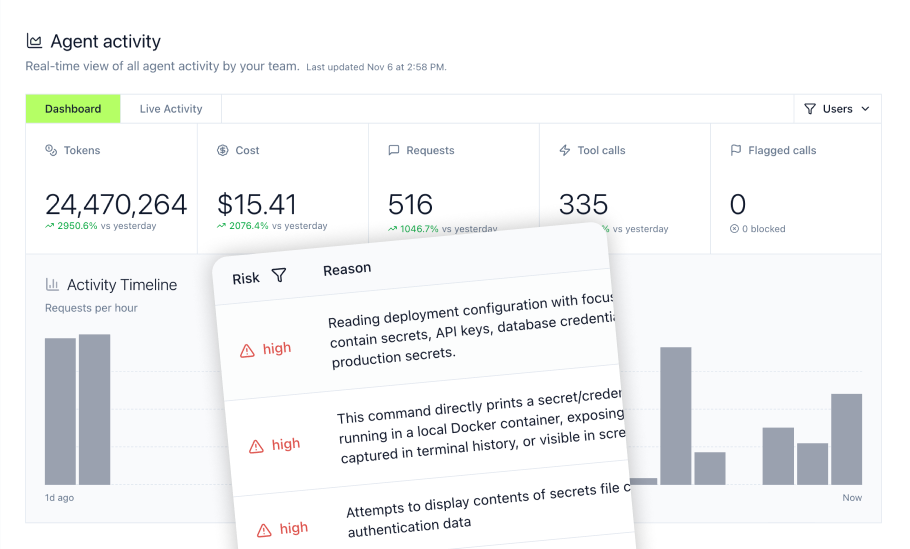
The LLM Proxy provides visibility into coding agent behavior that MCP gateway logs alone cannot capture. When developers use Claude Code or Cursor, these agents execute bash commands, read files, and modify code outside the MCP protocol.
LLM Proxy monitoring covers:
- Every MCP tool invocation across all coding agents
- Bash commands executed through AI assistants
- File access patterns and modifications
- Installed MCPs and their usage across teams
This visibility allows security teams to detect anomalous behavior, identify risky tool calls like reading environment secrets, and block dangerous commands in real-time.
Controlling Costs and Ensuring Compliance
Enterprise AI deployments require cost allocation and usage tracking. MintMCP provides:
- Real-time usage tracking: Monitor every AI tool interaction across Claude, Cursor, ChatGPT, Gemini, and Copilot
- Cost analytics: Track spending per team, project, and tool with detailed breakdowns
- Performance metrics: Measure response times, error rates, and usage patterns
- Data access logs: See which data each AI tool accesses and when
These capabilities support both financial management, such as allocating AI costs to appropriate cost centers, and compliance, such as demonstrating access controls for auditors.
Choosing the Right MCP Server Strategy for Your Enterprise
Cloud vs. Self-Hosted MCP Solutions
Most enterprise teams should begin with managed MCP gateway platforms rather than self-hosted infrastructure. Managed platforms can reduce early infrastructure work, while self-hosted deployments require substantial DevOps investment and usually make more sense for larger teams, air-gapped environments, or organizations with strict on-premise requirements.
Managed platforms handle:
- OAuth implementation and refresh token management
- Audit logging in compliance-ready formats
- Automatic scaling based on usage
- Security patches and dependency updates
- Uptime and support commitments based on the customer's plan
Self-hosted deployments make sense when:
- Regulatory requirements mandate on-premise data processing
- Organization already has dedicated DevOps capacity
- Large user counts make infrastructure ownership more practical than managed per-seat pricing
- Air-gapped environments prevent cloud connectivity
Key Considerations for Enterprise-Wide Rollout
Successful enterprise MCP deployment follows a phased approach:
Phase 1 (2-4 weeks): Deploy gateway for 10-50 pilot users with 3-5 carefully selected MCP servers. Validate architecture and establish baseline metrics.
Phase 2 (4-8 weeks): Establish server vetting policies, define role-based access aligned with organizational structure, implement monitoring and alerting.
Phase 3 (8-12 weeks): Expand to additional teams, integrate enterprise SSO, connect production data sources, enable self-service with governance guardrails.
The enterprise MCP deployment guide provides detailed implementation roadmaps for engineering teams.
Organizations with formal AI strategies tend to get better outcomes than teams that deploy AI tools without structured governance. Starting with governance infrastructure rather than retrofitting it produces better outcomes.
Why MintMCP for Enterprise MCP Deployment
Enterprise teams choosing MCP infrastructure need more than server access. They require a complete governance platform that transforms ungoverned AI tool usage into controlled, auditable, compliant workflows without sacrificing developer productivity.
MintMCP delivers this through four integrated capabilities:
Centralized Server Registry: The MintMCP registry provides access to 10,000+ MCP servers covering a wide range of enterprise systems. Teams deploy Snowflake, Elasticsearch, Gmail, GitHub, Salesforce, and dozens of other integrations through a single platform rather than managing separate infrastructure for each connection.
Enterprise Gateway Architecture: The MCP Gateway eliminates credential sprawl by centralizing authentication for all upstream MCP servers. SSO integration means employees authenticate once through existing identity providers. OAuth brokering handles token management automatically. SCIM directory sync ensures provisioning and deprovisioning happen instantly when directory membership changes.
Complete Audit and Observability: Every tool call, data access event, authentication attempt, and policy violation generates audit logs that integrate with existing SIEM systems. The LLM Proxy extends visibility beyond MCP protocol actions to cover bash commands, file operations, and prompt submissions in coding agents like Claude Code and Cursor.
Compliance-Ready Foundation: MintMCP is SOC 2 Type II audited with continuous compliance monitoring. Organizations handling protected health information can request HIPAA documentation, and MintMCP signs Business Associate Agreements. MintMCP is compliant with HIPAA standards. Audit logs support evidence collection for SOC 2, HIPAA standards, and GDPR-aligned access governance.
This integrated approach means security teams gain the governance they require, compliance teams get the audit trails they need, and development teams maintain the AI tool productivity that drives business value. Enterprise MCP deployment becomes a controlled rollout rather than shadow IT sprawl.
Frequently Asked Questions
What distinguishes an MCP server from a traditional API integration?
MCP servers implement a standardized protocol that any MCP-compatible AI client can consume without custom integration code. Traditional API integrations require building separate connectors for each AI tool. With MCP, you deploy a server once and Claude, ChatGPT, Cursor, Copilot, and dozens of other AI clients can immediately use it. The protocol handles tool discovery, parameter validation, and response formatting consistently across all clients.
How do MCP servers handle authentication for services that require user-specific credentials?
MCP gateways support both shared and per-user authentication models. For shared service accounts, administrators configure credentials once and all authorized users access through those credentials. For per-user OAuth flows, the gateway brokers individual authentication, maintaining separate tokens for each user. This enables scenarios where AI assistants access personal Gmail accounts or user-specific Salesforce data while maintaining appropriate access boundaries.
What happens when an MCP server vendor releases new tools or capabilities?
MintMCP's tool-update policy feature addresses silent capability expansion, which represents a significant security consideration in MCP deployments. Administrators can configure whether new upstream tools automatically become available to users or require explicit admin approval before activation. This prevents scenarios where a benign MCP server update suddenly grants AI agents capabilities that organizational policy would not permit.
Can MCP servers handle write operations or are they read-only?
MCP servers support bidirectional operations. The Snowflake MCP supports approved data operations. The Gmail MCP can draft and send emails. The GitHub MCP can support repository, issue, branch, pull request, and workflow actions depending on the tools enabled. Enterprise governance layers apply appropriate controls, such as requiring human approval for write operations while allowing read operations to proceed automatically. Tool-level permissions enable granular control over which operations different roles can perform.
How do organizations prevent AI agents from accessing sensitive files or executing dangerous commands?
The LLM Proxy security controls block dangerous commands in real-time and protect sensitive files from access. Administrators configure rules that prevent reading .env files, SSH keys, and credential stores. Command blocklists prevent execution of destructive operations. These protections apply to local agent actions that occur outside the MCP protocol, covering bash commands and file operations in Claude Code and Cursor environments.
What compliance documentation does MintMCP provide for regulated industries?
MintMCP is SOC 2 Type II audited, with continuous compliance monitoring via Drata. Customers handling protected health information can request HIPAA documentation, and MintMCP signs Business Associate Agreements. MintMCP is compliant with HIPAA standards. The Trust Center provides security documentation including penetration testing reports, data encryption practices, and compliance documentation. Audit logs support evidence collection for SOC 2, HIPAA standards, and GDPR-aligned access governance.