Data-driven insights revealing why enterprises need production-grade observability, governance, and security for AI agent deployments in 2025
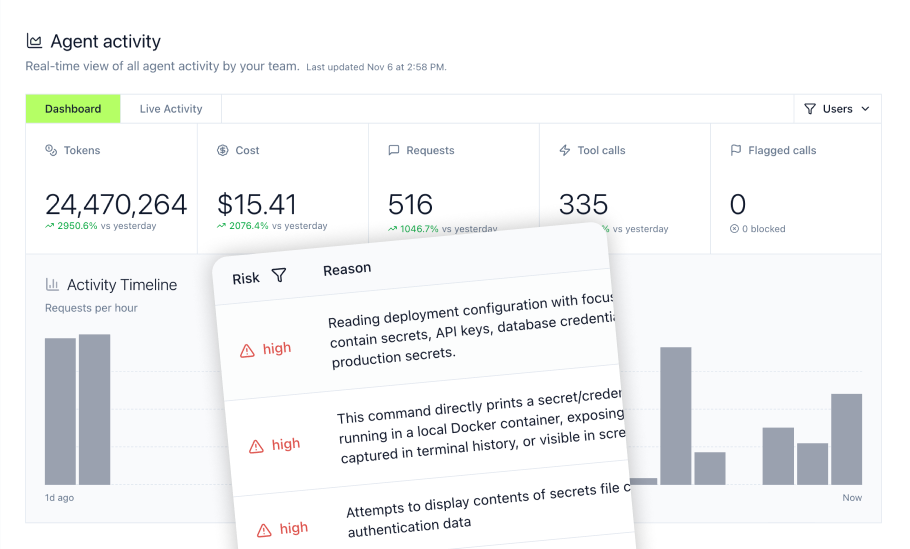
AI agents are transforming enterprise operations—but most organizations lack visibility into what these agents access, execute, and modify. While 79% of organizations report AI agent adoption, in any given business function, no more than 10% report scaling AI agents. The gap? Monitoring and governance infrastructure. MintMCP's LLM Proxy tracks every tool call, bash command, and file operation from coding agents—providing the observability enterprises need to deploy AI at scale. This comprehensive analysis examines market growth, adoption rates, security challenges, and implementation metrics shaping AI agent monitoring in 2025.
Key takeaways
- Market expansion validates monitoring urgency—Industry projections show the AI agents market projected to reach about $50.31B by 2030 (45.8% CAGR, 2025–2030)
- Adoption outpaces governance—79% of organizations have adopted AI agents, yet less than 10% have scaled successfully
- Security concerns dominate—81% of respondents have concerns about security and privacy of data with AI agents
- ROI expectations run high—62% of organizations expect more than 100% return on investment from agentic AI
- Integration remains the top barrier—95% of IT leaders report integration as a hurdle to effective AI implementation
Market growth and adoption statistics
1. The global AI agents market is projected to reach about $50.31B by 2030 (45.8% CAGR, 2025–2030)
Industry projections confirm explosive growth in AI agent technology, with the market expected to grow nearly tenfold over six years at a compound annual growth rate exceeding 45%. This expansion reflects mainstream enterprise adoption as businesses recognize measurable ROI from agent deployments. The projection encompasses software platforms, implementation services, and ongoing optimization—driven by competitive pressure and proven efficiency gains across industries.
2. The AI agents market is expected to grow from $5.4 billion in 2024 to $7.6 billion in 2025
Year-over-year projections show 40% growth in a single year, demonstrating sustained momentum rather than a temporary spike. This acceleration stems from proven enterprise implementations, expanding use cases beyond basic automation, and increasing sophistication of AI capabilities. Organizations delaying adoption risk falling behind competitors who gain substantial advantages in operational efficiency.
3. By 2028, 33% of enterprise software applications will include agentic AI
Industry projections indicate that agentic AI will move from less than 1% of enterprise applications in 2024 to one-third within four years. This trajectory demands production-grade monitoring infrastructure before agents become embedded in critical business systems. The shift requires enterprises to establish governance frameworks now rather than retrofitting controls after deployment.
4. By 2028, at least 15% of day-to-day work decisions will be made autonomously through agentic AI
Autonomous decision-making projections show AI agents moving from zero autonomous decisions in 2024 to handling significant portions of daily operations. This shift demands complete audit trails for every AI action. MintMCP's MCP Gateway provides the observability layer organizations need to track and govern autonomous agent behavior.
5. 79% of organizations say AI agents are already being adopted in their companies
Enterprise survey data from PwC reveals near-universal AI agent adoption across industries. This widespread deployment creates urgent monitoring requirements—organizations cannot secure what they cannot see. The adoption rate also indicates AI agents have moved from experimental status to production infrastructure.
6. 88% of enterprises report regular AI use in their organizations
McKinsey's State of AI survey confirms AI has become standard business infrastructure. Regular use demands regular monitoring—organizations need visibility into which AI tools teams use, what data they access, and what actions they execute. Without centralized observability, enterprises operate with blind spots that create security and compliance risks.
7. 95% of u.S. Companies are now using generative AI
Bain & Company research shows generative AI adoption has reached near-saturation in American enterprises. This ubiquity makes monitoring and governance non-negotiable for any organization serious about security and compliance. The question has shifted from "should we adopt AI" to "how do we govern AI effectively."
8. Less than 10% of organizations have scaled AI agents in any individual function
McKinsey's 2025 report reveals a critical adoption-to-scale gap. Despite 79% adoption, fewer than 10% have achieved enterprise-wide deployment. The primary barriers include lack of observability, governance frameworks, and integration infrastructure—precisely the capabilities that enterprise MCP deployment solutions provide.
9. 82% of executives plan to integrate AI agents within 1–3 years
Executive planning data from Capgemini via Google Cloud shows clear strategic intent for AI agent deployment. This timeline creates a narrow window for organizations to establish monitoring and governance infrastructure before agent deployments proliferate across business functions.
Security and governance statistics
10. 81% of respondents have concerns about the security and privacy of data with AI agents
Developer survey data quantifies widespread security anxiety around AI agent deployments. These respondent concerns are justified—agents often operate with extensive system access, reading files, executing commands, and accessing production systems. Without monitoring, organizations cannot see what agents access or control their actions.
11. 87% of respondentss agree they are concerned about the accuracy of AI agents
Accuracy concerns highlight the need for comprehensive audit trails that enable quality review of AI outputs. Organizations need visibility into every tool call and response to identify accuracy issues before they impact business operations. Real-time monitoring allows teams to catch and correct errors proactively.
12. 62% of practitioners and 53% of leadership identified security as a top challenge
Security challenge data shows alignment between practitioners and executives on AI security priorities. This consensus creates organizational momentum for monitoring investments. The gap between practitioner and leadership percentages suggests opportunities to strengthen executive buy-in through quantified risk assessments.
13. 49% of practitioners and 40% of leadership highlighted data governance as a significant concern
Data governance concerns reflect awareness that AI agents interact with sensitive enterprise data. Organizations need granular controls over what data agents can access and complete audit logs for compliance requirements. SOC2, HIPAA, and GDPR all require demonstrable data access controls that traditional monitoring tools cannot provide for AI agents.
14. 95% of IT leaders report integration as a hurdle to effective AI implementation
Integration challenges represent the most common barrier to AI deployment success. Enterprises struggle to connect AI agents with internal data sources, authentication systems, and existing infrastructure. MintMCP Gateway's 100+ integrations solve this challenge by providing pre-built connectors for enterprise systems.
15. 66% of developers cite AI solutions that are almost right, but not quite" as their biggest frustration
Developer frustration data highlights the importance of monitoring AI agent outputs for quality assurance. Organizations need visibility into agent performance to identify patterns of near-miss responses and refine agent configurations. Without observability, teams cannot systematically improve AI accuracy.
16. 45% report debugging ai-generated code is more time-consuming
Debugging challenges emphasize the need for comprehensive command history and tool call tracking. When AI agents generate problematic code, teams need audit trails to understand what the agent executed and why. MintMCP's LLM Proxy provides complete visibility into every bash command and file access for efficient debugging.
Monitoring and observability statistics
17. 43% of agent developers use grafana + prometheus for AI agent observability
Observability tool adoption shows organizations adapting traditional DevOps monitoring for AI agents. However, these tools lack agent-specific capabilities like tool call tracking, MCP server inventory, and sensitive file protection. Purpose-built solutions provide deeper visibility into AI agent behavior than generic monitoring platforms.
18. 96% of enterprise IT leaders plan to expand AI agent use over the next 12 months
Expansion planning data from Cloudera's global survey of 1,484 IT decision-makers confirms accelerating deployment timelines. Organizations planning expansion must establish monitoring infrastructure before proliferation creates unmanageable visibility gaps. The time to build governance frameworks is before—not after—agents spread across the enterprise.
19. 51% of respondents are using AI agents in production today
Production deployment data from LangChain shows AI agents have moved beyond experimental status. Production deployments demand production-grade monitoring with enterprise SLAs, automatic failover, and complete audit trails. Organizations running agents in production without observability operate with significant blind spots.
20. 78% have active plans to implement agents into production soon
Implementation planning indicates the remaining 49% not yet in production are rapidly moving toward deployment. This wave of new production agents will multiply monitoring requirements exponentially. Organizations should establish centralized governance now to avoid fragmented, ungovernable agent deployments.
Developer adoption and tool statistics
21. 84% of developers are using or planning to use AI tools in their development process
Developer adoption data confirms AI tools have become standard in software development workflows. This ubiquity means coding agents operate across most engineering organizations—often without centralized visibility. Enterprises need monitoring that tracks AI tool usage without disrupting developer workflows.
22. 51% of professional developers use AI tools daily
Daily usage statistics show AI tools are embedded in developer routines, not occasional experiments. Daily usage generates substantial volumes of tool calls, file accesses, and command executions that require systematic monitoring. Organizations need real-time dashboards to track patterns and detect anomalies across high-volume usage.
23. 15 million developers are already using GitHub copilot
GitHub Copilot adoption demonstrates the scale of coding agent deployment. With millions of developers using AI-powered tools, enterprises face unprecedented monitoring challenges. MintMCP's LLM Proxy provides the visibility layer organizations need to track what Copilot and similar tools access.
24. More than 230,000 organizations have used copilot studio to build AI agents and automations
Enterprise agent creation data from Microsoft shows organizations building custom AI agents at scale. Each custom agent represents new monitoring requirements—organizations need visibility into agent capabilities, permissions, and usage patterns across their entire agent portfolio.
Investment and ROI statistics
25. 88% of organizations plan to increase ai-related budgets in the next 12 months due to agentic AI
Budget expansion data from PwC's survey of 300 senior executives confirms sustained investment momentum. Budget increases should include monitoring and governance infrastructure—not just agent capabilities. Organizations that invest in agents without observability create technical debt that compounds over time.
26. 43% of companies allocate over half of AI budgets to agentic AI
Budget allocation data from Ernst & Young shows agentic AI commanding significant investment share. This allocation level justifies proportional investment in monitoring infrastructure. Organizations spending heavily on agents while underinvesting in governance expose themselves to security, compliance, and operational risks.
27. AI agent startups raised $3.8 billion in 2024, nearly tripling from the previous year
Investment data from CBInsights confirms explosive venture capital interest in AI agents. This funding wave will accelerate agent proliferation across enterprises, intensifying monitoring requirements. Organizations should establish governance frameworks before the next wave of agent tools enters their technology stack.
28. 62% of organizations expect more than 100% return on investment from agentic AI
ROI expectations from PagerDuty's research show aggressive return targets that demand measurable outcomes. Without monitoring, organizations cannot quantify AI agent impact or optimize deployments for maximum ROI. Complete usage analytics enable cost allocation, performance tracking, and continuous improvement.
29. 66% of organizations adopting AI agents say they're delivering measurable value through increased productivity
Productivity value data confirms organizations are seeing results from AI agent investments. Measuring this value requires usage analytics, performance metrics, and cost tracking—capabilities that require comprehensive monitoring infrastructure. Organizations without observability cannot prove or optimize AI agent ROI.
Implementation and scale statistics
30. 85% of organizations are currently using some form of AI
Current AI adoption data from a Wiz study shows widespread AI implementation across enterprises today. This high adoption rate underscores the immediate need for monitoring infrastructure—organizations cannot govern what they cannot see. As AI usage continues to expand, centralized observability becomes critical for maintaining security and compliance.
Strategic implementation insights
AI agent monitoring works best when built for complete observability—not just error tracking. The organizations achieving successful scale aren't those with the most agents deployed. They're teams with centralized governance that tracks every tool call, controls MCP permissions, and maintains complete audit trails for compliance.
Here's how to maximize monitoring effectiveness:
- Map your agent inventory—Identify every AI tool, MCP server, and coding agent operating across your organization
- Establish baseline visibility—Track tool calls, file accesses, and command executions before expanding deployments
- Implement security guardrails—Block dangerous commands and protect sensitive files like .env files, SSH keys, and credentials
- Centralize authentication—Enforce OAuth and SSO across all MCP connections using enterprise authentication models
- Build compliance infrastructure—Maintain complete audit trails for SOC2, HIPAA, and GDPR requirements
If you want the fastest path to production-grade monitoring, start with high-risk agents first. Establish observability for coding agents accessing production systems, then expand coverage systematically. MintMCP's documentation provides implementation guides for enterprise deployments.
Frequently asked questions
What is AI agent monitoring and why does IT matter for enterprises?
AI agent monitoring provides visibility into what AI tools access, execute, and modify across enterprise systems. Without monitoring, organizations cannot see which data agents access, what commands they run, or whether they comply with security policies. 81% of respondents have security concerns about AI agents—monitoring addresses these concerns by providing complete audit trails and real-time observability.
How does AI agent monitoring differ from traditional application monitoring?
Traditional tools like Grafana and Prometheus track application performance but lack AI-specific capabilities. Agent monitoring tracks tool calls, MCP server inventories, and file access patterns unique to AI systems. Only 43% of developers use traditional observability tools for agents—purpose-built solutions provide deeper visibility into agent behavior.
What compliance requirements does AI agent monitoring address?
AI agent monitoring supports SOC2, HIPAA, and GDPR compliance through complete audit trails of every tool interaction, access request, and data access. With 49% of practitioners citing data governance as a concern, compliance-ready monitoring infrastructure is essential for regulated industries.
Can AI agent monitoring integrate with existing enterprise systems?
Yes—enterprise monitoring platforms like MintMCP provide native integrations with CRMs, databases, authentication systems, and helpdesks. 95% of IT leaders report integration as a barrier to AI implementation. Pre-built connectors for systems like Elasticsearch and Snowflake eliminate integration friction.
What ROI can organizations expect from AI agent monitoring investments?
Organizations implementing AI governance see improved security posture, compliance readiness, and operational efficiency. With 62% expecting over 100% ROI from agentic AI, monitoring ensures organizations can measure, prove, and optimize that return through usage analytics and performance tracking.