When evaluating Barndoor AI alternatives, the choice comes down to whether organizations need unified LLM plus MCP governance or a dedicated MCP control plane with agent-specific capabilities. While Barndoor AI combines both capabilities in a single platform, many organizations seek solutions with different architectural approaches, specialized agent governance features, or distinct deployment models.
This guide examines six Barndoor AI alternatives, with particular focus on how MintMCP approaches enterprise MCP and agent governance. Organizations deploying AI assistants and autonomous agents through the Model Context Protocol face critical decisions around identity management, access control, runtime security, and observability. Understanding how each platform addresses these requirements helps teams select infrastructure that aligns with their governance priorities, compliance obligations, and operational constraints.
Key takeaways
- MintMCP differentiates its Virtual MCP model through per-use-case endpoints with SCIM-driven membership, curated tools, and access policies
- Agent identity as a first-class capability means autonomous agents receive independent credentials, scoped permissions, and attributable audit trails rather than inheriting human credentials or using shared API keys
- Pricing models vary significantly across alternatives, from transparent per-user pricing to custom quotes for enterprise features
- Deployment options span managed SaaS, self-hosted open source, and hybrid architectures depending on infrastructure control requirements
- Product scope and architecture vary: some alternatives began as broader AI or LLM gateways, while others focus primarily on MCP and agent governance
- Runtime security controls operate at different layers, from gateway-only traffic inspection to comprehensive agent behavior monitoring
Understanding Barndoor AI
Barndoor AI positions itself as a unified AI Gateway that combines MCP governance with LLM gateway capabilities. The platform offers a single endpoint for managing both model access and tool connections under one identity, policy, and audit layer.
Barndoor AI provides per-agent cost tracking through AgentProfile, advanced DLP with custom classifiers, and direct and indirect prompt injection detection. Token and cost attribution operates per agent. With pricing structured across two public tiers (Pro and Enterprise), Barndoor AI offers up to 50 human identities on the Pro plan with unlimited agents and MCPs. The Enterprise tier adds unlimited identities and full LLM Gateway capabilities.
Pro focuses on MCP Governance, while LLM Gateway capabilities are included in Enterprise or available as an upgrade. Public pricing uses contact-sales quotes rather than fixed dollar amounts. Barndoor's broader platform combines MCP governance, LLM gateway capabilities, data protection, and cost controls, which is a different scope from MCP-focused control planes.
1. MintMCP
MintMCP provides enterprise infrastructure for governing AI clients and autonomous agents across the Model Context Protocol ecosystem. The platform takes a data-permissions-first approach: governance starts from controlled access to enterprise data and tools, then extends that foundation to autonomous agents.
Core capabilities
MintMCP's architecture delivers several governance capabilities:
- SOC 2 Type II audited controls with compliance documentation and penetration testing
- Virtual MCPs bundle connectors behind one governed endpoint per team, role, or use case
- Agent Gateway provides first-class non-human identities for autonomous agents
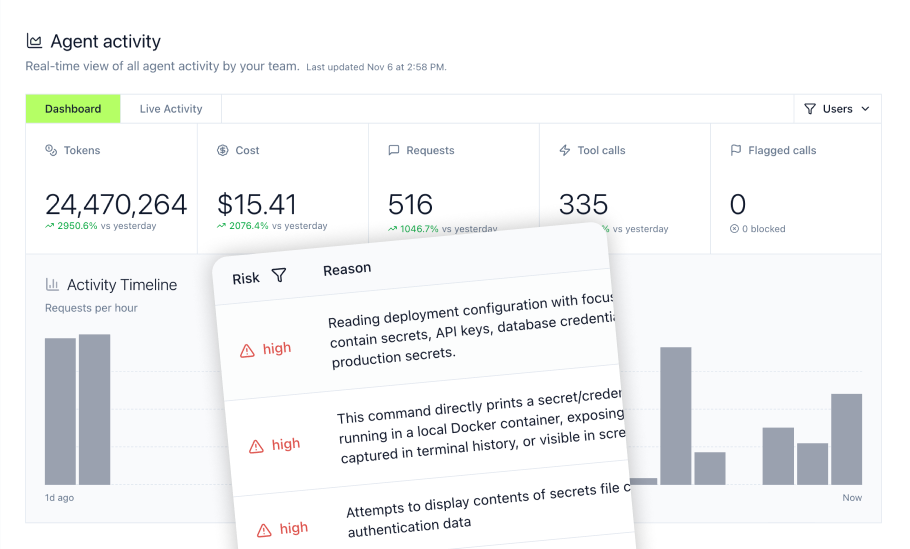
- Agent Monitor delivers visibility into prompts, commands, file access, and MCP tool calls
- Runtime controls through Mint Guard, Rules, and Gateway Middleware
- One-click deployment for rapid time-to-value
- Hosted connectors across data, engineering, collaboration, and security tools
Virtual MCP bundles
The Virtual MCP is MintMCP's core abstraction. Each VMCP serves as the unit of deployment, access control, tool curation, audit, and administration. Directory groups drive membership through SCIM, helping organizations apply consistent access policies without requiring every employee to configure MCP servers separately. Teams can create read-only and read-write VMCPs over the same connector simply by curating different tool sets.
Agent identity architecture
Unlike platforms where agents inherit human credentials or use shared API keys, MintMCP's Agent Gateway gives each autonomous agent its own identity with:
- Bearer keys with name, expiry, and individual revocation
- OAuth client-credentials exchange for short-lived M2M tokens
- Workload identity federation where the agent's infrastructure mints OIDC tokens
- Independent credential rotation and revocation
- Per-agent audit trails
Security and guardrails
MintMCP's runtime controls operate at the agent-tool interaction layer through three complementary mechanisms:
- Mint Guard: Managed detection for prompt injection, secrets, PII, and harmful content
- Rules: Declarative matching on tool names, arguments, and content
- Gateway Middleware: Customer-authored JavaScript for DLP integrations and custom policy
Pricing and deployment
MintMCP offers a free 7-day trial available without a credit card. Custom pricing is based on team size and requirements. Flexible deployment options include self-hosted deployments for organizations with specific infrastructure requirements.
Organizations using Claude, Cursor, ChatGPT, Gemini, or Copilot can centralize MCP governance through MintMCP. The platform supports teams wanting per-agent identity as a first-class primitive. Enterprises value SOC 2 Type II audited controls, compliance with HIPAA standards, and BAA availability for customers handling protected health information. Platform teams benefit when MintMCP hosts and runs connectors rather than operating the runtime themselves.
2. TrueFoundry
TrueFoundry offers a comprehensive AI control plane that combines LLM Gateway, MCP Gateway, Model Serving, and Agent Gateway in one platform. The solution targets platform engineering and ML teams that need more than just MCP governance.
Platform features
- Most transparent pricing with $0 free tier for 3 users and $25/user/month Pro plan
- Published vendor benchmarks reporting approximately 3-5ms of added gateway latency and 350+ RPS on a single vCPU
- Full-stack AI platform covering LLMOps, model serving, and agent infrastructure
- Self-hosted first-class support including VPC, on-prem, air-gapped, and multi-cloud deployments
- SOC 2 and HIPAA compliance with enterprise security controls
Pricing structure
TrueFoundry's pricing includes:
- Developer: $0 for 3 users, 10K requests/user
- Pro: $25/user/month plus $15 per 100K overage requests
- Enterprise: Custom pricing with VPC and air-gapped options
The broader platform scope means steeper learning curve than MCP-only solutions. Overage costs at $15 per 100K requests can accumulate at high volume. Platform engineering and ML teams that need LLMOps, model serving, and MCP governance in one control plane find value in TrueFoundry's integrated approach.
3. Obot
Obot takes an open-source-first approach to MCP gateway infrastructure. Licensed under MIT, the platform gives teams control over their MCP infrastructure.
Deployment and architecture
- MIT open-source license with full code access
- Managed Obot Cloud and self-hosted options let teams choose between a hosted deployment and customer-operated infrastructure
- GitOps-compatible infrastructure as code workflows
- Curated MCP server catalog for enterprise-relevant tools
Deployment options
- Development: Docker for local setup
- Production: Kubernetes for scaled deployments
- Managed cloud: Obot Cloud provides a fully hosted option
Self-hosted Community deployments require customer-operated infrastructure, while Obot Cloud removes that infrastructure-management burden. Some enterprise capabilities, including additional enterprise identity providers, SLAs, and support, are provided through Obot's commercial editions. Kubernetes-fluent infrastructure teams wanting control over MCP infrastructure can leverage Obot's open-source foundation.
4. Portkey
Portkey, now branded as PRISMA AIRS AI Gateway, spans AI gateway and MCP gateway capabilities. The platform provides unified access to over 1,600 LLM models with MCP governance extending those capabilities.
Platform strengths
- 1,600+ LLM model support with routing and load balancing
- Unified observability dashboard for LLM and MCP traffic
- SOC 2 compliance for enterprise deployments
- Open-source core with enterprise features available
- Strong LLM routing with fallbacks and caching
Architecture notes
The MCP Gateway is part of a broader AI Gateway platform rather than a standalone MCP-only product. The platform combines MCP access control, registry, observability, and policy enforcement with broader model routing and AI gateway capabilities. MCP Gateway launched in January 2026, with OAuth 2.0 support for authentication.
Teams already using or evaluating Portkey for LLM gateway needs can extend to MCP governance. Organizations that want unified LLM and MCP traffic management benefit from the integrated dashboard. Developers prioritizing broad model provider access can leverage Portkey's 1,600+ model catalog.
5. Runlayer
Runlayer combines MCP governance with ML-based threat scanning and shadow AI discovery capabilities. The platform targets IT security and AI operations teams concerned about unapproved AI usage.
Security and governance
- Shadow AI discovery through Watch feature
- ML-based threat scanning for security-focused organizations
- Policy engine for access control
- Hybrid deployment with managed SaaS plus self-hosted options
- Security-first positioning for IT-Sec buyers
Architecture and compliance
Runlayer has expanded beyond shadow AI discovery into agent IAM, runtime security, observability, managed agents, and MCP governance. Current Runlayer materials document SOC 2 Type II, GDPR, and HIPAA-related compliance claims. Managed SaaS deployment is available alongside self-hosted customer infrastructure options. The platform maintains a registered MCP server catalog with policy-driven access controls.
Changing catalog, client-support, benchmark, and compliance details should be verified against current vendor documentation before making purchase decisions. Security teams prioritizing shadow AI detection and threat scanning find value in Runlayer's ML-based approach.
6. Composio
Composio focuses on integration breadth, offering over 1,000 pre-built connectors for AI agent development. The platform targets developers building agentic applications.
Integration and governance
- 1,000+ pre-built integrations across enterprise and consumer tools
- Rapid prototyping with fast developer onboarding
- SOC 2 compliance for enterprise requirements
- User-scoped authentication for connector access
- Cloud-first architecture with VPC options on Enterprise tier
Considerations
Composio combines broad integration coverage with MCP gateway and agent-governance capabilities. Self-hosted deployment is available on the Enterprise tier. Its primary orientation remains developer and AI-engineering infrastructure, which differs from MintMCP's emphasis on internal IT and security governance.
Free tier is available for initial development, with Enterprise tier required for VPC and on-prem options. Developers prioritizing connector breadth can leverage Composio's 1,000+ integration catalog. Projects that need broad integration coverage alongside authentication, access policy, and audit controls find value in Composio's approach.
Why MintMCP for enterprise MCP governance
MintMCP's differentiation stems from architectural decisions that prioritize enterprise governance and agent identity from the foundation.
- Data-permissions-first architecture: Unlike platforms that add governance to existing infrastructure, MintMCP starts from permissions and governed access. The MCP Gateway authenticates users through your IdP, curates which tools each role sees, injects credentials per call, and logs everything. This approach ensures governance is foundational rather than bolted on.
- Virtual MCP bundles as differentiation: MintMCP's specific differentiation is the combination of per-use-case endpoints, SCIM-driven membership, curated tools, and access policy. The Virtual MCP abstraction creates per-use-case endpoints with centrally curated tools, access policies, and SCIM-driven membership. One VMCP can provide read-only access while another exposes read-write tools over the same connector.
- First-class agent identity: Agent identity is a core MintMCP capability. The Agent Gateway treats autonomous agents as first-class non-human principals rather than extensions of human credentials. Each agent gets independent credentials, scoped MCP access, and attributable audit trails. Credentials can be rotated or revoked without affecting other agents or users.
- Comprehensive monitoring beyond gateway traffic: Agent Monitor provides visibility into supported agent activity including prompts, commands, file access, and MCP tool calls. This coverage extends beyond gateway traffic to capture local agent behavior, addressing shadow AI concerns that gateway-only solutions miss.
- Runtime guardrails with three layers: MintMCP's guardrails operate through Mint Guard (managed detection), Rules (declarative matching), and Gateway Middleware (customer JavaScript). This layered approach provides out-of-the-box protection while enabling custom policy enforcement.
MintMCP is positioned around internal enterprise MCP and agent governance. Organizations can start a free trial to evaluate how Virtual MCPs, Agent Gateway, and Agent Monitor address MCP governance requirements.
Frequently asked questions
What is an MCP control plane and why does it matter for enterprise AI?
An MCP control plane governs how AI clients and agents connect to enterprise tools through the Model Context Protocol. It centralizes authentication, manages credentials, controls which tools each user or agent can access, and logs all activity. Without a control plane, organizations face scattered configurations, credential sprawl, missing audit trails, and no visibility into what agents are actually doing. For enterprises deploying Claude, Cursor, ChatGPT, or custom agents, an MCP control plane helps make AI systems deployable, governed, and measurable while supporting compliance requirements. The NIST AI Risk Management Framework emphasizes governance and accountability controls that MCP control planes help operationalize.
How does MintMCP's approach to agent identity differ from shared credential models?
MintMCP treats autonomous agents as first-class non-human principals through its Agent Gateway. Each agent receives its own identity, credentials, scoped MCP access, and audit trail independent from human users. Authentication can include bearer keys, M2M tokens, or workload identity federation. Credentials can be rotated or revoked per-agent without affecting others. This architecture prevents agents from inheriting human credentials or using shared API keys, which strengthens both security and auditability. Dedicated agent identities provide clearer attribution by separating autonomous-agent activity from human credentials and shared service accounts.
What visibility does Agent Monitor provide beyond gateway traffic?
Agent Monitor captures supported activity from AI coding agents including prompts, file reads (including .env and SSH keys), commands, and MCP tool calls. This visibility extends beyond gateway traffic to capture local agent behavior. Gateway-only solutions see what passes through the gateway but miss activity happening at the endpoint. Agent Monitor addresses shadow AI concerns by detecting MCP usage even when the MCP is not connected through the gateway.
What are Virtual MCPs and how do they enable per-use-case governance?
Virtual MCPs (VMCPs) are MintMCP's core abstraction for governed tool access. Each VMCP bundles approved connectors and a curated tool surface behind one endpoint for a particular team, role, use case, or agent. VMCPs serve as the unit of deployment, access control, tool curation, audit, and administration. Directory groups drive membership through SCIM, so access policies scale with organizational structure. Teams can create different VMCPs over the same connector for read-only versus read-write access, enabling fine-grained governance without duplicating connector infrastructure.