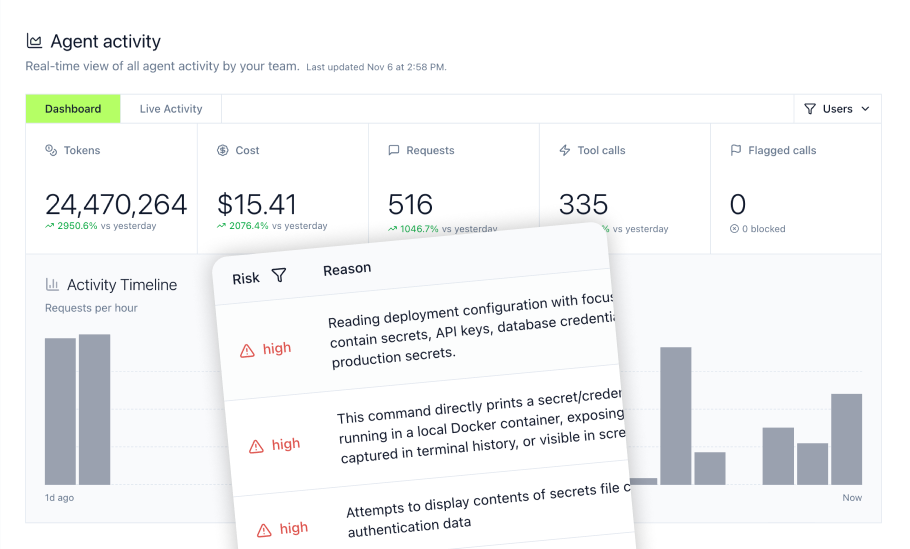
With Claude now expanding from chat and coding workflows into Slack-native agent experiences like Claude Tag, the platform's agentic capabilities create security exposures that traditional API governance cannot address. Claude Code operates as an autonomous coding agent with terminal-level access, enabling file operations, bash commands, and MCP tool integrations that extend far beyond simple chatbot interactions, while independent MCP ecosystem research has evaluated 1,899 open-source MCP servers highlighting the scale of third-party tool surfaces. Organizations deploying Claude face a mix of Claude Code-specific vulnerabilities, MCP ecosystem vulnerabilities, prompt injection risk, credential exposure, and audit visibility gaps that require controls beyond standard API monitoring. Addressing these risks requires purpose-built infrastructure like an MCP Gateway for governed tool access and an Agent Gateway layer for agent identities, permissions, memory, and monitoring across Claude Tag, Claude Code, and other enterprise agents.
This article outlines the specific security risks Claude introduces to enterprise environments and provides actionable strategies for implementing governance, securing credentials, achieving compliance, and detecting unauthorized usage.
Key Takeaways
- Claude Code can read files, execute bash commands, and connect to MCP tools, creating attack surfaces beyond traditional chatbot risk profiles
- Independent MCP ecosystem research found that 7.2% of servers contained general vulnerabilities and 5.5% exhibited MCP-specific tool poisoning, making unvetted MCP server installations a primary enterprise risk vector
- Cowork activity has been reported as excluded from Claude's audit logs, Compliance API, and data exports, while Claude Tag should be evaluated separately for Slack access, tool-call visibility, and admin controls
- Shadow AI through personal Claude accounts bypasses all organizational controls; domain capture and SSO must be deployed before rolling out Claude Code to developers
- Claude Code sandboxing reduced permission prompts by 84% in internal usage, showing how tighter execution boundaries can improve both security and usability
- Enterprise deployment should follow a phased rollout covering SSO configuration, gateway deployment, managed MCP policy, endpoint controls, and developer training
Understanding the Unique AI Security Risks Posed by Claude in Enterprise Settings
Claude's three-interface architecture creates distinct threat surfaces that compound when deployed without centralized governance. The web interface operates within browser sandboxes with limited system access. Claude Desktop integrates with local tools and MCP servers. Claude Code functions as an autonomous agent with bash command execution, file system access, and the ability to chain multiple tool calls without human intervention.
Claude Tag introduces a fourth surface: Slack-native agent deployment where Claude joins channels with persistent identity, channel-scoped memory, and connections to enterprise MCP tools through admin-governed access policies. Tag runs in Anthropic-hosted ephemeral cloud sandboxes separate from desktop or code environments.
How Claude's Nature Introduces New Security Considerations
Unlike passive AI assistants, Claude Code can autonomously complete multi-file code refactoring, execute database queries, deploy infrastructure, and interact with production systems. This agentic behavior means a single compromised prompt or malicious MCP server can trigger cascading actions across your infrastructure.
The MCP ecosystem amplifies this risk. Claude can connect to MCP servers providing database access, API integrations, and system controls. Each connection represents a potential data flow that bypasses traditional network security boundaries.
Common Attack Vectors Targeting Large Language Models
Enterprise Claude deployments face several documented attack categories:
- Prompt injection attacks: Adversarial inputs embedded in documents, emails, or web content can hijack Claude's instructions, causing it to exfiltrate data or execute unauthorized actions
- Supply chain compromises: Malicious MCP servers from public marketplaces can intercept credentials, inject backdoors, or exfiltrate sensitive context
- Credential harvesting: Claude Code's file system access means .env files, SSH keys, and API tokens become accessible to any process with sufficient permissions. Check Point Research documented CVE-2025-59536 enabling RCE and token exfiltration through project files
- Context window manipulation: Attackers can craft inputs that overflow Claude's context window, displacing security instructions with malicious directives
Understanding these vectors is essential for building effective security governance that protects enterprise data while enabling Claude's productivity benefits.
Navigating Data Privacy and PII Exposure Risks with Claude Agents
Claude's ability to access internal systems creates direct pathways for sensitive data exposure. When an agent queries a customer database or reads internal documents, that data flows through Claude's processing pipeline and may persist in logs, caches, or conversation histories.
Preventing Inadvertent Data Leakage Through Claude Interactions
Data loss prevention for Claude requires multiple layers:
- Access scoping: Limit Claude's connections to databases containing PII using tool-level permissions that allow read access for aggregate queries while blocking individual record retrieval
- Output filtering: Implement guardrails that detect and redact PII patterns (SSNs, credit cards, health records) before responses reach users
- Conversation isolation: Ensure cross-user conversation histories cannot leak between sessions or be accessed by unauthorized parties
- Regional data review: For GDPR and regional compliance, review where Claude, connected tools, logs, and gateway telemetry are processed and stored. Do not assume multi-region data residency controls are available without confirming the deployment architecture
Implementing Robust Data Loss Prevention for AI Agents
Effective DLP integration requires inline inspection of every MCP tool call. The MCP data risk framework outlines how to classify tool connections by sensitivity level and apply proportional controls.
Organizations with existing DLP investments can extend those capabilities to Claude traffic through middleware layers that integrate with AWS Bedrock Guardrails, Google Cloud DLP, or Microsoft Purview. This approach enforces consistent data handling policies across human and agent access patterns.
Mitigating Credential Leakage and Unauthorized Access in Claude Deployments
Credential exposure represents the highest-severity risk in Claude Code deployments. A single exfiltrated API key or database password can enable lateral movement across your entire infrastructure.
Securing Claude's Access to Internal Systems and Tools
Deploy managed Claude Code configuration and MCP controls with explicit restrictions for sensitive paths and approved MCP servers:
- Block access to
.envfiles containing environment variables - Deny reads from
~/.ssh/directories housing private keys - Prevent access to
secrets/,credentials/, and similar directories - Use
managed-mcp.jsonwithallowManagedMcpServersOnly: truewhen you need Claude Code to load only approved MCP servers
This configuration must be deployed via MDM (Jamf, Intune) to ensure enforcement. Developers should not have the ability to modify or disable these protections locally.
Implementing Automated Credential Management for AI Agents
Each AI agent should receive its own persistent identity with scoped credentials that rotate independently of human user accounts. This architectural decision enables:
- Audit attribution: Every tool call traces to a specific agent identity, not a shared service account
- Blast radius limitation: Compromised agent credentials affect only that agent's permission scope
- Independent rotation: Credentials can be revoked and rotated without disrupting other agents or users
- Compliance readiness: Per-agent audit trails satisfy requirements for access logging
The agent identities model treats agents as first-class security principals with their own OAuth 2.0 client credentials, bearer tokens, and access policies.
Ensuring Compliance and Auditability for AI Agent Activities with Claude
Enterprise compliance frameworks assume complete visibility into system access. Claude's architecture creates gaps that require proactive mitigation.
Audit Coverage Gaps Across Claude Agent Surfaces
Claude agent surfaces do not all provide the same audit coverage. Cowork has been reported as excluded from Anthropic's Audit Logs, Compliance API, and Data Exports, while Claude Tag should be evaluated separately based on its Slack channel access, session records, tool-call visibility, and admin controls.
This creates direct compliance challenges:
- SOC 2 Type II audit readiness depends on complete, attributable audit trails for in-scope system access
- HIPAA-aligned controls require logging PHI access with user attribution when Claude touches protected health information
- GDPR requires demonstrable data processing records
Meeting Industry Standards for AI Agent Governance
For regulated workloads, avoid Cowork entirely or implement documented compensating controls. Use Claude Chat (Enterprise tier) or Claude API, which provide audit logs exportable to SIEM platforms. Deploy an MCP Gateway to capture tool invocations with full context logging.
Configure OpenTelemetry export with 90-day minimum retention for compliance evidence. Note that OpenTelemetry does not replace audit logging for compliance purposes; it supplements gateway-level audit trails for operational observability.
Organizations handling PHI should request Anthropic's HIPAA documentation and execute a BAA for Claude usage. For MintMCP-managed governance, customers can request HIPAA documentation, and MintMCP signs BAAs.
Detecting and Preventing Shadow AI and Off-Gateway Claude Usage
Personal Claude accounts represent the largest governance gap in enterprise deployments. Employees using personal Pro subscriptions bypass all organizational controls, creating invisible data flows and compliance exposures.
Uncovering Unmanaged AI Agent Deployments
Shadow AI detection requires visibility beyond the MCP gateway. Developer tools like Claude Code and Cursor can connect to MCP servers without routing through centralized infrastructure.
Agent Monitor provides this visibility through hooks in Claude Code and Cursor that detect:
- Off-gateway MCP connections to unauthorized servers
- Local file access patterns indicating sensitive data reads
- Bash command execution that could enable data exfiltration
- Prompt submissions containing PII or credentials
Applying Consistent Security Policies Across All Claude Interactions
MDM integration enables push of detect-only or enforce-mode configurations to developer machines. This ensures consistent policy application regardless of whether developers use centrally managed Claude Enterprise accounts or attempt to use personal installations.
Domain capture through the Claude Admin Console routes all @company.com email addresses to your organization workspace, preventing employees from creating personal accounts that bypass governance.
Protecting Against Prompt Injection and Malicious Agent Behavior
Prompt injection attacks exploit the gap between Claude's instruction-following nature and the adversarial content it encounters during normal operation.
Safeguarding Claude from Adversarial Inputs
Prompt injection defense requires multiple layers:
- Input validation: Scan incoming context for injection patterns before processing
- Instruction anchoring: Use system prompts that resist override attempts
- Output verification: Check responses for signs of instruction hijacking before delivery
- Behavioral baselines: Detect anomalous tool call patterns that suggest compromised sessions
Implementing Runtime Blocking of Risky Agent Actions
Configure guardrail policies with block, flag, and alert actions based on risk severity:
- Block: Network calls to external hosts (curl, wget) from Claude Code contexts
- Block: File writes to system directories or executable paths
- Flag: Database DELETE or DROP statements for human review
- Alert: Unusual patterns like bulk file reads or credential directory access
Containerized sandbox execution for untrusted MCP server code provides additional isolation, with input/output inspection before responses reach Claude or users.
Securing API Integrations and Third-Party Tool Access for Claude
The MCP ecosystem creates a supply chain risk that traditional vendor management cannot address. Each MCP server represents third-party code executing within your security boundary.
Establishing Secure Connections for Claude to Enterprise Systems
Centralize MCP server management through a gateway that provides:
- One-click activation of pre-configured connectors with enterprise authentication for Salesforce, GitHub, Slack, HubSpot, Notion, and 50+ other platforms
- OAuth brokering for stdio-based MCP servers that cannot handle redirect URIs in hosted environments
- Transport normalization across stdio, HTTP-streamable, and SSE protocols
- Rate limiting per user and team to prevent abuse or runaway automation
Managing Permissions for External Tool Interactions
Tool-level access control enables granular permissions beyond all-or-nothing MCP server access:
- Enable database read operations while blocking writes
- Allow Slack message reading but require approval for posting
- Permit GitHub PR reviews while blocking direct merges to main
This approach implements least-privilege principles at the tool level rather than the server level, reducing exposure when any single MCP server is compromised.
Implementing Enterprise-Grade Governance and Infrastructure for Claude Deployments
Effective Claude governance requires purpose-built infrastructure that addresses the unique characteristics of agentic AI systems.
Building a Secure Foundation for AI Agents
The Bundle architecture packages tool access, policy enforcement, and audit logging into single governance units per team or role. Each Bundle provides:
- SCIM group membership synchronization with Okta or Azure AD
- Curated MCP server lists with admin approval workflows for additions
- Policy inheritance from organization to team level
- Isolated audit trails per Bundle for simplified compliance reporting
Virtual MCPs extend this model by creating role-specific tool surfaces that expose only the capabilities each team needs, with consistent governance across all access.
Zero-Trust Architecture for AI
Claude deployments should assume no default access. Every request requires:
- Authentication: SSO via SAML 2.0 or OIDC with MFA enforcement
- Authorization: Tool-level permission checks against Bundle policies
- Attribution: Per-user or per-agent logging with immutable audit records
- Validation: Input/output inspection against guardrail policies
This approach ensures compromised credentials or sessions cannot access resources beyond their explicitly granted scope.
Actionable Steps to Bolster Claude Security in Your Enterprise
A structured approach reduces risk while enabling faster time-to-value.
Developing a Strategic Approach to AI Agent Security
Phase 1: Foundation
- Configure SSO and domain capture before any developer deployment
- Define managed Claude Code policy with deny rules for sensitive file paths
- Establish MCP server vetting criteria and approval workflows
Phase 2: Infrastructure
- Deploy MCP Gateway with OAuth brokering and audit logging
- Configure SIEM integration with 90-day retention
- Set
allowedMcpServersto gateway-only access
Phase 3: Rollout
- Pilot with 5-20 developers across different teams
- Monitor deny-action rates and adjust policies for productivity
- Gradual expansion with training and documentation
Best Practices for Secure Claude Integration and Management
- Credential stores such as
.envfiles, SSH keys, and API tokens are high-risk targets; deny rules and sandbox boundaries for those paths should be treated as baseline controls - Use
managed-mcp.jsonor an approved-catalog pattern to block unapproved MCP servers until individually vetted by security - Review deny-action logs weekly to detect both security threats and excessive friction
- Use Claude Chat or API for regulated workloads; avoid Cowork until audit logging is addressed, or implement documented compensating controls for any Cowork usage in audit scope
- Organizations should track incident volume, denied actions, off-gateway connections, credential exposure attempts, and audit completeness before and after deploying governance controls
How MintMCP's Agent Gateway Secures Claude Tag and Coworker Agent Deployments
MintMCP's approach to Claude Tag security centers on treating agents as first-class governance principals with persistent identities, owned memory systems, and flexible model selection. MintMCP's Agent Gateway is designed to provide governance across Claude Tag, Claude Code, and multi-vendor coworker agent deployments.
The Agent Gateway builds on MCP Gateway's tool-level access control by adding agent-specific capabilities: persistent agent identities that integrate with enterprise SSO, per-agent memory systems that teams fully own and control, policy enforcement at the agent identity level rather than user level, and audit trails that trace every tool call to a specific agent context. This architecture enables Claude Tag to function within zero-trust security boundaries while maintaining the conversational continuity and channel-scoped memory that make Slack-native agents productive.
MintMCP's coworker agent feature extends this model beyond Claude. Teams can deploy agents with their own memory governance, choose which AI models power each agent (including cost-efficient options like GLM-5.2), and apply consistent security policies regardless of the underlying LLM. This flexibility proves essential for organizations managing multiple agent types across different use cases, cost profiles, and compliance requirements.
For Claude Tag specifically, an Agent Gateway approach helps map Slack-based agent usage to governed identities, approved MCP tools, scoped permissions, audit trails, and existing SIEM or compliance workflows. Organizations gain complete visibility into what Claude Tag accesses, which tools it invokes, and how data flows between Slack, Claude, and connected enterprise systems.
Deployment follows the phased approach outlined above, with Claude Tag access managed through Bundle policies that map to Slack channels or security groups. Admins curate which MCP servers each Bundle can access, apply tool-level permission boundaries, and monitor usage patterns through centralized dashboards. The result is Claude Tag adoption that satisfies security, compliance, and productivity requirements without forcing teams to choose between agent capabilities and governance controls.
Frequently Asked Questions
What specific data security risks does integrating Claude pose to my enterprise?
Claude's three interfaces create distinct risk profiles. Claude.ai operates in browser sandboxes with limited exposure. Claude Desktop can access local MCP servers and files. Claude Code has terminal-level access enabling bash execution, file system reads/writes, and connections to production databases. Claude Tag adds Slack-native deployment with channel-scoped context and memory. The primary risks include credential harvesting from .env and SSH key files, data exfiltration through network commands (curl, wget), supply chain attacks through malicious MCP servers, and prompt injection that redirects agent behavior. Organizations must implement deny rules for sensitive directories, route all MCP traffic through governed gateways, and deploy runtime blocking for dangerous operations.
How can I ensure that Claude agents only access authorized internal systems and data?
Implement tool-level access control through an MCP Gateway rather than relying on network segmentation alone. Configure Bundles that map to SCIM groups, with each Bundle containing a curated list of approved MCP servers and specific tool permissions within those servers. For example, a data analyst Bundle might enable database SELECT operations while blocking INSERT, UPDATE, and DELETE. Set allowedMcpServers in managed Claude Code configuration to route all MCP traffic through your gateway, blocking direct connections to public marketplace servers. Deploy per-agent identities with scoped OAuth credentials that can be rotated independently when compromised.
Is shadow AI a significant concern with Claude deployments, and how can it be detected?
Shadow AI represents the largest governance gap in enterprise Claude deployments. Employees using personal Claude accounts bypass all organizational controls including SSO, audit logging, and DLP integration. Detection requires multiple approaches: enable domain capture to prevent personal account creation with corporate email addresses, deploy Agent Monitor hooks in Claude Code and Cursor to detect off-gateway MCP connections, implement network-level blocking for Claude endpoints accessed without SSO authentication, and use MDM to push detect or enforce configurations to developer machines. Organizations should treat shadow AI discovery as a continuous process, not a one-time audit.
What compliance requirements are most critical when using Claude in a regulated industry?
For SOC 2 Type II audit readiness, ensure complete audit trails of in-scope Claude interactions with user attribution, defined log retention, and documented access control policies. The Cowork audit logging exclusion creates a compliance gap that requires either avoiding Cowork for in-scope workloads or implementing documented compensating controls. For organizations working toward compliance with HIPAA standards, execute a BAA with Anthropic, verify the deployment path for PHI-adjacent usage, confirm any Zero-Data-Retention terms that apply, and maintain access logs demonstrating minimum necessary principles. For GDPR, document where Claude-connected data is processed and stored, maintain records of processing activities, and ensure right-to-erasure requests can be fulfilled across Claude-connected systems.
How does per-agent credential management enhance security for Claude in an enterprise?
Traditional approaches use shared service accounts where multiple agents and automation processes share credentials. When any single component is compromised, attackers gain access to everything the shared account can reach. Per-agent credential management assigns each autonomous agent its own identity with scoped OAuth 2.0 client credentials, bearer tokens, and permission boundaries. This enables audit attribution (every action traces to a specific agent), blast radius limitation (compromised credentials only affect that agent's scope), independent rotation (revoke one agent without disrupting others), and compliance alignment (satisfies requirements for individualized access logging). Agent Bundles extend this model by applying Virtual MCP Bundle policies to agent identities, ensuring each agent's tool access follows least-privilege principles.