Claude Enterprise now ships real governance: managed settings for Claude Code, a Compliance API that captures Claude, Claude Code, and Cowork transcripts, audit-log exports, and inference hooks. All of it governs Claude. None of it governs the other AI clients your developers already use (Cursor, Copilot, ChatGPT, Gemini), and none of it controls what happens at the level of a single tool call. That is the gap this review is about. Claude Enterprise has become a common enterprise choice, with one 2025 usage report putting it at roughly 32% of enterprise LLM usage versus 25% for OpenAI, so it is worth being precise about what it covers out of the box and where a layer like MintMCP's MCP Gateway fits for regulated teams.
Key Takeaways
- One 2025 enterprise usage report put Claude at 32% of enterprise LLM usage versus 25% for OpenAI, making it a common choice for technical teams
- Claude Enterprise offers expanded context capacity for large documents, codebases, and research workflows, depending on plan configuration and model availability
- Claude's Compliance API provides pull-based programmatic access to usage telemetry, chat and file content, tool calls, and audit events, and now covers Claude Code and Cowork transcripts
- Anthropic's native controls (Compliance API, audit-log export, managed settings, inference hooks) govern Claude's own surfaces, including Claude Code and Cowork. They do not reach other AI clients like Cursor, Copilot, ChatGPT, or Gemini
- Standard Claude Enterprise runs as cloud SaaS rather than a customer-managed VPC or private deployment, so teams with strict isolation needs evaluate government cloud, Bedrock, or Vertex paths
- Usage-based billing can make costs harder to forecast unless teams model seat fees, usage charges, and spend controls before deployment
- HIPAA coverage depends on the specific Anthropic product, configuration, and BAA terms, so confirm eligibility and any product exclusions with Anthropic; zero-data-retention terms apply to specific products such as Claude Code
- A cross-client governance layer like MintMCP adds per-call control, per-agent identity, and one audit trail across every AI client, not just Claude
What Makes Claude an Enterprise AI Platform?
Claude Enterprise launched in September 2024 as Anthropic's answer to enterprise AI governance demands. The platform bundles Claude's foundation models with security controls designed for regulated organizations, including SSO integration, SCIM provisioning, custom data retention, and dedicated support tiers.
Claude's Core Enterprise Offerings
The Enterprise tier includes several features absent from Team and Pro plans:
- Extended context window: Expanded context capacity for large policy documents, codebases, or legal contracts, with exact limits depending on plan configuration and model availability
- Native integrations: Direct connectors for Google Drive, Gmail, Calendar, GitHub, Microsoft 365, and Slack with SSO-fronted access
- Compliance API: Pull-based programmatic access to usage data, customer content, tool calls, and activity logs for compliance monitoring, now including Claude Code and Cowork transcripts
- Claude Code CLI agent: Available for Enterprise customers through supported plan configurations, with usage analytics and spend controls for terminal-based AI assistance across development workflows
- Admin controls: Custom data retention periods, domain-verified workspaces, and SCIM-driven user provisioning
Claude Enterprise pricing is contract-based and uses a billing model with a fixed seat fee plus separate usage charges. Because usage is billed on top of seat access, organizations should model expected consumption before rollout, especially for teams processing large documents or running extensive code analysis. Anthropic's governance features (the Compliance API, audit logs, managed settings, and inference hooks) come with the Enterprise seat and govern Claude itself, so the real question for buyers is not whether Claude has governance, but how to govern every other AI client and every tool call to the same standard.
Tailoring Claude for Business Use Cases
Claude's instruction-following is strong for complex, multi-step tasks, holding coherence across extended technical conversations.
For organizations already using Claude across departments, the enterprise tier adds governance without changing workflows. But the platform operates as a closed ecosystem with Claude models only, creating vendor lock-in that limits flexibility as the AI landscape evolves.
Claude AI for Business: Unlocking Productivity with Advanced Chatbot Capabilities
Beyond chat, Claude Enterprise works across knowledge work, from document analysis to code review.
Beyond Basic Chat: Claude's Enterprise Use Cases
The expanded context window transforms Claude's utility for document-intensive work:
- Legal review: Process lengthy contracts in single sessions without losing context from early sections
- Code analysis: Analyze entire repositories to understand architecture, identify vulnerabilities, or generate documentation
- Research synthesis: Combine multiple lengthy reports into coherent summaries with consistent terminology
- Customer support: Reference complete conversation histories and product documentation when resolving complex cases
Claude is often evaluated favorably for complex enterprise tasks, especially where long-context reasoning, coding, and instruction following matter.
Measuring ROI with Claude
Enterprise deployments report efficiency gains when Claude handles document analysis that previously required manual review. The Compliance API enables tracking usage patterns across teams, and an audit-log export is available from the admin console in addition to the API.
However, Claude is not primarily positioned as an image-generation tool, so teams needing visual content creation may still maintain parallel subscriptions to other platforms.
Claude Code and Dev Agents: Elevating Engineering Workflows
Claude Code is popular with software development teams. It is available to Enterprise customers through supported plan configurations, but teams should still review usage limits, spend controls, and procurement requirements before rollout.
Code Assistance: Boosting Developer Efficiency
Claude Code operates directly in terminal environments, understanding project context across files and executing multi-step development tasks:
- Analyze existing codebases to suggest refactoring opportunities
- Generate unit tests based on function implementations
- Debug complex issues by tracing execution paths
- Draft pull request descriptions from commit histories
The expanded context in Claude Code enables analysis of large repositories that may exceed the limits of competing tools.
Automating Development with Claude
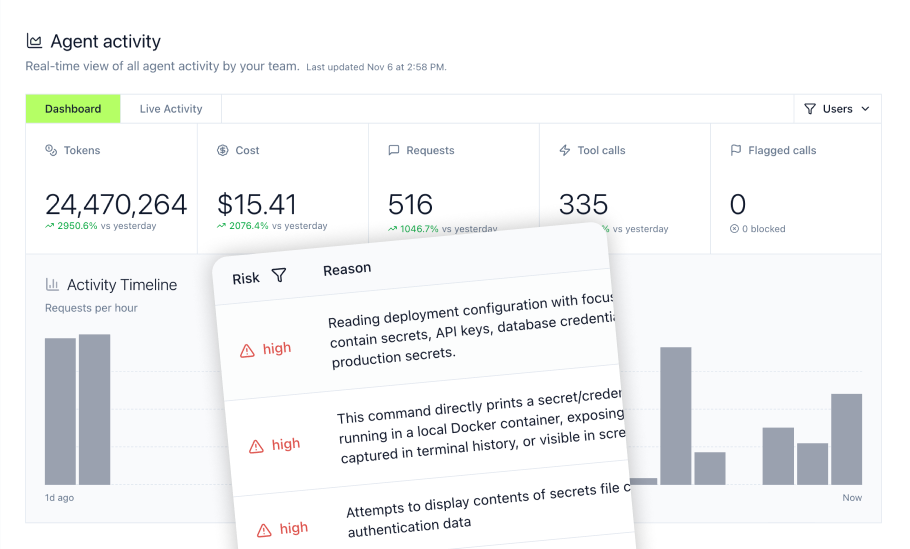
For organizations connecting Claude Code to CI/CD pipelines and project management systems, MintMCP's Agent Monitor helps teams monitor risky agent behavior, including sensitive-data exposure, credential leakage, risky bash commands, and prompt-injection patterns, addressing security concerns that arise when AI agents operate within development infrastructure.
Claude Code activity now flows into Anthropic's Compliance API and can be governed through admin-pushed managed settings. Those settings bind Claude Code only, so teams running Claude Code alongside Cursor or other clients still face fragmented visibility without a monitoring layer that spans every client.
Addressing the 'Last Mile Problem' in Claude Enterprise Deployments
Claude Enterprise provides the AI foundation, but connecting that foundation to internal systems remains the customer's engineering burden. This "last mile problem" surfaces whenever teams need Claude to access databases, CRMs, ticketing systems, or proprietary APIs.
Bridging Claude to Internal Systems
Native Claude integrations cover major SaaS platforms, but most enterprises maintain dozens of internal tools and data sources requiring custom connectivity. Each new integration demands:
- OAuth configuration or API key management
- Access control mapping to organizational roles
- Audit trail implementation for compliance
- Error handling and retry logic for reliability
Without a centralized approach, teams duplicate this work across every Claude deployment, multiplying engineering overhead and creating inconsistent security postures.
The Integration Challenge with Enterprise AI
MintMCP addresses the last mile problem by providing governed MCP connections to internal systems and data sources. Rather than building custom integrations for each Claude deployment, organizations configure connections once through MintMCP's gateway. The platform then handles credential management, access control enforcement, and audit logging across all tool access.
This approach can reduce custom integration work while helping teams apply consistent governance across every agent deployment. Teams can enable Claude access to Salesforce, Snowflake, Jira, and internal APIs through a single managed layer.
Securing Claude: Governance, Authentication, and Audit Trails
Claude Enterprise includes SOC 2 Type II attestation, SSO via SAML, SCIM directory synchronization, and custom data retention. These controls satisfy baseline enterprise security requirements.
Protecting Sensitive Data with Claude
The Compliance API represents Claude's strongest governance feature, providing programmatic access to:
- Conversation content and metadata
- Tool call records
- User attribution
- Timestamp data for audit reconstruction
This enables integration with SIEM platforms, automated policy checks, and compliance reporting workflows that would otherwise require manual log exports.
Claude Enterprise also enforces per-tool controls (allow, require approval, or block), set org-wide and per custom role. Those controls act at the level of the tool. A gateway layer adds control at the level of each call: rules on the arguments, masking sensitive data, routing an approval to a person, and holding back new or changed tools.
Building Audit-Ready AI Operations
Anthropic's Compliance API now covers Claude, Claude Code, and Cowork transcripts, and an audit-log export is available from the admin console. The gap that remains is not Claude's own surfaces, it is every other AI client: Cursor, Copilot, ChatGPT, and Gemini sit outside Claude's controls entirely.
MintMCP's audit and observability capabilities log every MCP tool call that routes through the gateway: the tool, its arguments, the response, and the user or agent that made the call, with per-user attribution across every AI client, not just Claude. MintMCP is SOC 2 Type II audited, compliant with HIPAA standards, and penetration tested, and it streams these logs to your SIEM for centralized monitoring.
MintMCP's Bundle architecture packages tool access, policy enforcement, and audit logging into single governance units. Its Agent Gateway builds on that MCP Gateway foundation by adding agent identities, permissions, memory, and monitoring for agents that work alongside users. Each AI agent receives its own persistent identity with scoped credentials that can be rotated independently, enabling audit attribution and credential hygiene at scale.
Beyond Gateway: Shadow AI Detection with Claude Code
When developers install Claude Code locally or configure Cursor with Claude backends, that activity often bypasses enterprise security controls. This "shadow AI" usage creates data exfiltration risks and compliance blind spots.
Identifying Unsanctioned AI Tool Usage
Anthropic now ships admin-pushed managed settings for Claude Code that can restrict which MCP servers it uses and apply hooks, and Claude Code activity flows into the Compliance API. Those settings bind Claude Code only. They do not reach Cursor, Copilot, ChatGPT, or Gemini, so developers can still run other clients against production codebases or connect unauthorized tools without touching Claude's audit systems.
Mitigating Shadow IT Risks in AI
MintMCP's Agent Monitor addresses shadow AI through hooks in Claude Code and Cursor that detect off-gateway MCP usage. The platform supports MDM-pushed enforcement configurations that apply consistent policies to developer machines regardless of how Claude is accessed.
Organizations can choose detect-only mode for visibility without disruption or enable enforcement mode to block risky operations in real-time. This two-layer approach, combining gateway governance with endpoint monitoring, closes visibility gaps that Claude Enterprise alone cannot address.
Compliance and Data Residency for Enterprise Claude Deployments
Healthcare, financial services, and government organizations face additional requirements beyond standard enterprise security.
Meeting Regulatory Requirements with Claude
Claude Enterprise can be covered by Anthropic's BAA for eligible healthcare customers using HIPAA-ready services, subject to configuration requirements and product exclusions. Coverage depends on the specific product and configuration, so confirm eligibility, supported products, and any exclusions with Anthropic before processing protected health information; zero-data-retention terms apply to specific products such as Claude Code.
For FedRAMP requirements, Claude Enterprise requires using a separate Claude for Government offering rather than the standard enterprise platform. Microsoft Copilot and Google Gemini have government-cloud deployment paths that may be relevant for public-sector buyers, while Anthropic directs government customers to Claude for Government, Bedrock, or Vertex pathways depending on requirements.
Ensuring Data Governance in Cloud AI
Standard Claude Enterprise operates as a cloud SaaS product rather than a customer-managed VPC or private deployment. For organizations requiring data isolation, this architecture presents compliance challenges that competitors address through dedicated cloud environments.
MintMCP provides encryption in transit and at rest, penetration-tested infrastructure, and data residency options as part of its enterprise security posture.
The Future of AI Agents: Claude within the MCP Ecosystem
The Model Context Protocol has become a widely adopted standard for AI-to-tool connectivity. Claude's native MCP support positions it well for the emerging agent ecosystem.
Claude and the Agentic AI Landscape
MCP's broader ecosystem momentum signals growing standardization around AI-to-tool connectivity. MCP support is expanding across major AI ecosystems, helping teams standardize tool connectivity across Claude, ChatGPT, Gemini, and Copilot deployments.
Driving Interoperability with MCP
MintMCP serves as the infrastructure layer for this standardization wave, functioning as both an MCP Gateway for governed data and tool connections and an Agent Gateway for agent identities, permissions, memory, and monitoring. Organizations gain unified governance across Claude and other AI platforms through a single control plane.
For teams building coworker agents that operate alongside employees in Slack, MintMCP provides long-term memory, sandboxed runtime, and scoped tool access through Virtual MCP Bundles. These agents maintain context across days while respecting least-privilege access controls.
Learn more about building secure Claude workflows in MintMCP's implementation guides.
Why MintMCP Completes the Claude Enterprise Stack
Claude Enterprise delivers powerful AI capabilities but leaves critical governance, identity, and monitoring gaps that surface immediately in regulated production environments. Organizations deploying Claude at scale face three unavoidable challenges: connecting Claude to internal systems without custom integration sprawl, maintaining audit visibility across web-based chat and terminal-based agents like Claude Code, and detecting shadow AI usage when developers install local AI tools.
MintMCP's architecture addresses these gaps through two integrated layers. The MCP Gateway provides governed connections to internal data sources and tools, handling credential management, access control enforcement, and audit logging for every tool call Claude makes. This eliminates redundant integration work and ensures consistent security postures across every deployment. The Agent Gateway extends this foundation by assigning persistent identities to each AI agent, managing scoped permissions that can be rotated independently, and capturing an audit trail of every MCP tool call, including the arguments, the response, and per-user or per-agent attribution.
For Claude Code and Cursor deployments, MintMCP's Agent Monitor closes the visibility gap that Claude Enterprise's audit logs cannot address. Agent Monitor detects off-gateway MCP usage through endpoint hooks, supports MDM-pushed enforcement policies, and operates in detect-only or enforcement mode depending on organizational risk tolerance. This two-layer approach, combining gateway governance with endpoint monitoring, ensures teams maintain security visibility regardless of how developers access Claude.
MintMCP is SOC 2 Type II audited, compliant with HIPAA standards, and penetration tested. The platform streams these logs to your SIEM, providing the audit-ready infrastructure that compliance teams require. Organizations using MintMCP gain unified governance across Claude, ChatGPT, Gemini, and Copilot through a single control plane, maintaining flexibility as the AI ecosystem evolves while enforcing consistent security policies across every agent deployment.
Frequently Asked Questions
What happens to my data when using Claude Enterprise?
Claude Enterprise does not train on customer data by default. Custom data retention periods let organizations specify how long conversation data persists before automatic deletion. Standard Claude Enterprise is delivered as cloud SaaS rather than a customer-managed private deployment, and it does not offer a VPC or dedicated deployment for standard Enterprise plans. Teams that need that level of isolation should evaluate a private or VPC deployment path directly, since adding another SaaS processor does not by itself isolate data.
Can I use Claude Enterprise with my existing identity provider?
Yes. Claude Enterprise supports SAML-based SSO and SCIM directory synchronization for automated user provisioning. Supported identity providers include Okta, Azure AD, and Google Workspace. SCIM integration enables automatic seat assignment and deprovisioning based on directory group membership, though SCIM configuration requires Enterprise tier access and cannot be enabled on Team plans.
How does Claude Enterprise pricing compare to ChatGPT Enterprise?
ChatGPT Enterprise pricing is generally contract-based, while Claude Enterprise uses a seat-fee plus usage-charge structure. Claude's usage-based model can be more variable than flat-rate enterprise pricing, especially for teams processing large documents or running extensive code analysis. Organizations with predictable usage patterns may find flat-rate models easier to budget, while those with variable workloads might benefit from pay-for-what-you-use approaches.
Does Claude Enterprise support multi-region deployments?
Standard Claude Enterprise operates as a cloud SaaS product with data processing in the United States. The platform does not currently offer customer-selectable data residency regions comparable to some competitors' regional deployment options. Organizations with strict data residency requirements in the EU or other jurisdictions should evaluate whether Claude's processing location meets regulatory obligations or whether additional governance layers are needed.
What monitoring options exist for Claude Code activity?
Claude Code activity is now covered by Anthropic's Compliance API, and admins can push managed settings to Claude Code to restrict MCP servers and apply hooks. Those managed settings bind Claude Code only, so the harder problem is consistent monitoring across every client a developer might use, from Cursor to ChatGPT. That is where a cross-client monitoring layer helps.