Model Context Protocol (MCP) enables AI assistants to connect directly to your databases, email systems, and production infrastructure—but each connection creates a potential entry point for attackers. With generative AI adoption accelerating and 25% unaware of what AI services are running internally, the attack surface expands faster than security teams can monitor. The Mintive (formerly MintMCP) MCP Gateway addresses this challenge by providing centralized authentication, tool governance, and real-time monitoring for enterprise MCP deployments.
This article examines how MCP connections transform data sources into attack vectors and outlines practical strategies—drawn from Mintive's enterprise security guides—to protect your organization while enabling AI-powered productivity.
Key Takeaways
- Every MCP connection expands your attack surface: AI agents with database, email, and code repository access create direct pathways to sensitive data that traditional perimeter security cannot protect
- Shadow AI creates blind spots: Unsanctioned agents, tools, and MCP connections can expand access faster than security teams can inventory them, making visibility and governance essential
- Four risk categories require distinct defenses: Data-driven attacks (prompt injection), supply chain attacks (tool poisoning), configuration attacks (static tokens), and operational attacks (no monitoring) each demand specific controls
- Compliance requires continuous monitoring: Continuous monitoring is generally more defensible than point-in-time reviews for SOC 2, HIPAA, and GDPR accountability workflows
- Build vs. buy tradeoffs are significant: DIY MCP security programs require substantial engineering, identity, logging, and compliance work, while managed solutions can reduce operational overhead and speed up deployment
- Real-time visibility can materially improve incident response: In one Wiz case study, Grammarly reported much faster triage after automating parts of its security workflow
Understanding the MCP Attack Surface: What Is It?
MCP creates standardized connections between AI agents and enterprise systems—databases, email platforms, calendars, code repositories, and knowledge bases. Unlike traditional APIs that respond to discrete requests, MCP-enabled agents can chain multiple tools together, use retrieved context, and execute autonomous actions across systems.
This architectural shift introduces attack vectors that conventional security tools cannot address:
- Stateful execution: Depending on the client and deployment model, agents may carry forward session context or cached auth state, creating broader attack opportunities
- Tool chaining: A compromised prompt can trigger cascading actions across multiple connected systems
- Autonomous execution: Agents make decisions and take actions without human approval for each step
- Credential aggregation: Single agent identities often hold access to dozens of data sources simultaneously
The Rise of AI Agents and Expanded Access
The OWASP GenAI Top 10 for Agentic Applications identifies excessive agency as a primary risk category. When AI agents operate with broad permissions across production systems, every connected data source becomes a potential exfiltration point.
Consider a coding agent with access to your GitHub repositories, CI/CD pipelines, and cloud infrastructure. A single malicious prompt could:
- Read environment variables containing API keys
- Modify deployment scripts to include backdoors
- Access production databases through development credentials
- Exfiltrate source code to external endpoints
Mintive's MCP Data Risk Framework categorizes these threats into four distinct risk types, each requiring specific defensive controls.
Identifying Common Vulnerabilities in MCP Deployments
Security research and vendor guidance on MCP implementations commonly emphasize three primary vulnerability categories:
- Indirect prompt injection: Malicious instructions hidden in data sources that hijack agent behavior when processed
- Tool poisoning: Compromised MCP servers that return manipulated responses or execute unauthorized actions
- Excessive permissions: Agents granted broad access without role-based restrictions or least-privilege controls
Analysis of MCP server implementations found inconsistent credential management patterns, with many relying on static API tokens stored in plaintext configuration files.
The Supply Chain Security Challenge of MCPs: New Risks to Data Sources
With thousands of MCP servers now available across official and community ecosystems, the supply chain attack surface has expanded dramatically. Not all MCP servers undergo security review, and community implementations vary widely in maturity.
Unsanctioned AI and Shadow MCPs
Shadow AI—AI tools deployed without IT approval—creates blind spots where security teams have zero visibility into data access or agent actions. Recent enterprise AI security reporting has shown that shadow GenAI usage is rising, with engineering teams independently deploying Cursor, Claude Code, and custom MCP servers.
Common shadow AI scenarios include:
- Developers connecting coding agents to production databases for debugging
- Sales teams linking AI assistants to CRM systems without data governance review
- Support staff using AI tools with customer ticket systems containing PII
- Marketing teams connecting agents to analytics platforms with user behavior data
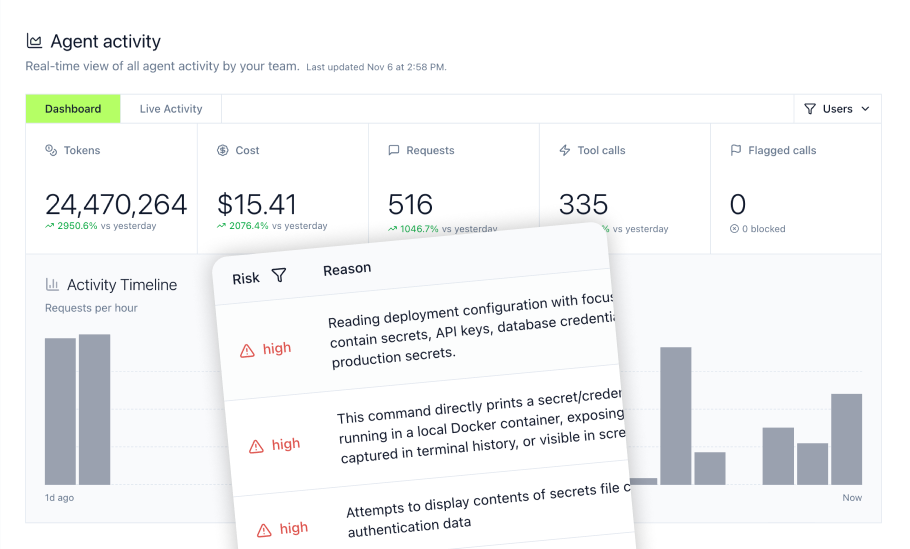
Mintive's Agent Monitor uses hooks in supported coding agents to capture MCP tool calls, commands, and file reads before they happen, helping teams identify activity that would otherwise escape monitoring.
Managing Third-Party MCP Integrations
Security research has identified emerging risks specific to MCP, including:
- Context manipulation: Attackers inject malicious data into agent memory to influence future decisions
- Credential exposure: MCP servers inadvertently logging or transmitting authentication tokens
- Tool poisoning: Compromised servers returning manipulated data that appears legitimate
The MCP official specification addresses confused deputy attacks, SSRF vulnerabilities, and session hijacking—but implementation remains inconsistent across the ecosystem.
Mitigating Software Supply Chain Security Threats Introduced by MCPs
Effective MCP security requires layered defenses addressing each risk category identified in Mintive's security documentation.
Implementing Robust Access Controls for MCPs
Role-based access control (RBAC) limits agent permissions to specific tools and data sources based on user identity:
- Viewer role: Read-only operations (list records, search documents, get reports)
- User role: Standard write access (create issues, update statuses, send emails)
- Admin role: Full access including destructive operations (delete data, manage permissions)
Mintive's MCP Gateway enables granular tool access control, allowing administrators to configure permissions by role—for example, enabling read-only database operations while excluding write tools for analyst teams.
Beyond static roles, attribute-based access control (ABAC) evaluates context at request time:
- Time of day restrictions (block production access outside business hours)
- Location-based policies (require VPN for sensitive operations)
- Resource sensitivity scoring (additional approval for PII access)
Automating Security Guardrails for AI Agent Actions
Agent Monitor uses hooks to capture actions before execution so rules can block risky commands and file access:
- Command filtering: Block destructive operations like
rm -rf,chmod 777, database drops - Sensitive file protection: Prevent access to
.envfiles, SSH keys, credentials, and configuration files - Input sanitization: The spotlighting technique isolates untrusted prompts from system instructions
- Rate limiting: Prevent bulk export attempts that suggest data exfiltration
These guardrails operate transparently—developers maintain their existing workflows with Cursor or Claude Code while security gains enforcement capabilities.
Attack Surface Management for AI-Powered Environments
Traditional attack surface management assumes static assets with known boundaries. AI agents blur these boundaries by dynamically connecting to systems based on user requests and conversation context.
Mapping Your AI-Driven Attack Surface
Effective mapping requires inventorying:
- All OAuth grants: Which SaaS applications have authorized AI tool access?
- API key usage: Where are tokens stored, and who generated them?
- IDE extensions: What coding agents are installed across developer machines?
- Network traffic patterns: Which AI service endpoints receive data from your network?
Organizations typically discover more agents than initially estimated during comprehensive security audits.
Proactive Strategies for MCP Security
Mintive's MCP Gateway provides real-time monitoring dashboards for:
- Server health and availability across all MCP endpoints
- Usage patterns identifying anomalous agent behavior
- Security alerts for policy violations and suspicious access patterns
- SLA compliance tracking for enterprise deployments
The Claude Cowork guide outlines collaboration patterns between AI agents and human teams that maintain security while maximizing productivity—establishing clear boundaries for autonomous agent actions versus operations requiring human approval.
Enhancing MCP Security with Real-time Monitoring and Audit Trails
Without monitoring, security teams operate blind to AI agent activities. The IBM Data Breach Report indicates average breach costs exceed $4.4 million, and organizations lacking AI governance face substantially higher risk.
Seeing Every AI Tool Interaction
Mintive's platform captures structured logs for every MCP interaction:
- Tool invocations with parameters and responses
- Data source queries with result summaries
- File access patterns across agent sessions
- Authentication events and permission checks
This visibility enables security teams to detect anomalies—unusual access times, bulk data requests, or attempts to access restricted resources—before they escalate to breaches.
The Importance of Comprehensive Audit Logs
Compliance frameworks require tamper-proof audit trails demonstrating who accessed what data and when. Mintive provides:
- Structured logging: Machine-readable records for investigation and reporting
- Audit trail coverage: Logs capture system activities with real-time monitoring capabilities
- Configurable retention: Retention can be aligned to organizational and regulatory requirements
- SIEM integration: Export and stream logs into tools like Splunk, Datadog, and ELK stacks
In a Wiz case study, Grammarly reported cutting parts of incident triage from roughly 45 minutes to about 4 minutes using MCP-based security automation.
Securing Internal Data: Protecting Sensitive Files from MCP Access
Coding agents like Cursor and Claude Code operate with extensive system access, reading files, executing commands, and connecting to production systems through MCP tools. Without guardrails, these agents can inadvertently expose credentials, intellectual property, and customer data.
Granular Control Over Data Access
Agent Monitor can block file reads through hooks and rules protecting sensitive files:
- Environment files (
.env,.env.local,.env.production) - SSH keys and certificates (
id_rsa,*.pem,*.crt) - Configuration files with credentials (
config.yaml,secrets.json) - Database connection strings and API tokens
Teams can customize these policies based on role—senior engineers may require broader access than junior developers, with all access logged for audit purposes.
Preventing Unauthorized Credential Exposure
When coding agents access credential files, vulnerabilities can expose authentication tokens in generated code or logs. Mintive's approach:
- Centralized credential management: Store secrets in the gateway rather than individual configs
- Short-lived tokens: Favor temporary credentials over long-lived static secrets, especially for elevated access
- Just-in-time elevation: Request temporary admin access for specific operations
- Credential redaction: Automatically mask tokens in logs and model responses
Building a Secure Enterprise MCP Deployment Framework
The Claude Skills Tips guide provides practical techniques for configuring AI assistants with appropriate capabilities while maintaining security boundaries. Enterprise deployment requires translating these principles into systematic controls.
From Shadow AI to Sanctioned AI
Mintive's deployment framework follows a phased approach:
Phase 1: Security Foundation
- Shadow AI audit identifying all existing AI tools and MCP servers
- OAuth provider configuration (Okta, Auth0, Azure AD)
- MCP Gateway deployment with initial RBAC policies
Phase 2: Access Control and Monitoring
- Role-based access control across all teams
- Agent Monitor hooks for coding-agent visibility
- Audit logging integration with existing SIEM
Phase 3: Compliance and Optimization (Ongoing)
- SOC 2 Type II preparation with continuous monitoring
- Self-service provisioning for developer teams
- Policy refinement based on usage patterns
Best Practices for Secure MCP Adoption
Drawing from the enterprise MCP guide:
- Default to least privilege: Start all users with Viewer role; require justification for elevation
- Implement dual-authentication migration: Run OAuth and legacy tokens in parallel during migration before hard cutoff
- Establish monitoring baselines: Run an initial observe-only period before enforcing blocks
- Provide self-service access: Make security an enabler by automating approvals for standard requests
Addressing Compliance: SOC 2, HIPAA, and GDPR for MCP Tools
Regulated industries face specific requirements for AI tool governance that MCP deployments must satisfy.
Meeting Enterprise Compliance Standards
Mintive Gateway has a SOC 2 Type II attestation, providing:
- SOC 2: Audit trails of AI interactions, access controls, and encryption to support SOC 2 control requirements
- GDPR: Data minimization, encryption, right to erasure, processing records
- HIPAA: Mintive can support auditability and access control workflows for regulated environments
Organizations using continuous monitoring achieve better audit outcomes compared to point-in-time assessments. The difference between proactive and reactive compliance often determines audit results.
Ensuring Data Governance with MCPs
Compliance requirements by industry:
- Financial services: SEC/FINRA recordkeeping (7-year retention), PII protection, transaction audit trails
- Healthcare: HIPAA considerations such as PHI encryption, access controls, breach notification, and retention policies defined by the organization’s compliance scope
- Government: NIST AI Risk Management Framework alignment, FedRAMP considerations
The security overview details specific controls for each compliance framework.
The Role of Centralized Governance in MCP Attack Surface Reduction
Decentralized MCP deployments—where each team manages their own servers and credentials—create inconsistent security postures and compliance gaps. Centralization addresses these challenges systematically.
Streamlining Enterprise Authentication for MCPs
Mintive Gateway provides unified authentication across all MCP connections:
- OAuth 2.0: Industry-standard token-based authentication
- SAML integration: Enterprise SSO with existing identity providers
- MFA enforcement: Required for admin operations and sensitive resources
- Session management: Automatic timeout and re-authentication policies
This centralization eliminates static API tokens scattered across configuration files—a primary source of credential leaks.
Enforcing Consistent Security Policies Across AI Agents
Policy-as-code enables security teams to define rules in version-controlled configuration:
- JSON or HCL format for CI/CD integration
- Automated testing before production deployment
- Rollback capabilities for policy changes
- Audit trails for all configuration modifications
The understanding MCP gateways article explains how gateway architecture transforms local MCP servers into production-ready services with monitoring, logging, and compliance built in.
Why Centralized MCP Governance Matters for Enterprise Security
As organizations scale their AI agent deployments, the complexity of managing multiple MCP connections, diverse authentication methods, and distributed audit trails becomes overwhelming. Mintive is positioned to help address this challenge by consolidating security, governance, and observability into a unified platform.
Mintive combines gateway controls and monitoring with Mint Guard, which screens every MCP gateway tool call's arguments and results for prompt injection, secrets, PII, and harmful content. The MCP Gateway serves as your centralized control plane, enforcing consistent authentication through OAuth 2.0 and SAML integration with existing identity providers. Every MCP tool invocation flows through policy enforcement engines that apply role-based access controls in real time, ensuring developers retain productivity while security teams maintain visibility and control.
Agent Monitor extends this protection to coding agents like Cursor and Claude Code through hooks that capture commands, file reads, and MCP tool calls before execution. Rules can block dangerous operations, such as reading .env files or running destructive commands, while logs trace calls to a person, agent, server, and model. Session review and SIEM export help security teams investigate activity across supported coding agents.
Implementation speed differentiates Mintive from DIY approaches. Organizations can deploy the full platform within weeks rather than months, avoiding the substantial engineering investment required to build OAuth infrastructure, policy engines, monitoring dashboards, and compliance reporting from scratch. The security documentation provides deployment guides and best practices refined through dozens of enterprise implementations, helping your team avoid common pitfalls and accelerate time-to-value. As your AI strategy evolves, Mintive scales seamlessly from pilot teams to organization-wide deployments without requiring architectural redesign.
Frequently Asked Questions
What makes MCPs a unique security challenge for enterprises?
Unlike traditional APIs that handle discrete requests, MCPs enable AI agents to chain multiple tools together, use retrieved context, and execute autonomous actions across connected systems. This creates attack vectors where a single compromised prompt can trigger cascading actions across databases, email systems, and code repositories. The autonomous decision-making capability means agents may take harmful actions without explicit human approval for each step, expanding the blast radius of successful attacks.
How does Mintive's Agent Monitor help manage the attack surface created by coding agents?
Agent Monitor uses hooks in supported coding agents, including Cursor and Claude Code, to capture MCP tool calls, commands, and file reads before execution. Rules can block risky commands and access to sensitive files, while audit trails support security review. This visibility helps address the shadow AI problem where 25% of organizations don't know what AI services are running internally.
Can Mintive help my organization achieve compliance for MCP usage?
Mintive can support auditability and access control requirements for SOC 2, HIPAA, and GDPR programs, and it has a SOC 2 Type II attestation. The platform supports encryption in transit and at rest, audit logging, and configurable administrative controls. Organizations using continuous monitoring achieve better audit outcomes compared to point-in-time assessments.
What is 'shadow AI' and how does it relate to MCP security?
Shadow AI refers to AI tools deployed without IT approval—engineers connecting Cursor to production databases, sales teams linking AI assistants to CRM systems, or support staff using AI tools with customer data. These deployments create security blind spots where sensitive data flows through unmonitored channels. Research shows shadow GenAI usage is rising, with organizations discovering more agents than initially estimated during security audits.
How does centralized governance contribute to reducing the MCP attack surface?
Centralized governance through Mintive Gateway eliminates the inconsistent security postures that emerge when teams independently manage MCP servers. It provides unified OAuth authentication (eliminating scattered static tokens), consistent RBAC policies across all agents, real-time monitoring with anomaly detection, and comprehensive audit trails. This approach reduces the number of potential entry points while ensuring every MCP connection meets enterprise security standards.
What are the cost implications of building MCP security in-house versus using a managed solution?
DIY MCP security programs require substantial engineering, identity, logging, and compliance work, including engineering time (2-3 FTEs for 6-12 months), security consultants, OAuth provider costs, SIEM integration, and SOC 2 audit fees. Managed solutions like Mintive can reduce operational overhead and speed up deployment, representing both cost savings and dramatically faster time-to-value during which organizations otherwise operate at elevated breach risk.