Claude Cowork represents Anthropic's most ambitious AI agent—an autonomous desktop tool that reads and writes files, executes commands, browses the web, and runs scheduled tasks with minimal human oversight. But beneath this capability lies a critical compliance blind spot: Cowork activity is explicitly excluded from Anthropic's Audit Logs, Compliance API, and Data Exports. For enterprises operating under SOC 2, HIPAA, or GDPR frameworks, this gap creates a major compliance risk for deployment in regulated or tightly governed environments. Organizations seeking centralized governance and complete audit trails for AI tool interactions should evaluate MCP Gateway solutions that provide the visibility Cowork currently lacks.
This article examines the specific audit logging limitations in Claude Cowork, quantifies compliance risks by regulatory framework, and outlines practical compensating controls for security teams evaluating enterprise AI agent deployment.
Key Takeaways
- Cowork activity excluded from all audit systems: Anthropic explicitly states that Cowork is not captured in Audit Logs, Compliance API, or Data Exports—this is an architectural limitation, not a configuration issue
- Anthropic's own guidance: "Do not use Cowork for regulated workloads"
- OpenTelemetry provides partial visibility: Available metrics cover token consumption and tool names, but Anthropic notes it does not replace audit logging for compliance purposes
- Regulated deployments should be avoided: Organizations handling PHI or cardholder data should not use Cowork for regulated workloads until audit coverage exists
- SOC 2 auditors will ask questions you cannot answer: File access logs, user attribution for data operations, and tamper-proof records are not available
- Local storage creates additional risk: Conversation history stores locally on users' computers—not subject to retention policies or central export
- Compensating controls exist but are partial: MCP Gateway solutions can cover MCP tool calls, while OpenTelemetry provides operational visibility into usage, costs, and tool activity, but neither replaces native Cowork audit logging for compliance purposes
Understanding the Claude Cowork Audit Logging Gap: A Compliance Blind Spot
What Defines an Audit Logging Gap?
An audit logging gap occurs when a system performs actions that cannot be recorded, retrieved, or verified by compliance teams. For AI agents with system-level access, this means operations like file reads, command executions, and data transfers happen without generating the evidence trail that auditors require.
Claude Cowork operates as an autonomous agent with extensive system access—reading files, executing commands, and accessing production systems through MCP tools. Unlike Claude Chat or Claude API (where Enterprise tiers include audit logs), Cowork generates no audit records for:
- User inputs and prompts to Cowork sessions
- Agent outputs and generated content
- Files accessed, read, modified, or deleted
- MCP tool invocations and parameters
- Browser actions via Claude in Chrome
- Scheduled task execution logs
- Cross-application data flows
Real-World Risks of Insufficient Logging
Consider a SOC 2 audit scenario: Your auditor requests file access logs demonstrating data protection controls. You provide OpenTelemetry logs showing token counts and session timestamps—but no file-level access records. The auditor cannot verify access control effectiveness (TSC CC6.1), data classification enforcement, or logging and monitoring completeness.
Security research by PromptArmor demonstrated a prompt injection attack soon after Cowork's launch—an attacker embedded malicious instructions in a PDF, and the agent uploaded sensitive data to an external server. Without audit logs, organizations cannot determine:
- Which files were accessed
- Scope of potential data breach
- Timeline for regulatory breach notification
- Evidence for "reasonable security" defense
Impact on Data Integrity and Accountability
Traditional audit models assume human operators create documented trails. When an AI system autonomously grants temporary access with no human involvement or documented approval process, it disrupts these models entirely. Cowork's ability to execute multi-step tasks without supervision means accountability gaps compound with each autonomous action.
SOC 2, HIPAA, and GDPR: The Audit Trail Imperative
Meeting SOC 2 Type II Requirements with AI Tools
SOC 2 Trust Service Criteria requires audit logs showing who accessed what data, what actions were taken, when access occurred, and automated integrity checks. Cowork fails these requirements:
What's missing:
- No audit trail of file operations
- Cannot demonstrate data protection controls
- No centralized log retention
- Cannot prove "no unauthorized access"
Anthropic's position is unambiguous: "Cowork activity is not captured in Audit Logs, Compliance API, or Data Exports... OpenTelemetry does not replace audit logging for compliance purposes."
Organizations using MCP Gateway can capture MCP tool interactions with audit trails that support SOC 2 evidence collection and GDPR accountability workflows—though this covers only the MCP layer, not direct Cowork file operations.
HIPAA's Strict Demands on Data Access Logs
HIPAA requires complete audit logs for all PHI access with 6-7 year retention, user attribution and access rationale, and demonstrable compliance during audits.
Cowork status: Should be avoided
Organizations cannot:
- Reconstruct "who saw what PHI when"
- Meet centralized audit requirements (local storage violates this)
- Demonstrate minimum necessary access
Safer alternatives for regulated teams include Claude Chat on Enterprise (where Anthropic provides audit logs for supported surfaces) or Claude API with a custom audit layer.
GDPR's Right to Be Forgotten and Auditability
GDPR accountability requires records of processing activities, support for data subject rights (access, deletion, portability), and the ability to reconstruct how personal data was processed.
Cowork challenges:
- Cannot prove data minimization (no access logs)
- Cannot honor deletion requests (local storage)
- Cannot provide access reports for data subjects
- Cannot centrally reconstruct many AI-driven processing actions
When an EU customer exercises Article 15 right to access, asking "What personal data did your AI agents process about me?"—organizations using Cowork cannot answer. Data stored locally across employee machines cannot be centrally retrieved within the 30-day deadline.
Enterprise Security and Data Governance: Bridging the Monitoring Gap
Turning Shadow AI into Sanctioned AI
Shadow AI continues to grow, and unmonitored Cowork deployments can accelerate this trend. Users on personal Claude accounts bypass all organizational controls. Without visibility into which tools teams use, what data AI accesses, and when interactions occur, security teams operate blind.
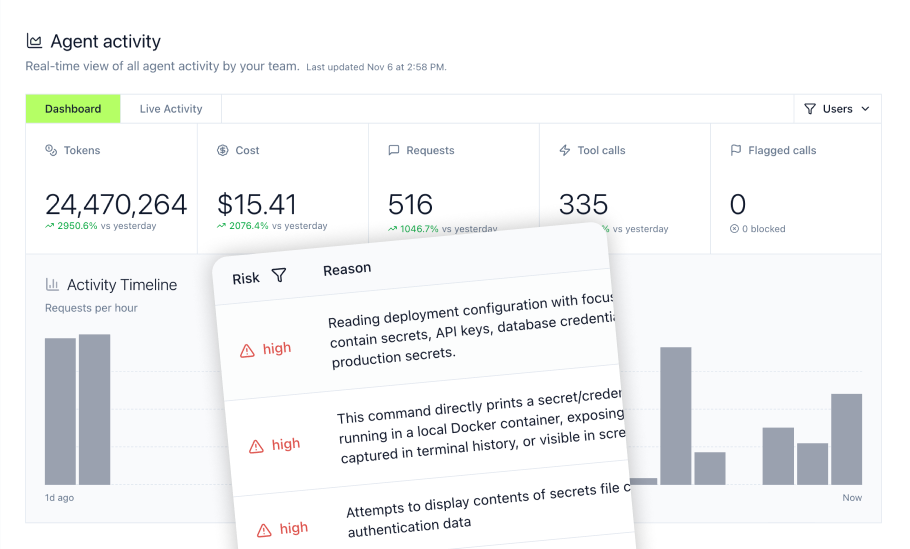
The LLM Proxy addresses this by monitoring every MCP tool invocation, bash command, and file operation from coding agents—providing the observability layer Cowork lacks. This includes:
- Tool call tracking across Claude Code, Cursor, and other agents
- MCP inventory showing installed servers and permissions
- Security guardrails blocking dangerous commands in real-time
- Sensitive file protection preventing access to .env files and credentials
Real-Time Monitoring for Enterprise-Grade Security
Effective AI governance requires live dashboards for server health, usage patterns, and security alerts. Cowork provides none of this natively. Organizations must build compensating infrastructure:
OpenTelemetry capabilities (with limitations):
- Token consumption (prompt/completion lengths)—not actual content
- Tool invocations (tool names only)—not parameters
- Session timestamps and user attribution (when SSO configured)
- Cost metrics and usage volume
What remains limited for compliance use:
- OpenTelemetry provides operational visibility, but Anthropic does not position it as a substitute for audit logs
- File and browser activity needed for formal audits remains incomplete in Cowork
- Centrally managed export and retention for Cowork activity is still unavailable
The Role of Centralized Governance
Organizations with formal AI strategies generally outperform those without structured approaches. Centralized governance through platforms like MCP Gateway provides unified authentication, audit logging, and rate control for all MCP connections—transforming fragmented AI tool usage into managed infrastructure.
The Threat of Shadow AI: Unmonitored Interactions and Data Exposure
How Unmonitored AI Tools Create Security Blind Spots
Coding agents operate with extensive system access—reading files, executing commands, and accessing production systems through MCP tools. Without monitoring, organizations cannot see what agents access or control their actions.
The autonomous nature of Cowork compounds this risk. A scheduled task running while the app is open can execute file operations, browser actions, and MCP calls without human review. If that task encounters a prompt injection attack embedded in a document, the agent may exfiltrate data before anyone notices.
Preventing Accidental Data Exposure
Best practices from security practitioners include:
- Deploy managed-settings.json via MDM with deny rules for .env, .ssh/, curl, wget
- Disable Claude in Chrome or use organization allowlists/blocklists to restrict which sites Claude can access
- Use org-vetted plugins only via private marketplace
- Configure network egress restrictions with targeted allowlists
For organizations requiring visibility into AI agent file access, the security documentation outlines authentication, identity management, and tool governance frameworks that complement native platform limitations.
Quantifying the Risk
Potential costs of audit gap incidents:
- Audit remediation can be expensive if a SOC 2 review identifies logging or governance gaps
- Breach response costs can escalate quickly if prompt injection causes a data leak
- Regulatory exposure can materially exceed the cost of implementing stronger controls
Cloud Security for AI Deployments: Preventing Data Leaks
Securing AI Agents in Multi-Cloud Environments
Organizations should validate Cowork's data processing regions, retention behavior, and residency implications directly against Anthropic's current documentation and contract terms. Data residency concerns multiply when:
- Cowork stores data locally (user machine jurisdiction)
- No automatic backup exists for Cowork sessions
- Users must manually back up work folders
MCP Gateway offers managed MCP deployment with centralized authentication, logging, and hosted STDIO server support in containerized environments accessible to clients without local installations.
Data Residency Controls for Global Compliance
For organizations operating under data sovereignty requirements, Cowork's architecture presents challenges. Conversation history exists only on local machines—outside centralized retention policies. The authentication models documentation covers OAuth protection and SSO enforcement options that add governance layers to MCP endpoints.
From Local to Enterprise: Scaling with Audit-Ready Infrastructure
Transforming Developer Tools into Production Infrastructure
Cowork’s paid-plan availability reflects its current positioning:
- Pro and Max: Individual paid plans with Cowork access on supported desktop apps, but no organization-level audit logging for Cowork
- Team: Centralized admin and billing—Cowork activity is still excluded from Audit Logs, the Compliance API, and Data Exports
- Enterprise: Advanced security and compliance controls—Cowork still excluded from Audit Logs, the Compliance API, and Data Exports
The one-click deployment model that makes MCP Gateway attractive for enterprises—transforming local MCP servers into production services with monitoring, logging, and compliance—doesn't exist for Cowork's native file operations.
Implementation Costs for Compensating Controls
Direct costs for controlled Cowork deployment vary by environment:
- Claude subscription cost depends on plan, billing term, and seat count
- OpenTelemetry infrastructure cost depends on your existing observability stack
- SIEM ingestion and storage costs depend on event volume and retention requirements
- Endpoint management and policy rollout costs depend on your current device-management tooling
- Training and operational-change costs vary by organization
Total Year 1 cost depends on subscription choice, existing tooling, and control requirements
The Scalability Challenge
Organizations face a decision framework:
Deploy Cowork now (with compensating controls):
- Productivity gain: Potential time savings on document-heavy workflows
- Risk exposure: Audit failure, breach, compliance violation
Wait for native audit logs:
- Productivity gain: None (miss Cowork benefits)
- Risk exposure: None (no audit gap)
For enterprises with mixed workloads, the enterprise MCP guide outlines phased approaches that balance productivity and governance.
Granular Access Control and Audit Trails: Essential for Sanctioned AI
Defining Who Can Use Which AI Tools
Role-based access control requires audit data to enforce. Without logs showing who accessed what, organizations cannot:
- Verify separation of duties
- Demonstrate least privilege principle
- Prove change management compliance (SOX, ISO 27001)
MCP Gateway provides granular tool access control—configuring access by role (enabling read-only operations while excluding write tools) with OAuth 2.0, SAML, and SSO integration for all MCP servers.
Implementing Fine-Grained Control
The LLM Proxy enables policy enforcement that blocks risky tool calls like reading environment secrets or executing dangerous commands. This complements Cowork deployment by providing:
- Complete audit trail of all operations
- Real-time blocking of dangerous commands
- Sensitive file protection
- MCP inventory visibility
Authentication Standards for Enterprise AI
Organizations requiring enterprise-grade authentication can implement:
- OAuth + SSO enforcement through authentication frameworks
- Centralized credentials management
- User provisioning with team-based access controls
Cost Analytics and Performance Metrics: Tracking AI Usage
Monitoring Every AI Tool Interaction
Only 18% of organizations have enterprise-wide AI governance councils. This gap means most organizations lack visibility into AI tool spending, performance, and data access patterns.
The LLM Proxy monitors every AI tool interaction across Claude Code, Cursor, ChatGPT, and more—providing:
- Cost analytics tracking spending per team, project, and tool
- Performance metrics measuring response times and error rates
- Data access logs showing exactly what each AI tool accesses
Integrating Usage Data for Proactive Governance
For organizations deploying Cowork despite audit limitations, OpenTelemetry integration with SIEM platforms enables:
- Weekly dashboard reviews for anomalies
- Spot-checks on scheduled task inventory
- Connector usage audits (disable unused)
The audit documentation covers implementation approaches for organizations building compensating control infrastructure.
How MintMCP Addresses the Cowork Audit Gap
While native Cowork audit logging remains unavailable, MintMCP gives organizations a stronger way to add visibility and control around AI agent infrastructure. Its approach helps turn unmonitored AI tool usage into governed, auditable enterprise infrastructure through three core capabilities.
First, MCP Gateway captures MCP tool interactions with centralized logging, user attribution, and audit trails. Backed by a SOC 2 Type II attestation, it adds a stronger control layer around MCP activity, even though it does not remove Cowork’s own audit limitations. Organizations can also deploy STDIO servers on MintMCP’s managed service, routing MCP activity through centralized governance without requiring local installs.
Second, the LLM Proxy extends visibility beyond MCP to broader AI agent activity, including file operations, bash commands, and cross-tool interactions. Real-time guardrails can block dangerous operations before execution, while sensitive file protection helps prevent access to credentials, environment variables, and other critical assets.
Third, MintMCP’s centralized governance model provides the visibility compliance teams need. OAuth 2.0 and SSO integration make actions attributable to specific users, role-based access control limits which teams can invoke which tools, and cost analytics track spending across AI interactions. Together, these capabilities help turn Shadow AI into sanctioned, governed infrastructure that auditors can review, even when the underlying agent platform lacks native audit support.
For enterprises evaluating Cowork, MintMCP offers a practical path forward: apply compensating controls at the MCP layer, add endpoint security for host-level visibility, and clearly document Cowork’s architectural limitations for auditors. While this does not provide complete coverage of Cowork’s autonomous actions, it can strengthen the evidence trail for audits and internal compliance reviews.
Frequently Asked Questions
When will Anthropic close the Cowork audit logging gap?
Anthropic has not published a timeline for adding Cowork to Audit Logs or the Compliance API. The current "research preview" status suggests awareness of the limitation. Security teams should monitor Anthropic's changelog, engage account teams (Enterprise customers), and set quarterly reminders to check status. Until official announcements confirm "Cowork now included in Audit Logs," the gap remains.
Can I use OpenTelemetry to satisfy SOC 2 audit requirements for Cowork?
No. Anthropic explicitly states that OpenTelemetry does not replace audit logging for compliance purposes. OTel provides operational visibility—token counts, tool names, session timestamps—but not the file-level access logs or audit-ready evidence that auditors typically expect for regulated workflows. Use OTel as a compensating control for operational monitoring, but document its limitations for auditors.
What's the difference between Claude Chat audit logs and Cowork audit logs?
Claude Chat (Enterprise tier) includes full audit logs, Compliance API access, and 180-day export capabilities. Cowork explicitly excludes all audit functionality—regardless of tier. This architectural difference means organizations can use Claude Chat for regulated workloads while Cowork remains prohibited. The same applies to Claude API, which organizations can instrument for programmatic logging at the application layer.
How do MCP Gateway solutions help with Cowork compliance?
MCP Gateway logs every MCP server call with parameters, provides infrastructure backed by a SOC 2 Type II attestation, and offers real-time dashboards. However, it covers only MCP interactions. Direct Cowork file operations, Claude in Chrome browser actions, and scheduled tasks remain outside MCP Gateway coverage. It's a partial compensating control, not a complete solution.
Should my organization adopt a lockdown posture for Cowork?
For regulated industries (healthcare, finance, PCI environments) and organizations approaching SOC 2 audits, lockdown is the recommended posture. This means disabling Cowork organization-wide, blocking Claude in Chrome, prohibiting MCP servers and plugins, and using only Claude Chat or Claude API where audit logs exist. The trade-off: you lose Cowork productivity benefits entirely but eliminate compliance risk.
What compensating controls provide the most coverage?
No single control fully replaces native audit logging. The most comprehensive approach combines OpenTelemetry for operational metrics, MCP Gateway for MCP tool interactions, endpoint security logs for host-level visibility, and policy enforcement that blocks sensitive workloads from Cowork entirely. Organizations must accept residual risk, document limitations, and await Anthropic's architectural updates.