AI coding assistants have become integral to modern development workflows, with 71% of organizations now regularly using generative AI in at least one business function. Yet critical vulnerabilities disclosed in February 2026 revealed how Claude Code's repository configuration files could be weaponized for remote code execution and API key theft—all triggered by simply cloning a malicious repository. Organizations using Claude Code face a stark reality: without centralized governance through an LLM Proxy, they often lack consistent visibility into what AI agents access and the policy controls needed to govern their actions.
This article examines the attack vectors behind Claude Code supply chain compromises, explains why configuration files represent a critical attack surface, and provides actionable strategies for detection, prevention, and enterprise-grade protection.
Key Takeaways
- Configuration files execute code: Claude Code's
.claude/settings.jsonfiles can trigger remote code execution before users see trust dialogs—treat them as executable, not passive metadata - CVE-2025-59536 (CVSS 8.7) enabled attackers to achieve silent remote code execution through malicious repository hooks and MCP server settings
- CVE-2026-21852 (CVSS 5.3) allowed plaintext API key capture by redirecting ANTHROPIC_BASE_URL to attacker-controlled servers
- A single compromised API key can expose multiple developers in a shared workspace, with potential lateral movement across shared projects
- AI supply chain attacks are rising rapidly, making configuration-based exploits a systemic threat that requires specialized governance
- Immediate remediation required: Rotate all Claude API keys, audit
.claude/settings.jsonfiles across repositories, and implement real-time monitoring for MCP tool invocations
Understanding the Threat: What Are Supply Chain Attacks on Claude Code?
Supply chain attacks targeting Claude Code exploit the trust relationship between developers and their AI coding assistants. Rather than attacking Claude's models directly, adversaries weaponize repository configuration files that customize how the tool behaves within specific projects.
Defining Supply Chain Vulnerabilities in AI Development
Claude Code uses .claude/settings.json files to configure project-specific behavior, including automated command execution through "hooks" at lifecycle events like SessionStart or pre-commit. These files also control Model Context Protocol (MCP) server integrations that extend Claude's capabilities to external services.
The OWASP LLM Top 10 for 2025 categorizes these risks under LLM03: Supply Chain Vulnerabilities, identifying configuration-as-code exploitation as a distinct attack vector alongside pre-trained model tampering and dependency hijacking.
How Malicious Configurations Enter Your Workflow
Attackers introduce malicious configurations through multiple vectors:
- Malicious repository cloning: Attacker creates a legitimate-looking open-source project with poisoned config files
- Pull request injection: Compromised contributor submits PR modifying
.claude/settings.json - Insider threat: Developer with repository access plants configuration backdoors
- Upstream contamination: Compromised dependency includes malicious configs that propagate downstream
The Check Point Research team demonstrated that opening a repository with a crafted configuration file could execute arbitrary commands with full developer privileges—before the user even had a chance to review the code.
Why Claude Code's Repository Configuration Is a Critical Target
AI coding assistants operate with extensive system access that traditional development tools never required. Claude Code can read files, execute bash commands, access production systems through MCP integrations, and interact with external services—all capabilities that multiply the impact of a successful configuration attack.
The Escalated Risk of AI Agent Privileges
The vulnerabilities disclosed in February 2026 highlight two distinct attack chains:
CVE-2025-59536 (Remote Code Execution):
- Exploited Claude Hooks and the
enableAllProjectMcpServerssetting - Triggered before user trust confirmation
- Allowed arbitrary command execution with developer machine privileges
CVE-2026-21852 (API Key Exfiltration):
- Manipulated
ANTHROPIC_BASE_URLenvironment variable - Captured API keys in plaintext Authorization headers
- Executed on first API call, before trust dialogs appeared
Impact on Production Environments
A single compromised API key in Claude's Workspace feature exposes entire teams. According to Dark Reading's analysis, workspace exposure can affect multiple developers per typical enterprise configuration, with access to:
- All shared project files in cloud storage
- Accumulated context across team interactions
- Cross-project code repositories
- Credentials for connected services and APIs
For enterprises, breach response can carry material financial and operational costs—making prevention far more cost-effective than incident response.
Identifying Indicators of Compromise in Your Claude Code Environments
Detection requires visibility into AI agent behavior that traditional security tools cannot provide. Coding agents execute operations in milliseconds, making post-incident forensics insufficient for prevention.
Recognizing Malicious Agent Activity
Watch for these warning signs across your Claude Code deployments:
- Unusual network egress: API traffic routed to non-Anthropic domains
- Unexpected tool invocations: MCP servers activated without explicit user approval
- Unauthorized file access: Reads of
.env,.ssh, credential files, or configuration directories - Configuration drift:
.claude/settings.jsonvariations across repositories without documented changes - Audit log anomalies: Gaps in logging or unexplained command sequences
Monitoring for Configuration Tampering
Implement automated scanning for suspicious patterns:
# Detection patterns for potentially malicious configurations
grep -r "ANTHROPIC_BASE_URL" .
grep -r "enableAllProjectMcpServers.*true" .
grep -r "SessionStart.*curl" .
grep -r "SessionStart.*wget" .
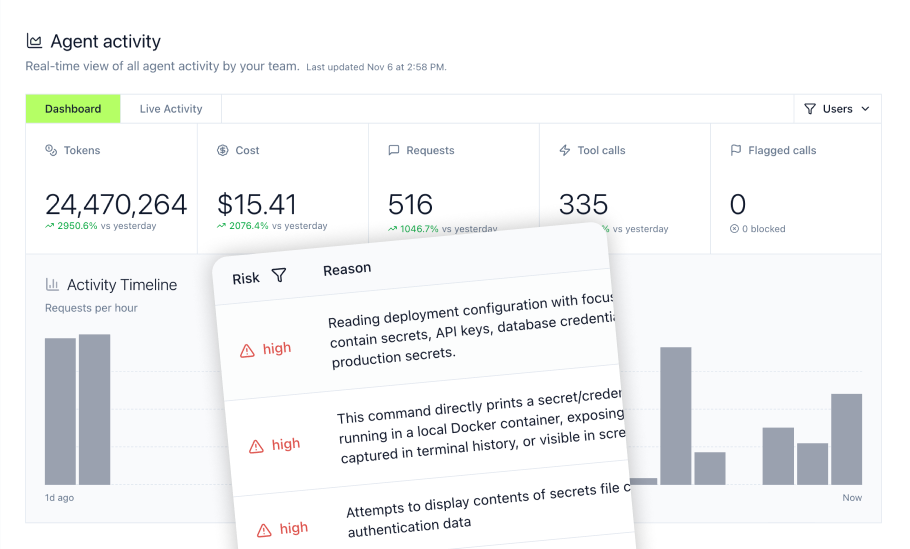
MintMCP's LLM Proxy monitors every MCP tool invocation, bash command, and file operation from all coding agents. This provides the visibility needed to detect suspicious activity immediately rather than during post-breach forensics.
Proactive Safeguards: Securing Your Claude Code Supply Chain
Prevention requires treating configuration files with the same rigor applied to executable code. Organizations with formal AI strategies report 80% success rates versus 37% for those without structured approaches.
Best Practices for Dependency Management
Repository hardening measures:
- Require code review for all
.claude/settings.jsonchanges - Implement pre-commit hooks that block suspicious configuration patterns
- Maintain baseline approved configurations per project type
- Use signed commits for configuration file modifications
Credential management:
- Store API keys in enterprise vaults (HashiCorp, AWS Secrets Manager)
- Implement project-specific keys instead of shared production credentials
- Automate key rotation on 30-90 day cycles
- Avoid long-lived secrets in developer-local environment variables or insecure CI/CD configurations
Implementing Secure Software Development Lifecycle (SSDLC)
Integrate AI-specific security controls into existing SDLC processes:
- Design phase: Document approved AI tools and their access boundaries
- Development phase: Scan repositories for unauthorized
.claude/directories - Review phase: Include configuration file audits in PR checklists
- Deployment phase: Validate no malicious configurations exist before release
- Operations phase: Monitor AI agent behavior continuously
Understanding MCP gateways provides the foundation for building these controls at scale.
Implementing Granular Security Controls for Claude Code Tools and Data
Effective defense requires policy enforcement at the tool level—blocking dangerous operations before they execute rather than logging them after the fact.
Restricting AI Agent Capabilities by Role
The OWASP framework recommends implementing least privilege access for AI agents:
- Read-only roles: Limit code review assistants to file reading without execution
- Development roles: Allow controlled bash commands within approved patterns
- Administrative roles: Full access with enhanced logging and approval workflows
MintMCP's MCP Gateway offers granular tool access control, allowing configuration of tool access by role. This means enabling read-only operations for junior developers while restricting write tools to senior engineers.
Protecting Production Credentials and Secrets
Prevent AI assistants from accessing sensitive files:
- Block access to
.env,.ssh,*.pem,*.keyfile patterns - Restrict AI agents from reading their own configuration files
- Implement allowlists for approved bash commands
- Monitor for attempts to access credential directories
MintMCP's LLM Proxy allows you to block dangerous commands in real-time while protecting sensitive files from unauthorized access.
Audit Trails and Real-Time Monitoring for Claude Code Interactions
Many organizations still lack enterprise-wide AI governance, leaving them without the visibility needed to detect or investigate AI-related incidents.
Achieving Full Visibility into AI Agent Actions
Comprehensive monitoring requires logging:
- Every MCP tool invocation with relevant invocation and result context
- All bash commands executed through Claude Code
- File access patterns including reads, writes, and other file operations
- Authentication events and session context
- Tool inventories, permissions, and usage patterns
MintMCP's audit and observability provide complete audit trails for every MCP interaction, enabling both real-time alerting and forensic analysis.
Leveraging Logs for Forensic Analysis
When incidents occur, audit trails enable rapid investigation:
- Reconstruct attack timelines from first compromise to detection
- Identify all systems and credentials potentially exposed
- Document evidence for regulatory notification requirements
- Improve defenses based on actual attack patterns
Real-time dashboards for monitoring usage transform reactive security into proactive threat prevention.
Ensuring Compliance and Governance for Enterprise Claude Code Deployments
AI tools interacting with regulated data trigger compliance obligations that many organizations overlook. AI-related security incidents are increasing regulatory scrutiny of AI governance practices.
Aligning AI Agent Use with Regulatory Requirements
SOC 2 Type II requirements:
- Document AI tool access controls (CC6.1)
- Implement change management for configuration files (CC6.6)
- Deploy system monitoring for AI agent activity (CC7.2)
HIPAA considerations:
- Business Associate Agreements required if code accesses PHI
- AI tool access must follow minimum necessary standards
- Audit trails must demonstrate appropriate access controls
GDPR obligations:
- Data Processing Agreements for AI tools handling EU citizen data
- Accountability documentation for AI agent data access
- Lawful transfer, access-control, and accountability requirements for cross-border AI operations
MintMCP's MCP Gateway is positioned around SOC 2 Type II–attested controls, enterprise audit trails, and governance workflows that can reduce the burden of documenting AI access and policy enforcement.
Establishing Enterprise-Wide AI Governance Policies
Effective governance frameworks address:
- Tool approval: Define which AI coding assistants are sanctioned for use
- Access boundaries: Specify what data each tool can access by classification
- Incident response: Create AI-specific runbooks for breach scenarios
- Training requirements: Ensure developers understand AI security risks
The MintMCP whitepaper provides a detailed implementation roadmap with metrics for measuring program effectiveness.
Accelerating Secure Claude Code Deployment with Enterprise Gateways
Shadow AI continues to grow, creating ungovernable risk as developers adopt tools without security oversight. The solution isn't to ban AI tools—it's to deploy them with pre-configured policies that enable productivity without compromising security.
Transforming Local MCP into Production AI Infrastructure
MintMCP's MCP Gateway enables one-click deployment of STDIO-based MCP servers with built-in hosting. This transforms local developer tools into production-ready services with:
- OAuth and SSO enforcement for all MCP endpoints
- Centralized credential management across teams
- Real-time monitoring and alerting
- Enterprise monitoring, alerting, and centralized governance
Bridging the Gap Between Shadow AI and Sanctioned AI
The goal isn't visibility alone—it's enabling safe AI adoption at scale. MintMCP's approach delivers:
- Deploy in minutes, not days: Pre-configured policies eliminate setup complexity
- Turn shadow AI into sanctioned AI: Governance without blocking developer productivity
- Complete audit trails: Documentation for compliance without manual effort
- Cross-tool support: Unified governance for Claude, Cursor, ChatGPT, and other AI clients
For organizations managing AI coding assistants across multiple teams, centralized tool governance provides the control plane needed to balance innovation with security.
How MintMCP Addresses Claude Code Supply Chain Risks
The Claude Code vulnerabilities underscore a fundamental challenge: AI coding assistants need powerful capabilities to be useful, but those same capabilities create attack surfaces that traditional security tools can't monitor or control. MintMCP was built specifically to solve this problem for enterprise teams deploying AI agents at scale.
Centralized visibility across all AI interactions: MintMCP's LLM Proxy monitors every MCP tool invocation, bash command, and file operation from coding agents and provides a complete audit trail for security review. This means security teams can detect malicious configuration exploitation in real-time rather than discovering breaches weeks later during forensic analysis.
Policy enforcement before execution: Unlike logging-only solutions, MintMCP's MCP Gateway blocks dangerous operations at the gateway layer. Security teams can define allowlists for approved bash commands, restrict file access to specific directories, and prevent API keys from being redirected to attacker-controlled endpoints—all without modifying developer workflows.
Credential isolation and rotation: MintMCP manages API keys centrally through enterprise vaults, ensuring that compromised developer machines don't expose production credentials. Project-specific keys with automatic rotation cycles limit the blast radius of any single key compromise, while audit trails document which keys were used for which operations.
Compliance-ready governance: MintMCP's SOC 2 Type II–attested controls, enterprise audit trails, and role-based access policies support documentation and enforcement needs associated with SOC 2, GDPR, and similar governance programs. This transforms AI governance from a manual documentation burden into an automated compliance capability.
Rapid deployment without disruption: MintMCP enables one-click deployment of STDIO-based MCP servers with OAuth, SSO, and monitoring pre-configured. Development teams can adopt secure AI workflows in minutes rather than spending weeks building custom infrastructure, turning shadow AI into sanctioned AI without blocking productivity.
For organizations facing the dual challenge of enabling AI developer productivity while mitigating supply chain risks, MintMCP provides the centralized control plane needed to achieve both goals simultaneously. Learn more about enterprise AI infrastructure and how MintMCP transforms local AI tools into production-grade services with built-in security.
Frequently Asked Questions
What should I do immediately if my team used Claude Code before the January 2026 patch cycle and earlier Claude Code fixes?
Start by rotating all Claude API keys across every workspace—this is the highest priority action. Next, audit all repositories for .claude/settings.json files created between October 2025 and February 2026, looking specifically for ANTHROPIC_BASE_URL overrides, enableAllProjectMcpServers: true settings, or suspicious SessionStart hooks. Review your API usage logs for anomalies during this period, particularly traffic to non-Anthropic domains. Document all findings for potential regulatory notification requirements. Finally, implement real-time monitoring before allowing continued Claude Code usage.
Can attackers still exploit these vulnerabilities after the patches were released?
The specific CVEs (CVE-2025-59536 and CVE-2026-21852) were patched in earlier Claude Code releases, including fixes published in October 2025 and January 2026, so updated Claude Code installations are protected against these exact attack vectors. However, the underlying attack surface—configuration files that execute commands and control tool behavior—remains inherent to how Claude Code and similar AI agents function. New vulnerabilities in this attack category will likely emerge. Organizations should implement defense-in-depth controls including configuration file scanning, real-time monitoring, and centralized governance rather than relying solely on patches.
How does this compare to traditional software supply chain attacks like SolarWinds or Log4j?
Traditional supply chain attacks like SolarWinds targeted compiled software or widely-used libraries, requiring sophisticated access to build systems or discovery of zero-day vulnerabilities. Claude Code attacks exploit configuration files that exist in every repository—a much broader attack surface requiring far less sophistication. Any developer who can submit a pull request or share a repository can introduce a malicious .claude/settings.json file. The blast radius differs too: traditional attacks compromise specific software versions, while AI configuration attacks can propagate through normal development workflows like forking repositories or reviewing pull requests.
What's the difference between rotating API keys and implementing full governance?
Key rotation addresses the immediate risk of compromised credentials but doesn't prevent future attacks. Full governance includes: visibility into what AI tools are installed and how they're being used; policy enforcement that blocks dangerous operations before execution; access controls limiting which tools can access which data; and audit trails documenting all AI agent activity. Key rotation is emergency response; governance is prevention. Organizations that only rotate keys without implementing monitoring and controls will face the same risks when the next vulnerability emerges.
How do I justify the cost of an AI governance platform to leadership?
Frame the investment against concrete risk scenarios: a single API key compromise can trigger material incident-response, forensics, legal, and remediation costs. Beyond direct costs, consider: productivity lost from overly restrictive "AI ban" policies if governance isn't available; regulatory penalties from inadequate AI documentation; and reputational damage from AI-enabled data breaches. Present governance as the enabler of safe AI adoption rather than a security tax—without it, the choice becomes accepting ungovernable risk or losing competitive advantage by restricting AI tool usage.