For some enterprises in regulated industries or those with strict data sovereignty requirements, deploying AI agent gateways on-premise may be necessary to satisfy internal policies, contractual obligations, or specific regulatory requirements. As organizations scale their AI agent deployments across internal tools, databases, and production systems, the choice between cloud-hosted and on-premise infrastructure becomes a strategic decision that affects security posture, latency, and regulatory compliance.
The right MCP gateway for on-premise deployment must handle enterprise authentication, provide complete audit trails, and integrate with existing IT infrastructure management tools without requiring extensive custom engineering. Organizations need solutions that work within VPCs, air-gapped environments, and hybrid architectures while maintaining the governance controls that security teams demand.
This guide evaluates the AI agent, MCP, and AI traffic gateways best suited for on-premise infrastructure in 2026, focusing on their capabilities for security, governance, and seamless integration with existing enterprise systems.
Key Takeaways
- MintMCP combines an MCP Gateway for governed tool and data connections (Claude, Cursor, ChatGPT, Gemini, Copilot) with an Agent Gateway for agent identities, permissions, memory, and monitoring. VPC and self-hosted deployment available on request.
- On-premise deployment options include VPC isolation, fully self-hosted data centers, air-gapped environments, and hybrid architectures combining on-premise control with cloud flexibility.
- Enterprise agent gateway requirements include SSO and SCIM-driven RBAC, tool-level policy enforcement, comprehensive audit logging, OAuth brokering, and integration with existing security infrastructure.
- Deployment model selection depends on regulatory requirements, data sovereignty mandates, latency sensitivity, existing infrastructure investments, and organizational security policies.
- Zero-trust architecture requires mandatory authentication per request, no default access assumptions, granular tool-level access controls, and continuous verification throughout agent sessions.
1. MintMCP: Agent Gateway with MCP foundation
MintMCP combines an MCP Gateway for governed tool and data connections with an Agent Gateway for agent identities, permissions, memory, and monitoring. Its MCP foundation provides authentication, tool-level access control, credential management, logging, and rule-based policy. The Agent Gateway layer adds first-class agent identities, scoped permissions, and governance for agents that work alongside users.
For organizations requiring private infrastructure, MintMCP offers VPC and self-hosted options on request. Organizations should confirm the available feature scope and operational responsibilities for their selected deployment.
What makes MintMCP different
MintMCP solves the fundamental problem enterprises face when connecting AI agents to internal systems. The platform wraps stdio, hosted, HTTP-streamable, and SSE MCP servers behind SSO-fronted remote MCP endpoints with OAuth brokering, SCIM-driven membership, and rule-based policy. This reduces fragmented security policies and visibility gaps that create operational challenges when managing point-to-point connections.
Core capabilities for on-premise infrastructure
MCP Gateway capabilities:
- Virtual MCP Bundles: Create team-specific, per-use-case endpoints exposing minimum required tools with SCIM-driven membership and role-based access
- Hosted MCP Connectors: Auto-scaling and isolated execution per connector, reducing infrastructure overhead
- OAuth Brokering: Add enterprise authentication to local and hosted MCP servers, including OAuth 2.x, bearer tokens, and SSO-fronted access
- Custom Gateway Middleware: Customer-authored middleware in JS sandbox with external DLP and guardrails integrations for masking, blocking, and policy enforcement
Agent Gateway capabilities:
- Agent identities: Give internal agents first-class identities with M2M auth, scoped tools, independent rotation and revocation
- Real-Time Monitoring: Live dashboards showing server health, usage patterns, tool call tracking, and security alerts across all MCP connections
- Agent Monitor coverage: Org-level analytics on MCP adoption, usage patterns, latency monitoring, and error tracking
Security and compliance
MintMCP is SOC 2 Type II audited, with continuous compliance monitoring. Enterprise SSO, complete audit trails, PII detection, and role-based access control are built into every layer. Customers handling protected health information can request HIPAA documentation. MintMCP signs BAAs.
Enterprise integrations
- Snowflake data warehouse access with natural language queries
- Elasticsearch knowledge base search for HR docs and logs
- Gmail integration for AI-driven response automation
- Custom MCP server deployment for internal tools
- Claude, Cursor, ChatGPT, Gemini, and Copilot governance through centralized gateway
2. TrueFoundry
TrueFoundry provides a unified AI platform combining LLM, MCP, and Agent Gateway with model serving and fine-tuning capabilities. The platform supports VPC, on-prem, and air-gapped deployment for enterprises requiring full infrastructure control.
Core features
- Virtual MCP Server abstraction for managing integrations
- VPC deployment for cloud-native data isolation
- On-prem deployment for data center infrastructure
- Air-gapped deployment for network isolation requirements
- SOC 2 Type II attestation and HIPAA compliance for managed infrastructure; self-hosted compliance depends on customer controls
Organizations seeking to consolidate AI operations, MCP gateway, and model serving into a single platform can reduce vendor and integration complexity.
3. Bifrost (Maxim AI)
Bifrost provides an open-source AI gateway built in Go, designed for high-performance workloads requiring air-gapped or VPC deployment. The Apache 2.0 license enables full customization and self-hosted deployment.
Core features
- Apache 2.0 open-source license
- Native MCP protocol support
- AI gateway with unified LLM routing, MCP Gateway capabilities, and agent integrations
- Semantic caching for token cost optimization
- Air-gapped and VPC isolation deployment
- Self-hosted via Docker or binary
Teams requiring maximum performance for on-premise AI workloads and organizations preferring open-source solutions with enterprise hardening options can leverage the Go implementation for low-latency operation.
4. agentgateway
agentgateway is an open-source project hosted by the Agentic AI Foundation under the Linux Foundation. Built in Rust, it provides protocol-aware routing and governance for MCP, A2A, LLM, HTTP, gRPC, and conventional service traffic.
Core features
- Built in Rust for AI agents from ground up
- A2A (Agent-to-Agent) and MCP protocol native support
- Contributing organizations include Microsoft, AWS, Cisco, Adobe, Salesforce, and Alibaba
- Virtual MCP support for federating tools from multiple MCP servers behind one endpoint
- Kubernetes-native deployment with CNCF kgateway integration
- Self-hosted on any Kubernetes cluster
Platform engineering teams requiring a protocol-aware data plane deployable as a standalone gateway or within Kubernetes environments benefit from the Linux Foundation governance structure and vendor-neutral infrastructure.
5. Obot
Obot provides MIT-licensed open-source MCP gateway capabilities as part of a broader AI agent orchestration framework. The open-source architecture offers full transparency and customization for teams with infrastructure expertise.
Core features
- MIT license for maximum openness
- Built-in curated MCP catalog with end-user discovery
- Composite server support for aggregating multiple MCP servers
- Okta and Entra ID integration in Obot Enterprise
- Kubernetes deployment for production
- Docker deployment for development and testing
- Self-hosted deployment available; Obot also offers a managed cloud option
Platform engineering teams with DevOps expertise requiring full infrastructure ownership and teams building custom AI agent platforms can leverage maximum flexibility for modification and redistribution.
6. Kong AI Gateway
Kong AI Gateway extends the established Kong API gateway platform with AI and MCP capabilities. Organizations with existing Kong infrastructure can add AI governance without deploying separate systems.
Core features
- A2A (Agent-to-Agent) protocol support
- Plugin architecture for extensibility
- API gateway foundation extended to AI workloads
- Hybrid deployment with Konnect control plane and self-hosted data plane
- Fully self-hosted deployment for complete infrastructure control
- Multi-cloud and hybrid enforcement across environments
Enterprises with established Kong deployments seeking to extend existing infrastructure to AI workloads benefit from proven scalability and enterprise support.
7. Lunar.dev MCPX
Lunar.dev's MCPX provides an open-source gateway for governing MCP traffic. End-to-end LLM, MCP, and API governance available when paired with Lunar.dev's AI Gateway.
Core features
- MCP governance through MCPX; end-to-end LLM, MCP, and API governance available when paired with Lunar.dev's AI Gateway
- MCP Evaluation Sandbox for evaluating servers in MCPX Enterprise
- MIT open-source core
- MCPX Enterprise can be self-hosted in a VPC or on-premises
- MCPX Enterprise supports air-gapped deployment
- Docker and Kubernetes deployment options
Teams requiring governance across the entire AI interaction chain, from user to agent to model to MCP to tool, can evaluate servers before production deployment through the MCP risk sandbox.
8. Microsoft MCP Gateway
Microsoft MCP Gateway provides an open-source Kubernetes reverse proxy for MCP with tight Azure ecosystem integration. The project offers a no-license-fee starting point for organizations in the Microsoft ecosystem, although infrastructure and operational costs still apply.
Core features
- Microsoft-backed open-source project
- Entra ID integration for enterprise authentication
- Kubernetes-native architecture
- Self-hosted Kubernetes deployment
- Runs in Kubernetes environments, with Azure deployment guidance and Entra ID integration
Organizations standardized on Azure infrastructure seeking to add MCP capabilities benefit from Entra ID integration that simplifies authentication for Microsoft-centric environments.
9. Docker MCP Gateway
Docker MCP Gateway provides a Docker-native gateway for running MCP servers in isolated containers and centrally managing routing, credentials, access control, logging, and server lifecycles.
Core features
- Docker Desktop MCP Toolkit or manual Docker Engine installation through the Docker MCP CLI
- Self-hosted on any Docker-capable infrastructure
- Standard container security practices
- Container isolation for MCP server deployments
- Integration with existing Docker orchestration
Teams with existing Docker environments seeking container-native MCP management benefit from familiar Docker tooling that reduces the learning curve for DevOps teams.
Navigating on-premise vs. cloud for AI agent gateways
The choice between on-premise and cloud deployment for AI agent gateways can be evaluated using the NIST AI Risk Management Framework and depends on several factors: regulatory requirements, latency sensitivity, existing infrastructure investments, and security policies.
Key drivers for on-premise AI agent infrastructure
Organizations choose on-premise deployment for specific reasons:
- Regulatory compliance: Industries such as healthcare, finance, and government often require data to remain within controlled environments
- Data sovereignty: Some jurisdictions mandate that certain data types never leave geographic boundaries
- Latency requirements: Edge deployments and real-time applications benefit from reduced network hops
- Existing infrastructure: Organizations with significant data center investments can leverage existing capacity
- Security policies: Some security frameworks require air-gapped or isolated network deployments
Evaluating deployment models
Most enterprises adopt hybrid approaches, combining on-premise control with cloud flexibility. This allows organizations to keep sensitive data and processing on-premise, use cloud resources for burst capacity and non-sensitive workloads, and maintain unified governance across both environments.
Essential on-premise infrastructure management
Deploying AI agent gateways on-premise requires careful consideration of underlying infrastructure components.
Core infrastructure components
- Containerization: Kubernetes or Docker for orchestrating gateway deployments
- Network topology: Proper segmentation and security zones for AI workloads
- Storage solutions: Persistent storage for audit logs and configuration
- Load balancing: Distribution of traffic across gateway instances
- Disaster recovery: Backup and failover procedures for critical AI infrastructure
Optimizing for AI workloads
AI agent gateways have specific infrastructure requirements including low-latency network paths between agents and tools, sufficient compute for policy evaluation and middleware execution, storage capacity for comprehensive audit logging, and high availability configurations for production deployments.
Securing on-premise network gateways
On-premise AI agent gateways require defense-in-depth security approaches that integrate with existing enterprise security stacks.
Implementing zero-trust principles
- Mandatory authentication and authorization per request
- No default access assumptions for any agent or user
- Granular tool-level access controls
- Continuous verification throughout agent sessions
Integrating with enterprise security
MintMCP's security governance approach demonstrates how agent gateways integrate with existing security infrastructure:
- OAuth 2.0 and SAML for enterprise authentication
- SIEM integration for centralized logging (Sentinel, Splunk, S3)
- DLP integration with platforms like Bedrock Guardrails, GCP DLP, Microsoft Purview, Nightfall, and Skyflow
- Automatic credential rotation and management
Monitoring and observability for on-premise AI agents
Comprehensive monitoring is essential for maintaining visibility into AI agent operations within on-premise infrastructure.
Key metrics for agent gateway performance
- Tool call latency and throughput
- Error rates by server and tool
- Usage patterns by team and agent
- Resource utilization across gateway instances
- Security event detection and alerting
Proactive monitoring approaches
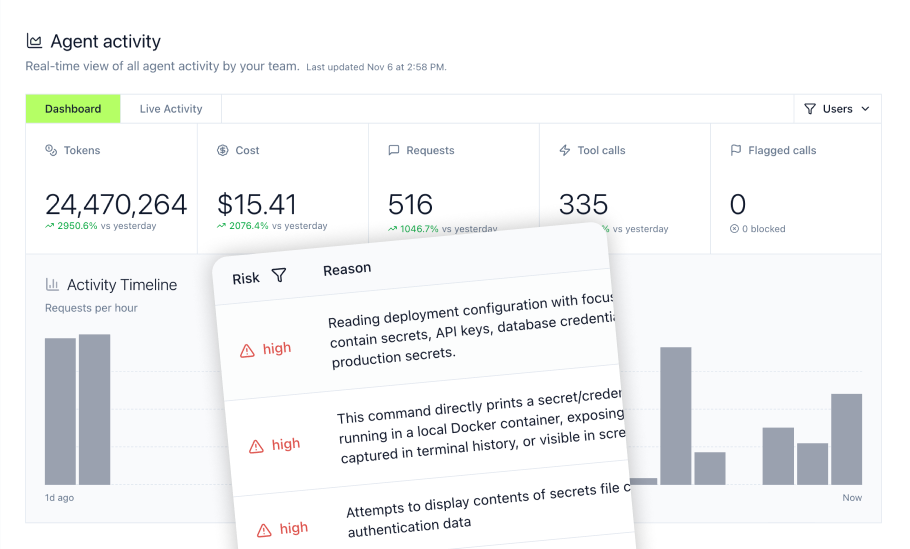
Agent Monitor provides org-level analytics on MCP adoption, usage patterns, latency monitoring, and error tracking. For on-premise deployments, this visibility extends to real-time detection of PII exposure and credential leakage, risky bash command detection, prompt injection attempt identification, and off-gateway MCP usage detection through Claude Code and Cursor hooks.
The hybrid cloud advantage for on-premise deployments
Many organizations adopt hybrid approaches that combine on-premise control with cloud flexibility. Organizations can deploy MCP gateways in hybrid configurations including gateway control plane in cloud with data plane on-premise, fully on-premise deployment with cloud-based monitoring, or split deployment based on data sensitivity classifications.
Hybrid architecture benefits
- Workload portability: Move workloads between on-premise and cloud based on requirements
- Burst capacity: Scale to cloud for peak demand while maintaining baseline on-premise
- Cost optimization: Balance infrastructure costs between owned and consumed resources
- Regulatory flexibility: Keep regulated workloads on-premise while using cloud for others
MintMCP's governance framework for on-premise security
MintMCP provides enterprise-grade governance specifically designed for organizations requiring on-premise or hybrid deployment.
The Bundle architecture advantage
MintMCP's Bundle architecture packages tool access, policy enforcement, and audit logging into single governance units:
- Per-team or per-role endpoint configuration
- SCIM-driven membership synchronization with identity providers
- Tool curation with granular access controls
- Isolated audit trails per Bundle
Per-agent identity and credentials
Agent identities in MintMCP ensure each AI agent has its own credential set scoped to required tools, independent rotation and revocation capabilities, no shared keys between agents or users, and full audit attribution for every action.
Shadow AI detection
For organizations with strict security requirements, Agent Monitor detects off-gateway MCP usage in developer tools. This addresses the visibility gap where developers might use AI tools outside governed infrastructure.
Choosing the right on-premise agent gateway
Selecting an agent gateway for on-premise infrastructure requires evaluating several factors:
Deployment flexibility
Verify the gateway supports your specific deployment requirements: VPC, fully self-hosted, air-gapped, or hybrid configurations. Some solutions offer capabilities across deployment models while others have limitations in self-hosted scenarios.
Authentication and identity
Enterprise on-premise deployments require integration with existing identity infrastructure. Evaluate support for OAuth 2.0 and SAML, SCIM for group synchronization, per-user and per-agent identity models, and credential rotation and management.
Compliance requirements
For regulated industries, verify the gateway supports required compliance frameworks. SOC 2 Type II attestation, HIPAA compliance support, and comprehensive audit logging are essential for many on-premise deployments.
Integration ecosystem
Assess which data sources and tools your AI agents need to access. MintMCP's server catalog demonstrates the breadth of integrations available for enterprise deployments.
Deploy AI agent infrastructure with MintMCP
For organizations requiring on-premise deployment of AI agent infrastructure, MintMCP provides the governance foundation needed for production deployment. The platform's dual architecture addresses both MCP Gateway and Agent Gateway requirements: governed data and tool connections for Claude, Cursor, ChatGPT, Gemini, and Copilot, plus agent identities, permissions, memory, and monitoring for agents that work alongside users.
MintMCP's data-permissions-first architecture ensures security and compliance are built in from the start, not bolted on afterward. The platform starts with SSO, SCIM-driven RBAC, IdP groups, Virtual MCP Bundles, tool-level policy, and audit logs, then enables agents on top.
For organizations requiring private infrastructure, MintMCP offers VPC and self-hosted options on request, with capabilities that can include Virtual MCP Bundles, Agent Bundles, OAuth brokering, and comprehensive audit logging. Deployment-specific availability should be confirmed during enterprise review.
The Bundle architecture packages tool access, policy enforcement, and audit logging into single governance units per team or role. Each Bundle provides SCIM-driven group membership synchronization, curated tool lists, and isolated audit trails. For on-premise deployments, this architecture simplifies governance by consolidating configuration that would otherwise require separate policy, access rule, and credential objects across multiple systems.
Agent identities ensure each AI agent has its own credential set scoped to required tools, independent rotation and revocation capabilities, and full audit attribution for every action. This eliminates shared keys and provides the visibility organizations need for regulated workloads.
Visit MintMCP Gateway to learn more about deploying governed AI agents on your infrastructure.
Frequently asked questions
What are the primary considerations for deploying AI agent gateways on-premise?
Key considerations include regulatory compliance requirements, data sovereignty mandates, latency sensitivity, existing infrastructure investments, and security policies. Organizations in regulated industries such as healthcare and finance often require on-premise deployment to maintain data control. Additionally, evaluate the gateway's support for your specific deployment model (VPC, air-gapped, fully self-hosted) and integration with existing IT infrastructure management tools.
How does MintMCP's Bundle architecture support on-premise AI agent governance?
MintMCP's Bundle architecture packages tool access, policy enforcement, and audit logging into single governance units per team or role. Each Bundle provides SCIM-driven group membership synchronization, curated tool lists, and isolated audit trails. For on-premise deployments, this architecture simplifies governance by consolidating configuration that would otherwise require separate policy, access rule, and credential objects across multiple systems.
Can on-premise agent gateways achieve the same capabilities as cloud solutions?
Some agent gateways provide similar core capabilities across cloud and on-premise deployments, but feature availability, support, upgrades, compliance scope, and operational responsibilities often differ by deployment model. MintMCP offers VPC and self-hosted options on request, with capabilities that can include Virtual MCP Bundles, Agent Bundles, OAuth brokering, and comprehensive audit logging. Deployment-specific availability should be confirmed during enterprise review.
What security measures are critical for on-premise AI agent gateway deployment in regulated industries?
Critical security measures include zero-trust architecture with mandatory authentication per request, granular tool-level access controls, comprehensive audit logging for compliance investigations, integration with enterprise identity providers (OAuth 2.0, SAML, SCIM), DLP integration for PII detection and blocking, and encrypted data in transit and at rest. SOC 2 Type II attestation and HIPAA compliance support are essential for many regulated deployments.
How do organizations manage hybrid cloud architectures for AI agent infrastructure?
Hybrid architectures typically deploy gateway data planes on-premise while leveraging cloud resources for control plane management, monitoring, or burst capacity. This approach maintains data sovereignty for sensitive workloads while gaining cloud flexibility for non-sensitive operations. Organizations can split deployments based on data sensitivity classifications, keeping regulated data processing on-premise while using cloud resources for development and testing environments.