AI agents can generate highly variable token and tool-call volumes, so request-count-only rate limiting is often insufficient. Research on agentic coding tasks found that they consumed about 1,000 times more tokens than code chat or code-reasoning tasks in the studied benchmark, with token use varying by up to 30x on the same task. Without token-based rate limiting and granular access control, organizations face unlimited billing exposure and uncontrolled data access across internal systems.
Agent gateways provide a control layer for agent identities, permissions, memory, monitoring, and connections to models, tools, and enterprise data. Depending on the product, they may support agentic protocols such as MCP or A2A, stateful sessions, request or token quotas, and policy enforcement across multi-step workflows. MintMCP Gateway governs data and tool connections through authentication, tool-level access control, credential management, logging, and rule-based policy. MintMCP's Agent Gateway builds on that foundation with identities, permissions, memory, and monitoring for agents. SSO-fronted endpoints, SCIM-driven RBAC, and tool-level policy enforcement transform MCP servers into governed production services.
The right gateway prevents cost overruns, enforces least-privilege access, and creates the audit trails required when 82% of organizations use AI agents, but only 44% have policies governing their use.
Key Takeaways
- MintMCP Agent Gateway provides agent identities, permissions, memory, and monitoring built on MintMCP's MCP Gateway foundation, with tool-level usage controls, team-based quota enforcement, Virtual MCP Bundles for per-use-case endpoints, Agent Bundles with M2M authentication, hosted MCP connectors, and Custom Gateway Middleware for inline DLP integration
- Open-source gateways offer MCP and A2A protocol support with token and request-based rate limiting, JWT authentication, and policy-based authorization
- Enterprise gateway extensions provide management UIs, advanced policy engines, multi-cluster deployments, and support agreements
- Unified gateways add agent capabilities to existing API management platforms with semantic caching, multi-model routing, and consolidated operational models
- Token budget management helps prevent cost overruns from uncontrolled agent workloads
- Policy-based filtering applies rate limiting and access control to LLM, MCP, and A2A traffic through protocol-specific proxies
1. MintMCP Agent Gateway: identities, permissions, and monitoring for agents
MintMCP Gateway governs data and tool connections through authentication, tool-level access control, credential management, logging, and rule-based policy. MintMCP's Agent Gateway builds on that foundation with identities, permissions, memory, and monitoring for agents. Its data-permissions-first architecture starts with SSO, SCIM-driven RBAC, IdP groups, Virtual MCP Bundles, tool-level policy, and audit logs, then enables agents on top.
What makes MintMCP Agent Gateway different
MintMCP solves the rate limiting and access control challenges that create runaway costs and security gaps. The platform wraps stdio, hosted, HTTP-streamable, and SSE MCP servers behind SSO-fronted remote MCP endpoints with OAuth brokering, SCIM-driven membership, and rule-based policy. This eliminates the fragmented approach where each MCP server requires separate rate limiting configuration and access control logic.
Rate limiting capabilities
- Configurable usage controls apply limits by user, team, and tool
- Tool-level policies let administrators govern high-risk or high-cost operations separately
- Team-based quota enforcement helps prevent a single workload from consuming shared capacity
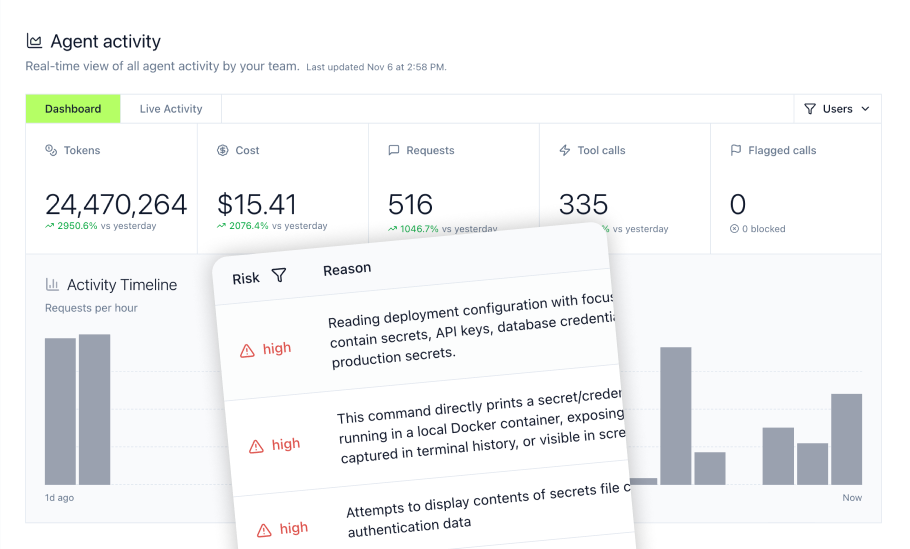
- Real-time monitoring dashboards surface usage patterns, server health, and security alerts
Access control architecture
MintMCP implements granular access control through multiple layers:
- Virtual MCP Bundles create team-specific, per-use-case endpoints that expose only the minimum required tools with SCIM-driven membership, curated tool lists, and fine-grained role-based access
- Tool-level permissions enable policies like database reads for analysts while restricting write operations to authorized administrators
- Agent Bundles give internal agents first-class identities with M2M authentication, scoped tools, independent rotation and revocation, and an "act as agent" flow for connectors requiring per-agent OAuth
- Tool-update policy controls whether new upstream tools are auto-enabled or require admin approval, addressing silent capability expansion
Custom Gateway Middleware
MintMCP runs customer-authored middleware in a JS sandbox with external DLP and guardrails integrations:
- AWS Bedrock Guardrails integration for blocking and masking
- Google Cloud DLP, Microsoft Purview, Nightfall, and Skyflow connectors
- Pre- and post-phase hooks that transform, mask, or block requests based on custom logic
- OpenAI moderation and jailbreak detection templates
Security and compliance
MintMCP is SOC 2 Type II audited, compliant with HIPAA standards, and penetration tested. Every agent action is logged with full context including who initiated it, which tools were called, what data flowed through, and when. Customers can review the full security posture in the Trust Center.
Deployment
Managed SaaS-first delivery with US and EU availability. VPC and self-hosted deployment available on request.
2. agentgateway (Linux Foundation open source)
The agentgateway project provides open-source MCP and A2A protocol support through the Linux Foundation's Agentic AI Foundation. The gateway handles stateful sessions, token-based rate limiting, and multi-step autonomous workflows without commercial license costs.
Rate limiting features
- Token-based limits that count actual LLM token consumption, not just request counts
- Request-per-minute quotas configurable per route or backend
- Window-based rate limiting with configurable time intervals
- 429 responses with Retry-After headers for graceful client handling
Access control model
- JWT authentication with configurable issuers and audience validation
- CEL (Common Expression Language) policy rules for fine-grained authorization
- RBAC policies that map JWT claims to tool access permissions
- Backend-specific authorization rules per MCP server
Technical specifications
The gateway supports Kubernetes Gateway API integration, standalone binary deployment, and Docker Compose configurations. The gateway can run as a standalone binary or on Kubernetes and supports HTTP, gRPC, LLM, MCP, and A2A traffic through one data plane.
Where agentgateway fits
Platform engineering teams with Kubernetes expertise who want full infrastructure control and zero software licensing costs. The self-managed model requires teams to operate the runtime, scaling, and policy configuration themselves.
3. Solo Enterprise for agentgateway
Solo Enterprise for agentgateway extends the open-source data plane with an enterprise control plane, management UI, global rate limiting, budget controls, advanced authorization, observability, and enterprise support.
Enhanced rate limiting
- Request- and token-based rate limits for LLM traffic
- Global rate limiting across gateway replicas
- Token or USD budgets scoped by user, group, virtual key, model, provider, or custom dimensions
- Token usage and realized-cost telemetry through logs, metrics, and traces
Advanced access control
- API key, JWT, OAuth, OIDC, and external authorization integrations
- CEL-based conditional authorization and policy targeting
- Fine-grained tool exposure based on identity and policy
- Integration with enterprise identity providers and centralized telemetry
Support and deployment
Solo Enterprise provides commercial support and is designed for Kubernetes-based, cloud-native environments, with a centralized management UI and observability stack. Organizations already using Istio or Envoy may find the integration familiar.
Where Solo Enterprise fits
Enterprises with complex multi-cloud environments requiring production-grade support, advanced policy engines, and the operational tooling to manage agent gateways at scale.
4. Kong AI Gateway
Kong AI Gateway adds agent and LLM gateway capabilities to the Kong API Gateway platform, providing a unified control plane for APIs, AI models, and MCP traffic.
Rate limiting approach
- Token-based rate limiting that counts LLM tokens across requests
- Semantic caching that reuses responses for semantically similar prompts when configured
- Semantic routing that can direct prompts to the most appropriate configured upstream, including lower-cost models when policy allows
- Unified rate limiting across traditional APIs and agent traffic
Access control integration
- OAuth 2.0 and API key authentication through existing Kong plugins
- Plugin-based policy enforcement using Kong's established plugin architecture
- Rate limiting policies that apply consistently across API and agent traffic
- Integration with existing Kong identity and access management configurations
Where Kong AI Gateway fits
Organizations already standardized on Kong for API management who want to add MCP and LLM gateway capabilities without deploying separate infrastructure. The unified operational model reduces complexity for teams managing both traditional APIs and agent traffic.
5. TrueFoundry Agent Gateway
TrueFoundry provides agent gateway capabilities as part of its ML platform, with request- and token-based rate limits, cost budgets, and policy controls for users, teams, models, and virtual accounts.
Rate limiting features
- Request- and token-based limits configurable per minute, hour, or day
- Rules scoped by user, model, virtual account, or request metadata
- Tenant and team cost budgets with enforcement or warn-only modes
- Budget usage views with breakdowns by user, model, virtual account, or metadata
Access control model
- Virtual Account Tokens for service-level authentication
- Role-based access to models and tools
- Policy enforcement through declarative configuration
- Integration with enterprise identity providers
Multi-agent coordination
TrueFoundry addresses the challenge of multiple agents sharing quotas through independently configurable rate-limit and budget rules for users, teams, virtual accounts, models, and request metadata. These controls help prevent one workload from consuming shared capacity.
Where TrueFoundry fits
ML platform teams who want agent gateway capabilities integrated with their existing model serving and experiment tracking infrastructure. The platform approach works for teams already invested in TrueFoundry's ML platform ecosystem.
6. Gravitee Gamma Agent Management
Gravitee Gamma Agent Management provides a unified control plane for LLM calls, MCP tool invocations, and A2A delegations, with protocol-specific proxies for authentication, authorization, rate limiting, and observability.
Rate limiting configuration
- Policy-based rate limiting applied to MCP tool invocations
- Token-based rate limiting for traffic handled by the LLM Proxy
- Integration with Gravitee's existing gateway policy infrastructure
- Observability for LLM, MCP, and A2A traffic
Access control approach
- Policy filtering middleware for authorization decisions
- Integration with enterprise identity providers
- Role-based access through existing Gravitee policy engine
- Audit logging for compliance requirements
Observability stack
Gravitee provides OpenTelemetry metrics and traces for MCP operations, viewable alongside existing API observability data. This unified view helps teams monitor agent performance alongside traditional API traffic.
Where Gravitee fits
Organizations already using Gravitee for API management who want to add agent gateway capabilities through familiar configuration patterns and operational tooling.
Why rate limiting matters for AI agents
Traditional request-based rate limiting fails for AI agents because agent workloads differ fundamentally from human-driven API usage. A single agent task can consume far more tokens than a simple chat interaction because the agent repeatedly processes accumulated context across multiple steps. Request limits set for human usage patterns either block legitimate agent work or allow cost overruns.
Token-based rate limiting
Effective agent gateways count actual LLM token consumption, not just request counts. This approach:
- Prevents cost overruns from token-heavy operations
- Allows high-frequency, low-token operations to proceed
- Creates accurate cost attribution for budget management
- Enables different limits for different operation types
Budget enforcement for multi-step workflows
AI agents often execute multi-step workflows that span many API calls. Gateways can track cumulative requests, tokens, or spend across those calls and enforce per-agent or per-team limits at each step. Agents should handle rate-limit responses through backoff, checkpointing, or resumable workflow logic so partial work is not lost.
Circuit breakers and adaptive limits
Static rate limits struggle with the bursty, unpredictable nature of agent workloads. Gateways that implement circuit breakers automatically throttle agents showing signs of runaway behavior. Adaptive limits adjust based on error rates and cost trajectories rather than fixed thresholds.
Access control for agent-to-data connections
When AI agents access production databases, CRM systems, and internal documents, access control becomes critical. The challenge is implementing least-privilege access while maintaining the flexibility agents need to complete their work.
Tool-level permissions
Effective access control operates at the tool level, not just the agent level. This enables:
- Read-only database access for analysis agents
- Write permissions only for specific tables or operations
- Different permission sets for different agent roles
- Audit trails showing exactly which tools each agent used
Per-agent identity
Shared service account credentials create security and audit challenges. When multiple agents share credentials:
- You cannot attribute actions to specific agents
- Credential rotation affects all agents simultaneously
- Compromised credentials expose all agent capabilities
- Audit logs show only the service account, not which agent acted
Per-agent identity with independent credentials solves these problems. Each agent gets scoped access, and credentials can be rotated or revoked without affecting other agents.
RBAC and ABAC models
Role-based access control (RBAC) assigns permissions based on agent roles. Attribute-based access control (ABAC) evaluates multiple attributes including agent identity, data sensitivity, time of day, and request context. Enterprise environments often need both models working together.
Implementation considerations
Setup sequence
Deploying an agent gateway typically follows this sequence:
- Deploy the gateway on Kubernetes or as a standalone service
- Register MCP servers as backends with protocol and authentication configuration
- Configure rate limiting policies with token-based quotas per user, team, or agent
- Set up access control through JWT validation and authorization rules
- Connect agents by pointing their MCP client configuration to the gateway URL
Common challenges
MCP servers unreachable from gateway: Network policies must allow the gateway to reach upstream servers over Streamable HTTP. Legacy HTTP+SSE deployments may also require separate SSE and POST endpoints.
Rate limits too strict: Begin in monitoring or warn-only mode, establish a representative usage baseline, and tighten limits gradually without disrupting legitimate workflows.
JWT validation failures: Issuer and audience claims must match exactly, including case sensitivity.
Monitoring and observability
Without comprehensive logging, organizations face a visibility gap where they cannot see which tools agents use or track data access. Essential metrics include:
- Tool call volume and latency per agent
- Token consumption trends and anomalies
- Error rates and failure patterns
- Cost attribution by team and workflow
Deploy governed AI agents with MintMCP
Rate limiting and access control form the foundation for production AI agent deployments. Without them, organizations face runaway costs, uncontrolled data access, and audit gaps that make compliance impossible.
MintMCP's Agent Gateway provides the infrastructure to deploy AI agents with confidence. Built on MintMCP's MCP Gateway foundation for governed data and tool connections, the Agent Gateway adds the identities, permissions, memory, and monitoring layer that agents need to work alongside users. Centralized rate control helps prevent cost overruns. Virtual MCP Bundles and Agent Bundles implement least-privilege access at the tool level. Custom Gateway Middleware integrates with existing DLP and guardrails investments. Full audit trails capture every agent action for compliance.
MintMCP's data-permissions-first architecture means governance is built in from the start, not bolted on afterward. SSO enforcement, SCIM-driven RBAC, and tool-level policies work together so an agent's access is always a subset of an already-governed permission model. This approach transforms how organizations think about agent deployment, moving from ad-hoc scripts with shared credentials to first-class agent identities with auditable, reviewable access patterns.
Whether you're running coworker agents in Slack that hold memory and continue work across days, or orchestrating multi-step workflows that span internal systems, MintMCP's Agent Gateway provides the control layer that makes production agent deployments possible. The platform handles the infrastructure complexity, rate limiting coordination, access control enforcement, and audit trail generation so your team can focus on building agents that deliver value.
Get started at mintmcp.com or request a custom quote for an enterprise deployment.
Frequently asked questions
What is the difference between request-based and token-based rate limiting for AI agents?
Request-based rate limiting counts the number of API calls, treating all requests equally. Token-based rate limiting counts actual LLM token consumption, which varies dramatically between requests. A simple query might use 100 tokens while a complex analysis task uses 10,000. Token-based limits prevent cost overruns more effectively because they measure actual resource consumption rather than request frequency.
How do agent gateways handle multi-step workflows that span multiple API calls?
Agent gateways can track requests, tokens, or spend across the calls in a workflow and enforce configured limits at each step. When a limit is reached, the gateway returns a rate-limit error, and the agent should use retry, backoff, checkpointing, or resumable execution to avoid losing completed work.
Can agent gateways work with existing API gateway infrastructure?
Some organizations extend existing API gateways with MCP support rather than deploying separate infrastructure. Kong AI Gateway, for example, adds agent capabilities to existing Kong deployments. The tradeoff is that purpose-built agent gateways often provide deeper MCP protocol support, agent-specific policy primitives, and specialized features like per-agent identity management that generic API gateways may lack.
What access control model works best for AI agents?
Most enterprise deployments need both RBAC (role-based) and tool-level permissions. RBAC assigns agents to roles with baseline capabilities. Tool-level permissions then refine access within those roles, enabling read-only database access for analysis agents while restricting write operations. MintMCP's Virtual Bundles implement this through per-use-case endpoints with curated tool lists and SCIM-driven membership.
How do agent gateways create audit trails for compliance?
Agent gateways can log tool invocations with the user or agent identity, timestamp, tool name, policy result, and selected request or response metadata, depending on configuration and privacy controls. This creates the attribution trail required for compliance audits. MintMCP maintains full audit trails showing who initiated each action, which tools were called, what data flowed through, and when, with exportable logs for security review workflows.