AI agents are only as powerful as the tools they can access. For startups building agentic AI products or deploying AI assistants internally, connecting agents to enterprise systems safely remains the primary bottleneck in 2026. The Model Context Protocol has emerged as the standard for AI-to-tool integration, with adoption from Anthropic, OpenAI, Google, and Microsoft. But protocol standardization alone does not solve security, governance, or scaling challenges, especially as production deployments still need infrastructure-level controls for identity propagation, tool budgeting, errors, and observability.
An MCP gateway transforms direct agent-to-tool connections into a governed infrastructure layer. MintMCP's Agent Gateway builds on that MCP Gateway foundation with identities, permissions, memory, and monitoring for agents that work alongside users. Instead of managing fragmented security policies across dozens of individual MCP servers, startups can centralize authentication, access control, and audit logging through a single control plane. For teams building AI products or deploying Claude, Cursor, ChatGPT, Gemini, and Copilot across their organization, the right gateway choice determines whether AI deployment takes weeks or months.
This guide analyzes twelve agent gateways across performance benchmarks, security posture, and real-world deployment evidence. Each gateway serves different startup profiles, from pre-revenue teams prototyping with open-source tools to growth-stage companies selling to enterprise customers who require compliance attestations.
Key Takeaways
- MintMCP provides enterprise MCP infrastructure with data-permissions-first architecture, Virtual MCP Bundles, Agent Bundles with M2M auth, hosted MCP connectors, and JS sandbox middleware for DLP integrations
- Gateway architecture centralizes authentication and policy across multiple MCP servers
- Performance ranges from microsecond overhead for high-throughput applications to single-digit milliseconds for integrated platforms
- Open-source options eliminate licensing costs but require teams to operate infrastructure
- Managed platforms handle scaling and compliance but introduce vendor dependencies
- Agent identity and credential management separates autonomous agents from human user access patterns
1. MintMCP: Enterprise MCP Infrastructure in Minutes
MintMCP Gateway provides enterprise-grade governance for Model Context Protocol, enabling startups to deploy AI agents with centralized security, authentication, and observability. The platform's data-permissions-first architecture establishes SSO, SCIM-driven RBAC, and tool-level policy before agents are enabled, ensuring governance is the foundation rather than an afterthought.
Unlike approaches that require weeks of infrastructure setup, MintMCP turns MCP servers and hosted connectors into governed production services with one-click deployment. For startups selling to enterprise customers, this architecture addresses the compliance requirements that often delay deals.
What Makes MintMCP Different
MintMCP solves the fundamental challenge startups face when connecting AI agents to multiple data sources. The platform wraps stdio, hosted, HTTP-streamable, and SSE MCP servers behind SSO-fronted remote MCP endpoints with OAuth brokering and rule-based policy. This eliminates the fragmented security policies and visibility gaps that create operational chaos when managing point-to-point connections.
The Bundle architecture packages tool access, policy enforcement, and audit logging into single governance units. Each team or role gets a Virtual MCP Bundle with SCIM-driven membership, curated tool lists, and isolated audit trails. This abstraction reduces configuration complexity while maintaining granular control.
Core Capabilities
Hosted MCP Connectors
- MintMCP runs connector instances with auto-scaling and sandboxed execution per connector
- Pre-built connectors for Snowflake, Elasticsearch, Gmail, Salesforce, GitHub, and hundreds more
- Customer teams do not manage Kubernetes pods, runtimes, or scaling for the connector layer
OAuth Brokering
- Add enterprise authentication to local and hosted MCP servers
- Support for OAuth 2.x, bearer tokens, headers, and SSO-fronted access
- Works around hosted-container redirect-URI limitations without rebuilding servers
Agent Bundles with M2M Auth
- Each AI agent receives its own persistent identity with scoped credentials
- Bearer API keys plus OAuth 2.0 client-credentials per agent
- Rotation and revocation independent of human users
- "Act as agent" admin flow for connectors requiring per-agent OAuth
Custom Gateway Middleware
- Customer-authored JavaScript running in a sandbox with allowed-domains fetch
- Built-in templates for OpenAI moderation, jailbreak detection, and AWS Bedrock Guardrails
- Integrations with AWS Bedrock Guardrails, Google Cloud DLP, Microsoft Purview, Nightfall, and Skyflow
Two-Layer Governance
- Gateway covers MCP traffic with full conversation-level logging
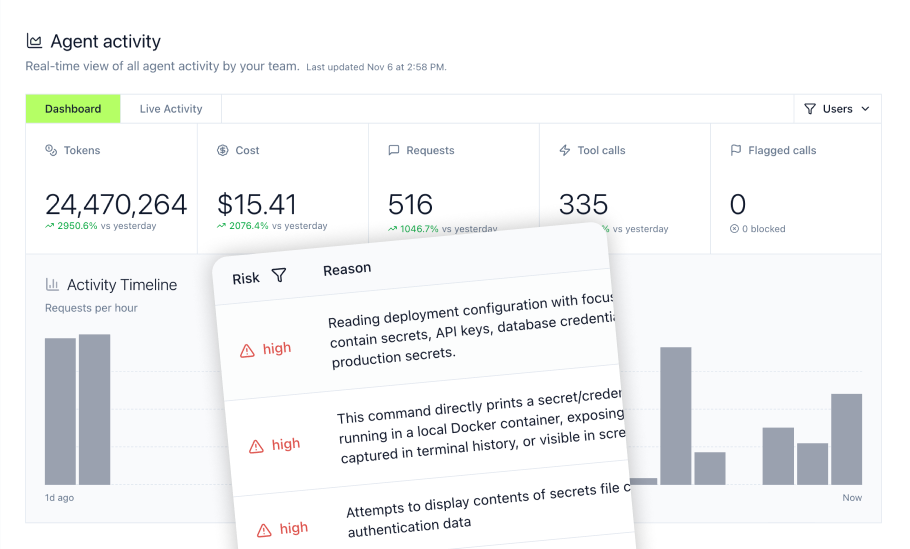
- Agent Monitor covers local non-MCP agent activity including Bash usage, file reads/writes, and prompt submissions via Claude Code and Cursor hooks
Enterprise Integrations
MintMCP connects AI agents to the data sources startups need:
- Snowflake data warehouse access with natural language queries
- Elasticsearch knowledge base search for documentation and log analysis
- Gmail integration for AI-driven response automation
- GitHub, Slack, HubSpot, and Salesforce connectors
- Custom MCP server deployment for internal tools and APIs
Security and Compliance
MintMCP is SOC 2 Type II audited with continuous compliance monitoring via Drata. The platform is compliant with HIPAA standards, with BAA available for healthcare customers. Enterprise SSO, complete audit trails, PII detection, and role-based access control are built into every layer.
For startups selling to enterprise customers, this compliance posture accelerates deal cycles. Security teams can review the full security posture in the Trust Center.
Deployment
Deploy with managed SaaS-first delivery in US and EU regions. VPC and self-hosted deployment available on request for teams requiring full infrastructure control.
2. TrueFoundry
TrueFoundry provides a comprehensive AI infrastructure platform that combines LLM deployment, MCP orchestration, and observability in a unified control plane. The platform targets teams that want to consolidate their AI infrastructure rather than deploy separate tools for each function.
Where TrueFoundry Fits
TrueFoundry works well for startups with platform engineering teams who want a single vendor for model hosting and MCP gateway functionality. The platform's in-memory auth and rate limiting reduces database overhead, with published benchmark materials reporting roughly 3-4ms added gateway latency at load.
Primary capabilities:
- Reported low single-digit millisecond gateway overhead in benchmark materials
- 350+ requests per second per CPU core in published benchmark materials
- Unified control plane for models and tools
- VPC and on-premises deployment options
- Interactive playground for experimenting with agent-tool calls
The platform holds SOC 2 Type II attestation and supports deployments in regulated environments.
3. Bifrost by Maxim AI
Bifrost is an open-source AI gateway built in Go that prioritizes raw performance. The platform reports 11 microseconds of gateway overhead per request at sustained 5,000 requests per second, making it a strong open-source option for latency-sensitive applications.
Bifrost's Primary Focus
Bifrost targets engineering teams building real-time AI applications where gateway overhead directly impacts user experience. The Go-based architecture avoids the performance penalties of Python-based alternatives.
Key characteristics:
- 11 microseconds of gateway overhead per request at sustained 5,000 requests per second
- Apache 2.0 license with full source code transparency
- Single binary handles both LLM routing and MCP gateway functionality
- MCP Code Mode reduces token consumption when using multiple MCP servers
- Zero-config deployment in under 30 seconds
For pre-revenue startups or teams building latency-critical applications, Bifrost's open-source approach eliminates licensing costs while delivering strong performance. An enterprise edition adds SSO, RBAC, and Vault support for teams that need additional governance features.
4. Portkey
Portkey integrates LLMOps capabilities with MCP gateway features, supporting 1,600+ LLMs through a unified API in current materials. The platform combines prompt management, evaluation frameworks, and gateway functionality for teams that want consolidated tooling.
Portkey for LLMOps Teams
Portkey works well for startups already invested in prompt engineering workflows who want to add MCP governance without deploying separate infrastructure.
Core features:
- 1,600+ LLM support with unified API in current materials
- 50+ pre-built guardrails for security and compliance
- Prompt versioning and management
- 99.99% uptime SLA
The platform offers SaaS, hybrid, and air-gapped deployment options. Pricing starts at $49/month with a free tier available for experimentation.
5. Docker MCP Gateway
Docker's MCP Gateway brings container orchestration expertise to MCP server management, providing a Docker-native approach to running and managing MCP servers. The solution ships as part of the MCP Toolkit in Docker Desktop.
Docker for Prototyping
Docker MCP Gateway targets developers running MCP servers locally and organizations with existing Docker environments. The zero-cost, open-source approach makes it ideal for pre-revenue startups and prototyping phases.
Capabilities:
- Container isolation with CPU and memory limits
- Docker Compose integration for orchestration
- OAuth flows and credential injection
- OpenTelemetry support for observability
- Cryptographically signed images for supply chain security
Teams familiar with Docker workflows can get MCP servers running quickly without learning new tooling. However, the DIY approach requires customers to operate connector runtimes, scaling, and infrastructure themselves.
6. Composio
Composio provides 1,000+ managed integrations with automatic authentication handling, oriented toward AI engineering teams building customer-facing agentic applications. The platform handles OAuth complexity so developers can focus on product functionality.
Composio for Integration Breadth
Composio fits startups building AI products that need to connect to many third-party services quickly. The massive integration library reduces custom OAuth work that typically delays product launches.
Features:
- 1,000+ managed integrations
- Unified authentication handled automatically
- Production-oriented latency performance
- Startup program offering credits
The managed platform approach means no DevOps overhead, but teams should evaluate whether they need internal employee governance features beyond customer-facing integration management.
7. Zuplo
Zuplo provides a programmable API and AI gateway deployed at 300+ edge points of presence worldwide. The platform emphasizes TypeScript programmability over configuration-only approaches.
Zuplo for Global Applications
Zuplo works well for startups building global SaaS products that need low latency everywhere. Edge deployment means gateway logic runs close to users regardless of location.
Capabilities:
- 300+ global edge points of presence
- TypeScript programmability for custom logic
- Unified API and AI gateway in single platform
- MCP Server Handler auto-exposes API endpoints as MCP tools
- Virtual MCP servers with OAuth and OIDC credential brokering
- Semantic caching at the edge
Pricing follows usage-based models with a free tier for getting started.
8. Obot Platform
Obot provides open-source MCP gateway capabilities as part of a broader AI agent orchestration framework. Built for organizations seeking full infrastructure control, Obot emphasizes transparency through its open-source architecture.
Obot for Kubernetes Teams
Obot targets platform engineering teams with Kubernetes expertise who want full infrastructure ownership. The Kubernetes-native deployment model provides maximum customization at the cost of operational overhead.
Platform components:
- Gateway plus catalog plus chat client plus agent orchestration
- Nanobot framework for agent workflows
- Built-in MCP Catalog with auto-documentation
- Enterprise identity provider support including Okta, Entra, GitHub, and Google
- Docker for development, Kubernetes for production
The OSS-first model means zero licensing costs, but teams operate the runtime, Kubernetes deployment, and scaling themselves. No managed SaaS option is currently available.
9. Lunar.dev MCPX
Lunar.dev's MCPX unifies AI Gateway, MCP Gateway, and API Gateway functionality in a single control plane. The platform centralizes policy enforcement, access control, and observability for teams managing multiple AI workload types.
Lunar.dev for Unified Governance
MCPX fits security and IT teams that want consistent governance across all AI and API traffic, not just MCP. The unified approach reduces the number of systems to manage and monitor.
Features:
- Multi-tier RBAC at global, service, and tool levels
- Tool description rewriting and parameter locking
- Full observability including latency, token cost, and request tracing
- Support for STDIO and remote HTTP/SSE MCP servers
- Docker and Kubernetes deployment with optional SaaS dashboards
- Air-gapped deployment support
10. Lasso Security
Lasso Security provides an open-source, security-focused MCP Gateway with threat detection as the foundational design principle. The platform specifically targets protecting agentic workflows from prompt injection, credential theft, and tool poisoning attacks.
Lasso for Security Teams
Lasso fits organizations prioritizing threat protection in AI deployments, particularly those in regulated industries handling sensitive data.
Security features:
- Real-time prompt injection detection and blocking
- Credential encryption and secure secret management
- Tool authorization with parameter validation
- Network filtering and allowlisting for MCP destinations
- MCP server reputation scoring
- Presidio integration for PII masking and redaction
The platform received Gartner Cool Vendor recognition for AI Security in 2024. Available free under MIT license.
11. Kong AI Gateway
Kong extends its established API gateway platform with MCP protocol support, offering organizations already using Kong a natural extension point. The platform brings over a decade of API infrastructure experience to MCP management.
Kong for Existing API Users
Kong fits enterprises already standardized on Kong for API gateway functionality who want to add MCP support without deploying separate infrastructure.
Capabilities:
- Plugin-based architecture for extensibility
- MCP Proxy plugin with OAuth 2.1 support
- MCP Registry in Kong Konnect
- Multi-cloud and hybrid deployment
- Enterprise RBAC and audit logging
Kong's pricing structure tends toward enterprise budgets.
12. LiteLLM
LiteLLM provides an open-source Python proxy supporting 100+ LLM providers through a unified OpenAI-compatible interface. The platform is widely adopted in the open-source community for its provider breadth.
LiteLLM for Provider Coverage
LiteLLM fits teams that need to work with many different LLM providers and want a single interface. The Python-based SDK integrates easily with existing Python codebases.
Features:
- 100+ LLM provider support
- OpenAI-compatible unified interface
- Virtual key management per team or project
- MCP tool integration built-in
Teams should note that Python-based proxies add more latency overhead compared to Go-based alternatives.
Deploy AI Agents with Full Governance
Choosing the right agent gateway determines whether your startup deploys AI agents in weeks or months. For teams selling to enterprise customers, compliance requirements make this decision even more critical.
MintMCP provides the fastest path from local MCP experimentation to governed production deployment. The data-permissions-first architecture ensures governance is built in from day one, not bolted on later. Virtual MCP Bundles give each team exactly the tools they need with SCIM-driven membership and isolated audit trails. Agent Bundles provide each AI agent its own identity with scoped credentials, eliminating shared keys that create security risks.
With hosted MCP connectors for Snowflake, Elasticsearch, Gmail, GitHub, Salesforce, and hundreds more, startups can connect AI agents to production data sources without managing connector infrastructure. The Agent Monitor extends governance beyond MCP to cover local agent activity in Claude Code and Cursor.
Start your free trial at mintmcp.com with no sales call required.
Frequently Asked Questions
What is an AI agent gateway and why do startups need one?
An AI agent gateway centralizes authentication, access control, and monitoring for connections between AI agents and tools. Without a gateway, startups face fragmented security policies across individual MCP servers, no visibility into which agents access which data, and duplicated authentication logic. Gateways transform this N-to-N complexity into a manageable hub-and-spoke model where one control plane governs all agent-to-tool interactions. For startups selling to enterprises, gateways also provide the audit trails and compliance documentation that security reviews require.
How does MCP gateway authentication work?
MCP gateways wrap upstream servers with enterprise authentication, typically OAuth 2.0, SAML for SSO, or API tokens. When an AI agent requests tool access, the gateway validates the request against configured policies before forwarding to the MCP server. Leading implementations support multiple authentication models: shared service accounts for simple deployments, per-user OAuth flows that inherit existing identity provider permissions, and per-agent M2M credentials for autonomous agents. MintMCP's OAuth brokering also works around the redirect URI limitations that affect hosted container environments.
Can agent gateways detect shadow AI usage?
Standard MCP gateways provide visibility into traffic routed through the gateway, but agents can still connect directly to tools bypassing central governance. MintMCP addresses this gap through Agent Monitor, which hooks into Claude Code and Cursor to track local agent activity including Bash commands, file operations, and prompt submissions. This two-layer approach covers both MCP traffic through the gateway and non-MCP activity in developer tools, giving security teams complete visibility into agent behavior across the organization.
What compliance standards should a startup's MCP gateway meet?
The compliance requirements depend on your customers and industry. For startups selling to enterprises, SOC 2 Type II attestation is typically the baseline expectation. Healthcare customers often require infrastructure that is compliant with HIPAA standards, along with HIPAA documentation and BAA availability. Financial services may require additional controls around data residency and encryption. Evaluate whether your gateway vendor provides the required attestations, documentation, and controls directly or whether you need to implement compliance controls yourself. MintMCP is SOC 2 Type II audited and compliant with HIPAA standards.
Should startups choose open-source or managed MCP gateways?
The decision depends on your team's DevOps expertise and timeline. Open-source gateways like Docker, Bifrost, and Obot provide full infrastructure control and zero licensing costs, but require your team to operate the runtime, handle scaling, and implement security controls. Managed gateways like MintMCP handle infrastructure operations so your team can focus on product development. For pre-revenue startups prototyping quickly, open-source options reduce costs. For growth-stage startups with enterprise customers expecting compliance documentation, managed gateways accelerate time to production.