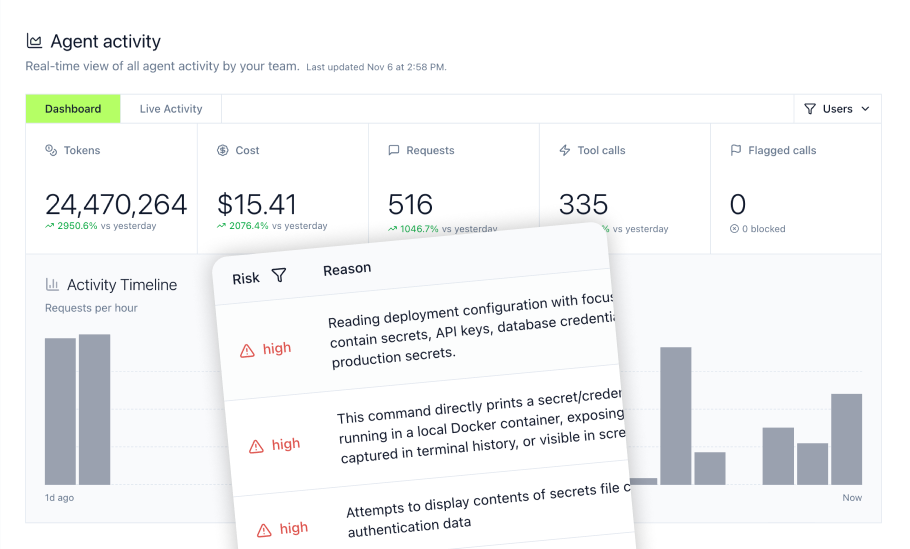
The moment autonomous AI moved beyond developer terminals and into everyday business workflows marked a fundamental shift in enterprise productivity. Claude Cowork—Anthropic's research-preview experience for agentic knowledge work in Claude Desktop—now enables non-technical knowledge workers to delegate multi-step tasks through natural language, but the path from "interesting tool" to "production-ready deployment" requires more than just downloading an app. With 100% of organizations surveyed having agentic AI on their roadmap, the gap isn't capability—it's governance. That's where MCP Gateway infrastructure becomes essential, providing the security, audit trails, and access controls that transform experimental AI tools into enterprise-ready solutions.
Key Takeaways
- Claude Cowork executes autonomous multi-step tasks—it's delegation-focused, not conversation-focused like traditional AI chat
- Anthropic built Cowork after observing non-developers using Claude Code for everyday tasks like organizing files and managing receipts
- Anthropic positions Cowork for high-effort, repeatable work such as research synthesis, document preparation, file organization, and data extraction from unstructured files
- Enterprise deployment requires governance infrastructure—Cowork activity is explicitly excluded from Audit Logs during research preview
- Effective instructions require specific outcome descriptions rather than vague requests
- The Mintive (formerly MintMCP) comprehensive guides provide non-engineers with practical frameworks for Claude skills, Cowork workflows, and data risk management
Demystifying Claude Cowork for Business Users
The critical distinction most non-engineers miss: Claude Cowork is not a chatbot. While Claude Chat requires you to prompt, review, and prompt again for each step, Cowork accepts an outcome description, creates a plan, breaks it into subtasks, and delivers finished deliverables. The interface prioritizes delegation over conversation.
This architectural difference matters for enterprise adoption:
- Chat mode: You guide every step, review each output, iterate constantly
- Cowork mode: You describe what "done" looks like, then review finished work
- Claude Code: Developer-focused tooling for technical workflows
Anthropic developed Cowork after observing a telling pattern—non-developers were using Claude Code (the developer tool) for everyday tasks like organizing receipts, managing vacation planning, and sorting files. Anthropic built Cowork to serve this demonstrated demand, not a hypothetical use case.
What Non-Engineers Can Actually Accomplish
Cowork excels at "high-effort, repeatable" knowledge work:
- Research compilation: Synthesizing multiple documents into structured reports
- File organization: Sorting, renaming, and categorizing hundreds of files by defined criteria
- Content repurposing: Adapting single pieces into multiple format variations
- Data extraction: Pulling specific information from documents into structured formats
- Expense processing: Categorizing receipts and generating formatted reports
- Form workflows: Create forms and manage submissions with the Jotform Claude App.
The pattern matters more than the specific task. If your work involves repetitive steps with defined outputs, Cowork can likely handle it. If the work requires real-time judgment, creative decisions, or specialized software expertise, manual approaches remain more effective.
Connecting Claude to Your Data: The Power of MCP Gateway
The standalone Cowork application handles local files effectively, but enterprise value emerges when AI agents connect to organizational data sources—databases, knowledge bases, communication platforms, and business intelligence systems. This is where the Model Context Protocol (MCP) becomes essential.
What is an MCP Gateway?
MCP provides an open standard for connecting AI applications like Claude and ChatGPT to enterprise tools and data. It enables agents to query databases, access business systems, search knowledge bases, and interact with productivity applications.
However, raw MCP connections introduce significant challenges:
- Authentication complexity: Each connection requires separate credential management
- Security gaps: No centralized audit trails or access controls
- Deployment friction: Most MCP servers are STDIO-based and difficult to deploy
- Governance blind spots: Organizations cannot see what data agents access
MCP Gateway solves these problems by providing centralized infrastructure that wraps MCP connections with enterprise-grade security. One-click deployment, OAuth protection, and real-time monitoring transform local MCP servers into production services without requiring engineering resources.
Bridging AI with Your Business Data
For non-engineers, the MCP Gateway value proposition is straightforward: access organizational data through Claude without waiting for IT to build custom integrations. Pre-built connectors enable immediate productivity gains:
- Snowflake integration: Query data warehouses using natural language instead of SQL
- Elasticsearch: Search knowledge bases and documentation instantly
- Gmail integration: Draft, search, and manage email within AI workflows
- Database connectors: Access MySQL, PostgreSQL, MongoDB, and other data sources
The MCP data risk guide provides detailed frameworks for understanding what data exposure means when AI agents access enterprise systems—essential reading before connecting sensitive data sources.
Unlocking Insights from Your Data
Querying Snowflake with Natural Language
Finance teams, product managers, and executives frequently need answers locked inside data warehouses. Traditional approaches require SQL expertise or requests to data teams, creating bottlenecks that delay decisions.
The Snowflake MCP Server enables natural language queries against enterprise data models:
- Product analytics: "What's our feature adoption rate by cohort for Q1?"
- Financial reporting: "Compare revenue variance against budget by region"
- Executive dashboards: "Show me cross-functional KPIs for the leadership review"
The technical mechanism—Cortex Analyst converts natural language to SQL using semantic models—remains invisible to users. You ask business questions; you receive structured answers.
Building AI-Powered Knowledge Bases with Elasticsearch
HR teams maintaining policy documentation, support teams managing ticket histories, and product teams organizing customer feedback all face the same challenge: valuable information exists but finding it requires knowing exactly where to look.
The Elasticsearch MCP Server transforms static document repositories into searchable AI knowledge bases:
- Policy search: "What's our remote work policy for international employees?"
- Ticket intelligence: "Find similar support cases with successful resolutions"
- Documentation queries: "How do customers typically configure feature X?"
For non-engineers, this means immediate access to institutional knowledge without learning Elasticsearch query syntax or navigating complex folder structures.
Streamlining Communication: Claude with Gmail
Email remains central to business communication, but the volume creates significant productivity drag. The Gmail MCP Server enables AI-assisted email workflows within enterprise governance frameworks:
Automating Email Responses
- Search and summarize: "Find all emails from [client] about project delays"
- Draft responses: "Write a follow-up to the procurement team about timeline concerns"
- Thread management: "Draft a reply to this support ticket requesting clarification"
The workflow maintains human oversight—Claude drafts, you review and approve before sending. This "AI assists, human decides" model balances productivity gains with appropriate control.
Efficiently Managing Inbox Tasks
Customer support teams report particular value from AI-assisted email processing:
- Feedback extraction: Pull structured insights from incoming customer emails
- Sentiment tagging: Automatically prioritize messages requiring immediate attention
- Response templates: Generate contextually appropriate replies for common queries
The Claude Cowork guide provides detailed workflows for email automation that non-engineers can implement without technical assistance.
Ensuring AI Safety and Compliance: A Business Imperative
Enterprise AI adoption requires more than productivity—it demands governance. According to Harmonic Security's guide, Cowork activity is "explicitly excluded from Audit Logs, Compliance API, and Data Exports" during research preview. Known vulnerabilities exist, including CVE-2025-59536 with CVSS 8.7 for remote code execution, patched in October 2025.
Meeting Regulatory Standards
Organizations operating under SOC2 or GDPR requirements face specific challenges:
- Audit trail gaps: Native Cowork doesn't provide enterprise-grade logging
- Access control limitations: Folder-level permissions are the primary containment mechanism
- Data residency concerns: Regional processing and residency requirements require separate review before deployment
- Compliance documentation: Conversation history stored locally, not in compliance exports
MCP Gateway addresses parts of these gaps with SOC 2 Type II attestation, centralized audit trails for MCP interactions, and role-based access controls.
Protecting Sensitive Information
For organizations also deploying coding agents, Agent Monitor uses hooks in Claude Code, Cursor, GitHub Copilot, and Codex to provide additional security controls:
- Tool call tracking: Monitor every MCP tool invocation and file operation
- Command blocking: Block dangerous bash commands in real-time
- Sensitive file protection: Prevent access to .env files, SSH keys, and credentials
- Complete audit trails: Track every operation for security review
Understanding these risks before deployment prevents costly incidents. The data risk guide provides frameworks for assessing exposure when AI agents access enterprise systems.
From Shadow AI to Sanctioned AI
Your teams are already using AI tools. The question isn't whether AI enters your organization—it's whether that adoption happens with visibility and control or as ungoverned "shadow AI" that security teams cannot monitor.
The Risks of Unmanaged AI
Shadow AI continues to create significant enterprise risk:
- Data exposure: Employees paste sensitive information into consumer AI tools
- Compliance violations: Untracked AI usage fails audit requirements
- Inconsistent outputs: No governance means no quality standards
- Security blind spots: IT cannot protect what IT cannot see
Building a Controlled AI Environment
The solution isn't blocking AI—that just drives adoption further underground. Instead, organizations need infrastructure that makes governed AI easier to use than ungoverned alternatives:
- Pre-configured policies: Deploy MCP tools with security controls already in place
- Self-service access: Developers and business users request and receive AI tool access through approved channels
- Centralized credentials: Manage all AI tool API keys in one secure location
- Usage analytics: Monitor tool usage, performance, and cost allocation
This approach—"turn shadow AI into sanctioned AI"—enables productivity gains while maintaining enterprise control.
Writing Effective Instructions for Claude Cowork
The most common frustration non-engineers experience with Cowork stems from instruction quality. Cowork takes instructions literally, which means vague requests produce inconsistent results.
Why Vague Prompts Fail
"Clean up this folder" could mean:
- Organize files by type
- Delete duplicates
- Archive old files
- Rename for consistency
- All of the above in some order
Cowork will infer an interpretation—often incorrectly. The Claude skills tips guide provides detailed frameworks for writing instructions that produce reliable results.
The Anatomy of a Good Cowork Instruction
Effective instructions include:
- Specific outcome: What the finished deliverable looks like
- Explicit constraints: What NOT to do (don't delete anything, don't modify originals)
- Format requirements: File naming conventions, folder structures, output formats
- Handling exceptions: What to do when situations don't fit the pattern
Ineffective: "Organize my project files"
Effective: "Create subfolders by client name (extract from file names), organize files by document type (proposals/contracts/invoices), rename using [Client][Type][Date] format, move anything older than 2023 to an Archive subfolder, don't delete anything, and create a log file showing what was moved and why."
Persistent Instructions That Improve Consistency
Reusable instruction files can help maintain your preferences across Claude-based workflows:
- CLAUDE.md: Project-specific instructions and constraints
- Reusable workflow notes: Personal preferences, communication style, and standard operating procedures stored alongside your working materials
Setting these up once reduces repetitive instruction-giving and improves output consistency.
Practical Applications That Actually Work
Research Report Compilation
Scenario: A research analyst receives 15 PDF reports, 30 news articles, and 10 internal memos requiring synthesis into a strategic brief.
Cowork approach: Create project folder with all sources, provide report structure outline, specify key questions to answer. Cowork reads documents, extracts relevant sections, identifies themes, generates draft with citations, flags contradictions for human review.
Content Repurposing
Scenario: Content director publishes blog post requiring adaptation for LinkedIn, Twitter, Instagram, email newsletter, and sales materials.
Cowork approach: Feed original content with format specifications for each channel, maintaining core message while adjusting for platform norms.
Result: Content output increased significantly; repurposing time reduced substantially.
Getting Started: Your Roadmap
Initial Setup and Testing
- Review Mintive's Cowork guide for foundational concepts
- Confirm current Claude Desktop and Cowork availability for your plan and operating system
- Identify 2-3 low-risk, high-repetition tasks for initial testing
- Start with file organization tasks (low risk, visible results)
- Document what works and what requires instruction refinement
Expanding Scope and Scaling
- Test research and content tasks
- Experiment with MCP integrations through MCP Gateway
- Evaluate enterprise governance requirements with IT/security
- Review MCP data risk frameworks
- Establish standard workflows for recurring tasks
- Document successful patterns for team sharing
- Plan phased rollout to additional team members
Why Mintive Enables Safe Claude Cowork Adoption
Enterprise AI adoption fails when organizations treat it as a technology problem rather than a governance challenge. Mintive provides the infrastructure and resources that bridge this gap—enabling non-engineers to leverage Claude Cowork effectively while maintaining the security and compliance standards enterprises require.
Mintive's guide collection addresses the specific challenges non-engineers face: the Claude Cowork Guide provides step-by-step workflows for business users, covering setup, effective instruction writing, and practical applications without technical prerequisites. The Claude Skills Tips framework helps write prompts that produce reliable results, with examples across common business scenarios. The data risk guide explains exposure models and mitigation strategies in accessible terms.
Beyond education, Mintive delivers the enterprise infrastructure that makes governed AI deployment practical: one-click deployment transforms local MCP servers into production services in minutes, OAuth protection provides automatic enterprise authentication for all MCP endpoints, real-time monitoring tracks every tool call and access request, and SOC 2 Type II attestation supports audit-focused security and governance reviews.
The productivity gains from Claude Cowork are real—but only accessible to organizations that solve governance first. Mintive eliminates the traditional barriers: no waiting for IT to build custom integrations, no navigating complex security approvals without guidance, no choosing between productivity and compliance, and less end-user setup burden for governed MCP access.
For non-engineers ready to leverage Claude Cowork productively and safely, Mintive's guides and gateway infrastructure provide a strong foundation for governed deployment.
Frequently Asked Questions
Do I need coding knowledge to use Claude Cowork with Mintive?
No coding knowledge is required for standard Cowork usage or Mintive integrations. Cowork accepts natural language instructions, and Mintive's pre-built connectors for Snowflake, Elasticsearch, Gmail, and databases handle the technical complexity. The Claude skills tips guide teaches effective instruction writing without technical prerequisites.
How does Mintive ensure data security and compliance?
Mintive provides multiple security layers: SOC 2 Type II attestation, OAuth and SAML-based enterprise authentication, centralized audit logs for MCP interactions, and role-based access control that limits tool availability by user role. Agent Monitor adds hook-based monitoring and command blocking for teams also using Claude Code, Cursor, GitHub Copilot, or Codex. Unlike standalone Cowork—which excludes activity from Audit Logs, Compliance API, and Data Exports during research preview—MCP Gateway provides the visibility and control enterprises require.
What tasks work best for Claude Cowork versus manual work?
Cowork excels at high-effort, repeatable tasks with defined outputs: research report compilation, file organization at scale, content repurposing across formats, data extraction from documents, and expense reporting automation. Manual work remains more effective for tasks requiring real-time judgment, creative decisions, specialized software expertise, or ambiguous outcomes. If you can describe exactly what "done" looks like with clear constraints, Cowork can likely handle it.
How quickly can my team start using Mintive with Claude?
Teams can get a first MCP server connected and verified quickly using Mintive's documented quickstart flow. Broader enterprise deployment—including SSO integration, role-based permissions, security review, pilot testing, and rollout—requires a more structured onboarding process. The quickstart guide provides step-by-step setup instructions, and Mintive's architecture docs help IT teams understand the security model before deployment.