Finding the right agent gateway can transform how your SaaS company deploys AI agents from a fragmented security problem into governed, production-ready infrastructure. As 86% of enterprises require tech stack upgrades to properly deploy AI agents, selecting a gateway that provides centralized authentication, real-time monitoring, and enterprise-grade compliance becomes a critical infrastructure decision.
The MCP Gateway category has matured rapidly in 2026, with solutions ranging from compliance-first managed platforms to performance-optimized open-source options. For SaaS companies specifically, the stakes are higher: you need governed connections to customer data, audit trails for compliance, and the ability to scale agent deployments across teams without creating credential sprawl.
This guide evaluates 12 agent gateways based on MCP protocol support, SaaS readiness, compliance posture, deployment model, and integration breadth to help you identify the right fit for your organization.
Key takeaways
- MintMCP Gateway provides enterprise MCP infrastructure with data-permissions-first architecture, SSO and SCIM-driven RBAC, tool-level policy, Virtual MCP Bundles, Agent Bundles with M2M auth, hosted MCP connectors, and audit logs
- Open-source gateways offer low-overhead routing with Go-based architecture for teams prioritizing self-hosted deployments
- Observability-focused platforms provide deep token-level analytics and prompt management features for LLMOps workflows
- Enterprise MLOps platforms combine MCP gateway functionality with broader model deployment infrastructure
- Integration platforms deliver broad coverage across 1,000+ apps for rapid tool access in agentic applications
- Managed API gateways, hybrid deployment platforms, edge services, and iPaaS solutions each address specific deployment models and ecosystem requirements
1. MintMCP Gateway: enterprise MCP infrastructure in minutes
MintMCP Gateway provides enterprise infrastructure for Model Context Protocol focused on authentication, tool-level access control, credential management, logging, rule-based policy, and agent governance. Its data-permissions-first architecture starts with SSO, SCIM-driven RBAC, IdP groups, Virtual MCP Bundles, tool-level policy, and audit logs, then enables agents on top. MintMCP's Agent Gateway builds on that MCP Gateway foundation by giving agents governed identities, scoped permissions, memory controls, and monitoring across the AI systems teams already use.
Unlike approaches that require weeks of infrastructure setup, MintMCP helps teams turn MCP servers and hosted connectors into governed production services with centralized observability, enterprise authentication, and SOC 2 Type II audited controls.
What makes MintMCP Gateway different
MintMCP solves the fundamental problem that 42% of enterprises face when needing access to 8 or more data sources for AI agent deployment. The platform's architecture wraps stdio, hosted, HTTP-streamable, and legacy SSE MCP servers behind SSO-fronted remote MCP endpoints with OAuth brokering, SCIM-driven membership, and rule-based policy.
This reduces fragmented security policies and visibility gaps that create operational challenges when managing point-to-point connections between AI agents and tools.
Core capabilities
- Hosted MCP Connectors: MintMCP runs connector instances on the customer's behalf with auto-scaling and sandboxed execution per connector, reducing the infrastructure overhead that typically delays production deployment
- OAuth Brokering: Add enterprise authentication to local and hosted MCP servers, including OAuth 2.x, bearer tokens, headers, and SSO-fronted access without rebuilding each server
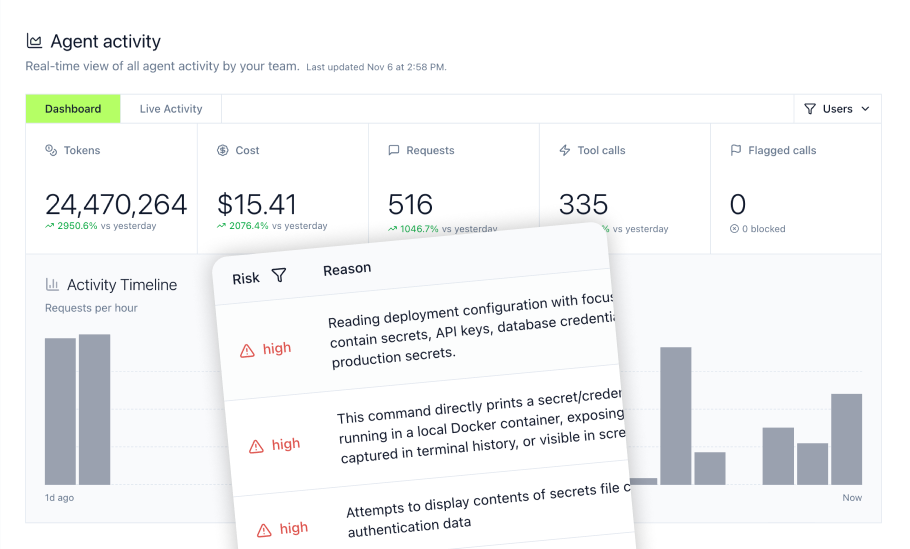
- Real-Time Monitoring: Live dashboards showing server health, usage patterns, tool call tracking, and security alerts across all MCP connections
- Granular Access Control: Configure tool access by role with read-only operations for analysts while restricting write tools to authorized administrators
- Virtual MCP Bundles: Create team-specific, per-use-case endpoints that expose only the minimum required tools with SCIM-driven membership and fine-grained role-based access
- Agent Bundles: Give internal agents first-class identities with M2M auth, scoped tools, independent rotation and revocation, and an "act as agent" flow for connectors that require per-agent OAuth
- Custom Gateway Middleware: Run customer-authored middleware in a JS sandbox with external DLP and guardrails integrations for masking, blocking, and policy enforcement
Security architecture
MintMCP implements defense-in-depth security through centralized governance, SSO enforcement, SCIM-driven RBAC, tool-level policy, credential management, and observability controls. For context, security concerns are a top challenge for both leadership (53%) and practitioners (62%) in AI agent deployment.
The platform provides visibility into which teams and agents use which tools, when they access data, and how frequently, addressing the visibility gap that exists with direct agent-to-tool connections.
Enterprise integrations
- Snowflake data warehouse access with natural language queries
- Elasticsearch knowledge base search for documentation and log analysis
- Gmail integration for AI-driven email automation
- Custom MCP server deployment for internal tools and APIs
- Claude, Cursor, ChatGPT, Gemini, and Copilot governance through centralized gateway and Agent Monitor coverage
Compliance
MintMCP is SOC 2 Type II audited, compliant with HIPAA standards, and penetration tested. Customers handling protected health information can request HIPAA documentation. MintMCP signs BAAs. Visit the Trust Center for compliance documentation.
Deployment
Deploy quickly with managed SaaS-first delivery and US and EU availability. VPC and self-hosted deployment are available on request.
2. Bifrost (Maxim AI)
Bifrost provides an open-source AI gateway built in Go, focusing on high-performance MCP routing for organizations that prioritize latency and self-hosted infrastructure control.
Where Bifrost fits
Teams with existing DevOps expertise seeking full infrastructure ownership and low-overhead routing. The Go-based architecture addresses performance requirements for high-throughput agent workloads.
Core capabilities
- Open-source codebase under Apache 2.0 license
- Go-based architecture for performance-optimized routing
- MCP gateway functionality with Agent Mode and Code Mode
- Self-hosted deployment model
Deployment model
Self-hosted via Docker or bare binary. Enterprise support tier available. Teams operate their own infrastructure, scaling, and runtime management.
Considerations for SaaS companies
A self-hosted open-source model provides infrastructure control but requires the customer to operate connector runtimes, scaling, and security configuration. Teams should evaluate how much authentication, SCIM-driven RBAC, tool-level policy, audit logging, OAuth brokering, and agent identity governance they need beyond the base gateway.
3. Portkey
Portkey provides an AI gateway with deep observability and LLMOps capabilities, focusing on token-level analytics, prompt management, and debugging tools for AI applications.
Portkey's primary focus
Developer and platform engineering teams building complex AI applications that need detailed visibility into LLM operations, cost tracking, and prompt optimization workflows.
Core capabilities
- Unified API access for multiple LLM providers
- Token-level observability and debugging
- Prompt management and versioning
- Guardrails with pre-built rules for PII detection and content filtering
- MCP gateway functionality
Compliance
SOC 2, ISO 27001, HIPAA, and GDPR compliance documentation is available.
Deployment model
SaaS platform with VPC and self-hosted options for enterprise deployments.
Considerations for SaaS companies
Portkey's strength lies in observability and LLMOps. Teams should evaluate whether they need deeper MCP-specific governance primitives such as SCIM-driven Virtual MCP Bundles, Agent Bundles with M2M auth, tool-update policy, hosted connector operations, and OAuth brokering for stdio and hosted MCP servers.
4. TrueFoundry
TrueFoundry provides an MLOps and AI infrastructure platform with MCP gateway capabilities, targeting enterprise ML teams that need both model deployment and agent governance.
TrueFoundry's primary focus
Platform engineering and ML teams seeking unified infrastructure for model deployment, agent governance, and enterprise compliance within a single platform.
Core capabilities
- MCP gateway with enterprise authentication
- Performance-optimized routing
- SOC 2, HIPAA, and GDPR compliance posture documented
- Integration with Kubernetes-based ML infrastructure
Deployment model
Hybrid deployment with managed SaaS and self-hosted control plane options. Air-gapped deployment available via forward proxy.
Considerations for SaaS companies
TrueFoundry's approach combines MLOps with MCP gateway. Teams should evaluate whether they need the broader ML platform features or a more focused MCP governance layer with capabilities like Virtual MCP Bundles, Agent Bundles, hosted connector management, and tool-update approval policies.
5. Composio
Composio provides an integration platform for AI agents with a broad connector library, focusing on rapid tool access for agentic applications.
Composio's primary focus
AI engineering teams building agentic applications that need quick access to a wide range of third-party tools and services without building custom integrations.
Core capabilities
- Access across 1,000+ apps for third-party services
- Identity provider delegation for user authentication
- MCP server generation from existing APIs
- Developer-focused SDK and tooling
Deployment model
Managed SaaS platform with VPC and on-premises options on enterprise tier.
Considerations for SaaS companies
Composio's integration breadth addresses the tool access challenge. Teams should evaluate whether they need enterprise governance primitives beyond connectors, including SCIM-driven team bundles, per-agent identity with M2M auth, tool-level policy enforcement, and centralized audit logging.
6. Zuplo
Zuplo provides a managed API gateway with MCP-specific features, focusing on OAuth-wrapped MCP endpoints and developer-friendly deployment.
Zuplo's primary focus
Teams seeking managed MCP server hosting with built-in OAuth 2.0 support and simplified deployment workflows.
Core capabilities
- Virtual MCP server hosting
- OAuth 2.0 authentication built into the gateway
- API management features for MCP endpoints
- Developer-focused configuration
Deployment model
Managed SaaS platform with usage-based pricing.
Considerations for SaaS companies
Zuplo's managed approach simplifies OAuth configuration for MCP. Teams should evaluate whether they need additional governance features like SCIM-driven RBAC, Agent Bundles with per-agent credentials, hosted connector runtime, and custom policy middleware.
7. Kong AI Gateway
Kong provides AI gateway capabilities as an extension to its established API gateway platform, targeting organizations already standardized on Kong infrastructure.
Kong's primary focus
Platform engineering and API teams with existing Kong deployments seeking to add MCP and AI gateway features without deploying separate infrastructure.
Core capabilities
- AI gateway plugin for existing Kong deployments
- Integration with Kong's authentication and rate limiting
- Hybrid deployment with Konnect SaaS control plane
- Enterprise security features through Kong platform
Deployment model
Hybrid deployment with Konnect SaaS control plane and self-hosted data plane, or fully self-hosted.
Considerations for SaaS companies
Kong's plugin approach works well for teams already invested in Kong infrastructure. Teams new to Kong should evaluate whether an API gateway extension provides MCP-specific primitives such as Virtual MCP Bundles, Agent Bundles, hosted connector runtime, tool-update policy, and audit logs designed around tool invocation.
8. Lunar.dev MCPX
Lunar.dev's MCPX provides an MCP gateway focused on access control, policy enforcement, and observability for teams deploying MCP to production environments.
MCPX's primary focus
Platform and infrastructure teams deploying MCP at scale who want centralized access control and observability with self-hosted deployment flexibility.
Core capabilities
- Centralized RBAC and policy enforcement
- Observability including latency, token tracking, and request tracing
- Support for STDIO, remote HTTP, and legacy SSE MCP servers
- Docker and Kubernetes deployment options
Deployment model
Self-hosted via Docker or Kubernetes with optional SaaS dashboards for telemetry and control plane visibility.
Considerations for SaaS companies
MCPX fits teams that want to self-host gateway infrastructure. Teams should compare whether they also need managed SaaS-first deployment, hosted MCP connectors, SCIM-driven Virtual MCP Bundles, Agent Bundles with M2M auth, and two-layer coverage for both MCP and local non-MCP agent activity.
9. Cloudflare AI Gateway
Cloudflare provides AI gateway capabilities as part of its edge network platform, offering caching, rate limiting, and observability for AI model requests.
Cloudflare's primary focus
Teams seeking edge-deployed AI gateway functionality with minimal infrastructure setup, leveraging Cloudflare's global network for low-latency AI requests.
Core capabilities
- Edge-deployed gateway on Cloudflare's network
- Caching and rate limiting for AI requests
- Basic analytics and logging
- Integration with Cloudflare's security features
Deployment model
Managed edge service with usage-based pricing integrated into Cloudflare billing.
Considerations for SaaS companies
Cloudflare's edge approach provides geographic distribution and ease of setup. Teams should evaluate whether they need MCP-specific governance beyond basic AI request routing, including tool-level access control, SCIM-driven team bundles, per-agent identity, and hosted MCP connector management.
10. LiteLLM
LiteLLM provides an open-source proxy for unified access to multiple LLM providers, with MCP support added as part of its broader model routing capabilities.
LiteLLM's primary focus
Developer teams seeking a unified API interface across 100+ LLM providers without vendor lock-in, with Python-based architecture for easy customization.
Core capabilities
- Unified API for 100+ LLM providers
- Open-source under MIT license
- MCP proxy functionality
- Python-based architecture for extensibility
Deployment model
Self-hosted via Python package or Docker. Enterprise support available.
Considerations for SaaS companies
LiteLLM's Python-based open-source approach provides flexibility and broad provider support. Teams should evaluate whether they need enterprise governance beyond model routing, including SCIM-driven RBAC, Virtual MCP Bundles, Agent Bundles with M2M auth, hosted connector runtime, and centralized audit logging and enterprise security controls.
11. Amazon Bedrock AgentCore
Amazon Bedrock AgentCore provides managed agent infrastructure within the AWS ecosystem, targeting organizations building AI agents on AWS.
AgentCore's primary focus
Teams building AI agents on AWS seeking native integration with Bedrock models, AWS identity services, and managed infrastructure.
Core capabilities
- Managed agent runtime on AWS infrastructure
- Integration with AWS IAM and security services
- Integrations with AWS services
- Bedrock model access
Deployment model
Fully managed AWS service with usage-based AWS billing.
Considerations for SaaS companies
AgentCore's AWS-native approach works well for teams fully invested in AWS. Teams with multi-cloud requirements or those using non-AWS AI tools (Claude Desktop, Cursor, ChatGPT) should evaluate whether they need cross-platform governance that covers agent activity across multiple vendors and deployment models.
12. Workato Enterprise MCP
Workato provides MCP capabilities as part of its enterprise integration platform (iPaaS), targeting organizations with existing Workato deployments seeking to add agent access to their integration workflows.
Workato's primary focus
Enterprise teams with existing Workato investments seeking to enable AI agents to access the integrations and workflows already built on the platform.
Core capabilities
- Pre-built enterprise connectors from Workato's iPaaS platform
- MCP access to existing integrations and workflows
- Enterprise authentication through Workato
- Workflow automation capabilities
Deployment model
Managed iPaaS platform with enterprise pricing.
Considerations for SaaS companies
Workato's approach leverages existing iPaaS integrations. Teams should evaluate whether they need MCP-specific governance primitives beyond iPaaS connector access, including per-agent identity with M2M auth, tool-level policy enforcement, SCIM-driven team bundles, and audit logging designed for AI agent activity.
Choosing the right agent gateway for your SaaS company
Deployment speed vs. control
Purpose-built gateways like MintMCP provide managed SaaS-first deployment with hosted MCP connectors and pre-configured governance controls. Self-hosted open-source options require infrastructure setup but offer full control. Consider whether you need production deployment this quarter or can invest weeks building and operating custom infrastructure.
Security and compliance requirements
Organizations in regulated industries face security concerns as a top challenge, with over half of both leadership and practitioners citing these issues. SOC 2 Type II audited controls, audit logs, SSO, SCIM-driven RBAC, credential management, and tool-level access controls matter for healthcare, finance, and enterprises handling sensitive data.
STDIO vs. remote server support
The critical question is whether your gateway handles STDIO-based MCP servers, which represent a significant portion of community-built servers but are difficult to deploy without proper infrastructure. Solutions that only support remote HTTP or legacy SSE servers limit ecosystem access.
Authentication architecture
The MCP authorization specification defines authorization flows for HTTP-based transports, but implementation varies across gateways. Some gateways broker OAuth and wrap stdio or hosted servers with enterprise SSO, while others require manual OAuth configuration per server. Consider whether you need shared service accounts, per-user authentication, per-agent identity, M2M auth, or an "act as agent" flow.
Observability and monitoring
Without comprehensive logging and monitoring, organizations lack visibility into which tools agents use or how data flows through their infrastructure. Essential metrics include tool call tracking, performance analytics, error rates, and cost allocation per team.
Integration ecosystem
Assess which data sources your AI agents need to access. If your requirements include data warehouses, knowledge bases, email systems, or custom internal tools, verify your gateway supports these integrations without extensive custom development.
Deploy governed AI agents across your SaaS organization
For SaaS companies deploying AI agents at scale, the right agent gateway transforms fragmented point-to-point connections into centrally governed infrastructure with the compliance, security, and observability enterprises require.
MintMCP Gateway provides the enterprise foundation with data-permissions-first architecture that starts with governed data and tool access, then enables agents on top. Virtual MCP Bundles give teams scoped access to only the tools they need, with SCIM-driven membership that reflects your organization structure. Agent Bundles provide per-agent identity with M2M auth, independent credential rotation, and an "act as agent" flow for connectors requiring per-agent OAuth.
The platform's hosted MCP connectors run without infrastructure overhead on your part, with auto-scaling and sandboxed execution that reduces the weeks of setup typically required for production deployment. OAuth brokering wraps stdio, hosted, and HTTP MCP servers with enterprise SSO, eliminating credential sprawl while maintaining compatibility with the broader MCP ecosystem.
For regulated industries, MintMCP's SOC 2 Type II audited controls, compliance with HIPAA standards, and BAA signing capability address the security and compliance challenges that delay agent deployment. Comprehensive audit logs, tool-level policy enforcement, and real-time monitoring provide the visibility that security and compliance teams require.
Get access to deploy MCP infrastructure in minutes, not months.
Frequently asked questions
What is the difference between an MCP gateway and a traditional API gateway?
MCP gateways specifically handle the Model Context Protocol for connecting AI assistants to tools and data, supporting transports such as stdio, streamable HTTP, and legacy SSE where needed. Traditional API gateways route HTTP/REST requests between services. While some API gateway vendors are adding MCP features, purpose-built MCP gateways understand protocol-specific requirements like context state management across multi-step agent workflows, tool authorization semantics, and stdio server hosting.
How quickly can I deploy an MCP gateway in my organization?
Deployment speed varies by approach. Managed services like MintMCP Gateway can accelerate deployment with managed SaaS-first delivery, hosted MCP connectors, SSO-fronted access, and pre-configured governance controls. Self-hosted open-source solutions typically require additional time for infrastructure setup, authentication integration, and security configuration.
How do MCP gateways prevent shadow AI tool usage?
Gateways transform shadow AI into sanctioned AI by providing centralized authentication that requires AI agent connections to route through governed infrastructure. The gateway catalogs approved MCP servers, enforces role-based access controls, determines which users and agents access which tools, maintains audit trails of tool invocations, and blocks unauthorized server connections.
What authentication methods do MCP gateways support?
Enterprise gateways can support OAuth 2.x, SAML for enterprise SSO integration, OpenID Connect (OIDC) for modern identity providers, bearer tokens, headers, and API token management. Leading implementations provide shared service accounts, per-user OAuth flows, and per-agent identity models including M2M auth and "act as agent" flows.
Can MCP gateways work with coding agents like Cursor and Claude Code?
Yes. Specialized governance layers like MintMCP's LLM Proxy and Agent Monitor can monitor MCP tool invocations, bash commands, file operations, and prompt submissions from Cursor, Claude Code, and other coding agents. This creates two-layer governance: the gateway covers MCP traffic, while Agent Monitor covers local non-MCP agent activity.