Marketing managers spend 8+ hours weekly on reporting, data assembly, and content reformatting—tasks with zero strategic value. Claude Cowork can significantly reduce that work, but deploying autonomous AI agents without proper governance creates compliance blind spots that cost more than the time saved. Many marketing teams are experimenting with AI tools, but moving from ad hoc usage to repeatable, governed workflows remains the harder challenge—an implementation gap that the Mintive (formerly MintMCP) new guides address through practical frameworks for secure enterprise deployment via the MCP Gateway.
This article outlines how marketing managers are using Claude Cowork to accelerate campaign execution, covering setup processes, workflow automation, security considerations, and the governance frameworks required for compliant enterprise deployment.
Key Takeaways
- Claude Cowork can deliver measurable time savings on routine reporting and campaign management tasks
- Marketing automation generates strong ROI over multi-year periods, but returns concentrate in teams who build proper context architecture first
- Marketing-focused plugins can package repeatable workflows for campaign planning, reporting, competitive research, email drafting, brand review, and content creation
- Critical compliance gap: Cowork activity is NOT captured in Anthropic's audit logs—organizations require supplementary governance like Mintive Gateway
- Context architecture determines output quality more than any individual prompt—teams that organize instructions, templates, and examples up front usually get better first-draft outputs
- Three security posture tiers—Lockdown, Controlled, Open—enable enterprises to match deployment to risk tolerance
- Real marketing teams report substantial time reduction on content audits and competitive analysis
What Is Claude Cowork and Why Marketing Managers Should Care
Claude Cowork transforms Claude from a conversational chatbot into an execution-focused workspace. Introduced as a research preview in January 2026, Cowork reads and writes local files, connects to marketing platforms via Model Context Protocol (MCP), and executes multi-step workflows autonomously—generating actual Excel spreadsheets, PowerPoint decks, and campaign briefs rather than just text suggestions.
What makes Cowork different from regular Claude:
- Direct file operations: Reads/writes Excel, PowerPoint, Word, and PDF files with actual formulas and formatting
- Multi-tool orchestration: Chains actions across Google Workspace, Slack, and connected systems in single workflows
- Sub-agent coordination: Breaks complex tasks into parallel workstreams (e.g., analyze 10 competitor sites simultaneously)
- Scheduled automation: Creates recurring tasks that run automatically for weekly reports and competitor monitoring
- MCP connectors: Integrates with approved workplace tools and data sources via standardized protocol
The practical impact: marketing managers report significantly faster campaign planning cycles and shorter content production timelines.
Setting Up Claude Cowork for Marketing: The Mintive Framework
Mintive's Claude Cowork guide provides a structured implementation framework that goes beyond basic setup instructions. The guide emphasizes context architecture as the foundation for successful deployment.
Building Your Context Architecture
The quality of your folder structure determines output quality more than any individual prompt. Marketing managers who invest 30 minutes in context architecture get dramatically better results than those who start prompting immediately.
Recommended folder structure:
Claude Cowork/
├── ABOUT-ME/ (brand brief, KPIs, competitors, voice guidelines)
├── PROJECTS/ (active campaign briefs, objectives)
├── TEMPLATES/ (report formats, audit structures)
└── OUTPUTS/ (where Claude saves finished work)
Critical files to create:
- about-me.md: Team role, channels, attribution model, KPIs, top competitors, reporting cadence
- anti-ai-writing-style.md: Brand voice rules, forbidden phrases, tone guidelines
- preferences.md: Deliverable formats, level of detail, file types
Installing a Marketing-Focused Plugin
Marketing-focused plugins can bundle repeatable workflows for common team tasks such as campaign planning, reporting, competitive research, email drafting, brand review, and content creation. The exact commands, structure, and outputs depend on the specific plugin your team installs.
Examples include workflows for campaign planning, performance reporting, competitive research, email sequencing, brand review, and draft content generation.
Connecting Essential Marketing Tools
Priority MCP connectors for marketing teams include:
- Google Drive: Strategy docs, templates
- Gmail: Campaign context, client communications
- Slack: Team updates, automated reporting delivery
- CRM and marketing systems: Customer data, campaign context, and reporting inputs where supported by your approved connectors or plugins
- Google Calendar: Scheduling context
Each connector uses OAuth authentication—Claude can pull data from these platforms directly in workflows once connected.
Building Reusable Marketing Skills: Three Production Insights
Mintive's Claude Skills tips guide provides three production-backed insights from teams running Cowork in live marketing environments.
Insight 1: Let the AI Write the Skill
Use Claude's built-in skill-creator tool rather than writing skills manually. Type "I want to create a skill for monthly reporting" and Claude asks clarifying questions, then generates a properly formatted skill file. This approach can move teams from concept to usable skill much faster than writing everything manually.
Insight 2: Ship Before/After Artifacts
Include examples of desired outputs in your skills. Marketing teams that provide sample reports, decks, or briefs get dramatically better results—Claude matches formatting, structure, and tone without iteration.
Insight 3: Use Validation Checklists
Build quality control directly into skills. For performance reports, include checklists verifying:
- All KPIs are present
- Formulas calculate correctly
- Recommendations align with strategy
This approach reduces avoidable QA cycles and helps teams catch errors before complex outputs reach end users.
Real Marketing Team Implementations
Case Study: SaaS Content Audit Automation
Kieran Flanagan built a content-audit skill connecting three MCP servers for HubSpot (traffic data), Google Search Console (ranking positions), and Ahrefs (backlink profiles). The result was a substantially faster content-audit workflow, with simultaneous analysis across data sources improving coverage and reducing manual effort.
Case Study: Competitive Ad Intelligence
Kamil Rextin at 42 Agency built a LinkedIn Ad Intel agent that scrapes competitor ad creative from LinkedIn Ad Library, analyzes messaging themes and positioning, tracks changes over time, and generates branded PDF reports. The outcome was a much faster reporting cycle compared with manual research.
Case Study: B2B Outbound Automation
Elaine Zelby at Tofu built a customer-lookalike-outbound agent that analyzes closed-won deals weekly, finds 10 lookalike companies with 3-5 contacts each, generates tailored 4-email sequences plus LinkedIn DMs, and delivers drafts to Slack for human review. The drafts are "very close to sendable" due to structured CRM data.
The Enterprise Security Gap: Why Governance Matters
Here's the critical issue most Claude Cowork guides overlook: Cowork activity is NOT captured in Anthropic's standard enterprise audit logs, Compliance API, or Data Exports. This creates significant governance and auditability barriers, especially for organizations with strict compliance or regulated-workload requirements.
Mintive's MCP Data Risk guide maps four risk categories and practical defenses for enterprise teams deploying autonomous AI agents.
Understanding the Risk Surface
Coding agents and marketing automation tools operate with extensive system access—reading files, executing commands, and accessing production systems through MCP tools. Without monitoring, organizations cannot see what agents access or control their actions.
Specific security concerns:
- Prompt injection vulnerability: Malicious instructions hidden in documents Claude processes can redirect behavior. A demonstrated attack showed a Word doc with white text caused file exfiltration to an attacker's account
- Shadow AI risk: Team plan users can sign out and switch to personal Pro/Max accounts, bypassing organizational guardrails entirely
- Credential exposure: MCP credentials stored locally create attack surface if endpoints are compromised
Three Security Posture Tiers
Mintive's framework defines three deployment postures:
Lockdown (Regulated Industries)
- Cowork disabled entirely
- All agentic features off
- Best for organizations without admin controls
Controlled (Most Enterprises—Recommended)
- Cowork enabled with guardrails
- Org-vetted plugins only
- Strict connector allowlist
- Browser disabled or limited to 5-10 trusted domains
Open (R&D/Innovation Teams)
- User discretion
- Policy-based controls
- User-installed plugins with approval
How Mintive Gateway Closes the Compliance Gap
The MCP Gateway addresses enterprise security gaps through:
- Centralized audit trails for all MCP interactions (closes Anthropic's audit gap)
- OAuth + SSO enforcement for all MCP endpoints
- Granular tool access control by role
- Real-time monitoring dashboards
- SOC 2 Type II attestation
- HIPAA-compliant governance features such as encryption, access controls, and audit logging
- GDPR-relevant governance features such as access control and auditability
For marketing teams specifically, the Gateway enables deployment of AI tools with pre-configured policies without slowing campaign execution.
Monitoring AI Activity Across Marketing Workflows
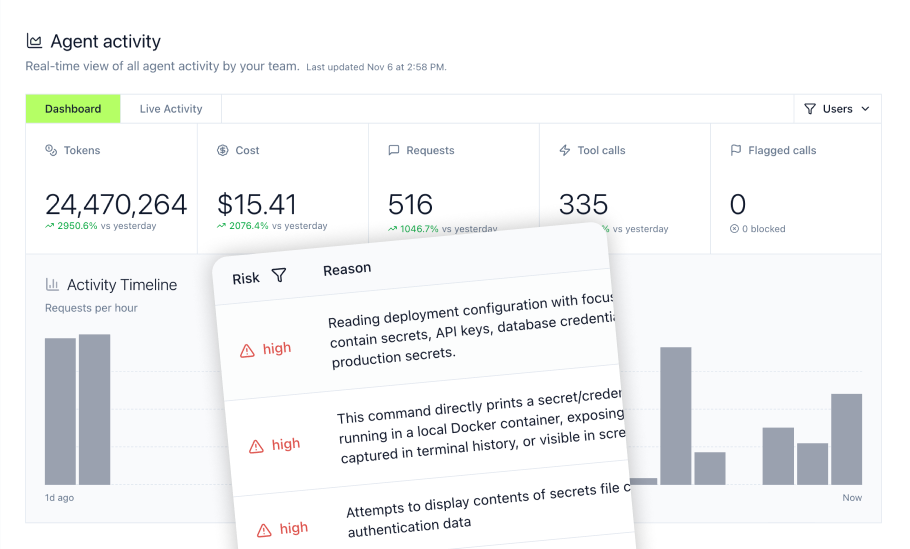
Mint Guard screens MCP gateway tool calls for PII, secrets, and prompt injection, which protects marketing data as Cowork usage spreads across campaigns and team members. Where teams also run coding agents, Agent Monitor adds visibility through hooks.
Key monitoring capabilities:
- Tool call tracking: Capture file reads, commands, and MCP calls through hooks in Claude Code, Cursor, GitHub Copilot, and Codex
- MCP inventory: Complete visibility into installed MCPs, their permissions, and usage patterns across teams
- Security guardrails: Block dangerous commands, restrict file access, and control MCP permissions in real-time
- Sensitive file protection: Prevent access to .env files, SSH keys, credentials, and other sensitive configuration
- Command history: Complete audit trail of every bash command, file access, and tool call for security review
Cost Analysis: Making the Business Case
Direct Costs
| Tier | Monthly Cost | Best For |
|---|---|---|
| Pro | $20 | Testing, light usage |
| Max | $100-200 | Daily marketing use (recommended) |
| Team | $20-$25 standard seat or $100-$125 premium seat (per user) | Centralized admin, connector controls |
| Enterprise | Seat price + usage at API rates | Full governance, SSO/SAML, tenant restrictions |
Hidden Costs to Plan For
- Context architecture development: 2-4 hours per marketing manager (one-time)
- Skills development: Time investment per skill × number of workflows
- Governance framework: Mintive Gateway pricing varies by contract scope and deployment requirements
- Review overhead: All outputs require review for client-facing work
Break-Even Analysis
Scenario: Marketing manager spending 8 hours/week on reporting, data assembly, content repurposing
Investment:
- Max plan: $100/month
- Initial setup: 4 hours × $50/hour = $200 (one-time)
- Total first year: $1,400
Savings:
- Time saved: 6 hours/week × 48 weeks = 288 hours/year
- Value at $50/hour = $14,400/year
Break-even: Approximately 1 month. ROI compounds as skills library grows.
Common Implementation Mistakes to Avoid
Setup challenges marketing teams encounter:
- Usage limits hit quickly on Pro plan: Complex multi-step tasks consume tokens fast—upgrade to Max for daily use
- Desktop app must stay open: Tasks only run while app is active (not cloud-based yet)
- First outputs don't match expectations: Claude needs 2-3 iterations to learn specific requirements
- Cross-device sync doesn't exist: Cowork sessions remain local to the Mac/PC where you run them
Critical success factors:
- Context architecture beats prompt engineering: The quality of your ABOUT-ME folder and templates determines output quality more than any individual prompt
- Start with high-frequency, low-complexity workflows: Weekly reporting, content repurposing, competitive monitoring—tasks you do repeatedly with predictable structure
- Build review checkpoints for client-facing work: Automate assembly, but always review results before delivery
Getting Started: Your First Week Action Plan
Day 1-2: Foundation Setup
- Download Claude Desktop and install marketing-focused plugin
- Create folder structure following Mintive's Claude Cowork guide
- Write core context files (brand brief, voice guidelines, KPIs)
Day 3-4: First Workflows
- Connect priority MCP connectors (Google Drive, Slack, email)
- Run first performance report from existing data exports
- Compare output to manual process—note gaps for context file updates
Day 5-7: Iteration and Scaling
- Refine context files based on initial outputs
- Build first custom skill following skills tips guide
- Review MCP data risk framework for security posture
For enterprise deployment with governance requirements, explore Mintive's security documentation to understand audit trail and access control options.
Deploying Claude Cowork with Enterprise Governance
For marketing teams operating under compliance requirements or managing sensitive customer data, deploying Claude Cowork requires more than technical setup—it demands a governance layer that Anthropic's native tooling does not provide. Because Cowork activity falls outside standard enterprise audit logs, the Compliance API, and data exports, organizations with SOC 2, GDPR, or regulatory obligations face a critical visibility gap.
Mintive helps address this gap through centralized control, real-time monitoring, and audit-ready infrastructure around MCP activity. The MCP Gateway gives IT and security teams unified visibility into every MCP tool call, file access, and connector interaction across your marketing organization—without slowing execution or forcing manual review queues. Marketing managers gain the freedom to automate repetitive workflows (reporting, content audits, campaign briefs) while compliance teams retain the audit trails and access controls often needed for internal reviews, customer security questionnaires, and formal compliance processes.
The platform supports role-based policies that let you define which connectors, file paths, and external APIs each team member can access. For distributed marketing teams, this means you can enable the Google Workspace connector for one group, restrict CRM access to another, and maintain separation of duties without manual oversight. Deployments integrate with existing SSO and OAuth infrastructure, so authentication flows remain consistent with your broader identity management posture.
Marketing leaders evaluating AI automation should assess both immediate time savings and long-term governance costs. Teams that deploy Cowork without monitoring infrastructure often discover compliance gaps months later—during audits, security reviews, or incident investigations—when reconstruction of agent activity becomes expensive or impossible. Mintive's approach embeds governance from day one, ensuring that the efficiency gains from AI-driven workflows don't introduce unmanageable risk or create technical debt that restricts future AI adoption.
Frequently Asked Questions
Can Claude Cowork access my marketing platforms directly without manual data exports?
Yes, through connectors, plugins, and approved MCP-enabled tools. Claude can pull data from Google Workspace and other connected systems directly once those integrations are enabled for your environment. However, each connector requires OAuth authentication, and your organization may want to restrict which connectors are available. The MCP Gateway enables centralized control over which tools team members can access.
How do I prevent Claude from accessing sensitive marketing data like customer PII or financial projections?
Cowork operates with folder-scoped access—you explicitly grant permission to specific directories, and Claude cannot access files outside those boundaries. For enterprise protection, Mint Guard screens MCP gateway tool calls for PII, secrets, and prompt injection, while Agent Monitor uses hooks in supported coding agents to block risky commands and sensitive file access. The MCP data risk guide covers additional mitigation strategies.
What happens to my Cowork sessions if I switch devices or work remotely?
Cowork sessions are currently local-only—they don't sync across devices. If you switch from your office Mac to a home laptop, you'll need to recreate your context files and folder structure. This is a known limitation; workaround is maintaining context files in cloud storage (Google Drive, Dropbox) and copying them to your local Cowork folder on each device.
Can multiple marketing team members share skills and workflows?
Skills are stored as markdown files, so they can be shared via any file-sharing method (email, Slack, shared drives). However, there's no native team skill library in Pro or Max plans. Team and Enterprise plans offer centralized admin controls for plugin governance. Mintive's vMCP concepts enable organizations to create virtual MCP servers with role-based access and permissions for team-wide deployment.
Is Claude Cowork suitable for agencies managing multiple client accounts?
Yes, but requires careful context architecture. Create separate PROJECT folders for each client with distinct brand guidelines, voice documentation, and templates. The critical consideration: outputs require review before client delivery because complex work can still miss context, formatting, or judgment calls. Agencies with compliance requirements should also evaluate whether Anthropic's audit gap affects their client contracts—Mintive Gateway provides the audit trails many agency agreements require.