Claude Code already reads and edits local repositories, searches codebases, runs shell commands, and works with Git. Model Context Protocol servers extend those built-in capabilities by connecting Claude Code to external databases, design systems, monitoring platforms, communication tools, and other services across your development stack. For enterprise teams, MintMCP Gateway provides the governance layer that makes deploying these servers production-ready with centralized authentication, audit trails, and tool-level access controls.
By December 2025, the MCP project reported more than 10,000 active servers and 97 million-plus monthly SDK downloads, reflecting rapid ecosystem growth alongside greater operational complexity. Claude Code's Tool Search defers MCP tool definitions until they are needed, limiting the upfront context impact of additional servers. The larger risks are excessive permissions, redundant tools, fragmented authentication, and unnecessary operational complexity. This guide covers 11 MCP servers for Claude Code in 2026, plus MintMCP Gateway as the governance layer for enterprise deployment, organized by use case with practical guidance on which to install first and how to govern them at enterprise scale.
Key Takeaways
- GitHub MCP Server is a high-impact integration for GitHub users, with official vendor backing
- Context7 retrieves version-specific documentation on demand, reducing reliance on outdated API information
- Playwright MCP enables Claude Code to verify its own UI changes through browser automation
- PostgreSQL implementations provide database access with read-only mode for safety
- Slack, Linear, and Sentry integrations connect code execution to team communication and production monitoring
- Supabase and Figma servers support full-stack development from backend to design handoff
- MintMCP Gateway centralizes authentication, audit trails, and tool-level access control across all MCP servers for enterprise deployment
1. MintMCP Gateway: Enterprise governance for all MCP servers
While the remaining items in this guide are individual MCP servers, MintMCP Gateway provides the governance layer for deploying them across enterprise teams. MintMCP's Agent Gateway builds on that foundation by governing the identities, permissions, memory, and monitoring of agents that use those connections.
What makes MintMCP Gateway different
MintMCP solves the fundamental problem enterprises face when deploying multiple MCP servers: fragmented authentication, no centralized audit trails, and zero visibility into which agents access which tools. The platform wraps stdio, hosted, HTTP-streamable, and SSE MCP servers behind SSO-fronted remote MCP endpoints with OAuth brokering, SCIM-driven membership, and rule-based policy.
Enterprise governance features
- Hosted MCP Connectors: MintMCP runs connector instances with auto-scaling and sandboxed execution, eliminating the infrastructure overhead of managing individual servers
- OAuth Brokering: Add enterprise authentication to any MCP server including OAuth 2.x, bearer tokens, and SSO-fronted access without rebuilding each server
- Virtual MCP Bundles: Create team-specific endpoints exposing only required tools with SCIM-driven membership and fine-grained access control
- Agent Bundles: Give each AI agent its own identity with M2M auth, scoped tools, and independent credential rotation
- Custom Gateway Middleware: Run customer-authored middleware in a JS sandbox with external DLP and guardrails integrations
Security and compliance
MintMCP is SOC 2 Type II audited with continuous compliance monitoring via Drata. Enterprise SSO, complete audit trails, PII detection, and role-based access control are built into every layer. Customers handling protected health information can request HIPAA documentation, and MintMCP signs BAAs.
Getting started
Visit mintmcp.com/mcp-gateway for the deployment guide. Enterprise teams can deploy in minutes with managed SaaS delivery in US and EU regions, with VPC and self-hosted deployment available on request.
2. GitHub MCP Server
The official GitHub MCP server provides a high-impact integration for developers using GitHub. It handles the complete repository workflow from reading issues to creating pull requests.
Core capabilities
- Repository management including read, create, and update operations
- Pull request creation, review, and commenting
- Issue tracking and GitHub Actions integration
- OAuth authentication with fine-grained token scoping
- Hosted remote endpoint available without local setup
GitHub introduced and now maintains an official MCP server, giving Claude Code users a vendor-supported option alongside community implementations. The server brings standardized authentication and comprehensive feature coverage. Claude Code can now read open issues, analyze code, create fix branches, and open pull requests in a single workflow.
Install command
claude mcp add --transport http github https://api.githubcopilot.com/mcp/
For enterprise deployments, route GitHub MCP through MintMCP Gateway to enforce SSO, audit every repository operation, and scope access by team. This prevents credential sprawl when multiple developers each configure their own GitHub tokens.
3. Context7 MCP Server
Context7 is a useful documentation-focused MCP server for coding agents. It indexes real, version-specific documentation and injects it into Claude Code's prompt on demand, stopping API hallucinations before they happen.
Why it matters
Context7 is useful because it solves a critical problem: Claude Code guessing outdated API signatures instead of looking them up. Instead of hallucinating the current React or Prisma method signatures, the agent fetches actual docs for the specific version in your project.
Technical details
- Indexes thousands of popular libraries with version-specific documentation
- Exposes minimal tools, keeping context window cost low
- Supports both stdio and HTTP transports plus hosted endpoint options
- Maintained by Upstash with active development
Install command
claude mcp add --transport http context7 https://mcp.context7.com/mcp
Teams deploying Context7 through MintMCP Gateway gain centralized logging of which documentation Claude Code accesses, enabling compliance teams to audit what external resources agents consume.
4. Playwright MCP Server
The official Microsoft-maintained Playwright MCP server enables Claude Code to verify its own UI changes by actually using the application. It brings real browser automation to AI coding workflows.
Key features
- Real browser automation via accessibility tree for lower context cost
- Screenshot capture and visual verification
- Form filling, navigation, and JavaScript execution
- Configurable browser profiles, allowed hosts, origins, and network access
- Official Microsoft backing with consistent updates
Frontend verification workflow
Playwright enables a powerful feedback loop: Claude Code writes frontend code, then uses Playwright to navigate to the page, interact with the UI, and verify the changes work correctly. This catches rendering bugs and interaction issues that static code analysis misses.
Install command
claude mcp add --transport stdio playwright -- npx -y @playwright/mcp@latest
For teams building customer-facing applications, MintMCP can control who may invoke Playwright tools, restrict the exposed tool set, and log browser actions. Use Playwright's own host, origin, and network configuration to confine automation to approved test environments.
5. PostgreSQL MCP Server
The former official PostgreSQL reference server is archived and should not be treated as a maintained 2026 recommendation. Teams should use a maintained PostgreSQL MCP implementation that supports restricted access, schema inspection, and query-plan analysis.
Database capabilities
- Schema inspection and table relationship analysis
- SQL query execution with recommended read-only mode
- EXPLAIN ANALYZE support for query optimization
- Low context window cost compared to alternatives
- Maintained third-party implementations available
Safety considerations
Run PostgreSQL MCP in read-only mode for production databases. This prevents Claude Code from accidentally mutating data while still enabling schema reading, query writing, and data inspection. For development databases where writes are acceptable, configure appropriate role-based permissions.
Install command
claude mcp add --transport stdio --env DATABASE_URI="postgresql://..." postgres -- uvx postgres-mcp --access-mode=restricted
Enterprise teams should enforce read-only and schema-level restrictions through dedicated database roles, then route the MCP server through MintMCP Gateway for centralized authentication, tool-level policy, and audit logging.
6. Slack MCP Server
The Slack MCP server bridges execution and communication, enabling Claude Code to notify teams about completed tasks and read conversation context. It fills a critical gap in automated workflows.
Communication features
- Send messages to channels and DMs
- Read channel history and thread context
- Async status updates for long-running tasks
- OAuth-based authentication with workspace-level permissions
- Streamable HTTP transport through Slack's hosted server, with workspace-admin approval required
Workflow integration
When Claude Code finishes a long-running task like generating a migration script or fixing a batch of Sentry errors, it can post a status update to the team channel. This keeps developers informed without requiring them to poll for completion.
Install command
claude plugin install slack
For organizations requiring audit trails, MintMCP Gateway logs every Slack message Claude Code sends, tracks which channels agents access, and enforces policies about what information can be shared.
7. Linear MCP Server
For teams using Linear for project management, the official Linear MCP server connects planning to execution through an official remote integration.
Project management integration
- Read and update issue status, assignees, and labels
- Create issues directly from code conversation
- Query projects, cycles, and sprint planning data
- Browser OAuth authentication
- Streamable HTTP transport through Linear's hosted server, requiring no local server setup
Issue-to-fix workflow
A powerful workflow combines Linear with GitHub: "Read all open bugs assigned to me. Pick the one with the smallest scope. Open a fix branch, write the patch, and link the Linear ticket from the PR." Claude Code can now execute this entire sequence autonomously.
Install command
claude mcp add --transport http linear https://mcp.linear.app/mcp
Teams managing multiple AI agents through MintMCP can scope Linear access by project or team, ensuring agents only see and modify issues within their designated scope.
8. Sentry MCP Server
The official Sentry MCP server wires production error context directly into Claude Code, enabling proactive bug fixing through an official hosted integration.
Error monitoring capabilities
- Query recent errors and issues by project
- Read stack traces and error grouping
- Frequency analysis and trend detection
- Official hosted server with no local token management
- OAuth-based authentication
Production debugging workflow
"Look at this morning's top three Sentry errors. Find the underlying bug in the code. Open a fix PR for the worst one." Sentry MCP enables Claude Code to triage production issues autonomously, connecting error monitoring directly to code fixes.
Install command
claude mcp add --transport http sentry https://mcp.sentry.dev/mcp
For teams requiring security governance, routing Sentry through MintMCP Gateway centralizes access controls and audit logging for the exposed Sentry tools.
9. Supabase MCP Server
The official Supabase MCP server provides backend development tools through an official vendor-maintained integration.
Full-stack backend access
- PostgreSQL database, migration, and schema operations
- Project management and development tools
- Debugging and log retrieval
- Edge Function deployment
- Storage bucket listing and storage configuration when enabled
- Streamable HTTP transport with official vendor maintenance
Unified backend workflow
For teams using Supabase, this server centralizes database, project, debugging, Edge Function, and selected storage-administration workflows. It does not expose general Auth user, role, or session management tools. Supabase recommends using it with development projects, project scoping, and read-only mode rather than production data.
Install command
claude mcp add --transport http supabase "https://mcp.supabase.com/mcp?project\_ref=YOUR\_PROJECT\_REF\&read\_only=true"
Enterprise teams using MintMCP can leverage Virtual MCP Bundles to expose only specific Supabase capabilities to different roles, such as giving developers database access while restricting project-management or Edge Function tools to administrators.
10. Figma MCP Server
The official Figma MCP server bridges design and code through an official vendor-maintained integration, enabling Claude Code to generate implementations that match actual design specs.
Design-to-code features
- Read Figma file structure and design tokens
- Extract colors, typography, spacing, and layout data
- Generate code matching actual design specifications
- Quality depends on Figma file organization with semantic naming
- Official vendor support with active maintenance
Design handoff workflow
Instead of translating screenshots to code, Claude Code can access the actual Figma file, read the layout structure, extract design tokens, and generate components that match the design system precisely.
Install command
claude mcp add --transport http figma https://mcp.figma.com/mcp
For teams handling design systems across multiple products, MintMCP's centralized gateway provides audit trails of which design files Claude Code accesses and which components it generates.
11. Filesystem MCP Server
The official Anthropic reference Filesystem MCP server provides scoped file access, though with an important caveat for Claude Code users.
File management capabilities
- Read and write files in specified directories
- Traverse directory structures
- Scoped access with path allowlisting
- Official reference implementation
- Low context window cost
Important caveat
Claude Code already ships with built-in file tools including Read, Edit, Write, Glob, and Grep with permission rules and sandboxing. Install the Filesystem MCP server only when you specifically need to expose additional directories beyond your current project, such as sibling repositories or shared configuration directories.
Install command
claude mcp add --transport stdio filesystem -- npx -y @modelcontextprotocol/server-filesystem /path/to/allowed/directory
Configure directory boundaries through the Filesystem server's allowlist or MCP Roots. MintMCP Gateway can then govern who may invoke the exposed file tools and maintain centralized audit logs of those calls.
12. Exa MCP Server
For teams requiring live web research during development, Exa provides AI-oriented web and code search capabilities for agent workflows.
Web research capabilities
- Semantic search optimized for AI agents
- Structured results instead of keyword matching
- Configurable tool selection so teams can expose only the search and research capabilities they need
- Supports both stdio and HTTP transports
- Vendor-backed with active development
Research workflow
"Pull the three most recent posts on this library's breaking change, summarize the migration steps, and check them against our current version." Exa enables Claude Code to research documentation gaps, breaking changes, and community solutions without leaving the agent workflow.
Install command
claude mcp add --transport http exa https://mcp.exa.ai/mcp
Organizations concerned about data leakage can route Exa through MintMCP Gateway to log every search query and enforce policies about what information Claude Code can retrieve from the web.
Deploying MCP servers for Claude Code: best practices
Start with the essential five
Do not enable every integration by default. Claude Code defers MCP tools through Tool Search, but each additional server still expands the permission surface, operational complexity, and set of actions available to the agent. Start with the highest-impact servers:
- GitHub MCP for repository workflow
- Context7 for documentation lookup
- Playwright for frontend verification
- PostgreSQL for database access
- Slack for team communication
Add additional servers as specific workflows require them.
Security considerations
Every MCP server connection represents a potential data exposure point. For enterprise deployments:
- Route all MCP traffic through MintMCP Gateway for centralized authentication
- Use read-only modes for production database access
- Scope OAuth tokens to minimum required permissions
- Enable audit logging for compliance requirements
Context window management
Claude Code's Tool Search defers MCP tool schemas and loads tools when they are needed, so additional servers have limited upfront context cost. Tool outputs and actively used definitions still consume context. Keep server instructions clear, scope tools by role, and avoid redundant integrations.
Why MintMCP is the governance layer for Claude Code at enterprise scale
Organizations deploying Claude Code across engineering teams face challenges that individual MCP servers cannot address. MintMCP Gateway provides the infrastructure layer that transforms MCP from developer experimentation to production deployment, while MintMCP's Agent Gateway extends that foundation to govern the identities, permissions, memory, and monitoring of agents that use those connections.
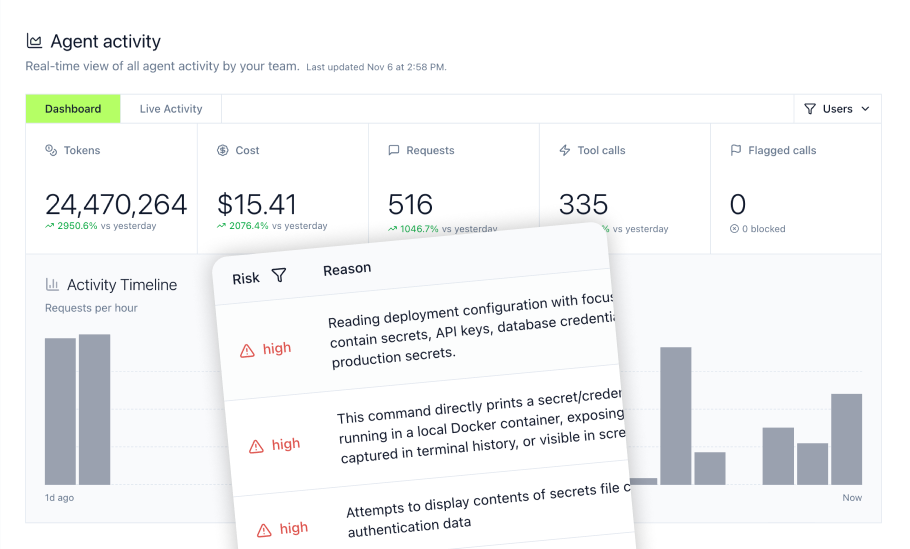
Every MCP request routed through MintMCP Gateway is logged with the initiating identity, tool call, and relevant request context. Agent Monitor extends visibility to supported local Claude Code and Cursor activity, including Bash commands and file operations. Security teams can review governed activity across connected repositories, databases, and communication tools. Engineering teams get self-service access to approved tools without waiting for individual server configurations.
The platform supports Claude, Cursor, ChatGPT, Gemini, and Copilot through centralized gateway and Agent Monitor coverage, giving organizations vendor-neutral governance across their entire AI tooling stack. MintMCP is SOC 2 Type II audited and compliant with HIPAA standards, with continuous compliance monitoring through Drata.
For teams requiring enterprise memory for their agents, MintMCP provides private, team, org, and customer memory scopes with Git-like version control, reviewability, auditability, and portability. This ensures that agent memory remains company-owned infrastructure rather than opaque vendor-controlled data.
Start your free trial to deploy governed MCP infrastructure in minutes.
Frequently asked questions
How many MCP servers should I install for Claude Code?
Start with 3-5 servers covering your core workflow: source control, documentation, database access, and team communication. Adding more servers expands capabilities but also increases permission scope and operational complexity. With Tool Search enabled, additional servers have limited upfront context impact. Install additional servers when specific workflows require them, not speculatively.
Can I use MCP servers with Claude Code without a gateway?
Yes, Claude Code supports direct MCP server connections. However, this creates fragmented authentication, no centralized audit trails, and individual credential management for each server. For personal projects, direct connections work fine. For enterprise teams requiring compliance and security controls, MintMCP Gateway provides the governance layer.
What happens if an MCP server exposes too many tools?
Claude Code normally defers MCP tool definitions through Tool Search, so a large catalog does not automatically load every tool into the context. The remaining concerns are tool discoverability, overlapping capabilities, permission scope, and the context consumed by tools that are actually invoked. Use Virtual MCP Bundles to expose only the specific tools each team needs rather than full server capabilities.
How do I prevent Claude Code from accessing sensitive data through MCP?
Route MCP traffic through MintMCP Gateway with tool-level access controls. Configure read-only modes for database servers. Use SCIM-driven group membership to scope access by team. Enable custom middleware with DLP integrations to detect and block PII exposure in real time.
Do I need separate MCP configurations for different AI tools?
MintMCP Gateway provides unified governance across Claude, Cursor, ChatGPT, Gemini, and Copilot. Configure MCP servers once at the gateway, then connect any supported AI tool through the same SSO-fronted endpoints. Agent Monitor extends visibility to local agent activity beyond MCP, covering Bash commands, file operations, and prompt submissions.