FastMCP is a Python framework for building Model Context Protocol servers, clients, and applications, enabling developers to connect AI assistants like Claude, ChatGPT, Cursor, and Gemini to enterprise data and tools through a standardized interface. Its maintainers report roughly 1 million daily downloads, while its decorator-based API reduces protocol boilerplate for Python developers moving from prototypes toward production deployments. For enterprises requiring governed deployments of these custom MCP servers, the MCP Gateway provides centralized authentication, access controls, and audit logging without requiring code changes to your Python servers.
This article walks through the complete process of building MCP servers in Python using FastMCP, covering architecture decisions, implementation patterns, security requirements, and enterprise deployment strategies.
Key Takeaways
- FastMCP reduces implementation boilerplate through Python decorators that automatically generate schemas, validation, documentation, and protocol handling
- The framework requires Python 3.10 or higher and supports STDIO for local subprocess connections, Streamable HTTP for remote deployments, and legacy SSE compatibility
- A basic server requires relatively little code, while production deployment time depends on authentication, hosting, monitoring, testing, and integration requirements
- FastMCP is Apache 2.0 licensed, so the open-source framework itself has no license fee; hosting, security, observability, support, and operational costs depend on the deployment
- Custom Python MCP servers can be deployed through MintMCP Gateway, which adds OAuth wrapping and enterprise authentication without code modifications
- FastMCP includes authentication, authorization, and middleware building blocks, but production security still depends on correct configuration, secret management, network controls, and auditable policy enforcement
- Agent Monitor provides visibility into supported Claude Code and Cursor activity, including MCP calls, prompts, commands, and file access reported through installed hooks
Understanding the Model Context Protocol (MCP) Landscape
The Model Context Protocol emerged to address fragmentation in how AI applications connect to external data sources, tools, and business systems. Before MCP, teams often relied on provider-specific integrations and custom connection logic for each AI application. Anthropic introduced MCP in late 2024 to standardize how AI assistants connect to databases, APIs, file systems, and enterprise applications.
What is MCP and Why is it Critical for Enterprise AI?
MCP defines a host-client-server architecture. An AI application acts as the host, manages MCP clients, and uses those clients to communicate with MCP servers through JSON-RPC 2.0 messages encoded as UTF-8. A server can often be reused across compatible hosts, although deployment may still require host-specific transport, authentication, and configuration settings.
MCP servers can expose three principal feature types:
- Tools: Functions the AI model can invoke to perform actions or retrieve computed results
- Resources: Context and data that users or AI models can read and reference
- Prompts: Reusable message templates and workflows that clients can present to users
For enterprises, MCP creates a consistent interface layer between AI systems and internal infrastructure. Instead of building custom integrations for each AI tool your team uses, you build one MCP server that works everywhere.
The Evolution of Generative AI and Agent Orchestration
MCP adoption accelerated dramatically through 2025 as major AI providers added native support. In December 2025, Anthropic reported 97 million monthly downloads across the Python and TypeScript MCP SDKs as the protocol moved under the Agentic AI Foundation, a directed fund of the Linux Foundation.
This standardization wave mirrors the API gateway category emergence of the previous decade. Just as REST APIs needed management layers for authentication, rate limiting, and observability, MCP connections require governance infrastructure for enterprise deployment.
MintMCP operates as this infrastructure layer, providing centralized control over MCP server access while preserving the protocol's flexibility. The MCP Gateway handles authentication, authorization, and audit logging so individual MCP servers can focus purely on business logic.
Why Python is the Ideal Choice for MCP Server Development
Python dominates MCP server development for practical reasons: the language's readability, extensive library ecosystem, and developer familiarity reduce the barrier to creating production-quality tool integrations.
Leveraging Python's Strengths for AI Infrastructure
FastMCP exploits Python's type hint system to automatically generate JSON schemas for MCP tools. When you annotate a function parameter as query: str or limit: int = 10, FastMCP produces the corresponding MCP schema without manual specification. This approach means documentation stays synchronized with implementation.
The async/await patterns native to modern Python map cleanly to MCP's request-response cycle. Servers can handle concurrent tool calls efficiently using asyncio, which matters when AI assistants issue multiple parallel requests during complex reasoning chains.
Key Python advantages for MCP development:
- Type hints drive automatic schema generation and validation
- Asyncio enables efficient concurrent request handling
- Rich library ecosystem for database connectors, API clients, and data processing
- Extensive testing frameworks (pytest) integrate with FastMCP patterns
- Wide developer familiarity reduces onboarding time for new team members
Comparing Python with Other Backend Languages for MCP
While MCP servers can be built in any language that handles JSON-RPC 2.0, Python's combination of developer velocity and production capability makes it the dominant choice. The official MCP repository hosts reference implementations in multiple languages, but FastMCP's Python approach has achieved wide adoption.
TypeScript represents the main alternative, particularly for teams already embedded in Node.js ecosystems. Go offers performance advantages for high-throughput scenarios. However, FastMCP's decorator-based approach and automatic schema generation provide rapid development cycles for most enterprise use cases.
Designing Your Python MCP Server: Architecture and Core Components
FastMCP abstracts the protocol complexity into a clean API surface. Developers write standard Python functions; the framework handles transport negotiation, message parsing, schema generation, and error formatting.
Mapping MCP Specification to Pythonic Design
The core abstraction is the FastMCP class, which serves as your server instance:
from fastmcp import FastMCP
mcp = FastMCP("My Enterprise Server")
Tools are Python functions decorated with @mcp.tool. The function signature, type hints, and docstring become the tool's MCP definition:
@mcp.tool

def search_customers(query: str, limit: int = 10) -> list[dict]:

    """Search customer database by name or email.


    Args:

        query: Search term to match against customer records

        limit: Maximum results to return (default 10)


    Returns:

        List of matching customer records with id, name, email

    """

    # Implementation connects to your actual database

    return customer_db.search(query, limit)
FastMCP parses the function signature, extracts parameter names and types, reads the docstring for descriptions, and produces the JSON schema that AI clients need to understand and call the tool.
Handling Concurrency and Scalability in Your MCP Server
MCP servers must handle concurrent requests efficiently. FastMCP supports both synchronous and asynchronous tool implementations:
@mcp.tool

async def fetch_analytics(date_range: str) -> dict:

    """Retrieve analytics data for specified date range."""

    async with aiohttp.ClientSession() as session:

        # Parallel API calls using asyncio

        results = await asyncio.gather(

            fetch_pageviews(session, date_range),

            fetch_conversions(session, date_range),

            fetch_revenue(session, date_range)

        )

    return combine_analytics(results)
For CPU-bound operations, consider using process pools or offloading to task queues. The MCP protocol itself imposes no throughput limits; scalability depends on your hosting environment and tool implementation efficiency.
MintMCP's architecture handles the scaling layer when you deploy custom servers through the gateway, providing auto-scaling and isolated execution per connector.
Implementing Request Handling and Business Logic in Your Python MCP Server
The power of MCP servers lies in the business logic they expose. A well-designed server presents focused capabilities that AI assistants can compose into complex workflows.
Crafting Robust Tool Implementations for AI Agents
Each tool should do one thing well. AI assistants work best with focused tools rather than Swiss Army knife functions with dozens of parameters.
Effective tool design patterns:
- Single responsibility: One tool queries customers; another creates tickets; a third updates records
- Clear parameter names: Use descriptive names AI can interpret from context
- Comprehensive docstrings: AI uses these descriptions to decide when and how to call tools
- Explicit error handling: Return meaningful error messages rather than generic failures
- Reasonable defaults: Provide sensible defaults so AI can call tools with minimal parameters
@mcp.tool

def create_support_ticket(

    customer_id: str,

    subject: str,

    description: str,

    priority: str = "medium"

) -> dict:

    """Create a new support ticket for a customer.


    Args:

        customer_id: The unique identifier for the customer

        subject: Brief summary of the issue (max 100 chars)

        description: Detailed description of the problem

        priority: Ticket priority - low, medium, high, urgent


    Returns:

        Created ticket with id, status, and assigned agent


    Raises:

        ValueError: If customer_id not found or priority invalid

    """

    if priority not in ["low", "medium", "high", "urgent"]:

        raise ValueError(f"Invalid priority: {priority}")


    customer = get_customer(customer_id)

    if not customer:

        raise ValueError(f"Customer not found: {customer_id}")


    return ticket_system.create(

        customer=customer,

        subject=subject,

        description=description,

        priority=priority

    )
Integrating External Services and Databases Seamlessly
Most MCP servers wrap existing systems. The server acts as a governed interface layer between AI and your databases, APIs, and internal services.
Common integration patterns:
- Database access: Use SQLAlchemy, Prisma, or direct drivers with connection pooling
- REST APIs: Wrap external services with proper authentication and error handling
- Internal microservices: Connect to existing service mesh through appropriate clients
- File systems: Provide scoped access to specific directories with proper permissions
from sqlalchemy import create_engine

from sqlalchemy.orm import sessionmaker

engine = create_engine(DATABASE_URL, pool_size=10)

Session = sessionmaker(bind=engine)

@mcp.tool

def query_sales_data(

    start_date: str,

    end_date: str,

    region: str = None

) -> list[dict]:

    """Query sales transactions within date range.


    Args:

        start_date: Start date in YYYY-MM-DD format

        end_date: End date in YYYY-MM-DD format

        region: Optional region filter (NA, EU, APAC)


    Returns:

        List of sales records with amount, product, customer

    """

    with Session() as session:

        query = session.query(Sale).filter(

            Sale.date >= start_date,

            Sale.date <= end_date

        )

        if region:

            query = query.filter(Sale.region == region)


        return [sale.to_dict() for sale in query.all()]
Building a Basic Streamable HTTP MCP Server in Python
FastMCP supports multiple transports. STDIO works for local subprocess connections, while Streamable HTTP provides the current standard transport for remote deployments. The older HTTP+SSE transport remains available only for compatibility with legacy clients.
From Request to Response: A Walkthrough with a Python Framework
A minimal FastMCP server requires just a few lines:
from fastmcp import FastMCP

mcp = FastMCP("Demo Server")

@mcp.tool

def add_numbers(a: int, b: int) -> int:

    """Add two numbers together."""

    return a + b

@mcp.tool

def multiply_numbers(a: int, b: int) -> int:

    """Multiply two numbers together."""

    return a * b

if __name__ == "__main__":

    mcp.run()
Running this script starts the server in STDIO mode. For Streamable HTTP deployment, FastMCP can expose an ASGI application:
from fastmcp import FastMCP

from starlette.responses import JSONResponse

mcp = FastMCP("HTTP Server")

# Define your tools...

@mcp.custom_route("/health", methods=["GET"])

async def health_check(request):

    return JSONResponse({"status": "healthy"})

app \= mcp.http\_app(stateless\_http=True)

# Run with uvicorn or another ASGI server

# uvicorn server:app --host 0.0.0.0 --port 8000
Reporting Progress During Long-Running Operations
MCP supports progress notifications for long-running operations. In FastMCP, tools report progress through the request context, and compatible clients receive updates when they include a progress token:
from fastmcp import Context

@mcp.tool

async def process_large_dataset(

    dataset_id: str,

    ctx: Context,

) -> dict:

    """Process a large dataset with progress reporting."""

    dataset = load_dataset(dataset_id)

    total = len(dataset)

    for i, record in enumerate(dataset, start=1):

        process_record(record)

        if i % 100 == 0 or i == total:

            await ctx.report_progress(

                progress=i,

                total=total,

                message=f"Processed {i}/{total} records",

            )

    return {"processed": total, "status": "complete"}
MintMCP Gateway supports STDIO and Streamable HTTP, with legacy SSE compatibility where required, and can convert local STDIO servers into hosted services with OAuth authentication.
Securing Your Python MCP Server: Authentication, Authorization, and Data Privacy
FastMCP includes authentication and authorization mechanisms for HTTP deployments, including JWT verification, OAuth integrations, and component-level access controls. Production deployments can configure these directly or centralize identity and policy enforcement through a gateway.
Implementing Robust Authentication for AI Agent Interactions
FastMCP provides built-in authentication for production deployments:
from fastmcp import FastMCP

from fastmcp.server.auth.providers.jwt import JWTVerifier

auth = JWTVerifier(

    jwks_uri="https://auth.example.com/.well-known/jwks.json",

    issuer="https://auth.example.com",

    audience="mcp-server",

)

mcp = FastMCP("Secured Server", auth=auth)
Gateway-level authentication:
For enterprise deployments, centralizing authentication at the gateway layer provides stronger security and simpler management. MintMCP Gateway handles OAuth 2.0 and SAML authentication, automatic credential rotation, and granular tool-level access control.
This approach means your Python server code stays focused on business logic while authentication, SSO integration, and access policies are managed centrally across all your MCP servers.
Protecting Sensitive Data: Encryption and Access Controls
Data protection in MCP servers requires attention at multiple layers:
- Transport encryption: Use TLS for all remote HTTP connections
- Credential storage: Store API keys and database credentials in secret managers, not code
- Input validation: Validate all tool parameters before processing
- Output filtering: Ensure tools do not expose sensitive fields unintentionally
- Access scoping: Limit tool capabilities to minimum required permissions
@mcp.tool

def get_customer_profile(customer_id: str) -> dict:

    """Retrieve customer profile information.


    Note: Returns public profile data only.

    Payment info and SSN are excluded.

    """

    customer = customer_db.get(customer_id)


    # Filter sensitive fields before returning

    return {

        "id": customer.id,

        "name": customer.name,

        "email": customer.email,

        "account_status": customer.status

        # Explicitly exclude: ssn, payment_methods, internal_notes

    }
MintMCP's security governance features include inline DLP integration with AWS Bedrock Guardrails, Google Cloud DLP, and other providers, enabling automatic detection and masking of sensitive data in MCP responses.
Integrating and Deploying Your Python MCP Server at Scale
Moving from development to production requires containerization, orchestration, and proper infrastructure configuration.
Containerizing Your MCP Server for Production Environments
Docker provides the standard approach for packaging MCP servers:
FROM python:3.11-slim

WORKDIR /app

COPY requirements.txt .

RUN pip install --no-cache-dir -r requirements.txt

COPY . .

EXPOSE 8000

CMD ["uvicorn", "server:app", "--host", "0.0.0.0", "--port", "8000"]
For Kubernetes deployments, define appropriate resource limits and health checks:
apiVersion: apps/v1

kind: Deployment

metadata:

  name: mcp-server

spec:

  replicas: 3

  selector:

    matchLabels:

      app: mcp-server

  template:

    metadata:

      labels:

        app: mcp-server

    spec:

      containers:

        - name: mcp-server

          image: your-registry/mcp-server:latest

          ports:

            - containerPort: 8000

          resources:

            requests:

              memory: "256Mi"

              cpu: "250m"

            limits:

              memory: "512Mi"

              cpu: "500m"

          livenessProbe:

            httpGet:

              path: /health

              port: 8000

          readinessProbe:

            httpGet:

              path: /health

              port: 8000
Achieving High Availability and Scalability
Production MCP deployments require:
- Load balancing: Distribute requests across multiple server instances
- Auto-scaling: Scale instances based on request volume
- Health monitoring: Detect and replace unhealthy instances
- Graceful shutdown: Handle in-flight requests during deployments
MintMCP Gateway provides managed hosting for custom MCP servers, handling auto-scaling and isolated execution per connector. This approach eliminates the need to manage Kubernetes pods, runtimes, or scaling infrastructure for the connector layer.
For teams preferring self-hosted deployments, MintMCP offers VPC installation options maintaining feature parity with the managed service.
Monitoring and Governing Your Python MCP Servers with Enterprise Tools
Visibility into MCP server activity is essential for security, compliance, and operational management. Enterprise deployments require comprehensive logging, real-time monitoring, and policy enforcement.
Gaining Insight into Agent Activity and Server Performance
Production monitoring should track:
- Request volume: Tool calls per minute/hour across all connected clients
- Latency distribution: Response times for each tool
- Error rates: Failed requests by error type
- User attribution: Which users or agents made specific calls
- Data access patterns: What data was queried or modified
FastMCP includes middleware for request logging and timing. Avoid logging raw tool arguments or outputs when they may contain credentials, personal data, or confidential business information:
from fastmcp.server.middleware.logging import LoggingMiddleware
mcp.add_middleware(LoggingMiddleware())
For enterprise requirements, MintMCP provides full conversation-level logging with per-user attribution, configurable retention, and export to SIEM platforms including Microsoft Sentinel and Splunk.
Enforcing Governance Policies Across Your Organization
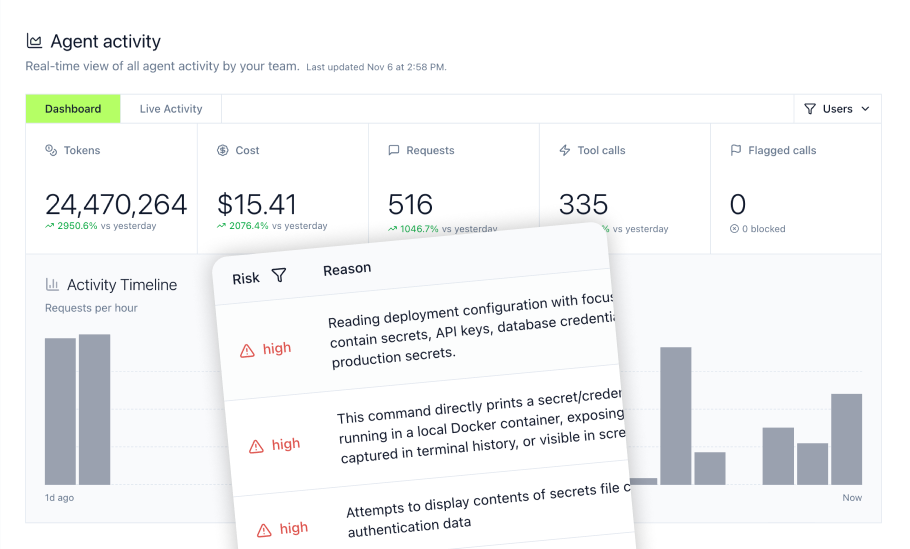
Agent Monitor extends visibility beyond gateway traffic to include local agent activity in Cursor and Claude Code. This coverage addresses shadow AI detection, identifying MCP usage outside governed channels.
Policy enforcement capabilities include:
- PII exposure detection in tool inputs and outputs
- Credential leakage monitoring (API keys, tokens in prompts)
- Risky command blocking (destructive database operations, dangerous bash commands)
- Prompt injection attempt detection
- Custom guardrail policies with block, flag, or alert actions
The agent identities feature provides each deployed agent with its own credentials and permission scope, enabling precise audit attribution and credential rotation independent of human user accounts.
MintMCP: From MCP Gateway to Agent Gateway
As enterprises move from governed data access to autonomous agent deployments, MintMCP's product evolution reflects this expanding landscape. The company's foundation - providing secure, auditable connections between AI systems and enterprise tools - remains core to the MCP Gateway offering. This layer governs how Claude, ChatGPT, Cursor, Gemini, and Copilot access company data through Python MCP servers and other connectors, providing centralized authentication, authorization, and audit logging.
Building on this foundation, MintMCP's Agent Gateway extends governance to long-running agents that persist across sessions, hold memory, and operate alongside employees. Where MCP Gateway secures the data connections your FastMCP servers expose, Agent Gateway provides the identity, permission, memory, and monitoring infrastructure these agents require. This distinction matters because coworker agents - the Slack-native assistants that continue work across days and hold institutional context - need capabilities beyond tool access: they require their own credentials independent of human users, scoped memory that separates team context from customer data, and audit trails that attribute actions to specific agent identities rather than shared service accounts.
For teams building autonomous agents using Python MCP servers, this two-layer approach means your FastMCP implementation focuses purely on exposing business logic as MCP tools. MintMCP handles the identity layer (which agent is calling), the permission layer (what that agent can access), the memory layer (what context persists across sessions), and the monitoring layer (what actions were taken and why). Organizations already using MintMCP Gateway for governed MCP access can extend that foundation to support coworker agents without rebuilding authentication, audit, or policy infrastructure.
Frequently Asked Questions
What is the primary benefit of building MCP servers in Python for enterprise AI applications?
Python's type hint system enables FastMCP to automatically generate JSON schemas from function signatures, keeping documentation synchronized with implementation. Combined with Python's extensive library ecosystem for database connectors, API clients, and data processing, development teams can reduce implementation boilerplate when creating production-quality MCP servers. The language's wide developer familiarity also reduces onboarding time when expanding teams.
How does MintMCP Gateway integrate with custom Python MCP servers using STDIO transport?
MintMCP Gateway automatically converts locally-run STDIO MCP servers to hosted, production-ready services with OAuth wrapping, requiring no code changes to your Python server. The gateway handles transport conversion, authentication, and scaling while your server code remains focused on business logic. This approach works for both FastMCP-based servers and any other MCP server implementation using STDIO transport.
What is the role of the Bundle architecture in simplifying governance for Python MCP server deployments?
Bundles (Virtual MCPs) package tool access, policy enforcement, and audit logging into single governance units per team or role. Instead of manually configuring separate access rules, credential objects, and logging policies for each MCP server, administrators define one Bundle that ties SCIM group membership to curated MCP server lists with consistent access policies. When group membership changes in Okta or Azure AD, Bundle access updates automatically.
Can a Python-based MCP server detect and mitigate shadow AI usage within an organization?
The MCP server itself cannot detect shadow usage since it only sees requests that reach it. However, MintMCP's Agent Monitor hooks into Claude Code and Cursor to identify off-gateway MCP usage, detecting when developers connect to MCP servers outside governed channels. This shadow AI detection expands visibility beyond gateway traffic across supported and properly configured Claude Code and Cursor deployments.
What security certifications should enterprises require when deploying Python MCP servers in production?
MCP servers handling sensitive enterprise data should deploy through infrastructure with appropriate security attestations. MintMCP is SOC 2 Type II audited with continuous compliance monitoring via Drata, and customers handling protected health information can request HIPAA documentation. For self-hosted deployments, ensure your infrastructure meets equivalent standards for encryption in transit and at rest, access controls, and audit logging. The MintMCP Trust Center provides detailed security documentation for enterprise evaluation.