Developers are already connecting AI agents to GitHub repositories, the question is whether engineering leaders have visibility into what those agents access, modify, or expose. With GitHub launching its MCP Registry in 2025 and MCP adoption accelerating across developer workflows, Model Context Protocol has become a standard way to connect AI tools to external systems. But connecting Claude, Cursor, or ChatGPT directly to codebases without a governance layer creates credential sprawl, audit blind spots, and security risks that enterprise teams cannot afford.
An MCP gateway solves this by sitting between AI agents and GitHub's API, providing centralized authentication, tool-level access control, and complete audit trails for every repository interaction. Instead of scattered Personal Access Tokens across developer machines, security teams gain unified observability over who accessed what code, when, and through which AI tool.
According to NIST's Cybersecurity Framework, centralized authentication and access controls are fundamental to protecting sensitive systems, principles that apply equally to AI-to-GitHub integrations. The May 2025 GitHub MCP prompt injection disclosure demonstrated why gateway-level security controls matter for enterprise GitHub automation.
This guide evaluates the leading MCP gateways for GitHub integration in 2026, covering managed platforms for teams that want production-ready deployment without infrastructure overhead, and self-hosted options for organizations with specific compliance or data residency requirements.
Key Takeaways
- MCP gateways eliminate the "N×M integration problem" where connecting multiple AI agents to GitHub creates unmanageable credential sprawl and security risks
- Managed platforms like MintMCP can deploy quickly with built-in OAuth brokering, while self-hosted options typically require more setup time and dedicated DevOps resources
- GitHub rate limits become critical at scale, personal access tokens typically allow 5,000 requests per hour, while requests made through an OAuth or GitHub App owned or approved by a GitHub Enterprise Cloud organization can reach 15,000 requests per hour
- SOC 2 Type II audited posture is important for regulated industries; verify gateway vendor compliance posture before deployment
- Virtual MCP Bundles enable granular tool access, exposing only the GitHub tools each team needs rather than full API access
- Gateway-level security controls provide the observability required for enterprise GitHub automation
1. MintMCP: Enterprise-Grade Governance for GitHub AI Automation
MintMCP transforms local GitHub MCP servers into production-ready services with the security, governance, and observability that enterprise teams require. The platform addresses the core challenge facing engineering leaders: enabling AI-powered development workflows while maintaining complete audit trails for compliance.
What Makes MintMCP Different
MintMCP's one-click deployment eliminates the infrastructure complexity that typically delays MCP adoption. STDIO-based GitHub servers that would normally require local installation become hosted services accessible to MCP-compatible clients including Claude, Cursor, ChatGPT, Gemini, Copilot, VS Code, or custom agents.
The platform's Virtual MCP Bundles architecture enables administrators to create curated tool sets for specific teams. Rather than granting developers full GitHub API access, administrators expose only the tools each role requires: read-only repository access for analysts, PR management for developers, and workflow monitoring for DevOps. SCIM-driven membership, tool-level allowlisting, rule-based policy, and audit logs keep GitHub access aligned with existing enterprise identity controls.
Core Capabilities
MintMCP provides comprehensive GitHub integration features designed for enterprise security and compliance requirements:
- Centralized GitHub Authentication: Enterprise SSO, SCIM-driven RBAC, and OAuth brokering replace scattered PATs with governed access, reducing credential sprawl across developer machines
- Complete Audit Trails: Every GitHub tool invocation, including repository access, PR creation, and issue updates, is logged for SOC 2, GDPR, and broader audit requirements
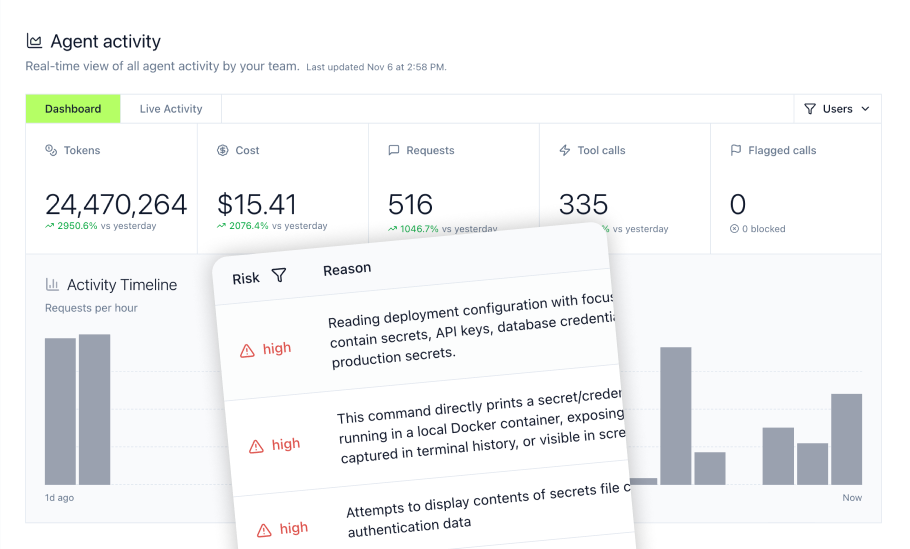
- Centralized Observability: Dashboards track server health, usage patterns, and security alerts across GitHub connections
- Tool-Level Access Control: Configure granular permissions by role, enabling
list_issueswhile blockingdelete_repository - Comprehensive GitHub Tool Coverage: Support for repositories, issues, pull requests, Actions workflows, code security findings, and related GitHub operations
- Agent Identity Governance: Agent Bundles provide per-agent identity, scoped tools, M2M auth, and an “act as agent” flow for connectors that require per-agent OAuth
Security and Compliance
MintMCP is SOC 2 Type II audited, compliant with HIPAA standards, penetration tested, and designed with audit trails, role-based access control, PII detection, and data encryption in transit and at rest. Customers handling protected health information can request HIPAA documentation, and MintMCP signs BAAs.
The Gateway and Agent Monitor model adds two-layer governance for GitHub workflows. The gateway governs MCP traffic, while Agent Monitor can cover local non-MCP agent activity such as bash commands, file reads and writes, and prompt submissions from coding agents.
Implementation
Setup is designed to be fast for a complete GitHub integration:
- Sign up and access the MintMCP console
- Add a GitHub connector with governed OAuth or brokered credentials
- Create Virtual MCP Bundles scoped to specific teams or repositories
- Connect AI clients via the generated endpoint URL
Deployment Model: Managed SaaS-first, with US and EU availability and VPC or self-hosted options on request
AI Clients Supported: Claude, Cursor, ChatGPT, Gemini, Copilot, VS Code, Windsurf, and custom MCP-compatible agents
2. Microsoft MCP Gateway
Microsoft's MCP Gateway provides a Kubernetes-native approach for organizations already operating Azure infrastructure. Released as open-source, it offers enterprise authentication through Azure Entra ID and role-based access control for multi-tenant deployments.
Microsoft's Primary Focus
The gateway targets teams with existing Kubernetes expertise who require on-premises deployment or specific Azure compliance requirements. It serves as infrastructure that DevOps teams manage rather than a turnkey platform.
Core Capabilities
- Kubernetes-Native Architecture: Deploys via standard manifests with horizontal scaling and automatic failover
- Azure Entra Integration: Enterprise authentication for organizations using Microsoft identity infrastructure
- Adapter Registry: Register multiple MCP servers including GitHub, managing them through a unified control plane
- Status Monitoring: API endpoints for checking adapter health and connection status
Implementation
Deployment requires .NET, Docker, and Kubernetes knowledge. After building the gateway image and deploying to a cluster, teams register the GitHub server via the adapter API.
Deployment Model: Self-hosted on Kubernetes
License: Open-source
Tradeoffs to consider
A Kubernetes-native gateway can fit teams already standardized on Azure and cluster operations, but it can require customers to operate gateway infrastructure, scaling, and connector runtime details themselves. MintMCP addresses that gap with managed SaaS-first deployment, hosted MCP connectors, centralized audit logs, and Virtual MCP Bundles for per-use-case GitHub access.
3. Docker MCP Gateway
Docker's MCP Gateway brings container-native simplicity to organizations that already use Docker Compose workflows. The gateway provides an approach that leverages existing container infrastructure without requiring Kubernetes expertise.
Docker's Primary Focus
This gateway serves teams comfortable with containerized applications who want to manage MCP servers using familiar Docker tooling. It provides container isolation between servers while maintaining straightforward configuration.
Core Capabilities
- Container Isolation: Each MCP server runs in its own container with defined resource limits
- Docker Compose Integration: Configure multiple servers through standard compose files
- Local Development Support: Run GitHub MCP servers locally for testing before production deployment
- ARM64 Support: Experimental builds available for ARM-based development machines
Implementation
Setup involves defining GitHub MCP servers in Docker Compose files with the appropriate environment variables. The gateway handles routing between AI clients and containerized servers.
Deployment Model: Self-hosted via Docker
License: Open-source
Tradeoffs to consider
A Docker-based gateway can simplify local development and containerized self-hosting, but production teams still need to manage connector runtimes, credentials, updates, and observability across environments. MintMCP addresses this with hosted MCP connectors, OAuth brokering for stdio and hosted servers, tool-update policy, and centralized observability.
4. IBM ContextForge
IBM ContextForge offers multi-protocol support for organizations needing to connect AI agents across MCP, REST, and gRPC services simultaneously. The platform provides observability through OpenTelemetry integration.
IBM's Primary Focus
ContextForge addresses enterprises with heterogeneous infrastructure where GitHub MCP is just one of many integration points. The multi-protocol architecture serves teams consolidating various API styles under unified governance.
Core Capabilities
- Multi-Protocol Gateway: Route requests to MCP, REST, and gRPC backends through a single entry point
- OpenTelemetry Observability: Distributed tracing and metrics collection built into the gateway architecture
- Plugin Extensibility: Broad plugin and integration support for common enterprise use cases
- OAuth Authentication: Enterprise authentication support for secure GitHub connections
Implementation
Deployment follows standard container workflows with configuration via YAML files. Teams with existing observability infrastructure can integrate ContextForge metrics directly into monitoring stacks.
Deployment Model: Self-hosted container or Kubernetes
License: Apache 2.0
Tradeoffs to consider
A multi-protocol gateway can be useful when teams need to consolidate MCP, REST, and gRPC traffic, but it may require more customer-operated infrastructure and policy design for MCP-specific GitHub governance. MintMCP focuses on MCP-native governance primitives such as Virtual MCP Bundles, Agent Bundles, OAuth brokering, tool-level policy, and audit logs.
5. Composio
Composio provides a managed gateway with a broad pre-built integration catalog beyond GitHub, appealing to teams that need unified AI agent access across many tools. The platform holds SOC 2 Type II audited status for organizations with compliance requirements.
Composio's Primary Focus
The platform targets development teams prioritizing integration breadth and rapid setup. OAuth flows are managed centrally, reducing the need to configure authentication for each tool separately.
Core Capabilities
- Extensive Integration Library: Connect AI agents to GitHub plus numerous additional APIs through a single platform
- Managed OAuth: Centralized credential management across connected services
- Framework Support: Native integrations with LangChain, CrewAI, and LlamaIndex agent frameworks
- Low-Latency Design: Architecture optimized to reduce overhead on tool calls
Implementation
Setup runs through the managed console. Select GitHub from the integration catalog, authenticate via OAuth, and connect preferred AI clients.
Deployment Model: Managed SaaS, with VPC or on-prem options on Enterprise tier
Tradeoffs to consider
Composio is developer and AI-engineering oriented, with a strong integration catalog for agentic applications. Teams evaluating GitHub governance should also assess whether they need IT and security primitives such as SCIM-driven RBAC, Virtual MCP Bundles, Agent Bundles, rule-based policy, and centralized audit streams for internal employee and internal-agent governance.
6. TrueFoundry
TrueFoundry approaches MCP gateway functionality as part of a broader ML infrastructure platform. The platform addresses 2025 security considerations for enterprise deployments.
TrueFoundry's Primary Focus
The platform serves teams already using TrueFoundry for ML operations who want to add MCP gateway capabilities to their existing infrastructure. Performance optimization receives emphasis as part of its broader platform approach.
Core Capabilities
- ML Platform Integration: MCP gateway functionality within broader MLOps tooling
- Performance Optimization: Architecture designed for low-latency tool invocations
- Security Documentation: Detailed guidance on securing MCP servers in production environments
- Hosted and Custom Servers: Support for both managed and self-deployed MCP servers
Implementation
Configuration integrates with existing TrueFoundry deployments. Teams already on the platform can add GitHub MCP servers through familiar workflows.
Deployment Model: Hybrid managed SaaS and self-hosted control plane
Tradeoffs to consider
TrueFoundry can fit platform engineering and ML platform teams that want MCP gateway capabilities inside a broader ML infrastructure stack. Teams focused on GitHub access governance should also evaluate MCP-specific controls such as SCIM-driven RBAC, Virtual MCP Bundles, Agent Bundles, tool-update policy, OAuth brokering for stdio and hosted servers, and two-layer governance across MCP and local coding-agent activity.
Securing Enterprise GitHub AI Workflows with MintMCP
Organizations ready to deploy governed AI-to-GitHub integration face a critical decision: implement scattered point solutions that create new security blind spots, or deploy unified governance that transforms shadow AI into sanctioned AI. MintMCP provides the enterprise gateway that security and engineering teams both require.
The platform's approach addresses the complete governance challenge. Engineering teams gain the AI-powered workflows they need, connecting Claude, Cursor, ChatGPT, Gemini, Copilot, or custom agents to GitHub repositories without friction. Security teams gain the visibility and control enterprise deployment demands, complete audit trails for every repository operation, tool-level access controls that prevent dangerous actions, and centralized authentication that eliminates credential sprawl.
According to CISA guidance on securing AI systems, organizations must implement defense-in-depth strategies that include access controls, monitoring, and audit trails. MintMCP's architecture applies these principles specifically to MCP-based GitHub integration.
MintMCP is SOC 2 Type II audited, compliant with HIPAA standards, penetration tested, and built with complete audit trails for regulated-industry review. The platform's Virtual MCP Bundles architecture enables granular tool governance, exposing only the GitHub operations each role needs rather than full API access. Centralized observability surfaces security alerts before they become incidents.
For organizations evaluating MCP gateways, three factors matter most: compliance posture, operational model, and observability depth. Does the vendor provide the security documentation regulated teams need? Is it managed SaaS-first or self-hosted infrastructure that requires DevOps resources? Can security teams track every tool invocation for review?
MintMCP addresses each. The quickstart guide walks through connecting GitHub repositories with built-in OAuth brokering and audit logging from day one. The managed SaaS-first deployment reduces infrastructure overhead, with no Kubernetes clusters to maintain and no connector orchestration to troubleshoot. Complete audit trails capture every GitHub operation AI agents perform.
Book a demo to see how MintMCP transforms GitHub AI workflows with enterprise-grade governance.
Frequently Asked Questions
What is an MCP gateway and how does it benefit GitHub integration?
An MCP gateway is a centralized layer between AI agents and external tools like GitHub. It solves the credential sprawl problem where each developer manages their own Personal Access Token in local config files. The gateway handles OAuth authentication once, routes all GitHub operations through a single audited endpoint, and provides visibility into which agents access which repositories. For enterprise teams, this means replacing scattered credentials with unified access control and complete audit trails for compliance.
How do MCP gateways ensure compliance when AI agents interact with GitHub?
Gateways with SOC 2 Type II audited status provide the audit-ready documentation regulated industries require. They log every tool invocation, including repository access, PR creation, and issue updates, with timestamps and user attribution. MintMCP's tool governance features enable granular permissions so administrators can allow certain GitHub operations while blocking others. Customers handling protected health information can request HIPAA documentation, and MintMCP signs BAAs.
Can MintMCP integrate with GitHub Enterprise and custom AI agents?
Yes. MintMCP can support GitHub Enterprise environments, including enterprise-managed deployments and custom MCP client setups. The platform works with MCP-compatible clients including Claude, Cursor, ChatGPT, Gemini, Copilot, VS Code, Windsurf, and custom agents built on frameworks like LangChain.
What real-time monitoring and security features protect AI activity in GitHub workflows?
MintMCP provides centralized observability for server health, usage patterns, and security alerts across GitHub connections. The Gateway and Agent Monitor model can monitor MCP traffic along with local non-MCP agent activity such as bash commands, file operations, and prompt submissions from coding agents. Security teams see what data each AI tool accesses and when.
How does an MCP gateway transform shadow AI into governed AI for GitHub?
Teams are already using AI tools to interact with GitHub, the question is visibility. Without a gateway, each developer's local configuration creates security blind spots where credential exposure, unauthorized access, and compliance violations go undetected. MintMCP's Virtual MCP architecture lets administrators create curated tool sets exposing only the GitHub operations each role requires. Developers get the AI-powered workflows they want; security teams get the audit trails and access controls enterprise deployment demands.