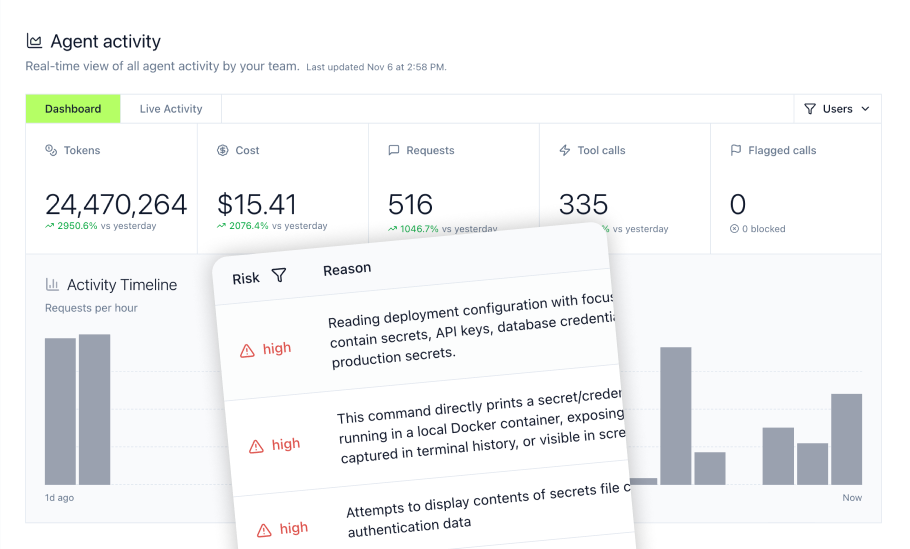
Notion's Model Context Protocol (MCP) server transforms static knowledge bases into active data sources that AI assistants can read from, write to, and act upon in real time. Unlike traditional integrations requiring manual copy-paste workflows, Notion MCP creates a bidirectional bridge where Claude, ChatGPT, Cursor, and other AI clients can search workspaces, create databases, and execute multi-step business workflows autonomously. However, this power introduces significant governance challenges that enterprise teams must address before deployment. Organizations connecting Notion to AI agents through an MCP Gateway can centralize authentication, apply access controls, and maintain audit trails across their entire AI tool ecosystem.
This article provides a complete guide to implementing Notion MCP for enterprise environments, covering setup procedures, capability boundaries, security considerations, and governance frameworks that ensure compliance without blocking productivity.
Key Takeaways
- Basic Notion MCP connections use a short client configuration plus OAuth flow; enterprise governance setup time varies by organization, identity provider, and policy requirements
- Custom Agents have used Notion credits since May 4, 2026 at $10 per 1,000 monthly credits for Business and Enterprise workspaces; actual usage varies by task complexity and run frequency
- The hosted MCP server requires user-based OAuth for initial authorization and does not support bearer-token authentication
- Enterprise plan MCP governance allows admins to restrict which AI apps can connect to workspaces through approved-list enforcement
- September 2025 research demonstrated a prompt-injection data-exfiltration attack against Notion 3.0's built-in Agent, not the Notion MCP server itself; it remains relevant as an adjacent example of the risks created when agents combine private data, untrusted content, and external communication
- Notion supports HIPAA-compliant Enterprise workspaces when customers accept Notion's BAA and apply the required HIPAA configurations; Beta Services are excluded from the BAA
Understanding the Notion MCP Server
What the Notion MCP Server Does
The Notion MCP server functions as an official hosted endpoint that connects MCP-compatible AI clients directly to Notion workspaces. Rather than requiring developers to build custom integrations or manually transfer context between tools, the hosted server exposes an evolving tool set for:
- Search and retrieval - Query pages, databases, connected sources
- Content and files - Create and modify pages, handle attachments
- Databases and views - Create databases, query data sources, manage views
- Workspace operations - Comments, users, teams, meeting notes
The key distinction from traditional integrations is bidirectionality and real-time access. AI clients connected through MCP can reason over live workspace data and modify content directly, while the duration and autonomy of multi-step workflows depend on the AI client. This enables use cases like automated meeting note processing, cross-functional project coordination, and database creation from unstructured inputs.
The Enterprise Problem with Unmanaged MCP Connections
While Notion MCP unlocks productivity gains, unmanaged deployments create substantial governance gaps:
- Limited per-user MCP visibility - Enterprise admins can see approved and active AI apps and audit many external-AI events, but Notion says detailed visibility into which users are using each tool is not yet available
- User-scoped authentication - Direct Notion MCP connections use user OAuth; supported Enterprise-managed connections can centralize connection setup through the identity provider
- Limited protocol-level detail - Notion audit logs cover connection and workspace events but do not document a complete protocol-level record of every MCP tool request and response
- Broad user permission scope - Notion MCP operates with the authenticated user's existing Notion permissions, so least privilege depends on the user's underlying access and enterprise controls
- OAuth lifecycle requirements - MCP clients must store credentials securely and handle token refresh, with re-authorization required when an authorization grant is no longer valid
For teams managing AI governance across multiple clients like Claude, Cursor, and ChatGPT, these gaps multiply. A governed MCP gateway addresses this by centralizing authentication through SSO, applying role-based access controls, curating which tools each team can use, and maintaining comprehensive audit logs.
Setting Up the Notion MCP Server
Prerequisites and Account Requirements
Before connecting AI clients to Notion through MCP, verify these requirements:
- Notion account tier - Free accounts support basic connections; Business plans ($20/user/month) include AI features and Custom Agents; Enterprise plans add MCP governance controls
- MCP-compatible AI client - Claude Desktop or Code, Cursor, ChatGPT, VS Code with GitHub Copilot, or other clients supporting the MCP protocol
- Workspace permissions - Standard members can connect with Admin approval; Workspace Owners can create integrations and enable governance settings
Step-by-Step Connection Process
Step 1: Choose Your Server Type
Decide between the hosted MCP server or self-hosted deployment:
- Hosted MCP (recommended) - Notion-maintained server at
https://mcp.notion.com/mcpusing OAuth authentication, best for interactive use where a user is present - Self-hosted MCP - Uses integration tokens instead of user OAuth and can support headless automation. Notion says the open-source local server is no longer actively maintained and recommends the hosted server for most use cases
Step 2: Configure Your AI Client
Configuration varies by client:
For Claude Code:
claude mcp add --transport http notion https://mcp.notion.com/mcp
Then run /mcp to complete OAuth.
For Cursor: Navigate to Settings, then MCP, and add:
{
  "mcpServers": {
    "notion": {
      "url": "https://mcp.notion.com/mcp"
    }
  }
}
Restart Cursor after saving.
For ChatGPT: Go to Settings, then Connectors, then Add Connector. Enter https://mcp.notion.com/mcp as the URL.
Step 3: Complete OAuth Authorization
When prompted, sign in to your Notion account and authorize the target workspace. Notion MCP operates with the authenticated user's existing Notion permissions, so the AI client can reach the Notion content that user can already access. After authorization completes, the connection becomes active and Notion tools appear in your AI client's available tool list.
Step 4: Test the Connection
Verify the setup with a simple prompt:
"Search my Notion for project notes and summarize the top 3 priorities"
The AI should call the notion-search tool, retrieve relevant content, and provide a summary. If tools do not appear, check MCP client troubleshooting for common issues.
Common Setup Challenges and Solutions
Common Notion MCP setup issues include:
- OAuth stops working after a prior connection: Access tokens may expire, refresh may fail, or authorization may be revoked. Ensure the MCP client handles token refresh and reconnect only when re-authorization is required.
- "Page not found" or "Access denied" errors with the local server: Integration tokens only access pages explicitly shared with them. Open the page, click the three-dot menu, select Connections, and add your integration.
- Data-source queries are limited:
notion-query-data-sourceshas plan-dependent modes and quotas. Use the query mode available on your plan; Business and Enterprise with Notion AI receive broader SQL query access. - Hosted MCP cannot access expected content: The authenticated user may lack Notion access, or Enterprise MCP governance may block the client. Fix the user's Notion permissions or admin allowlist settings, then reconnect if needed.
Notion MCP Tool Capabilities
Available Tools and Functions
The hosted Notion MCP server exposes an evolving tool set, so fixed tool counts become stale quickly. Current categories include:
Search and Retrieval
notion-searchandnotion-ai-search- Search supported Notion content and connected sourcesnotion-fetch- Retrieve supported pages, databases, data sources, views, and related metadatanotion-get-usersandnotion-get-teams- Retrieve workspace users and teamspaces
Content and Files
notion-create-pagesandnotion-update-page- Create and modify pages- File and attachment tools - Handle supported upload, attachment, and download workflows
- Comment tools - Add and retrieve comments
Databases, Data Sources, and Views
notion-create-database- Create databasesnotion-update-data-source- Modify data-source schemas and propertiesnotion-query-data-sources- Read and query supported data sources with plan-dependent access- View tools - Create and modify supported database views
Notion also exposes additional tools for page operations, meeting notes, Skills, asynchronous tasks, and supported Custom Agent workflows.
Enterprise Governance for Notion MCP
The Governance Gap in Standard Deployments
Standard Notion MCP deployments create visibility and control gaps that compound as organizations scale AI usage. Without governance infrastructure, security teams lack the comprehensive protocol-level logging and unified policy layer needed to satisfy enterprise compliance requirements across multiple AI clients.
Enterprise Plan Governance Controls
Notion's Enterprise plan provides admin-level MCP governance through workspace settings.
Restricting AI App Connections
Workspace Owners can navigate to Settings, then Connections, then Permissions to set "Restrict AI apps members can connect" to "Only from approved list." This allows administrators to explicitly approve which AI applications (Claude, ChatGPT, Cursor) can connect while blocking all others.
Permission Scoping
Granular database permissions are available on Business and Enterprise plans and can limit access to database rows based on configured access rules. Combined with page-level sharing, this can support more granular access patterns for users and agents.
Audit Logging
Enterprise plans include audit logs tracking connection events, though complete protocol-level detail varies. For comprehensive audit trails that capture every MCP request, teams typically need an MCP gateway layer that logs at the protocol level.
Implementing Governed Access Through Virtual MCPs
For organizations requiring governance beyond Notion's built-in controls, Virtual MCPs provide a powerful abstraction. A Virtual MCP bundles approved connectors and curated tools behind one governed endpoint for a specific team, role, or use case.
How Virtual MCPs solve enterprise governance challenges:
- Single authentication - Users connect once through SSO rather than managing individual OAuth sessions per connector
- Tool curation - Administrators define which Notion tools each role can access, preventing over-permissioned agents
- Credential injection - The gateway handles credential management, eliminating scattered API keys on developer laptops
- Unified audit - Every tool call routes through the gateway with comprehensive logging for compliance reporting
- SCIM integration - Directory groups drive membership automatically, applying consistent access policies as employees change roles
A practical example: create separate VMCPs for "Notion Read-Only" and "Notion Read-Write" over the same underlying Notion connector. The marketing team connects to the read-only VMCP for research queries while the documentation team uses read-write for content updates. Both authenticate through SSO, see only relevant tools, and generate audit trails.
Security Considerations for Notion MCP
Known Vulnerabilities and Attack Vectors
Security research has documented specific risks with Notion MCP deployments:
Prompt Injection via Untrusted Content
September 2025 research demonstrated a prompt-injection data-exfiltration attack against Notion 3.0's built-in Agent, not the Notion MCP server itself. The incident is still relevant as an adjacent warning: agents that combine access to private workspace data, untrusted content, and external communication tools can be vulnerable to indirect prompt injection.
OAuth Session Risks
The hosted MCP server's OAuth-only design means session tokens persist on client devices. If a developer laptop is compromised, attackers could potentially access connected Notion workspaces through the established OAuth session.
Tool Description Poisoning
MCP servers expose tool descriptions that AI clients include in their context. Malicious or compromised servers could inject adversarial instructions through these descriptions, influencing agent behavior in ways users do not expect.
Security Best Practices
- Limit agent access to trusted content only - Treat all untrusted content as potentially dangerous. Configure agents to access only pages and databases created by known, trusted users
- Enable confirmation prompts for write operations - Where supported, configure your AI client to require human confirmation before executing non-read-only tools
- Implement runtime guardrails - Mint Guard provides managed detection policies for prompt injection, credentials, PII, and harmful content
- Monitor agent activity - Deploy agent monitoring that captures prompts, tool calls, and file access across AI clients
- Apply least-privilege sharing - Only share pages with integrations that agents genuinely need to access. Use page-level permissions rather than workspace-wide access
Compliance Considerations
Notion's compliance capabilities vary by requirement:
- SOC 2 Type II: Notion is in scope, providing third-party assurance over applicable security controls.
- GDPR: Notion supports GDPR compliance and makes data processing agreements available.
- HIPAA: Supported on Enterprise with a BAA and required configuration. PHI must remain within the scope and limitations of Notion's BAA, and Beta Services are excluded.
- Data residency: Enterprise customers have regional options in the U.S., EU, Japan, and Korea. Residency applies to specified Customer Data at rest, while some data and services remain outside the selected region.
Organizations in regulated industries should assess whether their specific Notion MCP workflows meet applicable compliance requirements. For HIPAA-covered entities, Notion supports HIPAA-compliant Enterprise workspaces under its BAA and required configuration, but teams should confirm that the specific features they use fall within the BAA's scope.
Business Use Cases and ROI
Use Case 1: Customer Feedback Compilation
Problem: Customer feedback can be scattered across Slack, email, support tickets, and meeting notes, creating manual aggregation work for product teams.
Implementation: Configure an agent to retrieve approved feedback sources, pull relevant Notion meeting notes, and create or update a Customer Insights database with categorized entries and trend analysis.
Outcome: Reduces repetitive aggregation work and creates a repeatable process for producing customer-insight summaries.
Use Case 2: Meeting Notes to Action Items
Problem: Action items and decisions can become difficult to track when they remain buried in meeting notes.
Implementation: Connect supported meeting and calendar data to an agent that extracts action items, creates task database entries with owners and deadlines, and drafts follow-up summaries.
Outcome: Creates a more consistent workflow for turning meeting notes into structured follow-up tasks.
Use Case 3: Automated Database Creation from Unstructured Data
Problem: Converting unstructured files such as lead CSVs into structured Notion databases can require repetitive manual work.
Implementation: An agent can transform approved input data into structured database entries, apply defined categorization or scoring logic, and generate a summary for review.
Outcome: Reduces repetitive data-entry work while keeping the workflow inside a reviewable process.
ROI Indicators
Organizations should measure governed Notion MCP deployments against their own baseline, including:
- Time savings - Hours spent on search, aggregation, and repetitive workspace updates
- Workflow quality - Action-item completion, documentation freshness, and exception rates
- Cost efficiency - Workspace subscription, Custom Agent credit usage, and governance overhead
- Operational throughput - Volume of approved tasks completed per workflow or agent
Cost and Pricing Considerations
Current Pricing Structure
Notion's MCP-relevant plan differences include:
- Free - $0: Includes basic Notion workspace access and limited AI trials. It does not include Enterprise MCP governance or Custom Agents.
- Plus - $10/user/month: Includes 30-day page history and limited AI trials. It does not include Enterprise MCP governance or Custom Agents.
- Business - $20/user/month: Includes Notion AI, Enterprise Search, SAML SSO, granular database permissions, and Custom Agents with Notion credits. It does not include SCIM, the Enterprise audit log, or Enterprise MCP governance.
- Enterprise - Custom pricing: Includes unlimited page history, SCIM, audit logs, advanced security controls, and MCP Governance.
Credit-Based Agent Pricing
Since May 4, 2026, Custom Agents have used Notion credits on Business and Enterprise plans. Monthly credits cost $10 per 1,000 credits and are shared across the workspace. Credit usage varies based on task complexity, the amount of content an agent reads, the number of steps it performs, and how often it runs.
Total Cost of Ownership Considerations
At the listed $20 per-user monthly Business rate, a 20-user deployment has a $400 monthly base subscription before Custom Agent credits. Actual credit spend, onboarding costs, and governance overhead vary by workload and organization.
Rather than assuming a break-even point, model total cost using observed credit usage, administration time, and measured workflow savings.
Agent Identity and Long-Running Automation
The OAuth Limitation for Autonomous Agents
The hosted Notion MCP server requires user-based OAuth for initial authorization and does not support bearer-token authentication. This can be a constraint for workflows that must be provisioned and run with no interactive user step. After authorization, compatible clients can maintain access through the OAuth token lifecycle, with re-authorization required when an authorization grant is no longer valid.
For fully unattended Notion access, Notion documents the local open-source MCP server with an integration token as an option, although it is no longer actively maintained. Teams can also use the direct Notion API. If a gateway is introduced, verify that its Notion authentication model supports the required unattended workflow rather than assuming user OAuth becomes headless automatically.
Implementing Agent Identities for Autonomous Workflows
For enterprises scaling autonomous agents, agent identities provide a governance model where each agent receives its own credential, scoped permissions, and audit trail separate from human users. This answers critical questions:
- Who is this agent? - Named, org-scoped identity distinct from the human who created it
- What can it access? - Purpose-built toolset through a scoped Virtual MCP
- How is it authenticated? - Bearer keys, M2M tokens, or workload identity federation
- What did it do? - Per-agent audit trail with every action attributed
When an autonomous agent needs Notion access, the admin completes OAuth "as the agent" through an act-as-agent flow. The agent then operates with its own credentials that can be rotated or revoked independently from any individual employee's access.
Coworker Agents for Persistent Notion Workflows
Coworker Agents extend beyond one-time tasks to persistent autonomous work that continues across days. These long-running agents can:
- Operate through Slack, responding to mentions in channels
- Run on schedules for regular reporting or data synchronization
- Maintain company-owned memory that persists between sessions
- Use scoped Notion tool access through Virtual MCPs
- Execute in sandboxed environments with governed credentials
For teams that want AI agents handling ongoing Notion workflows (daily standup summaries, weekly metric reports, continuous documentation updates), coworker agents provide the persistence and governance infrastructure that one-off MCP connections lack.
Monitoring and Visibility for Notion MCP
What Security Teams Need to See
Effective AI governance requires visibility beyond basic connection logs. For Notion MCP deployments, security teams need:
- Tool call logs - Which tools did the agent call, with what arguments, and what results did it receive?
- Content access patterns - Which pages and databases does each agent access, and how frequently?
- Prompt visibility - What instructions are users giving to agents that access company workspaces?
- Cost attribution - How much is each team, project, or user spending on AI agent operations?
- Anomaly detection - Are any agents exhibiting unusual patterns suggesting compromise or misuse?
Agent Monitor for Cross-Platform Visibility
Agent Monitor provides organizational visibility into supported AI agent activity beyond gateway traffic. Depending on the supported client, agent, and hook phase, visibility can include:
- Prompt submissions
- File access including sensitive files like
.envand SSH keys - Commands executed by supported coding agents
- MCP tool calls from supported environments
- Usage and token cost by model, user, and session
This can include supported agents using Notion MCP even when their activity does not route through MintMCP's MCP Gateway. Coverage varies by client and instrumentation, so it should not be described as universal visibility into every agent action.
SIEM Integration for Compliance Reporting
For organizations with existing security infrastructure, SIEM export sends tool calls, prompt submissions, gateway requests, and access policy changes to systems like Splunk or through OTLP. This integration enables:
- Correlation of AI agent activity with other security events
- Automated alerting on policy violations
- Compliance reporting for SOC 2 and internal audits
- Historical analysis of agent behavior patterns
MintMCP: Enterprise-Grade Governance for Notion MCP
Organizations scaling Notion MCP beyond pilot deployments face a fundamental choice: accept the limitations of unmanaged direct connections, or implement comprehensive governance infrastructure that maintains security, visibility, and control as AI usage grows.
MintMCP provides the governance layer enterprises need to deploy Notion MCP at scale. The platform addresses each of the critical gaps in standard deployments through MCP Gateway infrastructure, Virtual MCPs for role-based access, agent identities for autonomous workflows, and comprehensive security controls.
Centralized Authentication and Access Control
Rather than scattered OAuth sessions across every employee laptop, MintMCP centralizes authentication through SSO and allows administrators to configure which teams can access which Notion tools. Virtual MCPs enforce least-privilege access by bundling only approved connectors and curated tools behind governed endpoints, while SCIM integration automatically applies consistent access policies as employees change roles.
Complete Visibility and Audit Trails
MintMCP captures protocol-level logs for every MCP request and response, documenting which users and agents accessed which Notion content and what actions they performed. This visibility extends through Agent Monitor to supported activity across AI clients, while SIEM export enables correlation with existing security infrastructure for comprehensive compliance reporting.
Runtime Security Without Blocking Productivity
Mint Guard applies managed detection policies for prompt injection, credentials, PII, and harmful content, and can automatically block high-confidence threats when configured in Enforcing mode. Combined with tool curation that maintains explicit allowlists regardless of upstream changes, organizations gain protection against evolving risks without requiring manual approval for every agent task.
Support for Autonomous and Long-Running Workflows
While direct Notion MCP connections require user OAuth, MintMCP's Coworker Agents provide persistent autonomous work that continues across days through Slack integration, scheduled runs, and company-owned memory. These agents operate with their own credentials through scoped Virtual MCPs in sandboxed environments, maintaining the governance and audit requirements enterprises need for unattended automation.
Organizations deploying Notion MCP through MintMCP gain the productivity benefits of AI-augmented knowledge management while maintaining the security posture, compliance documentation, and operational control that enterprise environments require.
Frequently Asked Questions
Can I use Notion MCP for workspaces containing sensitive customer data?
Notion MCP access follows your existing Notion permission model. However, AI agents introduce additional risk vectors including prompt injection and unintended data exposure. For sensitive data, implement multiple controls: restrict agent access to specific pages rather than entire workspaces, enable confirmation prompts for all write operations, deploy runtime guardrails that screen for PII before transmission, and monitor agent activity for anomalous access patterns. Organizations subject to HIPAA should note that Notion supports HIPAA-compliant Enterprise workspaces when customers accept Notion's BAA and apply the required HIPAA configurations; Beta Services are excluded from the BAA.
How do I handle Notion MCP connections when employees leave the organization?
Standard Notion MCP connections authenticate through individual OAuth sessions tied to user accounts. When employees depart, their OAuth sessions should be revoked along with their Notion access. However, this distributed model creates risk if offboarding is delayed or incomplete. Organizations using an MCP gateway with SCIM integration can suspend access automatically when the employee is disabled in the identity provider, ensuring immediate revocation without manual intervention across each connected service.
What happens when Notion adds new tools to the MCP server?
MCP servers can add, modify, or remove tools through the list_tools endpoint without notification. When Notion updates its hosted server with new capabilities, connected AI clients automatically see and can use those tools. This creates governance concerns: an agent might gain write capabilities it did not have when initially approved. Organizations can address this through tool-update policies that require administrator approval before new tools become available, or through tool curation that maintains explicit allowlists regardless of upstream changes.
Can multiple AI clients share the same Notion MCP connection?
Each AI client establishes its own OAuth session with Notion. There is no native mechanism to share a single authenticated connection across Claude, Cursor, and ChatGPT. This creates credential sprawl as each client maintains separate tokens. An MCP gateway can consolidate the client-facing endpoint and centralize authentication policy, credential handling, tool curation, and audit. The downstream Notion credential model may still be per-user, shared, or agent-specific depending on the connector and governance design.
How do I migrate from Notion MCP to a governed gateway deployment?
Migration follows a phased approach. First, deploy the gateway infrastructure and configure the approved Notion MCP connection using the supported connector type and authentication model for your deployment. Second, create Virtual MCPs with the required tool access, such as separate read-only and read-write endpoints where appropriate. Third, update AI client configurations to point to the governed gateway endpoints rather than directly to Notion. Finally, retire direct connections only after confirming that the required users and workflows have migrated successfully.