Hermes Agent represents a fundamental shift in how AI assistants work: instead of starting fresh with each conversation, it creates reusable skills from successful tasks, remembers context across weeks or months, and runs on infrastructure you control. Released by Nous Research in February 2026, Hermes operates as a persistent autonomous agent that connects to five supported chat platforms, plus its CLI interface, works with multiple cloud and local model providers, and compounds in capability over time. Yet production deployments require careful configuration of security controls, network exposure, and governance policies. MintMCP's Agent Gateway provides the control layer for agent identities, permissions, memory, and monitoring around self-improving agent frameworks, built on its MCP Gateway foundation for governed data and tool connections.
This article explains what Hermes Agent is, how teams deploy it for security operations, compliance automation, and developer productivity, and how governance platforms like MintMCP can support enterprise adoption.
Key Takeaways
- Hermes Agent's self-improving learning loop creates reusable skills from completed tasks, allowing it to reuse and refine successful procedures across later sessions instead of starting every task from scratch
- GitHub represented more than 81% of third-party application session hits in one Cato Networks telemetry dataset
- A basic DIY installation can take around 15 minutes, while production deployment, security hardening, integrations, and organizational approvals may take days or weeks depending on the environment
- Hermes is open-source, but total cost depends on hosting, model usage, integrations, security controls, monitoring, and internal implementation time
- Security operations teams can use Hermes to summarize alerts, enrich incidents, and automate repetitive investigation steps
- Compliance teams can use scheduled workflows and evidence-generation tools to reduce repetitive documentation work
- Development teams can use automated summaries, issue labeling, and reviewer suggestions to reduce repetitive pull-request administration
- Hermes includes pairing, allowlist, and API authentication controls, but teams still need to review network exposure, command approvals, credentials, and tool permissions before production deployment
- Public vulnerability counts are not directly comparable across newer agent frameworks
Hermes AI Explained: The Self-Improving Agent Framework Teams Run on Their Own Infrastructure
Hermes Agent operates as a self-hosted AI assistant that improves through a "closed learning loop." When it completes a complex multi-step task (research, summarize, save to file), it automatically creates a reusable "skill" document. The next time a similar task appears, the agent loads that skill instead of reasoning from scratch.
Key capabilities include:
- Persistent memory across sessions through MEMORY.md for facts and USER.md for preferences
- Full-text search of conversation history via SQLite
- Messaging platform integration so you can interact from Slack, Discord, Telegram, and other channels
- Multi-model support through native and OpenAI-compatible interfaces
Defining the Model Context Protocol (MCP)
The Model Context Protocol standardizes how AI agents access data sources and tools. Instead of building custom integrations for every combination of agent and data system, MCP provides a common interface that works across Claude, ChatGPT, Gemini, Cursor, and other platforms. Hermes Agent uses native MCP support to connect to GitHub, databases, Slack, and hundreds of other services through standardized servers. MintMCP's MCP Gateway adds enterprise authentication, access controls, and audit logging to these connections, transforming MCP from a developer protocol into a governed enterprise integration layer.
Why Enterprise AI Needs Specialized Governance
Hermes supports pairing and allowlists for messaging platforms, while its API server can require an authentication key. Production deployments still require careful configuration of network binding, command approvals, tool access, and credential storage. Self-improving agents that create their own skills and retain memory require governance approaches that traditional prompt-and-response AI security does not address.
Organizations need to control which tools agents can access, audit what skills agents create, track memory across sessions, and prevent credential leakage through LLM-generated code. MintMCP's Agent Gateway provides the control layer for agent identities, permissions, memory, and monitoring. It adds SSO through enterprise identity providers, tool-level access controls, real-time detection of supported risky behaviors, and detailed MCP tool-call logging with user or agent attribution. Full Hermes conversation capture depends on how the agent is integrated and which activity is routed through MintMCP. This governance infrastructure helps teams adopt self-hosted agents like Hermes with appropriate enterprise controls.
How Hermes AI Streamlines Team Productivity
Hermes Agent delivers productivity gains across security operations, compliance documentation, and developer workflows by learning organizational patterns and automating repetitive tasks.
Automating Security Operations
Security operations centers deploy Hermes to monitor security feeds, analyze log anomalies, and flag genuine threats via Slack. The agent connects to SIEM APIs, applies threshold configurations, and creates skills from successful incident investigations. Teams can configure Hermes to enrich alerts and summarize security data, potentially reducing repetitive investigation work. Actual alert quality and response-time improvements depend on the organization's telemetry, detection rules, integrations, and human-review process.
Enhancing Developer Workflows
Development teams use Hermes for GitHub automation, where it auto-summarizes pull requests, identifies breaking changes, suggests reviewers based on code ownership, and labels issues. GitHub accounted for more than 81% of the third-party application session hits associated with Hermes activity in Cato Networks' observed telemetry, rather than 81% of all enterprise Hermes deployments. Automated summaries and reviewer suggestions can reduce pull-request administration, but merge-time and description-quality improvements depend on repository practices, review requirements, and team adoption.
Streamlining Compliance Processes
Compliance teams deploy Hermes with SSH backend access to track control implementation, monitor configuration drift, auto-generate evidence documents, and maintain compliance posture. The setup requires file access tools, scheduled daily audits, and Slack notifications. Hermes can help collect evidence, monitor selected configurations, and generate draft documentation. These workflows still require control-owner review because the agent cannot independently determine whether evidence satisfies an auditor or regulatory requirement.
MintMCP's Virtual Bundles enable teams to scope tool access per use case. A compliance agent Bundle provides read-only database access, file system access for evidence generation, and Slack integration, but blocks terminal access and external API calls. This least-privilege approach prevents agents from expanding beyond their intended scope while maintaining productivity gains.
Mitigating Risks with Advanced Governance
Hermes Agent's flexibility creates security challenges that require specialized governance controls. Organizations need to protect sensitive data, prevent credential leakage, detect unauthorized activities, and maintain audit readiness.
Protecting Sensitive Data with Inline DLP
Hermes processes prompts, tool calls, and responses that may contain PII, API keys, database credentials, or regulated data. Without inline data loss prevention, this information flows through LLM APIs, persists in SQLite conversation history, and appears in skills documents. MintMCP's Gateway Middleware runs in a JS sandbox with integrations to AWS Bedrock Guardrails, Google Cloud DLP, Microsoft Purview, Nightfall, and Skyflow. Pre-phase hooks scan prompts for sensitive patterns before they reach the agent. Post-phase hooks mask or redact PII in responses. Block actions prevent high-risk tool calls from executing.
Detecting and Preventing Shadow AI Activities
Organizations face "shadow AI" risk when developers run Hermes locally without governance controls, connecting to production databases and internal APIs outside IT visibility. Where supported hooks are installed, MintMCP's Agent Monitor captures local activity from supported clients such as Cursor and Claude Code, including commands, file operations, prompts, and MCP calls. Hermes activity must be routed through MintMCP or connected through compatible instrumentation to receive the same visibility. Its built-in rules can detect exposed secrets, prompt-injection patterns, risky commands, and unauthorized tool access. PII and DLP controls can be implemented separately through MintMCP's Gateway Middleware integrations.
Ensuring Audit and Compliance Readiness
Enterprises require conversation-level logging that captures prompts, tool calls, responses, and context with per-agent attribution. Hermes stores conversations in local SQLite databases without centralized audit infrastructure. MintMCP provides detailed MCP tool-call audit logs with user or agent attribution and tamper-evident, append-only history. Full Hermes conversation capture depends on how the agent is integrated and which traffic is routed through MintMCP. Each agent receives its own persistent identity with scoped credentials that rotate independently, enabling attribution of every action to a specific agent rather than shared service accounts.
Exploring the AI Platform Ecosystem
Hermes Agent's model-agnostic architecture reduces reliance on a single provider by supporting several cloud model services, OpenAI-compatible endpoints, and local models. This flexibility enables teams to optimize cost and performance by selecting models based on task complexity.
The Growing AI Agent Landscape
Organizations deploy multiple AI tools simultaneously: Claude for document analysis, Cursor for code generation, ChatGPT for brainstorming, Gemini for research, and GitHub Copilot for inline suggestions. Each platform maintains separate authentication, data connections, and usage tracking. Hermes Agent runs alongside these tools, providing a unified interface for scheduled automation, multi-step workflows, and persistent memory that complements session-based chat interfaces.
The Role of MCP in Interoperability
The Model Context Protocol emerged as the standard for AI agent tool access, with all major foundation model providers (OpenAI, Anthropic, Google, Microsoft) offering native support. MCP reached 97 million monthly SDK downloads and transitioned to Linux Foundation's Agentic AI Foundation governance in December 2025. Hermes Agent's native MCP support enables it to use the same connectors that work with Claude, ChatGPT, and other platforms. Organizations can reuse many MCP integrations across compatible agent systems, subject to each client's transport, authentication, and implementation support.
Hermes AI as Connective Tissue
MintMCP's Gateway provides centralized governance for Claude, Cursor, ChatGPT, and Gemini, with Hermes Agent as another governed endpoint:
- Single authentication layer through Okta, Azure AD, or Google Workspace
- Unified audit stream across all platforms
- Consistent policy enforcement regardless of which tool teams use
When a developer uses Cursor for code generation, ChatGPT for documentation, and Hermes for GitHub automation, MintMCP can bring activity into one governance interface when tool traffic is routed through its Gateway or covered by supported Agent Monitor hooks. This vendor-neutral approach prevents data governance fragmentation as organizations adopt multiple AI tools.
Custom Control: Tailoring Access and Policies
Hermes Agent requires granular access control at the tool level, credential scope per agent, and policy enforcement that adapts to organizational workflows. MintMCP's Bundle architecture packages these governance elements into deployable units.
Simplifying Governance with the Bundle Model
A Virtual Bundle represents one endpoint per role or use case:
- SCIM-driven group membership for automatic provisioning
- Curated tool list scoped to specific workflows
- Per-Bundle access policy for fine-grained control
A security operations Bundle includes web search, log analysis tools, and Slack integration but blocks database writes and terminal access. A compliance Bundle provides read-only database access, file system access for evidence generation, and scheduled execution but prevents external API calls.
Ensuring Granular Access Control for Agents
Agent Bundles extend this model to non-human principals. Each deployed Hermes agent receives its own persistent identity with bearer API keys and OAuth 2.0 client credentials for M2M authentication. Credentials rotate independently of human users, and admin flows support "act as agent" OAuth for connectors that require per-agent authorization. An agent's permissions are explicitly scoped through its assigned Bundle, never inheriting broad service account keys that grant access beyond its intended function.
Automating Policy Enforcement
MintMCP's Gateway Middleware enables custom policy code in a JS sandbox with allowed-domains fetch, secret injection, and AWS SigV4 signing helpers. Organizations write rules that examine every tool call:
- Block Hermes from writing to production databases during business hours
- Require approval for terminal commands that modify system files
- Mask SSNs in responses before they reach the agent
- Rate-limit expensive API calls
Policies cascade from organization level to team level to individual Bundles, providing consistent enforcement with role-specific overrides.
Building and Monitoring Internal AI Tools
Platform engineering teams value Hermes Agent for its ability to host custom MCP servers, integrate with existing engineering workflows, and automate deployment through infrastructure-as-code.
From Local to Production: Hosting Custom MCP Servers
Hermes supports STDIO server transport, enabling teams to run locally developed MCP servers as subprocess-based tools. MintMCP's Gateway automatically converts STDIO servers to production-ready hosted services with OAuth wrapping, eliminating the need for code changes. Custom connectors deploy via Admin MCP or the @mintmcp/hosted-cli command-line tool. MintMCP reduces connector-runtime work by operating hosted connectors with isolated execution and managed scaling. Teams remain responsible for the Hermes runtime, model provider, messaging integrations, and local execution environment unless those services are covered by a separate deployment arrangement.
Integrating Hermes AI into Workflows
Hermes Agent exposes an OpenAI-compatible API for programmatic access, enabling integration with CI/CD pipelines, infrastructure-as-code repositories, and business automation platforms. Teams trigger agent workflows from GitHub Actions, schedule recurring tasks through cron expressions in natural language, and chain multi-step processes that span code deployment, database migrations, and documentation updates. MintMCP's managed connector catalog connects the governance layer to common business systems, while custom connectors can cover internal applications and specialized workflows.
Automating Deployment and Management
Organizations operating Hermes at scale require consistent deployment configurations, version management, and monitoring across multiple instances. MintMCP's configuration-as-code support uses Terraform to manage organization-wide Global Rules. Teams can store .tf files in version control and use standard terraform plan and terraform apply workflows for review, deployment, and drift detection. The Admin MCP interface provides conversational platform management directly from any MCP client, enabling teams to manage rules, deploy connectors, pull logs, and restart services through natural language commands with full audit trails.
Achieving Enterprise Compliance
Organizations in regulated industries require security certifications, data residency controls, and audit-ready documentation for AI agent deployments.
Meeting Regulatory Demands with Certified Controls
MintMCP is SOC 2 Type II audited with continuous compliance monitoring via Drata. Enterprise SSO, complete audit trails, PII detection, and role-based access control are built into every layer of the platform. Customers handling protected health information can request HIPAA documentation, and MintMCP is compliant with HIPAA standards and signs BAAs. The platform undergoes penetration testing and encrypts data in transit and at rest. Organizations with regional residency requirements should confirm deployment and contractual requirements directly with MintMCP during procurement. These controls apply equally to human users and agent identities, ensuring that self-improving agents like Hermes operate within the same security framework as traditional applications.
Secure Data Handling
Hermes Agent stores conversation history locally in SQLite and reusable skills as Markdown files. Self-hosting keeps this local state on the organization's infrastructure, but data may still be processed by configured model providers, messaging platforms, MCP servers, and other external services. Traffic between agents, the Gateway, and connected services is encrypted in transit. Credentials for connected services (GitHub tokens, database passwords, API keys) are stored in encrypted secret providers with access logging and rotation enforcement. The platform supports AWS Secrets Manager as an external secret provider for customers that want credentials stored in their own cloud account, with GCP Secret Manager available by request.
Audit-Ready Logging
Compliance investigations require detailed records of agent behavior with sufficient detail to reconstruct decision chains. MintMCP provides detailed MCP tool-call audit logs with user or agent attribution and tamper-evident, append-only history. Logs can be exported through OTLP-compatible endpoints or Splunk HEC for integration with existing observability and security workflows. Agent Monitor extends this visibility by capturing supported local-agent activity when the required hooks and organizational deployment controls are installed.
Real-time Visibility: Monitoring Performance
Organizations operating self-improving agents need continuous monitoring of adoption patterns, performance bottlenecks, and operational health.
Gaining Insights into Activity
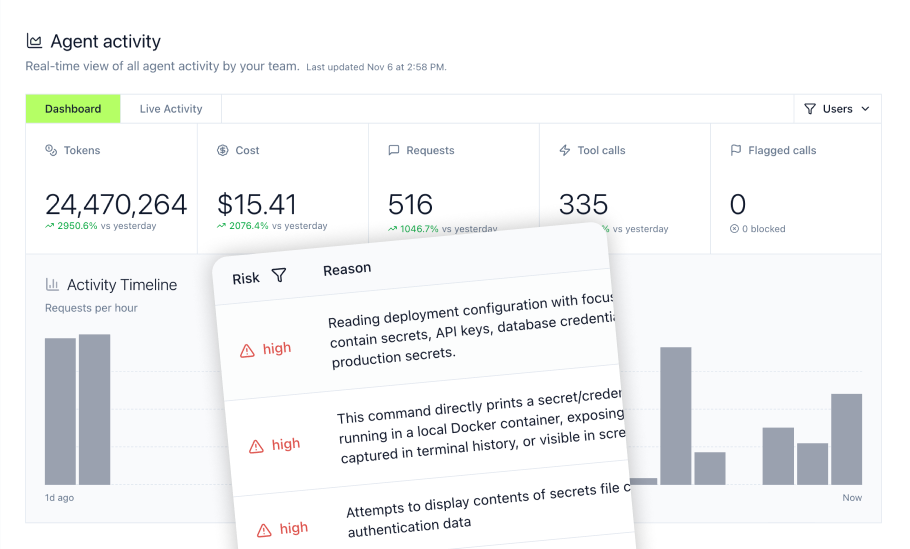
MintMCP's Agent Monitor provides real-time dashboards showing MCP adoption across the organization, usage patterns by team and tool, error rates, and latency distributions. Administrators see which Bundles generate the most traffic, which connectors fail most frequently, and which users or agents consume the most LLM tokens. This visibility supports capacity planning, cost allocation, and security investigation.
Optimizing Performance
Hermes Agent's performance depends on LLM selection, tool call efficiency, and network latency to connected services. Organizations monitor conversation turn time, tool execution duration, and token consumption to identify optimization opportunities. DeepSeek V4 Flash is listed at $0.14 per million cache-miss input tokens and $0.28 per million output tokens, but actual savings depend on output volume, caching, model quality requirements, and the model being replaced. MintMCP's Gateway tracks these metrics per Bundle and per agent, enabling data-driven decisions about model selection, caching strategies, and tool optimization.
Integrating with Security Tools
Security operations centers correlate AI agent activity with other security events through SIEM integrations. When MintMCP detects a credential leakage event, it sends events through configured OTLP-compatible or Splunk HEC pipelines with context about the affected agent, user, and data source. Security teams create rules that cross-reference agent behavior with identity provider logs, network traffic analysis, and endpoint detection systems.
Why MintMCP's Agent Gateway Matters for Hermes Deployments
Organizations adopting Hermes Agent today position themselves for a future where autonomous agents handle increasingly complex workflows. The skills library that Hermes builds becomes organizational knowledge that transfers across teams and persists beyond individual employees. Security operations skills, compliance procedures, development workflows, and customer support protocols accumulate in documented form, creating institutional memory that survives personnel changes.
MintMCP's Agent Gateway provides the governance infrastructure that ensures this accumulated capability remains under organizational control. Built on MintMCP's MCP Gateway foundation for governed data and tool connections, the Agent Gateway adds four essential layers:
Identities: Each Hermes agent receives its own persistent identity with scoped credentials that rotate independently. This enables attribution of every action to a specific agent rather than shared service accounts, creating audit trails that distinguish which agent performed which action.
Permissions: Agent Bundles scope each agent to an assigned Virtual MCP, curated tool set, rules, and middleware. SCIM-driven group membership applies to human users and directory groups rather than agent identities. A security operations agent can access log analysis and Slack but not production databases. A compliance agent can read configurations and generate evidence but cannot execute terminal commands. This least-privilege approach prevents agents from expanding beyond their intended scope.
Memory: As agents accumulate skills and organizational knowledge, that memory becomes company-owned, reviewable, and auditable. Organizations can version-control skills, transfer agent knowledge between teams, and maintain institutional memory through documented procedures rather than opaque vendor-controlled stores.
Monitoring: Real-time dashboards show MCP adoption across the organization, usage patterns by team and tool, error rates, and latency distributions. Built-in rules detect exposed secrets, prompt-injection patterns, risky commands, and unauthorized tool access. When an agent exhibits anomalous behavior, security teams have the context to investigate.
This governance infrastructure makes self-hosted agents like Hermes viable for enterprises that require appropriate access restrictions, audit trails, and policy enforcement as agents become more capable and more autonomous. As coworker agents become long-running team members that hold memory, continue work across days, and operate alongside employees, the governance layer that manages their identities, permissions, and behavior becomes as critical as the agent framework itself.
Frequently Asked Questions
What hardware and infrastructure does Hermes Agent require for enterprise deployment?
Hermes Agent requires minimal resources for the agent process itself (512 MB RAM minimum), but infrastructure needs scale with use case complexity. Basic deployments run on low-cost VPS hosting with 2 GB RAM. Enterprise deployments supporting multiple agents, persistent gateways for supported messaging platforms, and isolated code execution require infrastructure sized to their expected workloads. Organizations using local LLMs through Ollama instead of cloud APIs require GPU infrastructure for acceptable response times.
How does Hermes Agent's skills library work and who owns the intellectual property in generated skills?
Hermes Agent creates skills documents automatically when it completes multi-step tasks successfully. These Markdown-based skill files document procedures, instructions, tools, and reusable context for later tasks. Skills improve during subsequent use as the agent refines procedures based on outcomes. Skills are stored locally, making them easier to inspect, back up, transfer, and version-control. Organizations should define ownership and licensing through their contracts, employment policies, and applicable law. This can offer greater portability and reviewability than systems that keep procedural memory inside an opaque hosted service.
Can Hermes Agent integrate with enterprise identity providers for single sign-on and multi-factor authentication?
Hermes provides gateway pairing, allowlists, and optional API-key authentication, but it does not natively provide enterprise SSO, SCIM provisioning, or centralized identity governance. Organizations deploy Hermes behind reverse proxies that enforce authentication, implement allowlists restricting which users can invoke specific agents, or use third-party authentication middleware. MintMCP solves this gap by providing SSO integration with Okta, Azure AD, and Google Workspace at the Gateway layer. Every agent connection requires authenticated user context, SCIM synchronization automatically maps users to appropriate Bundles based on identity provider groups, and MFA enforcement follows organizational policies.
What happens to Hermes Agent's persistent memory and skills when the organization needs to terminate an agent or transfer it to a new team?
Hermes stores core local state, including memory files, conversation history, and skills, under its local Hermes data directory. Organizations should also inventory backups, external memory providers, messaging platforms, model-provider records, secrets, and connected systems before transferring or terminating an agent. MintMCP's Agent Bundles add governance to this lifecycle: agent identities can be archived (maintaining audit history while preventing new actions), credentials rotate independently when agents transfer between teams. Agent Bundles can scope tools, rotate or revoke credentials, and archive an agent identity. Hermes' local memory, conversation history, and skills still require a separate retention, deletion, and transfer process.
How does Hermes Agent compare to cloud-based enterprise AI platforms in total cost of ownership?
Hermes avoids a required software license fee, but its total cost includes hosting, model usage, implementation, security controls, monitoring, maintenance, and staff time. Cloud and managed-agent platforms use different per-seat, usage-based, and enterprise pricing models, so teams should compare costs using their expected workload and operational requirements. Self-hosted deployments shift infrastructure burden, security responsibility, and maintenance overhead to internal teams. Organizations should account for ongoing updates, dependency management, security review, monitoring, backups, incident response, and integration maintenance. MintMCP's governance layer adds cost but provides enterprise controls around identities, permissions, memory, and monitoring that help make self-hosted agents viable for organizations that require appropriate governance infrastructure.