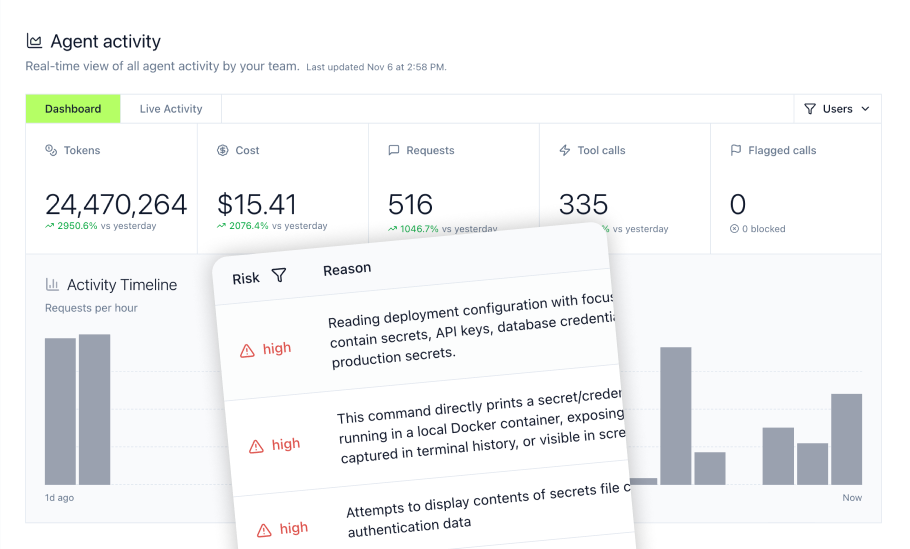
Claude Code usage depends on how users authenticate. Pro, Max, Team, and seat-based Enterprise plans generally use five-hour session and weekly limits, while usage-based Enterprise and API-key access are billed by consumption rather than stopped by the same fixed caps. For individual developers, subscription limits mean occasional lockouts mid-task. For enterprises with 20, 50, or 500 developers, these limits become an Anthropic usage-management challenge, while MCP access creates a separate need for centralized identity, tool permissions, policy enforcement, and audit logging. Organizations deploying AI coding assistants at scale need authentication, tool-level access control, and audit logging for MCP-connected actions, with Agent Monitor extending visibility to selected local Claude Code and Cursor activity.
This guide breaks down Claude Code's limit mechanics, pricing tiers, and enterprise management strategies so your team can maximize productivity without unexpected disruptions.
Key Takeaways
- Claude Code subscription usage generally includes five-hour session and weekly limits, but users can continue with usage credits where enabled, while usage-based Enterprise and API access are billed by consumption
- Pro plan capacity varies based on model selection, context size, effort level, files, and tool activity; Anthropic does not publish a guaranteed prompt count
- Model selection is your biggest cost lever: Opus generally consumes meaningfully more quota than Sonnet, although the exact difference varies by model version, workload, and current pricing
- Context compounding burns limits faster than message count; a short Claude Code session can still consume substantial usage because every turn may include conversation history, project instructions, referenced files, and tool outputs
- Enterprise governance becomes increasingly important at team scale: Anthropic Team and Enterprise provide native billing, identity, and usage controls, while an MCP governance layer can add tool-level permissions, per-agent identity, and cross-platform visibility
- Team Premium provides five times the usage of a Standard seat, while Team-level features include centralized billing, SSO, administration, and connector controls
- Paid plans can enable additional usage credits; after included limits are reached, eligible users can continue at standard API rates or wait for the regular reset
Understanding Claude AI: A Primer on Usage and Access
Claude AI from Anthropic operates across multiple access points: Claude.ai for web chat, Claude Code for development workflows, and the Anthropic API for programmatic access. Each access method shares the same underlying models (Haiku, Sonnet, Opus) but applies different billing and limit structures.
Getting Started: Claude AI Free Tier and Login
The free tier provides access to Claude.ai chat with usage caps, but excludes Claude Code entirely. To use Claude Code, you need at minimum a Pro subscription at $20/month (or $17/month with annual billing). Authentication happens through claude.ai credentials or, for API users, through Anthropic Console API keys.
Beyond Free Access: When to Upgrade
Track your usage for one week before committing to a plan. Compare your actual API token spend with the subscription tier you are evaluating. Pro costs $20 monthly or $17 with annual billing, while Max starts at $100 monthly, so there is no universal daily break-even point. If you need predictable monthly costs, upgrade to Max or Team plans.
Claude Code: Your AI Coding Assistant for Enhanced Development
Claude Code differs from code completion tools like GitHub Copilot. Rather than suggesting the next line, Claude Code handles entire development tasks autonomously: refactoring modules, writing tests, debugging across multiple files, and executing code in your terminal or IDE.
How Claude Code Enhances Your Workflow
Key capabilities include:
- Autonomous multi-file editing with approval gates before changes apply
- Tool calling for file operations, search, execution, and web lookup
- Context windows up to 1M tokens for large codebase understanding
- Prompt caching providing 90% discount on repeated context like system prompts and project files
Integrating Claude Code with Developer Environments
Installation options include Anthropic's native installer, Homebrew, WinGet, supported Linux package managers, the VS Code extension, or JetBrains plugins. Run claude auth login to authenticate, then open Settings → Usage on claude.ai to view your current five-hour session and weekly limits. The /model command shows available models based on your subscription tier.
For teams using Claude Code alongside other AI tools, Agent Monitor provides real-time visibility into agent activity across Claude, Cursor, ChatGPT, Gemini, and Copilot, including detection of off-gateway MCP usage in developer tools.
Claude AI Pricing and Plans: Navigating Costs and Subscriptions
Claude's pricing structure spans individual subscriptions, team plans, and enterprise contracts. Understanding the tiers helps you avoid overpaying for capacity you won't use or hitting limits that block critical work.
Breaking Down Claude AI Pricing Tiers
| Tier | Monthly Price | Claude Code Access | Usage Structure |
|---|---|---|---|
| Free | $0 | No | N/A |
| Pro | $17 annually or $20 monthly | Yes | Included usage with five-hour and weekly limits; optional usage credits |
| Max 5x | $100 | Yes | Five times the usage of Pro; optional usage credits |
| Max 20x | $200 | Yes | Twenty times the usage of Pro; optional usage credits |
| Team Standard | $20 annually or $25 monthly per seat | Yes | More included usage than Pro; organization-managed usage credits available |
| Team Premium | $100 annually or $125 monthly per seat | Yes | Five times the usage of a Standard seat; organization-managed usage credits available |
| Enterprise | $20 per seat plus usage at API rates | Yes | Usage-based billing; some seat-based arrangements may use included limits and usage credits |
Optimizing Your Claude AI Subscription
Start with Pro unless you hit limits more than three days per week. Track actual token consumption, not message count, since context compounding means one complex task can consume a significant portion of your five-hour session limit when it includes large files, long context, extensive tool output, or a higher-cost model.
Claude Code Limits: Understanding and Overcoming Usage Restrictions
The limit system creates two independent constraints for subscription users. Understanding how each works prevents unexpected lockouts.
The Rolling 5-Hour Session Window
This quota resets 5 hours after your first prompt in a session. Every prompt, file upload, tool call, and code execution counts against it. If you start at 2 PM, your next full window opens at 7 PM, not midnight. Pro users' capacity varies dramatically based on context size and model choice.
The Weekly Capacity Cap
Weekly limits measure usage across Claude and Claude Code and vary by plan, model, and workload. Users can view their current consumption and reset times under Settings → Usage on claude.ai.
What Actually Burns Your Limits
Token cost, not message count, determines consumption:
- Short prompts generally consume less usage than long prompts or file-heavy requests
- Conversation history is resent on each turn and grows throughout the session
- Referenced files, project instructions, and tool outputs add to the active context
- Multi-file tasks can consume substantial usage when Claude reads many files or produces extensive diffs
- Opus requests generally consume more quota than equivalent Sonnet requests, with the exact difference depending on the current models and workload
Claude Code sessions compound context faster than chat because each turn includes your prompt, full conversation history, contents of all referenced files, tool call outputs, and system prompt instructions.
Strategies for Managing Limits
- Start fresh sessions per discrete task to avoid context bloat
- Default to Sonnet and reserve Opus for complex reasoning
- Use prompt caching (writes cost 1.25× but reads are 90% cheaper)
- Install monitoring tools for real-time visibility
- Check
/usagehourly during heavy development sessions
For enterprises, MintMCP's MCP Gateway governs MCP-connected tools through authentication, tool-level permissions, policy enforcement, and audit logging. Claude Code plan limits, usage credits, and token spend remain managed through Anthropic.
Claude AI vs. ChatGPT: Choosing the Right AI for Your Needs
Both platforms serve AI coding use cases, but architectural differences affect enterprise deployment decisions.
Key Differences Compared
Claude's context window extends to 1M tokens for large codebase understanding. Claude Code and OpenAI's Codex can both execute multi-step coding tasks. Their practical differences include model behavior, deployment surfaces, integrations, administration, and governance options.
Deciding for Your Project
Choose Claude Code when you need autonomous multi-file operations, large context handling, or deep integration with VS Code and JetBrains. Consider ChatGPT and Codex when your workflows align with OpenAI's coding, app, and workspace ecosystem.
For organizations running both, a centralized governance layer provides consistent policy enforcement regardless of which AI tool developers use. MintMCP covers Claude, Cursor, ChatGPT, Gemini, and Copilot through unified authentication, access control, and audit logging.
Enterprise AI Platforms: Governing Claude Code at Scale
Individual Claude Code subscriptions create management challenges when deployed across engineering teams. Without centralized management, organizations face:
- Limited visibility into who's using Claude and how much
- Fragmented spend when developers hit API overages simultaneously
- Credential sprawl across personal accounts touching company code
- Shadow AI risk when developers use personal Claude accounts for work
The Challenge of Distributed AI at Scale
A 20-developer team on individual Pro accounts costs $400/month with limited central oversight. When developers hit included limits, they can wait for a reset, use organization-approved usage credits, or move to an approved consumption-based arrangement. Personal API keys remain a governance risk when used outside company policy.
Why Governance Matters Beyond Cost
Cost consolidation alone justifies centralized management, but security and compliance requirements make governance important. Teams handling regulated data need:
- Audit trails for every AI interaction
- Policy enforcement preventing sensitive data in prompts
- Identity management tied to corporate SSO/SCIM
- Spend caps by team, project, or individual
MintMCP's security governance capabilities address these requirements through tool-level access control, MCP request and tool-call logging, and integration with existing identity providers.
Securing Claude Code in the Enterprise: Data Privacy and Compliance
Claude Code's autonomous file access and code execution capabilities create security considerations beyond standard chat interfaces.
Mitigating Risks with Claude Code
Key security concerns include:
- PII exposure when Claude reads files containing customer data
- Credential leakage through API keys or tokens in prompts
- Risky command execution in bash or terminal operations
- Prompt injection from malicious content in codebases
Detecting and Preventing Shadow AI Usage
Shadow AI occurs when developers use personal Claude accounts for work, bypassing corporate security controls. Detection requires monitoring at the endpoint level, not just the gateway.
MintMCP's Agent Monitor extends visibility beyond gateway traffic by monitoring local Claude Code and Cursor activity through hooks, including Bash commands, file reads and writes, and prompt submissions.
Ensuring Compliance in AI-Powered Workflows
For organizations in regulated industries, Claude Enterprise offers a HIPAA-ready option and includes audit logs, a Compliance API, custom data retention controls, network-level access controls, and IP allowlisting. Organizations should confirm BAA terms and any specific data residency requirements directly with Anthropic. However, subscription-level compliance doesn't eliminate the need for governance infrastructure that enforces policies, maintains audit trails, and integrates with existing security tooling.
Managing AI Agent Access and Authentication
Enterprise Claude Code deployments require identity management that scales beyond individual user accounts.
Centralizing Identity for AI Agents
Team supports SSO and centralized administration, while Enterprise adds SCIM provisioning, fine-grained RBAC, audit logs, network controls, and custom data retention. This enables:
- Automated user provisioning and deprovisioning
- Group-based permission assignment
- Centralized user lifecycle management
- Audit attribution to corporate identities
The Importance of Per-Agent Credentials
When AI agents operate autonomously, they need their own identities separate from the humans who created them. Shared service accounts create audit gaps and prevent credential rotation without disrupting multiple agents.
MintMCP's Agent Gateway builds on its MCP Gateway foundation by adding identities, permissions, memory, and monitoring for agents. Its Bundle model ties SCIM group membership to curated MCP server lists, custom policy rules, and isolated audit trails, while Agent Bundles give each deployed agent its own rotatable credentials and permission scope independent of its creator.
Observability and Auditability for Claude Code
Regulated industries require detailed logging that subscription plans alone don't provide.
Why Audit Trails Are Critical
Claude Enterprise includes audit logs, a Compliance API, usage analytics, RBAC, SCIM, retention controls, and spend limits. Organizations may still require additional controls for MCP tool actions and activity across multiple AI platforms:
- Full conversation-level logging (prompts, tool calls, responses)
- Per-user and per-agent attribution
- Configurable retention policies
- Export to SIEM platforms
Real-Time Monitoring of Claude Code Activities
MintMCP provides org-level analytics on MCP adoption, usage patterns by team and tool, latency monitoring, and error tracking. Audit records and real-time monitoring support incident investigation and compliance workflows.
Exporting AI Agent Logs to SIEM Platforms
Integration with existing security operations requires structured log export. MintMCP provides exportable audit trails that security teams can use for incident review, retention, and compliance workflows.
How MintMCP Solves Enterprise Claude Code Governance
Organizations deploying Claude Code at scale face two parallel challenges: managing Anthropic's subscription limits and usage credits, and governing how developers use MCP-connected tools. While Anthropic handles the first through Team and Enterprise plans, MintMCP's Agent Gateway addresses the second by providing centralized control over MCP tool access, agent identity, and cross-platform visibility.
The Agent Gateway extends MintMCP's MCP Gateway foundation with four enterprise-critical capabilities:
Per-agent identity and credentials: Each deployed agent receives its own rotatable API keys and permission scope independent of its creator. This eliminates shared service accounts, enables precise audit attribution, and supports credential rotation without disrupting production workflows.
Tool-level access control: Instead of granting blanket MCP server access, Bundle policies map SCIM groups to curated tool lists with custom guardrails. A junior developer might access read-only database tools while senior engineers get write permissions. Agent Bundles extend this model to non-human principals.
Cross-platform monitoring: Agent Monitor tracks local Claude Code and Cursor activity through hooks, capturing Bash commands, file operations, and prompt submissions that bypass the gateway. This closes the shadow AI gap where developers use personal accounts or local tools outside corporate policy.
Policy enforcement with context: MintMCP supports PII detection, real-time allow or block enforcement, and customer-authored JavaScript gateway middleware. Templates and documented DLP integrations can transform, mask, or block MCP traffic based on organizational policies.
Together, these capabilities enable enterprises to deploy Claude Code broadly while maintaining security posture, compliance requirements, and operational visibility. Teams get the productivity benefits of AI coding assistants without sacrificing governance, auditability, or control.
Frequently Asked Questions
How do I recover from a mid-task lockout when Claude Code hits its limit?
Save your current context by copying the conversation to a text file. Check /usage to determine which limit you hit. If it's the 5-hour window, your capacity returns after the timer resets. If it's a weekly limit, you can wait for the displayed reset time or continue with usage credits when they are enabled for your plan. Consider switching to API billing for critical tasks, as API access has no session or weekly caps (only rate limits and costs). To prevent future lockouts, start fresh sessions per task and monitor usage proactively.
Can I mix Team Standard and Team Premium seats to optimize costs?
Yes. Provision Premium seats for users who need substantially more usage and Standard seats for lighter users; both Team seat types include Claude Code and Cowork. This approach works well for mixed teams where product managers, analysts, and designers need Claude chat while engineers need full Claude Code capabilities with higher usage allowances.
What happens to my work if Claude Code is unavailable due to Anthropic outages?
Local Claude Code files remain on your machine, and terminal conversations are normally saved locally for resumption. However, web sessions, background agents, Remote Control, and other cloud-hosted workflows may rely on Anthropic-managed infrastructure. For business continuity, consider maintaining API access as backup (API and subscription are independent systems) and documenting critical workflows that can fall back to manual processes. Multi-cloud AI orchestration through governance platforms can route requests to alternative providers when primary services experience issues.
How do prompt caching economics affect my limit consumption?
Prompt caching stores repeated content (system prompts, project files, unchanged context) for reuse. Cache writes cost 1.25× base input, but cached reads cost 90% less. Standard cache TTL is 5 minutes; extended TTL is 1 hour. For long sessions with stable context, caching significantly reduces token consumption. However, cache entries evict after TTL expires, so very long gaps between prompts reset the benefit.
Does using Claude Code through VS Code extension count differently than terminal usage?
No. All Claude Code usage, regardless of interface (terminal, VS Code, JetBrains), draws from the same subscription pool and applies identical limits. The interface affects workflow convenience but not capacity consumption. Session limits and weekly caps apply across all Claude Code access points tied to your account.