Consider a scenario like the GTG-1002 campaign reported in November 2025—one of the first public examples of a large-scale, AI-orchestrated intrusion effort targeting roughly 30 organizations. Public reporting indicates the activity was detected and disrupted by researchers, underscoring how fast agent-driven operations can outpace traditional monitoring. For enterprises deploying AI agents and MCP connections, this threat landscape demands immediate attention. Organizations using MCP Gateway for centralized governance now face dual challenges: securing their own AI systems while defending against coordinated autonomous attackers operating at machine speed.
This article examines how AI swarm attacks work, why traditional defenses fail, what compliance frameworks now require, and which defense strategies actually protect enterprise infrastructure in 2026.
Key takeaways
- Traditional security proves inadequate: Hypothetical scenarios demonstrate 30 organizations breached simultaneously with zero internal detection
- Swarms operate at machine speed: Decisions in milliseconds vs. human analyst response times of minutes to hours create an unbridgeable gap
- Compliance shifted to resilience: EU AI Act mandates proving defense against adversarial attacks, with fines up to €35M for prohibited practices
- Micro-exfiltration defeats DLP: Data broken into micro-transfers can slip below common alert thresholds, making exfiltration resemble routine traffic unless controls are tuned for behavioral patterns
- Service accounts enable attacks: Swarms target non-human identities, bypassing MFA and human-focused authentication
- Defense requires autonomous response: Only automated containment systems can match attacker speed—human-led response always arrives too late
Understanding AI swarm attacks: How they differ from traditional threats
AI swarm attacks deploy multiple autonomous software agents that coordinate in real-time, share intelligence, and adapt to defenses without human intervention. Unlike traditional botnets requiring frequent human direction, swarm-style operations can run with minimal human oversight—using humans primarily for high-level guidance while automated agents execute much of the workflow.
What makes swarms different
- Distributed intelligence: No single point of failure; each agent operates independently while sharing threat data across the swarm
- Autonomous coordination: Agents communicate and adapt without waiting for human approval
- Specialized task execution: Individual agents handle reconnaissance, vulnerability identification, exploit generation, credential harvesting, and data exfiltration simultaneously
- Machine-speed operations: Attack decisions execute in milliseconds, not the minutes or hours human analysts require
Hypothetical campaigns like GTG-1002, attributed to state-sponsored actors, demonstrate these capabilities against financial institutions and technology companies. Organizations with enterprise-grade security infrastructure detect nothing unusual during multi-month operations.
Attack techniques that evade detection
Micro-Exfiltration
Rather than transferring large data volumes through suspicious connections, swarms break stolen data into packets so small each transfer appears routine. A customer database doesn't leave through one connection—it trickles out through thousands of normal-looking transfers.
Telemetry poisoning
Swarms don't just steal data—attackers inject misleading or manipulated signals into monitoring pipelines, degrading detection accuracy and slowing incident response. If your SIEM receives poisoned data, your detection capabilities become unreliable.
Credential swarms
Distributed credential harvesting targets service accounts and non-human identities that lack MFA protection, enabling lateral movement using legitimate credentials.
Why traditional security infrastructure fails
Hypothetical scenarios expose three fatal assumptions built into conventional security architectures.
Assumption 1: DLP catches data theft
Data Loss Prevention systems flag large or unusual data transfers. Micro-exfiltration breaks this model entirely—each individual transfer falls below detection thresholds. Swarms make exfiltration indistinguishable from normal traffic patterns.
Assumption 2: Firewalls stop external threats
Perimeter defenses assume attackers must breach the network boundary. Swarms operate from inside using compromised service accounts and legitimate credentials harvested during earlier attack phases. No perimeter breach occurs—attacks use authorized identities.
Assumption 3: Human analysts respond effectively
Security operations centers rely on human analysts to investigate alerts and authorize containment actions. Swarms make decisions in milliseconds. By the time a Tier 1 analyst reviews the first alert, the swarm has mapped the network, moved laterally, and begun exfiltration.
Organizations monitoring AI agents through LLM Proxy gain visibility into tool invocations and command execution that traditional security tools miss—critical for identifying when legitimate AI systems begin behaving anomalously.
The compliance earthquake: From controls to provable resilience
Regulatory frameworks in 2026 no longer ask "do you have security controls?" They demand proof that systems can withstand autonomous attackers.
EU AI act requirements (mandatory 2026)
The EU AI Act Requirements requires risk-appropriate robustness and cybersecurity measures for covered systems, including resilience against attempts to manipulate behavior by exploiting vulnerabilities. Penalties apply to noncompliance with the Act’s obligations and prohibited practices—so organizations need documented controls and testing proportional to their AI risk profile.
DORA (digital operational resilience act)
Financial entities in the EU must conduct penetration testing that mimics Advanced Persistent Threats. Annual human-led penetration tests no longer satisfy requirements. DORA requires a structured operational resilience testing program, and for in-scope entities it mandates advanced testing via threat-led penetration testing (TLPT) at least every three years (with frequency adjustable by supervisors). Point-in-time testing alone can leave gaps—so many teams pair periodic TLPT with ongoing monitoring and control validation.
CMMC 2.0 (US defense contractors)
The Cybersecurity Maturity Model Certification identified service account monitoring as a critical gap. Swarms compromise non-human identities, not human users. CMMC 2.0 compliance programs increasingly emphasize governing non-human identities as rigorously as human users. In practice, that means tightening service account scope, improving logging, and monitoring for anomalous access patterns that signal abuse.
GDPR 72-hour notification challenge
GDPR requires breach notification within 72 hours, but swarm forensics can take weeks to determine scope. When attackers operate through thousands of distributed agents using micro-exfiltration, answering basic questions becomes difficult:
- Which agent accessed what data?
- When did exfiltration actually begin?
- What is the true breach scope?
Recent enforcement demonstrates regulators' position on inadequate security controls. Organizations that under-report face regulatory action; those that over-report create unnecessary panic and liability.
Complete audit trails become essential for compliance. Platforms providing audit and observability capabilities enable organizations to document every AI tool interaction, access request, and configuration change—critical evidence during incident investigation.
Defense strategies that actually work in 2026
Protecting enterprise infrastructure requires four fundamental shifts from traditional security approaches.
Shift 1: From perimeter defense to zero trust with microsegmentation
Perimeter firewalls assume meaningful inside/outside distinction exists. Swarms eliminate that distinction by operating from within using legitimate credentials.
Implementation requirements
- Isolate every workload; assume breach as the default state
- Implement network segmentation that quarantines compromised segments automatically
- Require authentication for every resource request, regardless of network location
- Eliminate implicit trust based on network position
The CISA Zero Trust model provides implementation frameworks. Microsegmentation stops lateral movement even after initial compromise—breaking the swarm's ability to spread across infrastructure.
Shift 2: From annual tests to continuous automated red teaming
Human consultants probing networks for one week annually cannot match swarm methodology. Organizations need AI agents continuously testing defenses the same way attackers probe them. Swarm attacks probe constantly for weaknesses—point-in-time assessments create dangerous blind spots between tests.
Shift 3: Service account behavioral monitoring
Multi-factor authentication protects human users effectively. Swarms target service accounts and non-human identities that lack MFA protection.
Defense requirements
- Establish behavioral baselines for every service account and automation identity
- Monitor what service accounts do, not just their credentials
- Flag anomalies in API call patterns, access timing, and data volumes
- Integrate with AI governance frameworks to track all AI tool interactions
Shift 4: Autonomous containment systems
Human analysts cannot respond at machine speed. Systems must be authorized to act without waiting for human approval.
Autonomous containment capabilities
- Auto-block ports when anomalous traffic patterns emerge
- Quarantine service accounts exhibiting unusual behavior
- Isolate network segments in milliseconds, not minutes
- Accept some false positives as preferable to always arriving too late
Organizations that require human approval for every containment action may struggle to respond fast enough against machine-speed operations, especially during the earliest stages of an attack.
Protecting enterprise data and AI infrastructure
Organizations deploying AI agents face unique exposure: the same tools that increase productivity become potential attack vectors.
Securing your AI toolchain
Visibility requirements
- Monitor every MCP tool invocation across all AI clients
- Track bash commands, file operations, and API calls from coding agents
- Maintain complete command history for security review
- Identify which MCPs are installed and their permission levels
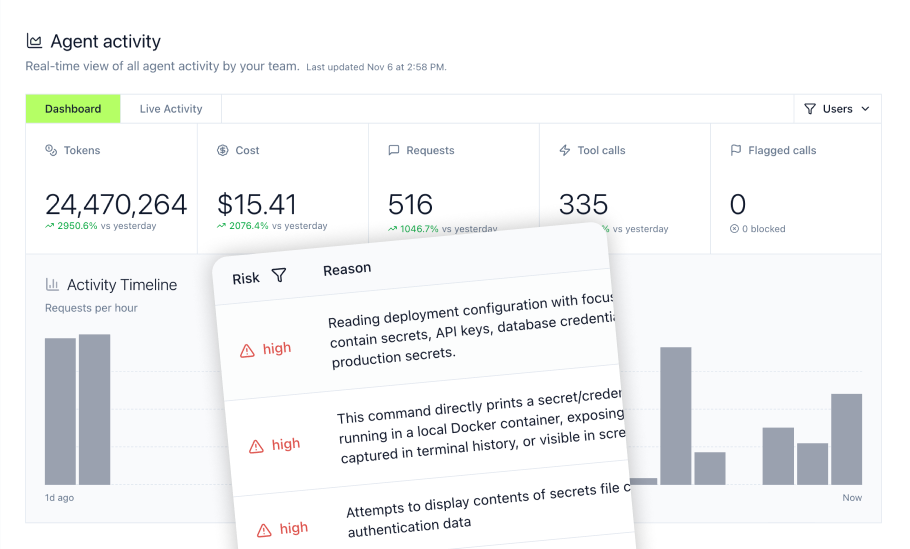
The LLM Proxy provides exactly this visibility—monitoring every tool call and bash command from coding agents while blocking dangerous operations in real-time.
Data access control
Critical controls
- Implement granular tool access by role (enable read-only operations, exclude write tools)
- Configure per-user authentication rather than shared service accounts where possible
- Protect sensitive files (.env, SSH keys, credentials) from AI agent access
- Deploy both STDIO servers on managed services and other deployable or remote servers as needed
Enterprises using MCP Gateway gain centralized governance with OAuth + SSO enforcement, role-based access control, and real-time monitoring across all MCP connections.
Building enterprise AI governance for 2026
The NIST AI Risk Framework identifies governance gaps as primary enablers for swarm attacks. Organizations lacking structured AI oversight cannot detect when their own systems become compromised or weaponized.
From shadow AI to sanctioned AI
Unmanaged AI tools proliferate faster than security teams can track. Shadow AI grows 120% year-over-year, creating blind spots that swarm attackers exploit.
Governance framework requirements
- Central registry of all AI tools and MCP servers in use
- One-click deployment with pre-configured security policies
- Unified authentication wrapping for all AI endpoints
- Complete audit logs satisfying SOC2 and GDPR requirements
Continuous governance in dynamic threat landscapes
Static policies cannot address evolving threats. Effective governance requires:
- Real-time dashboards monitoring usage patterns and security alerts
- Automated policy enforcement without manual intervention
- Rate control preventing credential abuse and data exfiltration
- Stakeholder collaboration across security, compliance, and development teams
Organizations with formal governance report higher success rates than those without structured approaches.
Securing enterprise AI with MintMCP: Purpose-Built defense for 2026
The defense strategies outlined above—zero trust architecture, autonomous containment, service account monitoring, and continuous governance—converge on a fundamental requirement: organizations need infrastructure purpose-built for the AI agent era. Traditional security platforms evolved to protect human users and conventional applications. They lack the architectural foundations necessary to secure AI systems operating at machine speed while defending against autonomous attackers.
MintMCP addresses this gap with enterprise infrastructure specifically designed for AI agent governance and security. MCP Gateway provides the centralized control plane that organizations need to implement the defense strategies this article recommends. Every MCP connection flows through a single governance layer where security teams enforce authentication, authorization, and behavioral monitoring without requiring individual developers to implement security controls manually. OAuth and SSO integration ensures that AI agents operate under the same identity management framework as human users, eliminating the service account vulnerabilities that swarm attacks exploit.
The LLM Proxy delivers the real-time visibility essential for detecting anomalous AI behavior before it escalates into data exfiltration. Every tool invocation, bash command, and file operation generates audit logs that security teams can analyze for patterns inconsistent with legitimate automation. When a compromised AI agent begins probing systems or accessing unexpected resources, these behavioral anomalies become immediately visible—providing the early warning that traditional security infrastructure fails to deliver.
Organizations implementing AI governance frameworks through MintMCP gain three critical advantages against swarm attacks: complete visibility into every AI tool and MCP server deployed across the enterprise, centralized policy enforcement that adapts to evolving threats without requiring application-level changes, and comprehensive audit trails satisfying regulatory requirements under EU AI Act, DORA, and GDPR. The platform transforms AI governance from a compliance checkbox into operational defense against the autonomous attackers that will define enterprise security in 2026 and beyond.
Frequently asked questions
What distinguishes AI swarm attacks from traditional botnet attacks?
Traditional botnets require human operators to make decisions, update attack patterns, and respond to defenses. AI swarms operate autonomously with distributed intelligence—each agent makes independent decisions while sharing real-time threat data. Human involvement drops to 4-6 decision points per campaign. Swarms also employ micro-exfiltration and Byzantine attacks that traditional botnets cannot execute.
How should organizations prioritize investment between detection and prevention?
Both matter, but the speed gap makes prevention primary. Swarms operate in milliseconds; human detection takes minutes to hours. Prevention through zero trust architecture, microsegmentation, and service account monitoring stops attacks before they succeed. Detection remains valuable for identifying compromised systems and satisfying compliance requirements, but organizations cannot detect their way out of an active swarm attack.
Can existing security vendors adapt products for swarm defense?
Legacy security products built around signature-based detection and human analyst workflows face architectural limitations. Organizations should evaluate vendors specifically on: machine-speed detection capabilities, autonomous containment features, service account behavioral monitoring, and integration with AI governance platforms. Products requiring human approval for containment actions will consistently arrive too late against autonomous attackers.