The definition of insider threat has fundamentally changed. While organizations spent decades building defenses against malicious employees and human error, autonomous AI agents now operate with elevated privileges across enterprise systems—accessing sensitive data, executing commands, and making decisions at machine speed. With 83% having experienced insider attacks in 2024, security leaders face a critical inflection point: traditional insider threat programs cannot detect or contain AI-based risks. Organizations need purpose-built solutions like MCP Gateway that provide centralized governance, granular tool access control, and complete audit trails for AI agent interactions.
This article examines why AI agents represent the defining insider threat of 2026, the specific attack vectors they introduce, and actionable strategies for implementing enterprise-grade security and governance before these risks mature.
Key takeaways
- AI agents now operate as autonomous insiders with privileged access to databases, APIs, and production systems—creating attack surfaces traditional security tools cannot address
- The average annual cost of insider threats reached $17.4 million in 2025, according to the Ponemon Institute, with US data breaches averaging $10.22 million
- Memory poisoning attacks represent a critical new vector where attackers plant false information in agent long-term memory, causing downstream compromises across multi-agent systems
- 90% of security professionals report insider attacks are as difficult or more difficult to detect than external threats
- Shadow AI usage has exploded, with 80% of employees using unauthorized applications and 61% of IT leaders acknowledging the problem
- Organizations with mature AI governance frameworks demonstrate significantly better security outcomes than those without structured approaches
- Implementing zero-trust principles for AI agents—including least-privilege access and human-in-the-loop controls—significantly reduces incident risk
The evolving landscape of insider threats in cybersecurity: Beyond human malice
Traditional insider threat programs focused on three categories: malicious employees stealing data, negligent workers making mistakes, and compromised credentials enabling unauthorized access. These human-centric threats remain significant—the Verizon DBIR 2024 attributes human factors to 68% of breaches.
However, the threat landscape has expanded. Organizations experiencing 11-20 insider attacks increased 5x from 4% to 21% between 2023 and 2024. This acceleration correlates directly with AI adoption: 71% of organizations now regularly use generative AI, yet many lack formal governance structures.
The gap between AI deployment velocity and security maturity creates systemic risk:
- Privileged access expansion: AI agents often receive broader system access than individual employees to perform their functions
- Speed of execution: Agents operate at machine speed, potentially exfiltrating data or modifying systems before human detection
- Lack of accountability: Traditional user behavior analytics cannot baseline or monitor autonomous agent activity
- Persistence: Unlike human sessions, agents may maintain continuous access to systems around the clock
Understanding AI agents: Capabilities, autonomy, and unforeseen risks
AI agents differ fundamentally from traditional software. Rather than following predetermined logic, they leverage large language models to perceive context, plan multi-step workflows, and take independent actions. Modern agents can schedule meetings, process invoices, analyze customer data, generate code, and execute financial transactions—all with minimal human oversight.
Core agent capabilities creating security concerns
- Autonomous decision-making: Agents analyze context and act without human input, making their behavior difficult to predict
- Multi-system integration: A single agent may access email, CRM, databases, APIs, and cloud storage simultaneously
- Persistent memory: Agents retain information across sessions, creating new attack surfaces
- Tool use: Agents invoke external tools and services, extending their reach beyond their primary function
- Learning and adaptation: Behavior changes over time as agents incorporate new information
These capabilities deliver substantial business value—customer service AI delivers 12x cost efficiency at $0.50 per interaction versus $6.00 for human agents. However, the same autonomy that enables productivity creates risk when agents access sensitive resources without appropriate governance.
Why AI agents pose a unique insider threat in cyber security
AI agents introduce threat vectors that traditional security tools cannot address. Understanding these specific risks is essential for building effective defenses.
Memory poisoning attacks
Attackers can plant false information in agent long-term memory that persists across sessions. Unlike prompt injection requiring active interaction, poisoned memories activate later when triggered by specific contexts. Research demonstrates that malicious instructions can propagate through multi-agent systems, creating cascading failures across connected agents.
Cascading failures in Multi-Agent systems
When organizations deploy interconnected agents, a single compromise can cascade through the entire workflow. Manufacturing companies have experienced fraudulent orders when attackers compromised vendor-validation agents through poisoned memory, causing them to approve fake suppliers over extended periods.
Shadow AI and unauthorized tool usage
Employees increasingly deploy AI tools without IT approval. 61% of IT leaders acknowledge shadow AI as a significant problem, yet organizations consistently discover 3-5x more AI agents than expected during security audits.
Prompt injection and privilege escalation
Attackers craft malicious inputs that cause agents to bypass access controls, reveal sensitive data, or execute unauthorized commands. Traditional DLP cannot detect these attacks because data flows through natural language interfaces rather than file transfers.
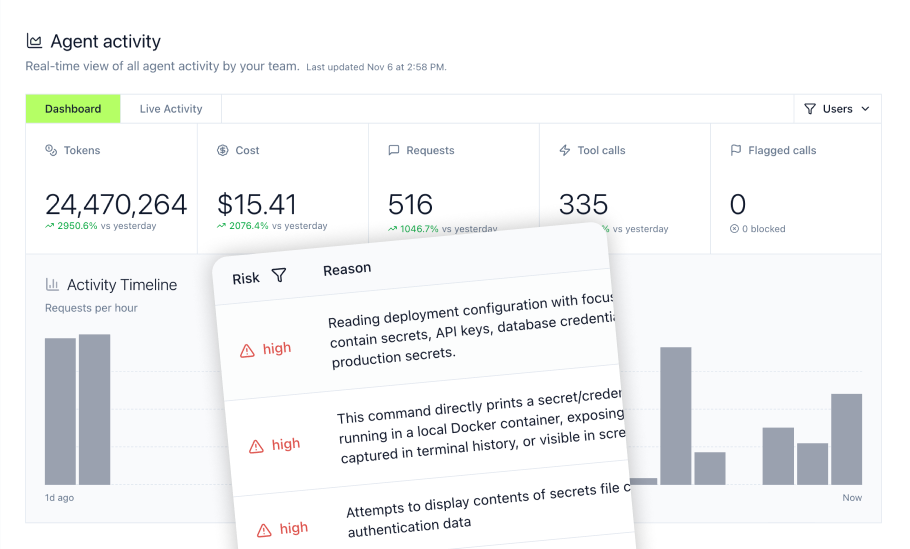
The LLM Proxy addresses these challenges by monitoring every MCP tool invocation, bash command, and file operation from coding agents—providing the visibility gap organizations need to detect anomalous agent behavior.
The 2026 warning: Proactive measures for cybersecurity risks with AI agents
Security leaders predict 2026 as the inflection point when AI agent threats mature from theoretical to operational. Proofpoint's insider risk outlook identifies this as "the turning point for insider risk," warning that organizations have limited time to implement controls.
Why 2026 represents critical timing
- EU AI Act compliance deadlines: The EU AI Act is rolling out in phases, with early provisions applying in 2025 and broader requirements taking effect on later timelines
- Threat actor sophistication: Threat-intelligence reporting has documented AI-assisted cybercrime activity, including North Korean IT worker schemes
- Agent proliferation: Enterprise AI deployments are scaling from pilots to production, expanding attack surfaces exponentially
- Detection gaps: Containment timelines for insider incidents can stretch to around 81 days in industry reporting—raising the cost of delayed visibility
Proactive defense priorities
- Implement pre-ingestion data classification and sanitization before data enters AI systems
- Deploy behavioral baselines specific to AI agent patterns rather than human user profiles
- Establish semantic access controls requiring agents to justify high-impact data requests
- Create incident response playbooks addressing agent isolation, credential rotation, and memory forensics
- Follow NIST AI Risk Management Framework guidance
Essential enterprise security for governing AI agent tool access
Effective governance requires controlling what tools agents can access, under what conditions, and with what oversight. This extends beyond traditional role-based access control to semantic policy enforcement.
Key governance capabilities
- Granular tool permissions: Configure access by role, enabling read-only operations while excluding write capabilities
- Just-in-time access: Provide time-limited permissions that expire after task completion
- Human-in-the-loop checkpoints: Require approval for high-impact actions like financial transfers, data deletion, or privilege escalation
- Attribute-based access control (ABAC): Authorize requests based on context rather than static roles
Implementation framework
Effective implementation requires phased deployment across five control layers:
Authentication addresses who or what is requesting access and should be implemented immediately. Authorization determines what resources can be accessed and requires immediate deployment. Behavioral monitoring tracks how resources are being used and should be implemented in weeks 2-4. Anomaly detection identifies deviations from expected patterns and belongs in weeks 4-8. Automated response blocks dangerous operations and should be deployed in weeks 8-12.
MCP Gateway provides centralized governance with OAuth and SSO enforcement, automatically wrapping authentication around MCP endpoints while maintaining complete audit trails of every interaction.
Real-time threat detection and response for AI agent activity
Detection speed determines breach impact. Organizations using stronger automation and behavioral analytics can materially shorten detection and response time for high-severity anomalies.
Essential detection capabilities
- Tool call tracking: Monitor every MCP tool invocation, bash command, and file operation
- MCP inventory: Maintain complete visibility into installed MCPs, their permissions, and usage patterns
- Behavioral baselines: Establish normal patterns for data access volume, API calls, and timing
- Anomaly alerting: Flag deviations exceeding threshold tolerances
Response automation
Effective response requires pre-configured playbooks that execute automatically when threats are detected:
- Block dangerous commands: Prevent execution of risky operations like reading environment secrets
- Protect sensitive files: Restrict access to .env files, SSH keys, and credentials
- Isolate compromised agents: Quarantine affected systems while preserving forensic evidence
- Rotate credentials: Automatically invalidate tokens and API keys associated with suspicious activity
The LLM Proxy security guardrails enable real-time blocking of dangerous commands while maintaining complete audit trails for security review. Understanding how MCP gateways bridge AI infrastructure helps organizations architect appropriate defensive layers.
Implementing enterprise security with compliance for AI agents
Regulatory frameworks increasingly address AI-specific risks. Organizations must align agent security programs with compliance requirements to avoid penalties and demonstrate due diligence.
Relevant compliance frameworks
- SOC 2 Type II: Requires documented controls over data processing, including AI agent activities
- GDPR: Requires ability to explain automated decision-making (Article 22) and complete data processing records
- ISO 42001: The 2023 AI Management System standard specifically addresses AI governance and risk management
- EU AI Act: Effective 2025, imposes strict requirements on high-risk AI with substantial penalties
Compliance implementation checklist
- ✅ Deploy immutable audit trails capturing all agent activities
- ✅ Implement data classification before AI ingestion
- ✅ Establish access logging with retention meeting regulatory requirements
- ✅ Create documentation for AI decision-making transparency
- ✅ Configure security audit dashboards
- ✅ Conduct regular risk assessments of AI agent deployments
MCP Gateway is SOC 2 compliant with complete audit logs for GDPR requirements, providing the compliance foundation enterprises need for AI agent governance.
Turning shadow AI into sanctioned AI: A strategic approach to governance
The goal isn't eliminating AI tools—it's bringing them under governance. Organizations that block AI adoption entirely lose competitive advantage; those that enable it without controls face unacceptable risk. The path forward requires transforming shadow AI into sanctioned, monitored deployments.
90-day governance roadmap
Weeks 1-4: Discovery and Assessment
- Inventory all AI agents including unauthorized shadow deployments
- Classify agents by data access sensitivity and business impact
- Identify gaps between current controls and required capabilities
Weeks 5-8: Baseline and Monitoring
- Deploy behavioral analytics to establish normal patterns
- Configure SIEM integration for centralized visibility
- Implement initial access controls for highest-risk agents
Weeks 9-12: Controls and Governance
- Extend governance to 80%+ of agent deployments
- Establish human-in-the-loop approvals for sensitive operations
- Document incident response procedures
Success metrics to track
- Shadow AI discovery rate (target: identify 95%+ of unauthorized tools)
- Mean time to detect anomalies (target: under 5 minutes for high severity)
- False positive rate (target: below 2% to prevent alert fatigue)
- Compliance audit readiness (target: pass all relevant frameworks)
MintMCP's mission centers on bridging the gap between AI assistants and internal data with security, governance, and ease-of-use that enterprises need to deploy MCP at scale. Reviewing AI governance trends provides additional context for building sustainable programs.
Frequently asked questions
What is the difference between prompt injection and memory poisoning attacks?
Prompt injection attacks require active interaction—an attacker crafts malicious input that causes an agent to bypass controls during a single session. Memory poisoning is more insidious: attackers plant false information in an agent's long-term memory that persists across sessions and activates when triggered by specific contexts, making them significantly harder to detect and remediate.
How do I determine which AI agents require the highest security priority?
Prioritize agents based on three factors: data sensitivity (agents accessing PII, financial data, or trade secrets), system privileges (agents with write access or administrative capabilities), and blast radius (agents connected to multiple downstream systems). Agents meeting two or more criteria should receive immediate governance controls.
Can existing SIEM platforms effectively monitor AI agent behavior?
Traditional SIEM platforms can ingest AI agent logs but lack the contextual understanding needed for effective threat detection. AI agents generate significantly more events than human users, and their behavioral patterns differ fundamentally from human baselines. Organizations need AI-native monitoring capabilities that understand agentic workflows, tool invocations, and semantic intent.
What skills does a security team need to manage AI agent threats?
Effective AI agent security requires hybrid expertise spanning traditional security operations, AI/ML fundamentals, and behavioral analytics. Key capabilities include understanding large language model architectures, recognizing prompt injection patterns, configuring behavioral baselines, and responding to agent-specific incidents. Most organizations find success with dedicated AI security specialists supported by cross-functional governance councils.