AI agents now operate with extensive system access—reading files, executing commands, and accessing production systems through MCP tools. Enterprises increasingly encounter risky AI agent behaviors including improper data exposure and unauthorized system access, yet few have formal AI governance frameworks. Without proper security audits, organizations cannot see what agents access or control their actions. An MCP Gateway provides the essential visibility and control that transforms shadow AI into sanctioned AI—complete with authentication, permissions, and audit trails.
This article outlines a comprehensive approach to assessing security risks in LLM applications, covering agent security audit frameworks, monitoring strategies, access controls, compliance requirements, and ongoing governance to prevent costly breaches and ensure regulatory adherence.
Key takeaways
- Healthcare AI agent incidents can create multi-million-dollar regulatory and remediation exposure when PHI leaks go undetected—making audit trails and containment controls non-negotiable
- The OWASP Top 10 highlights critical LLM risks like prompt injection, sensitive information disclosure, supply chain weaknesses, data/model poisoning, insecure output handling, and excessive agency
- Comprehensive audit implementations achieve significant reductions in security incidents within months
- Continuous monitoring platforms reduce mean time to detect threats from days-long manual investigation to minutes
- NIST AI Risk Management Framework provides structured methodology for AI governance
Understanding the evolving threat landscape for LLM applications
The rise of shadow AI in the enterprise
Shadow AI—unsanctioned AI tools deployed without security review—grows as employees adopt AI agents to boost productivity. Business units deploy AI agents across customer service, data analysis, and development workflows without centralized oversight, creating blind spots that traditional security tools cannot address.
The challenge intensifies when agents inherit user permissions and access production systems. Organizations often operate more agents than teams expect. Without comprehensive inventory, security teams cannot enforce policies on systems they cannot see.
Common attack vectors on LLM apps
AI agents face attack vectors fundamentally different from traditional software vulnerabilities:
- Prompt injection: Attackers embed malicious instructions in data sources that agents process, hijacking agent behavior without touching application code
- Memory poisoning: Compromising agent knowledge bases with malicious content that influences future decisions across sessions
- Tool misuse: Agents invoking external tools (databases, APIs, file systems) in unintended ways that bypass access controls
- Privilege escalation: Agents accumulating permissions beyond their intended scope through chained operations
- Data exfiltration: Silent extraction of sensitive information through agent outputs
The OWASP Top 10 for LLM Applications provides a taxonomy of these vulnerabilities, developed with contributions from security experts worldwide.
Establishing a framework for AI agent security audit
Key phases of an LLM security audit
A structured audit follows five distinct phases:
Phase 1: Preparation (Weeks 1-2) Form a cross-functional team including IT, legal, compliance, risk management, and data science. Assign a lead auditor with AI expertise and establish decision-making authority through a RACI matrix.
Phase 2: Agent Discovery (Weeks 2-4) Deploy automated tools to identify all AI agents across SaaS platforms, cloud environments, and endpoints. Document each agent's purpose, data access, integration points, and risk level. Include endpoint-based agents like Claude Desktop and Cursor that operate outside SaaS discovery.
Phase 3: Technical Assessment (Weeks 3-6) Perform structured risk analysis using NIST AI RMF methodology: identify capabilities, classify data sensitivity, evaluate threats, assess impact and likelihood, and prioritize risks.
Phase 4: Control Implementation (Weeks 5-8) Deploy security controls addressing OWASP Top 10 risks: input sanitization, output validation, least-privilege access, comprehensive logging, and runtime guardrails.
Phase 5: Continuous Monitoring (Ongoing) Shift from point-in-time audits to continuous compliance monitoring with automated drift detection and quarterly formal reviews.
Defining audit scope and objectives
Effective scoping prevents both over-ambitious projects that stall and narrow assessments that miss critical risks:
- Start with high-risk agents: The 20% of agents with write access, sensitive data handling, or financial operations represent 80% of exposure
- Layer multiple frameworks: Combine OWASP (vulnerabilities) + NIST (governance) for comprehensive coverage
- Define success metrics: Target measurable reductions in security incidents and audit preparation time
Monitoring and control: The foundation of LLM application security
Gaining visibility into agent behavior
Without monitoring, organizations operate blind to agent activities. Security teams need visibility into:
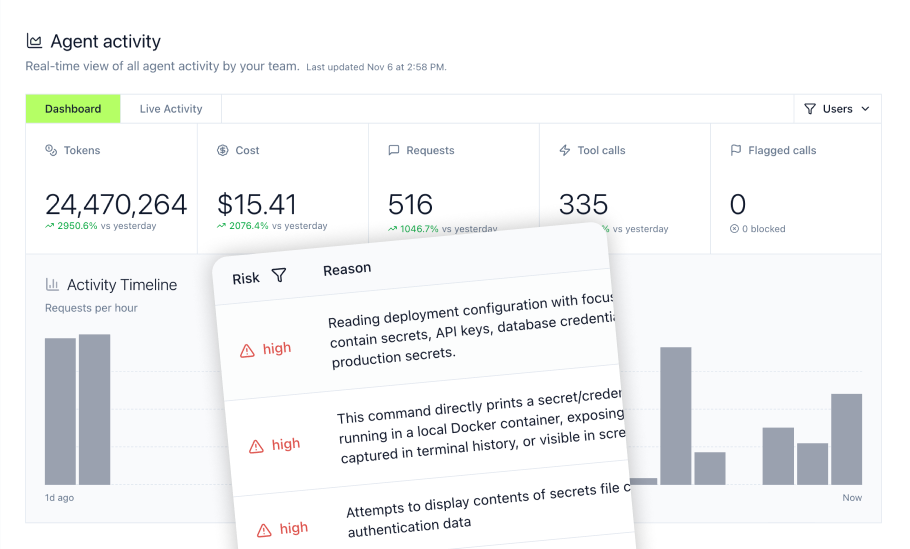
- Every MCP tool invocation and bash command execution
- Which MCPs are installed across the organization
- What files and data sources agents access
- Usage patterns and anomaly detection across teams
MintMCP's LLM Proxy sits between LLM clients (Cursor, Claude Code) and the model itself, forwarding and monitoring requests. This lightweight service provides observability into how employees use LLM clients, including what tools the LLMs invoke—essential for understanding your actual risk posture.
Detecting and preventing malicious activities
Real-time monitoring must detect and respond to threats before damage occurs:
- Behavioral analytics: Machine learning establishes baseline agent behavior and alerts on deviations indicating compromise
- Command blocking: Security guardrails intercept dangerous commands like reading .env files or accessing SSH keys
- Anomaly thresholds: Alert when behavior deviates significantly from baseline for sustained periods
Mature implementations achieve low false positive rates through machine learning tuning, preventing alert fatigue that undermines security effectiveness.
Implementing granular access controls for AI agents
Protecting sensitive data and systems
Coding agents and AI assistants operate with extensive system access by default. Without controls, they can:
- Read configuration files containing API keys and credentials
- Execute arbitrary bash commands with user permissions
- Access production databases through MCP connections
- Exfiltrate data through seemingly benign outputs
Protection requires sensitive file protection preventing access to .env files, SSH keys, and credentials, combined with command history capturing every operation for security review.
Configuring permissions and policy enforcement
Enterprise access controls must match organizational complexity:
- Role-based access control (RBAC): Configure tool access by role—enable read-only operations for analysts while restricting write tools
- OAuth and SAML integration: Enterprise authentication with SSO integration for all MCP servers
- Least privilege enforcement: Agents receive minimum permissions required for their specific functions
MintMCP's MCP Gateway provides granular tool access control, enabling security teams to configure exactly which capabilities each role can access. This transforms local servers into production-ready services with enterprise-grade authentication.
Ensuring compliance and auditability for AI agent interactions
Regulatory requirements demand complete audit trails of AI agent activities. SOC 2 Type II requires demonstrating operating effectiveness of security controls. HIPAA’s Security Rule requires retaining required security documentation for at least six years; organizations commonly align audit-log retention to their risk and regulatory needs, but HIPAA does not prescribe a single universal log-retention period. GDPR Article 22 restricts certain solely automated decisions with legal or similarly significant effects and requires safeguards such as the ability to obtain human intervention, express a viewpoint, and contest the decision.
Agent Decision Logs (ADL) capture an audit-ready record for every significant agent action:
- Action taken and decision context
- Reasoning chain and alternatives considered
- Human oversight trail
- Model version and configuration used
Without ADRs, organizations cannot answer auditor questions about why an agent made a specific decision months ago. MintMCP provides complete audit logs to support SOC 2 and GDPR auditability, with configurable logging and retention controls.
Securing AI agents using an enterprise MCP gateway
Local MCP servers lack the security infrastructure enterprises require. Transforming them into production-ready services requires:
- One-click deployment: Deploy STDIO-based MCP servers instantly with built-in hosting and lifecycle management
- OAuth protection: Add SSO and OAuth to any local MCP server automatically
- Centralized registry: Central inventory of available MCP servers with role-based access and permissions
- Real-time monitoring: Live dashboards for server health, usage patterns, and security alerts
The MCP Gateway transforms local MCP servers into production-grade infrastructure. Rather than running servers locally on individual machines, containerized servers become accessible to clients enterprise-wide with unified governance.
For teams implementing MCP at scale, the deployment guide provides detailed implementation steps and best practices.
Integrating AI agents with enterprise data and tools securely
AI agents create value when connected to enterprise data—but these connections multiply risk without proper controls. Secure integration requires:
Database and analytics access: The Snowflake MCP Server enables AI agents to query data warehouses with natural language while maintaining governance. Finance teams automate reporting; product teams run analytics; executives gain real-time intelligence—all through governed connections.
Enterprise search integration: The Elasticsearch MCP Server allows AI agents to search knowledge bases, support tickets, and documentation. HR teams build AI-accessible policy repositories; support teams search historical resolutions; product teams power contextual help systems.
Communication tools: The Gmail integration enables AI assistants to search and draft communications—and send approved drafts within governed workflows, with full security oversight preventing unauthorized access.
Each connector inherits enterprise authentication, audit logging, and access controls from the MCP Gateway—ensuring consistent governance regardless of data source.
Advanced threat protection and real-time incident response
Proactive defense requires both prevention and rapid response capabilities:
Security guardrails block dangerous operations in real-time:
- Prevent execution of commands accessing sensitive files
- Block tool calls attempting to read environment secrets
- Restrict file access to approved directories
Incident response for AI agents follows specialized procedures:
- Immediate agent isolation
- Credential and token revocation
- Action audit and forensic analysis using preserved logs
- Attack vector identification and lateral movement containment
- Stakeholder notification per compliance requirements
MintMCP's LLM Proxy provides the complete audit trail of every bash command, file access, and tool call required for security forensics—turning potential incidents into contained events.
Strategic AI governance: From shadow AI to sanctioned AI
Effective AI governance extends beyond technical controls to organizational strategy. Research from McKinsey shows organizations with formal AI strategies achieve dramatically better outcomes.
Building governance infrastructure:
- Centralized credentials: Manage all AI tool API keys and tokens in one place rather than scattered across teams
- Self-service access: Developers request and receive AI tool access instantly through approved workflows
- Policy enforcement: Automatically enforce data access and usage policies without manual review bottlenecks
- Cost analytics: Track spending per team, project, and tool with detailed breakdowns
The goal is enabling innovation while maintaining control. When governance enables rather than blocks, organizations see improved developer productivity alongside better security posture.
MintMCP bridges the gap between AI assistants like ChatGPT and Claude with your internal data and tools. The platform handles authentication, permissions, audit trails, and all complexity that comes with enterprise deployments—turning shadow AI into sanctioned AI. Learn more about MCP gateway architecture and how it enables secure AI tool adoption.
Frequently asked questions
What is the difference between auditing LLM applications versus traditional software?
Traditional software audits focus on code vulnerabilities, access controls, and data handling. LLM application audits must additionally assess autonomous decision-making, multi-agent coordination, persistent memory systems, and tool invocation patterns. Agents create unique attack surfaces through prompt injection and memory poisoning that traditional scanners cannot detect. The OWASP Top 10 specifically addresses these AI-specific risks.
How long does a comprehensive AI agent security audit take?
Initial framework implementation requires 4-12 weeks depending on organization size and agent portfolio. Phase 1 (preparation) takes 1-2 weeks. Phase 2 (agent discovery) requires 2-4 weeks. Phase 3 (assessment) spans 2-3 weeks. Phase 4 (controls) takes 3-4 weeks. Following initial deployment, organizations shift to continuous monitoring with quarterly reviews.
What team composition is required for an AI agent security audit?
Minimum viable teams include 5 cross-functional members: Lead Auditor (AI security expertise), Data Scientists (model behavior analysis), Compliance Specialists (regulatory mapping), Security Professionals (control implementation), and Domain Experts (business context). Executive sponsorship is essential for successful implementations.
Should we choose OWASP or NIST frameworks for our security audit?
Most enterprises benefit from layering both frameworks. OWASP Top 10 provides actionable vulnerability priorities ideal for security teams—implement first for fastest value. NIST AI RMF delivers comprehensive lifecycle governance for executives and regulated industries—implement for board-level reporting.
How do we handle audit trail storage costs at scale?
Enterprise AI agents making thousands of decisions daily generate substantial log volume. Cost optimization strategies include: selective logging of decision boundaries, tiered storage (hot storage with cold archival for compliance), PII redaction before storage, and log sampling (full logging of high-risk actions, sampled logging of routine operations). These approaches can significantly reduce storage costs while maintaining security coverage.