Enterprise AI deployments now involve multiple protocols working at different layers of the technology stack. MCP (Model Context Protocol) connects individual AI agents to external tools and data sources, while A2A (Agent-to-Agent) enables autonomous agents to discover and coordinate with each other across vendor and organizational boundaries. Understanding where each protocol operates and when your organization needs both is essential for building governed, scalable AI infrastructure. Platforms like MCP Gateway help enterprises centralize and govern MCP-mediated tool and data connections through authentication, access control, credential handling, and comprehensive audit logging.
This article explains the core functions of A2A and MCP interactions, clarifies their distinct roles, and outlines when an enterprise needs both for comprehensive AI governance in 2026.
Key Takeaways
- MCP and A2A operate at different layers: MCP handles vertical integration (agent-to-tool connections), while A2A handles horizontal coordination (agent-to-agent communication). These protocols complement rather than compete with each other.
- Protocol adoption has reached enterprise scale: MCP's Tier 1 SDKs were seeing close to half a billion downloads per month as of July 2026, while the Linux Foundation reported more than 150 organizations supporting A2A in April 2026, including AWS, Google, IBM, Microsoft, Salesforce, SAP, and ServiceNow.
- Many production systems use both: MCP and A2A are complementary. Use both when standardized tool access and standardized cross-agent coordination are both requirements.
- Managed platforms can reduce deployment work: Centralized connectors, authentication, credentials, and access policies can reduce setup and operational overhead compared with managing those components separately.
- Identity governance becomes critical at scale: When organizations scale from 10 to 100+ agents, distinguishing "who did what" becomes the central governance question that requires first-class agent identities.
- Context governance fills protocol gaps: Neither protocol alone governs meaning or prevents definition drift. Organizations need a governed context layer to ensure agents interpret shared concepts consistently.
Understanding the Model Context Protocol (MCP) in Enterprise AI Governance
The Model Context Protocol standardizes how AI applications and agents connect to external tools, databases, and data sources. Released by Anthropic in November 2024, MCP replaces custom integrations with a universal protocol, functioning as "USB-C for AI" by enabling agents to query Snowflake, access Gmail, call REST APIs, and read file systems through one standardized interface.
What is an MCP Gateway?
An MCP Gateway serves as a single governed entrypoint between AI clients and MCP servers. Rather than having developers configure each MCP server locally across laptops and AI clients, a gateway centralizes:
- Authentication and SSO: Users connect through existing identity providers
- Credential handling: Secrets never live on developer machines; credentials inject per-call
- Tool curation: Administrators control which tools each role or team can access
- Audit logging: Every tool call generates a traceable record
- Access policies: RBAC driven by directory groups through SCIM
The MCP specification defines three core server primitives:
- Resources: Expose context and data for applications or models
- Tools: Expose executable functions for models to call
- Prompts: Expose reusable templates intended to be user-controlled through the client
The Role of Virtual MCPs
Virtual MCPs (VMCPs) represent the key abstraction for enterprise MCP governance. A Virtual MCP bundles approved connectors and a curated tool surface behind one governed endpoint for a particular team, role, use case, or agent.
Virtual MCPs serve as the unit of:
- Deployment: One endpoint per use case instead of per-server configuration
- Access control: Directory groups determine who can connect
- Tool curation: Administrators select which tools appear for each VMCP
- Audit: All activity through a VMCP flows to centralized logs
- Administration: Configuration changes apply at the bundle level
This approach addresses the configuration sprawl problem where every developer configures every MCP server locally, creating N installs, N auth flows, and N points of failure. As MCP deployments expand across organizations, centralized governance can reduce configuration, credential, and access-control sprawl.
What are AI Agents and How Do They Differ from Traditional AI Clients?
AI agents represent a fundamental shift from human-operated AI clients toward systems that can act autonomously. AI clients such as Claude Desktop and Cursor can support both human-directed and agentic workflows, while autonomous agents can independently decide which tools to call, when to delegate tasks, and how to coordinate with other systems.
Defining Autonomous AI Agents
Autonomous agents differ from traditional AI clients in several important ways:
- Decision autonomy: Agents determine which tools to invoke at runtime rather than following explicit human instructions for each action
- Persistent operation: Long-running agents can continue work across days rather than operating only during active sessions
- Tool discovery: Agents use
tools/listto discover available capabilities, which can appear, change, or disappear over time - Coordination capability: Agents can delegate subtasks to other agents or services when A2A protocols are available
Key Characteristics of Agentic AI
Agentic AI introduces specific governance challenges that differ from traditional AI client management:
- Runtime unpredictability: Agents decide which tools to call based on context, making action prediction difficult
- Tool description as attack surface: Malicious tool descriptions can inject instructions into an agent's prompt (tool poisoning)
- Credential usage patterns: Agents may need persistent access that outlasts any single human session
- Attribution complexity: Distinguishing agent actions from human actions requires first-class non-human identities
These characteristics explain why organizations need governance infrastructure specifically designed for autonomous agents rather than repurposing human-oriented access controls.
The Need for Agent-to-Agent (A2A) Protocols in Multi-Agent Systems
While MCP connects agents to tools and data, A2A enables agents to discover, delegate tasks, and coordinate with other agents across vendors and frameworks. Announced by Google in April 2025, A2A addresses the horizontal coordination problem that emerges when multiple specialized agents need to work together.
Facilitating Agent Collaboration
A2A standardizes inter-agent communication through several mechanisms:
- Agent Cards: JSON documents at
/.well-known/agent-card.jsonthat advertise an agent's capabilities, supported interfaces, skills, and authentication requirements - Task lifecycle: A defined state machine that includes submitted, working, input-required, auth-required, completed, failed, canceled, and rejected states
- Multi-modal support: Agents can exchange text, audio, video, and structured data through standardized interfaces
- Discovery protocols: Orchestrator agents can read remote Agent Cards via HTTP to understand what other agents can do
The protocol has gained rapid adoption with support from major platforms including Azure AI Foundry, AWS Bedrock, Google Vertex AI, and enterprise systems like Salesforce Agentforce.
Architecting Decentralized AI Workflows
A2A enables workflow patterns that single-agent MCP deployments cannot achieve:
- Specialist delegation: An orchestrator agent routes compliance subtasks to a specialized regulatory agent without custom integration
- Cross-vendor coordination: Agents on Azure can collaborate with agents on AWS through standardized protocols
- Long-running workflows: Tasks can span hours or days with proper state management and handoffs
- Multi-modal pipelines: Audio processing agents can pass results to text analysis agents through consistent interfaces
A2A can reduce the amount of custom integration code required when agents built on different frameworks or platforms need to coordinate.
Agent Identity and Permissions: Securing A2A Interactions
As autonomous agents proliferate, the question of "who is this agent?" becomes central to governance. Traditional approaches where agents inherit human credentials or use shared service accounts break down when organizations need to distinguish, audit, and control individual agent behavior.
Establishing Agent Trust
Agent identity governance treats autonomous agents as first-class non-human principals with their own:
- Credentials: Each agent receives its own authentication mechanism rather than sharing human API keys
- Scoped permissions: Agents access only the tools and data their specific role requires
- MCP access: A dedicated Virtual MCP limits what each agent can reach
- Audit trail: Governed activity can be attributed to the specific agent that performed it
MintMCP's Agent Gateway extends the MCP Gateway foundation by providing agents with their own identities, permissions, memory, and monitoring.
Credential Management for Autonomous Agents
Agent authentication mechanisms range from simple to sophisticated based on security requirements:
- Bearer keys: Static keys on every request with named identity, expiry dates, and individual revocability
- M2M tokens: OAuth client-credentials exchange produces short-lived tokens, keeping secrets out of the request path
- Workload identity federation: The agent's own infrastructure (Kubernetes service account, cloud role, CI job identity) mints short-lived OIDC tokens
This credential hierarchy prevents the common anti-pattern where agents run on "whichever human's API key was lying around," which collapses the audit log, over-privileges the agent, and breaks rotation schedules.
Bridging MCP and A2A: When Both Protocols Are Essential for Governance
MCP and A2A operate at different layers and solve different problems. Understanding when you need one, the other, or both determines your architecture decisions.
Why a Combined Approach Can Be Superior
The protocols address complementary concerns:
| Concern | MCP Solution | A2A Solution |
|---|---|---|
| Agent accessing Snowflake data | MCP server with query tools | Not applicable |
| Agent delegating to specialist | Not applicable | A2A task with lifecycle |
| Tool-level access control | MCP gateway RBAC | Not applicable |
| Agent capability discovery | tools/list per server | Agent Cards across network |
| Authentication | MCP authorization and implementation-specific credential handling | Security schemes declared in Agent Cards; authorization remains implementation-specific |
| Cross-vendor coordination | Not in scope | Core A2A purpose |
Multi-agent systems can coordinate through framework-native or custom mechanisms without A2A, and agents can access tools through APIs or other integrations without MCP. Use both when standardized tool access and standardized cross-agent coordination are both requirements.
Scenarios Requiring Both Protocols
Financial services risk workflow: A risk-scoring agent uses MCP to query portfolio data from Snowflake. When accounts get flagged, A2A delegates compliance review to a specialized regulatory agent. The combined architecture lets MCP handle governed data access while A2A handles delegation to the specialist agent.
Healthcare diagnosis system: Multiple specialist agents (cardiology, radiology, pharmacology) each connect to relevant medical databases via MCP. A2A coordinates their collaboration on patient cases, developing differential diagnoses through multi-agent workflows.
E-commerce recommendations: Behavioral analysis, purchase history, and recommendation agents each access different data sources through MCP. A2A can coordinate their outputs into a unified recommendation workflow.
Monitoring and Guardrails: Ensuring Controlled Agent and MCP Activity
Visibility into agent behavior and runtime controls that prevent dangerous actions form the operational backbone of enterprise AI governance. Understanding what agents are doing and stopping risky behavior before it executes requires dedicated infrastructure.
Observing Agent Behavior
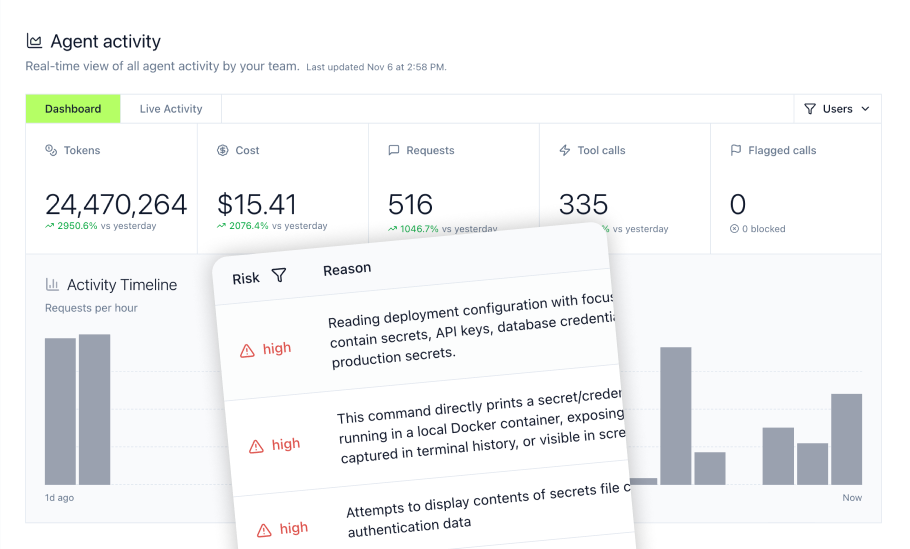
Agent Monitor provides organizational visibility into supported activity from AI coding agents and related agent environments. Captured activity can include:
- Prompts: What users and agents are requesting
- File access: Which files agents read, including sensitive content
- Commands: Bash commands, package installations, git operations
- MCP tool calls: Every invocation through governed connections
- Usage and cost: Token spend by model, user, agent, and session
Where supported, Agent Monitor captures local and off-gateway activity from coding-agent environments, broadening visibility beyond gateway traffic.
The live activity feed enables filtering by user, tool, or time period.
Implementing Runtime Security for AI
MintMCP's guardrail architecture operates through three complementary layers:
- Mint Guard: Managed detection policies for prompt injection, credentials/secrets, PII, and harmful content
- Rules: Declarative matching on tool names, arguments, or content using regex patterns
- Gateway Middleware: Customer-authored JavaScript that can inspect or modify supported calls
Agent Monitor explains what happened. Guardrails determine what can happen. Organizations need both for comprehensive AI governance.
Company-Owned Memory and Persistent Agents: Advancing Autonomous Work
Long-running agents that operate alongside employees require infrastructure for persistent memory, scheduled operation, and governed execution.
The Role of Persistent Agent Memory
Enterprise agent memory should be treated as governed infrastructure rather than opaque vendor storage. Coworker Agents implement memory through git-backed systems that provide:
- Company ownership: Memory lives in repositories the organization controls
- Scoped access: Private, team, organization, and customer memory silos
- Version history: Changes tracked through standard git mechanisms
- Reviewability: Memory contents can be inspected and audited
- Portability: Memory moves between systems without vendor lock-in
Enabling Long-Running Autonomous Tasks
Coworker Agents operate through multiple trigger mechanisms:
- Slack mentions: Team members can invoke agents directly in conversation
- Scheduled runs: Cron-based triggers execute recurring tasks
- Manual triggers: Run buttons enable on-demand execution
Governance remains built in through VMCP-scoped tool allowlists, Agent Monitor session visibility, sandboxed execution with restricted egress, and secret brokering where the running agent sees only placeholders for sensitive values.
Achieving Enterprise-Grade Security and Compliance for Your AI Workforce
Enterprise AI deployments require security and compliance infrastructure that satisfies regulatory requirements while enabling productive work.
Establishing Trust in AI Operations
The security foundation includes:
- SSO and SCIM integration: Okta, Entra ID, and Google directory groups drive both admin roles and tool access
- Role-based access control: Org-level roles control administrative reach while VMCP access policies control tool reach
- Audit and tamper-evident history: Tool calls, credential lifecycle events, and access-policy changes are logged. Tamper-evident access-grant history is signed at write time and can be verified offline through published JWKS
- Operational controls: Org-wide kill switches, per-VMCP or per-tool disables, credential rotation, and connector restart capabilities
Compliance Requirements for AI Agents
Different regulatory contexts impose specific requirements:
Financial services: Requirements vary by regulator, jurisdiction, and use case. Auditability, access controls, credential lifecycle management, and clear attribution can support internal and regulatory controls.
Healthcare: Organizations subject to HIPAA must implement applicable administrative, physical, and technical safeguards, including access and audit controls, and use BAAs where required.
EU/GDPR: GDPR requires principles such as lawfulness, transparency, purpose limitation, and data minimization. Additional safeguards apply to certain solely automated decisions with legal or similarly significant effects; GDPR does not impose a blanket EU data-residency requirement.
MintMCP is SOC 2 Type II audited and compliant with HIPAA standards, signs BAAs for customers handling protected health information, is penetration tested, and encrypts data in transit and at rest. SIEM export through OTLP or Splunk HEC enables integration with existing security operations tooling.
Configuration as code enables declarative management of gateway settings and global rules, supporting infrastructure-as-code workflows and change management processes.
Implementation Considerations
Organizations planning MCP and A2A deployments should understand the practical aspects of implementation.
Setup and Timeline Expectations
Deployment time varies by integration count, authentication model, network topology, security review, and orchestration complexity. A local proof of concept is generally simpler than a production remote deployment, while an enterprise rollout adds work for identity, access policies, logging, testing, and change management.
A2A rollout similarly depends on Agent Card design, task handling, authentication, protocol bindings, and orchestration requirements.
Cost Planning
Both MCP and A2A specifications and official SDKs are open source. Total deployment cost depends on engineering effort, infrastructure, integrations, authentication, security controls, orchestration complexity, and ongoing operations. Neither protocol defines a standard enterprise implementation cost.
The MCP data risk assessment provides detailed analysis of security considerations during planning and implementation phases.
Why MintMCP for MCP Governance
MintMCP centralizes the controls enterprises need to move MCP deployments from proof of concept to production. Its MCP Gateway reduces configuration sprawl by managing authentication, credential brokering, tool curation, and audit logging in one place.
Instead of configuring every MCP server separately, organizations can use Virtual MCPs to bundle approved connectors behind governed endpoints with SSO- and SCIM-driven access.
Key governance layers include:
- MCP Gateway: Governs enterprise tool and data access through centralized authentication, credentials, and curated tools
- Agent Gateway: Gives autonomous agents first-class identities, scoped permissions, and dedicated MCP access
- Agent Monitor: Provides visibility into supported agent activity, including prompts, commands, file access, MCP calls, usage, and cost
- Guardrails: Applies runtime controls to detect or restrict risky actions
- Coworker Agents: Supports long-running autonomous work with company-owned memory, scheduled or Slack-triggered execution, and governed tool access
Together, these layers help organizations govern both human-operated AI clients and autonomous agents while maintaining consistent identity, access, audit, and operational controls.
Explore MCP Gateway to see how centralized MCP governance can simplify enterprise AI deployment.
Frequently Asked Questions
How do MCP and A2A handle authentication differently?
MCP uses OAuth 2.1-based authorization for protected HTTP interactions, while A2A declares supported security schemes in the Agent Card, including OAuth 2.0, OpenID Connect, API keys, HTTP authentication, and mTLS. In combined architectures, the two protocols remain separate security boundaries that should be governed consistently.
What happens when A2A task lifecycle conflicts with MCP tool execution?
A2A manages task state and coordination, while MCP handles tool interactions. When an A2A task requires an MCP call, the receiving agent can execute the tool during its working state and update the A2A task to reflect success, failure, or a need for additional input.
Can existing API integrations coexist with MCP during migration?
Yes. MCP servers can wrap existing APIs while direct API integrations continue operating, allowing organizations to migrate AI-agent traffic gradually without replacing the underlying systems all at once.
How does context drift affect multi-agent A2A systems?
Context drift occurs when agents interpret shared concepts differently over time. Because neither MCP nor A2A provides protocol-level context governance, organizations may need additional metadata, policies, or shared definitions to keep agent behavior consistent.