Windsurf's Cascade agent gives developers autonomous code generation across multiple files, command execution, and agentic workflows—but this power creates new security challenges that traditional governance frameworks weren't designed to handle. With coding agents operating with extensive system access, organizations cannot see what agents access or control their actions without proper monitoring infrastructure. An LLM Proxy provides essential visibility and control over agent behavior, enabling enterprises to capture the productivity benefits of AI coding while maintaining security and compliance standards.
This article outlines actionable strategies for deploying Windsurf securely in enterprise environments, covering risk mitigation, governance frameworks, compliance requirements, and infrastructure deployment to ensure your AI coding workflows remain protected.
Key takeaways
- Security rules files reduce AI-generated vulnerabilities through prompt engineering that enforces secure coding patterns
- MCP tool usage expands the blast radius of agent workflows—enforce admin-approved MCP allowlists, and keep human approval required for side-effecting commands and sensitive tool actions
- Three deployment options—Cloud, Hybrid, and Self-hosted—enable compliance across financial services, healthcare, and government sectors
- Centralized governance through MCP gateways provides unified authentication, audit logging, and rate control for all AI agent connections
Understanding the evolution of Windsurf with AI: Blending power with secure coding practices
Windsurf is an AI-native IDE developed by Codeium that provides autonomous code generation through its Cascade agent. Unlike typical AI coding assistants that only suggest completions, Windsurf enables multi-file edits, command execution, and agentic workflows while maintaining enterprise security controls.
Windsurf's role in the ai-powered SDLC
The platform combines deep codebase understanding with security controls that allow developers to write, refactor, and deploy code with AI assistance. Key capabilities include:
- Cascade Agent: Autonomous multi-step AI handling complex coding tasks across multiple files with human-in-the-loop approval
- Security Certifications: SOC 2 and FedRAMP compliance with zero data retention by default
- Deployment Flexibility: Cloud, Hybrid (customer-managed data plane), and Self-hosted (customer-managed tenant; can be operated without outbound traffic except to a trusted LLM endpoint, with offline install/update support)
- Enterprise Controls: SSO/SCIM, RBAC, audit logs, attribution filtering, and customizable security rules
Benefits for developers using AI in Windsurf
The platform's pricing scales from free individual accounts to Enterprise tier for organizations requiring SSO/SCIM, RBAC, and audit logging capabilities.
Identifying and mitigating risks in Windsurf AI coding: A secure coding approach
AI coding agents introduce security risks that require proactive mitigation strategies. Understanding these vulnerabilities enables organizations to implement targeted controls.
Common vulnerabilities in ai-assisted coding
Research indicates AI-generated code may contain security vulnerabilities when used without governance controls. Primary risk vectors include:
- MCP Server Auto-Invocation: Lack of security controls for tool execution can lead to unintended infrastructure changes or data exposure
- Prompt Injection via Filenames: Malicious filenames can manipulate AI behavior
- Secrets Leaked in Prompts: Credentials and API keys inadvertently exposed through AI interactions
- Command Injection: Unvalidated bash commands executed through agent workflows
Proactive security measures for Windsurf users
Implementing .windsurfrules files with NEVER/ALWAYS security flags creates guardrails that prevent common vulnerabilities. Organizations should:
- Disable auto-execution of terminal commands in Admin Portal settings
- Whitelist approved MCP servers explicitly rather than allowing unrestricted tool access
- Store secrets in vault systems rather than code repositories
- Integrate runtime security testing (DAST) to catch issues static analysis misses
MintMCP's LLM Proxy monitors every tool invocation, bash command, and file operation from coding agents, blocking dangerous commands and protecting sensitive files in real-time. This provides the security guardrails enterprises need to prevent unauthorized data access.
Governing Windsurf AI agents: Centralized control for enterprise secure coding
Enterprise governance requires centralized control over AI agent permissions, access patterns, and tool usage across development teams.
Defining Role-Based access for AI coding in Windsurf
Windsurf's Enterprise tier provides SSO via SAML and role-based access controls. Configuration steps include:
- Connect identity provider (Okta, Azure AD, Google) through SAML
- Enable SCIM auto-provisioning to sync user groups
- Configure feature toggles for MCP servers, auto-run commands, and conversation sharing
- Set model access controls by team or role
Implementing granular tool access control
Effective governance requires controlling which tools each role can access. Organizations should:
- Create explicit whitelists: Approve MCP servers at the admin level rather than allowing individual installations
- Configure read/write permissions: Enable read-only operations for analysts while restricting write tools to senior developers
- Enforce approval workflows: Require human confirmation before executing infrastructure-modifying commands
MintMCP's MCP Gateway provides centralized governance with unified authentication, audit logging, and rate control for all MCP connections. The platform supports both shared and per-user authentication, enabling flexible service account configuration or individual OAuth flows.
Deploying secure AI coding infrastructure for Windsurf: From local to enterprise scale
Windsurf offers three deployment models addressing different security and compliance requirements.
Deployment options
Cloud Deployment routes through Windsurf servers with zero data retention options, best for SMBs and rapid testing with setup in days.
Hybrid Deployment keeps sensitive data within customer infrastructure while accessing Windsurf features, ideal for regulated industries with 2-4 week setup time.
Self-hosted Deployment runs inside a customer-managed, GPU-enabled tenant (private cloud or on-prem) and can connect to a trusted LLM endpoint..
Scaling AI coding with enterprise infrastructure
Transitioning from individual use to enterprise deployment requires infrastructure planning:
- 200+ users: Enterprise tier with full admin controls, hybrid deployment options
- Government/Defense: Self-hosted with customer-owned LLM endpoints
MintMCP's MCP Gateway enables one-click deployment for STDIO-based MCP servers and transforms local servers into production services with enterprise-grade monitoring. Learn more in our MCP deployment guide.
Real-time monitoring and observability for Windsurf secure coding practices
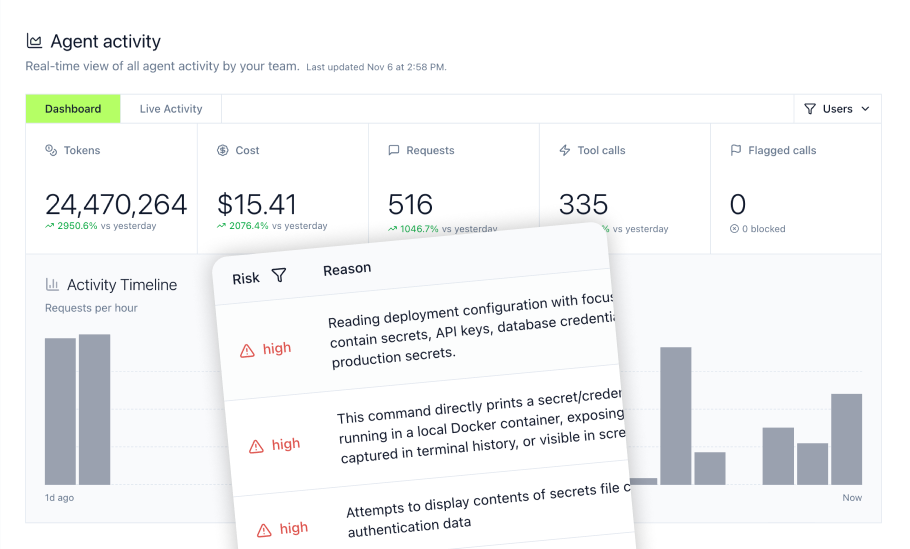
Visibility into AI agent behavior is essential for security and compliance. Without monitoring, organizations cannot detect unauthorized data access or policy violations.
Live dashboards for AI coding activity
Effective observability requires tracking:
- Tool invocations: Every MCP server call, API request, and external integration
- Command execution: All bash commands and file operations
- Data access patterns: Which files, databases, and systems agents interact with
- Usage anomalies: Unusual patterns indicating potential security incidents
Tracking every tool invocation and file access
MintMCP's LLM Proxy offers complete visibility into installed MCPs, their permissions, and usage patterns across teams. The platform provides audit observability with command history tracking every bash command, file access, and tool call for security review.
Ensuring compliance and data residency for Windsurf AI coding workflows
Regulated industries require specific certifications and data handling controls before deploying AI coding tools.
Compliance certifications
Windsurf maintains comprehensive security certifications:
- SOC 2 Type II: Completed February 2025 pentest
- FedRAMP High: Via Palantir FedStart program
- HIPAA: Compliant with BAA for significant implementations
- GDPR: EU deployment available (Frankfurt)
- DoD: IL4/IL5/IL6 and ITAR compliant
Data residency controls
Organizations operating under data sovereignty requirements can deploy Windsurf in specific regions:
- US Standard: Default cloud deployment
- EU (Frankfurt): GDPR-compliant European data residency
- GovCloud: FedRAMP High environments
- Self-hosted: Complete control over data location
MintMCP's MCP Gateway is SOC 2 compliant and offers HIPAA compliance options with complete audit trails for SOC2, HIPAA, and GDPR compliance. Multi-region support with data residency controls enables global deployment while meeting regulatory requirements.
Integrating Windsurf AI coding with enterprise data sources securely
AI coding agents become more powerful when connected to organizational data—but these integrations require careful security controls.
Secure integration architecture
Windsurf supports MCP server integrations for databases, APIs, and enterprise systems. Each integration should be:
- Admin-controlled: Whitelist approved MCP servers rather than allowing individual installations
- Permission-scoped: Limit data access to necessary operations
- Audit-logged: Track every query and data retrieval
Available enterprise connectors
MintMCP provides secure connectors enabling AI agents to access enterprise data with proper governance:
- Elasticsearch MCP Server: Query knowledge bases and perform log analysis
- Snowflake MCP Server: Natural language queries for product analytics
- Gmail MCP Server: AI-driven email automation
These integrations enable enterprise AI agents to access real-time data while maintaining security controls and compliance requirements.
Empowering Windsurf developers: Fast, secure deployment of AI coding tools
Security controls should enable productivity, not obstruct it. The goal is self-service access within governed boundaries.
Enabling developers with supervised AI access
Effective enterprise deployment balances security with developer experience:
- Pre-configured policies: Deploy MCP tools with security rules already defined
- Self-service access: Developers request and receive AI tool access instantly
- Centralized credentials: Manage all API keys and tokens in one place
- No workflow disruption: Security operates transparently without changing developer habits
One-Click deployment for developer productivity
Organizations achieve significant productivity gains when security infrastructure supports rather than hinders AI coding adoption. The key is implementing governance from day one rather than retrofitting controls after incidents occur.
MintMCP's MCP Gateway enables rapid deployment with one-click installation of MCP servers and automatic OAuth protection. Developers can access AI tools immediately while IT maintains tool governance and compliance controls.
Bridging shadow AI to sanctioned AI in Windsurf: The gateway to secure coding
Developers adopt AI coding tools regardless of official approval. The choice is between ungoverned shadow AI or sanctioned tools with proper controls.
The shadow AI challenge
When organizations block or delay AI tool access, developers find workarounds—creating security blind spots and compliance gaps. A governance-first approach provides:
- Visibility: See which AI tools teams are using across the organization
- Control: Enforce policies without blocking legitimate productivity gains
- Compliance: Generate audit trails meeting SOC2, HIPAA, and GDPR requirements
- Speed: Deploy approved tools faster than shadow alternatives spread
Building an enterprise AI strategy for Windsurf
Successful AI governance programs implement:
- Inventory existing usage: Identify current AI tools and access patterns
- Define acceptable use policies: Establish clear guidelines for AI coding
- Deploy monitoring infrastructure: Implement visibility before expanding access
- Enable self-service within guardrails: Provide sanctioned alternatives to shadow tools
- Iterate based on data: Use observability to refine policies continuously
Understanding MCP gateways is essential for organizations building comprehensive AI governance frameworks. MintMCP helps turn shadow AI into sanctioned AI by providing the security, governance, and ease-of-use needed for enterprise-wide deployment.
Frequently asked questions
What is the total cost of deploying Windsurf securely for a 100-person team?
Direct costs include Teams subscription ($30/user/month = $36,000/year) plus SSO add-on (+$10/user/month = $12,000/year) for approximately $48,000 annually. Hidden costs include network configuration (4-8 hours IT time), SSO setup (8-16 hours), and security rules maintenance (4-8 hours/month ongoing). Many teams find the subscription cost can be offset quickly by developer time savings, but the timeline depends on usage and internal rollout efficiency.
How do I migrate from Cursor or GitHub copilot to Windsurf?
Migration complexity is low since Windsurf is built on VS Code. The platform imports VS Code settings automatically, though security rules and custom workflows require manual recreation. Plan 1-2 weeks for individual developers or 4-6 weeks for enterprises with SSO/governance. Phases include preparation (3 days), testing with pilot group (1 week), phased rollout (2-3 weeks), and verification (1 week).
Can Windsurf be deployed in air-gapped environments for classified projects?
Yes. Windsurf's self-hosted deployment option operates entirely within customer networks with customer-owned LLM endpoints (such as AWS Bedrock in GovCloud). Windsurf markets a FedRAMP High authorized government offering, and describes serving FedRAMP High customers via Palantir FedStart on AWS GovCloud. Self-hosted is a separate option focused on customer-managed compute/data-plane control (and comes with product capability tradeoffs). Setup requires Kubernetes deployment, private container registry, and integration with internal identity providers—typically 4-6 weeks for infrastructure plus authorization.
How do I prevent prompt injection attacks in Windsurf?
Prompt injection risks exist, including vulnerabilities that allow malicious filenames to manipulate AI behavior. Mitigation strategies include implementing security rules files with explicit NEVER flags for dangerous operations, disabling auto-execution of terminal commands, using .codeiumignore to exclude sensitive directories, and integrating runtime security scanning. Regular security audits of AI-generated code remain essential regardless of preventive controls.