Salesforce's Model Context Protocol (MCP) Server transforms how AI agents interact with CRM data, enabling Claude, ChatGPT, Cursor, and custom agents to query accounts, update opportunities, and trigger automations through standardized tool calls. With general availability announced in April 2026 for Enterprise Edition and above, organizations gain powerful AI-to-CRM connectivity, but face governance challenges around permissions, credentials, and audit trails. MintMCP's MCP Gateway provides the governed entry point enterprises need to connect AI clients to Salesforce securely, with centralized authentication, tool curation, and complete audit logging.
Key Takeaways
- Salesforce Hosted MCP Servers provide standard servers for CRUD operations, SOQL queries, Data 360, analytics, and other Salesforce capabilities, while custom servers can expose tools backed by Apex, Flows, Apex REST endpoints, and API Catalog entries
- Salesforce states that initial setup takes under 30 minutes, while production security review and hardening time varies by organization
- Virtual MCPs allow teams to create role-specific Salesforce endpoints with curated tools, read-only or read-write access, and SCIM-driven membership
- Security teams face 30+ CVEs filed in Q1 2026 related to MCP vulnerabilities including tool poisoning and rug pull attacks
- Agent Gateway provides autonomous agents with first-class non-human identities, independent credentials, and attributable audit trails for Salesforce operations
- Salesforce MCP can reduce manual UI steps for multi-action CRM workflows, but published workflow demos should not be treated as controlled productivity or adoption benchmarks
- Enterprise MCP governance requires runtime guardrails, DLP integration, and operational controls to prevent dangerous agent actions in CRM systems
Understanding the Need for Salesforce MCP Server Integration with AI
Why Traditional Salesforce Integration Falls Short for AI
Traditional Salesforce integrations require custom API development for each AI tool, creating duplicated setup across Claude, Cursor, ChatGPT, and other clients. Key challenges include:
- Each developer configures MCP servers locally
- Credentials scattered across laptops
- No centralized audit trail
- N installs and failures as teams scale AI adoption
The Salesforce Hosted MCP Server addresses the connectivity problem by providing standardized endpoints for AI clients. Salesforce provides multiple standard server types for different use cases, including:
- SObject All: Full CRUD operations plus query and search capabilities
- SObject Reads: Read-only access for analysis and reporting
- SObject Mutations: Create and update operations
- SObject Deletes: Delete operations
- Data 360: Unified customer data queries
- Tableau Next: Analytics and KPI access
- Archive Connect: Archived-record search and compliance operations
- Backup and Recover: Backup inspection, policy management, and guided restore workflows
- Headless 360 (Beta): Broader Salesforce platform and Setup operations
- CRM Analytics (Beta): Read-only CRM Analytics discovery and SAQL queries
However, Salesforce's native controls are scoped to the Salesforce environment. Salesforce provides per-user authentication, permission enforcement, audit logging, and MCP activity telemetry, while organizations operating multiple AI clients and enterprise systems may still need a centralized layer for consistent tool curation, cross-platform access policies, runtime guardrails, and unified auditability.
The Rise of AI Agents and CRM Data Access Challenges
AI agents operating in Salesforce environments introduce unique risks. An agent can decide at runtime which tools to call, and tool descriptions themselves become an injection surface for malicious instructions. Without proper governance, a user can prompt an agent to delete all leads in a single request.
The core challenges include:
- Fragmented telemetry: Salesforce logs Hosted MCP activity through Event Monitoring, but organizations using multiple AI clients and enterprise systems may still need centralized visibility across their broader agent environment
- Human-bound identity: Salesforce Hosted MCP ties each session to an authenticated Salesforce user and does not currently support machine-to-machine authentication, creating a separate identity challenge for autonomous agents that should operate as non-human principals
- Unpredictable actions: Agents choose tools autonomously, making behavior difficult to predict or control
- Tool poisoning risks: Malicious instructions in MCP tool metadata can instruct models to exfiltrate data
MintMCP's Agent Gateway addresses these challenges by extending governed data and tool access to first-class agent identities, scoped permissions, and monitoring.
Setting Up Your Salesforce MCP Server with MintMCP
Creating Virtual MCPs for Salesforce Access
MintMCP's Virtual MCP (VMCP) abstraction bundles Salesforce connectors behind one governed endpoint for each team, role, or use case. Instead of every developer configuring Salesforce MCP access locally, administrators create curated VMCPs with pre-configured authentication and tool sets.
The setup process through MintMCP involves:
- Activate Salesforce MCP Server: In Salesforce Setup, search "MCP Servers," select the appropriate server type (start with SObject Reads for pilots), and click Activate
- Create External Client App: Configure OAuth with PKCE requirement, using only mcp_api and refresh_token scopes
- Configure VMCP in MintMCP: Create a Virtual MCP that references the Salesforce connector, define tool curation rules, and set access policies
- Connect AI Clients: Users connect to the single VMCP endpoint rather than configuring Salesforce directly
This approach centralizes Salesforce MCP configuration so administrators can manage governed access through shared Virtual MCP endpoints instead of repeating connector setup and policy configuration for every developer.
Connecting Salesforce with MintMCP: Hosted vs. Custom Connectors
MintMCP supports multiple connector deployment models for Salesforce:
Hosted Connectors: MintMCP operates the connector runtime, injecting credentials per call without storing long-lived secrets. Connectors run in MintMCP's data plane and are never exposed to the public internet.
Remote Connectors: Organizations can run Salesforce connectors in their own infrastructure while routing through MintMCP for governance. The private network tunnel enables connectivity to on-premises or VPC-hosted connectors.
Custom Connectors: Teams can build organization-specific MCP servers backed by Flows, Apex Invocable Actions, or Named Queries and deploy them through MintMCP's hosted CLI.
For multi-tenant B2B SaaS scenarios, Salesforce's per-org authentication and provisioning model can introduce onboarding overhead because each customer environment requires its own Salesforce configuration. However, Salesforce's standard SObject servers support both standard and custom objects, while custom MCP servers can expose additional org-specific logic through Apex, Flows, REST endpoints, and API Catalog entries.
Leveraging Virtual MCPs for Granular Salesforce Access Control
Defining Read-Only vs. Read-Write Access with Virtual MCPs
Virtual MCPs enable granular access control by curating different tools over the same underlying Salesforce connector. A sales analytics team might receive a read-only VMCP exposing query tools, while sales operations receives a read-write VMCP with create and update capabilities.
Access patterns for Salesforce VMCPs typically include:
- Read-only analytics: Expose SOQL queries and Data 360 for pipeline reporting and customer analysis.
- Standard sales operations: Allow read, create, and update actions for activity logging and opportunity management.
- Admin operations: Provide broader CRUD and Apex access for data cleanup and bulk operations.
- Marketing integrations: Limit access to read operations and specific updates for campaign tracking and lead scoring.
Tool curation also addresses context-window management. Salesforce notes that MCP clients can struggle to select the right tool once catalogs grow beyond a few dozen tools, so curating capabilities helps keep the available tool surface relevant to each role or use case.
Automating Access Policies through SCIM for Salesforce
MintMCP integrates with identity providers through SCIM provisioning, enabling directory groups to drive VMCP membership automatically. When a user joins the "Sales Analytics" group in Okta or Entra ID, they automatically gain access to the corresponding Salesforce read-only VMCP.
This approach provides:
- Consistent access control: Salesforce permissions align with organizational identity structure
- Automated provisioning: No manual VMCP assignments when employees change roles
- Immediate revocation: Suspending a user in the IdP propagates to MCP access
- Audit alignment: Access grants tie directly to directory group membership decisions
Governing Autonomous AI Agents in Salesforce Environments
Assigning Unique Identities to Agents Accessing Salesforce
Autonomous agents accessing Salesforce require first-class non-human identities, not inherited human credentials. MintMCP's Agent Gateway treats each agent as a named, org-scoped principal with its own credential, scoped MCP access, and audit trail.
Agent identity benefits for Salesforce operations:
- Attribution: MintMCP can attribute gateway activity to the specific agent, while Salesforce Hosted MCP records downstream actions under the Salesforce user who authenticated the session
- Independent rotation: Agent credentials can be rotated without affecting human users
- Scoped access: Each agent receives only the Salesforce tools required for its function
- Revocation: Compromised agents can be disabled without disrupting other operations
Credential Management for AI Agents in CRM Contexts
MintMCP supports multiple authentication mechanisms for agent Salesforce access, from simplest to most secure:
- Bearer keys: Static key on every request with name, expiry, and individual revocation
- M2M tokens: OAuth client-credentials exchange for short-lived tokens, keeping secrets out of the request path
- Workload identity federation: The agent's infrastructure mints short-lived OIDC tokens; MintMCP holds no secret at all
MintMCP can give an autonomous agent its own Agent Gateway identity and credentials. However, Salesforce Hosted MCP currently requires authorization-code OAuth tied to an individual Salesforce user, so the downstream Salesforce session remains associated with that authenticated user.
Monitoring and Auditing Salesforce Interactions by AI Agents
Real-Time Visibility into Salesforce Data Access by AI
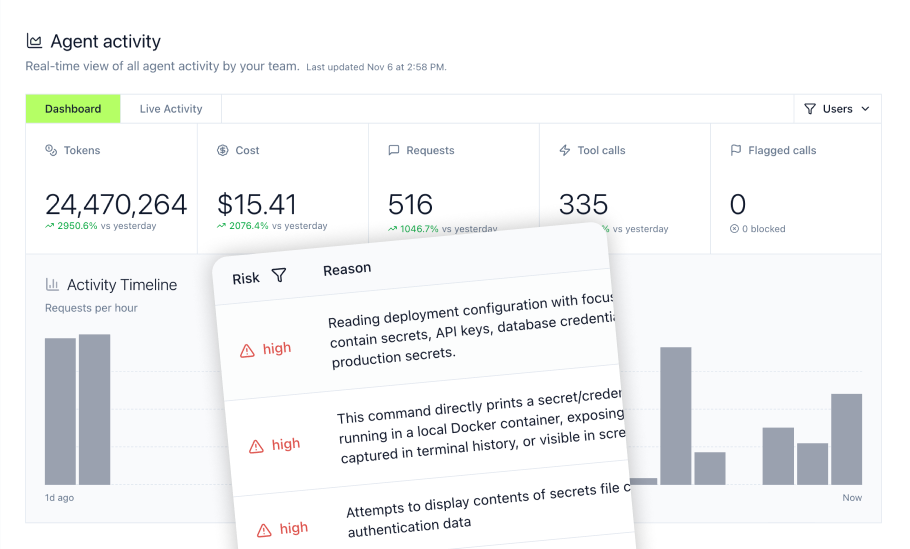
MintMCP's Agent Monitor provides visibility into what AI agents do with Salesforce data. Activity captured includes:
- MCP tool calls (which Salesforce objects were queried or modified)
- Prompts that triggered Salesforce operations
- Commands and file access from coding agents
- Token usage and costs per agent, user, and session
The live activity feed enables filtering by user, tool, time, and agent, giving security teams visibility into agent Salesforce operations.
Exporting Salesforce-Related AI Activity to SIEM Systems
For compliance and security operations, MintMCP exports agent activity to SIEM systems via OTLP or Splunk HEC. Exported events include:
- Gateway requests with tool names and arguments
- Prompt submissions
- Access-policy changes
- Credential lifecycle events
This integration enables security teams to correlate Salesforce AI activity with other enterprise security data, supporting SOC 2, HIPAA, and internal risk reporting requirements.
Applying Runtime Guardrails for Secure Salesforce Operations with AI
Preventing Data Leaks and Prompt Injections in Salesforce
MCP security vulnerabilities pose real risks to Salesforce data. Over 30 CVEs were filed in Q1 2026 related to tool poisoning, rug pull attacks, and supply chain compromises. MintMCP's guardrails operate through three complementary layers:
Mint Guard: Managed detection policies screen every tool call for prompt injection, credentials and secrets, PII, and harmful content. Blocks at high confidence in enforcing mode.
Rules: Declarative conditions match tool names, argument patterns, and content. Actions include flag, block, ask-user, mask, and notify.
Gateway Middleware: Customer-authored JavaScript runs in a sandbox on every matching call, enabling integration with external DLP systems, custom classifiers, and resource allowlists.
Customizing Security Policies for Salesforce AI Interactions
For Salesforce-specific security, organizations can implement:
- Tool restrictions: Prefer SObject Reads or SObject Mutations where delete access is unnecessary, and block delete-capable tools from SObject All or SObject Deletes except for explicitly authorized users or agents
- Field-level protection: Mask or redact sensitive fields (SSN, credit card) in query results before they reach the AI model
- Query validation: Prevent SOQL injection by validating query patterns against approved schemas
- Concurrency planning: Design client and orchestration concurrency around Salesforce's API limits; production orgs and sandboxes allow 25 concurrent inbound requests that run for 20 seconds or longer
Middleware templates ship with integrations for AWS Bedrock Guardrails, Google Cloud Model Armor, and other DLP systems, keeping security policy in the tools enterprises already operate.
Enterprise-Grade Security & Operations for Salesforce MCP
Streamlining User and Agent Access with Salesforce SSO/SCIM
MintMCP's enterprise security infrastructure provides:
- SSO integration: Okta, Entra ID, and Google Workspace authentication
- SCIM provisioning: Directory groups drive both admin roles and tool access
- RBAC: Organization-level roles for admin reach, VMCP access policies for tool reach
- Cross App Access (XAA): IdP-governed token exchange with dual attribution (human + agent)
Salesforce describes three security layers for Hosted MCP Servers: authentication, authorization, and permission controls, with logging providing an additional audit trail for MCP activity.
Ensuring Compliance and Auditability for Salesforce AI Data
Enterprise compliance requires tamper-evident audit trails. MintMCP provides:
- Complete logging: Every tool call, credential lifecycle event, and access-policy change
- Tamper-evident history: Access-grant history signed at write time, verifiable offline via published JWKS
- Operational controls: Org-wide kill switch, per-VMCP/per-tool disable, connector restart
- Compliance: MintMCP is SOC 2 Type II audited and compliant with HIPAA standards, with BAAs available for organizations handling protected health information
Integrating Coworker Agents for Salesforce-Driven Autonomous Work
Automating Salesforce Tasks with Persistent Coworker Agents
MintMCP's Coworker Agents enable long-running autonomous agents that work alongside employees on Salesforce tasks. These agents can:
- Respond to Slack threads with Salesforce data lookups
- Run scheduled pipeline summaries and push reports to channels
- Log activities and update opportunities based on meeting transcripts
- Open pull requests for Salesforce configuration changes
Triggers include Slack mentions, cron schedules, and manual runs. Each agent operates with scoped tool access through Virtual MCPs, governed credentials, and sandboxed execution.
In one ApexHours hands-on demonstration, a multi-step Salesforce update took roughly 30-40 seconds compared with an estimated five minutes of UI interaction. Treat this as a workflow demonstration rather than a controlled benchmark or adoption study.
Managing Company-Owned Agent Memory for CRM Operations
Coworker Agents maintain company-owned memory rather than opaque vendor-managed state. Memory follows Git-like principles:
- Versioned: Changes tracked over time
- Reviewable: Instructions and memory are files, not hidden state
- Auditable: Complete run history available for compliance review
- Portable: Organizations own their data, not locked to a single provider
Memory can be scoped to individual agents, teams, or the organization, enabling appropriate information sharing while maintaining governance boundaries.
How MintMCP Makes Salesforce MCP Enterprise-Ready
Salesforce Hosted MCP Servers provide standardized AI-to-CRM connectivity, but enterprise deployments often need governance that extends across multiple AI clients, tools, and data sources.
MintMCP adds that control through three core layers:
- Governed access with Virtual MCPs: Bundle Salesforce connectors behind curated tool surfaces, role-specific access policies, and SCIM-driven membership.
- Agent identity with Agent Gateway: Give autonomous agents first-class non-human identities, independent credentials, scoped tool access, and attributable MintMCP audit trails.
- Runtime enforcement with Mint Guard, Rules, and Gateway Middleware: Detect prompt injection, protect sensitive data, enforce custom policies, and integrate existing DLP systems.
MintMCP also adds:
- Agent Monitor for supported agent activity, usage, and security visibility
- SIEM export for centralized security analysis
- Operational controls for disabling tools, VMCPs, or broader access when needed
Together, these capabilities let organizations use Salesforce Hosted MCP Servers while applying consistent access controls, runtime policies, auditability, and observability across their broader AI environment.
Frequently Asked Questions
Can Salesforce MCP Servers access custom objects with __c fields?
Yes. Salesforce's standard SObject Hosted MCP Servers can access both standard and custom objects, subject to the authenticated user's Salesforce permissions. Custom MCP servers are additionally available when organizations need to expose custom logic backed by Apex, Flows, REST endpoints, or API Catalog entries.
What happens if an agent tries to delete all records in Salesforce?
With native Salesforce MCP alone, a user with appropriate permissions could instruct an agent to perform mass deletions. MintMCP can add runtime controls around destructive operations: Virtual MCP tool curation can exclude delete-capable tools, Rules can block or require approval for matching operations, and Gateway Middleware can apply customer-authored policies before supported calls execute. Agent Monitor can provide visibility into supported agent activity for security review.
How do Salesforce API limits affect MCP agent operations?
Salesforce limits concurrent inbound API requests lasting 20 seconds or longer to 25 for production orgs and sandboxes and 5 for Developer Edition and trial orgs. Agent workflows with long-running parallel calls should account for this limit in their client or orchestration design. MintMCP can govern which Salesforce tools agents can access and apply supported runtime policies, but its approved Rules actions do not include request queuing or throttling.
Does using MCP affect Salesforce's existing permission model?
No. Every MCP transaction runs with the authenticated user's identity and enforces existing Salesforce permissions including field-level security, sharing rules, and validation rules. MCP adds connectivity, not permission bypass. Organizations that have properly configured Salesforce security will see those controls enforced through MCP access.
Can I use Salesforce MCP with AI clients other than Claude?
Yes. Salesforce Hosted MCP Servers work with any MCP-compatible client including Claude, ChatGPT, Cursor, Codex, and custom agents. MintMCP's Virtual MCP approach provides a single governed endpoint that all these clients can connect to, eliminating the need to configure Salesforce MCP access separately for each tool.