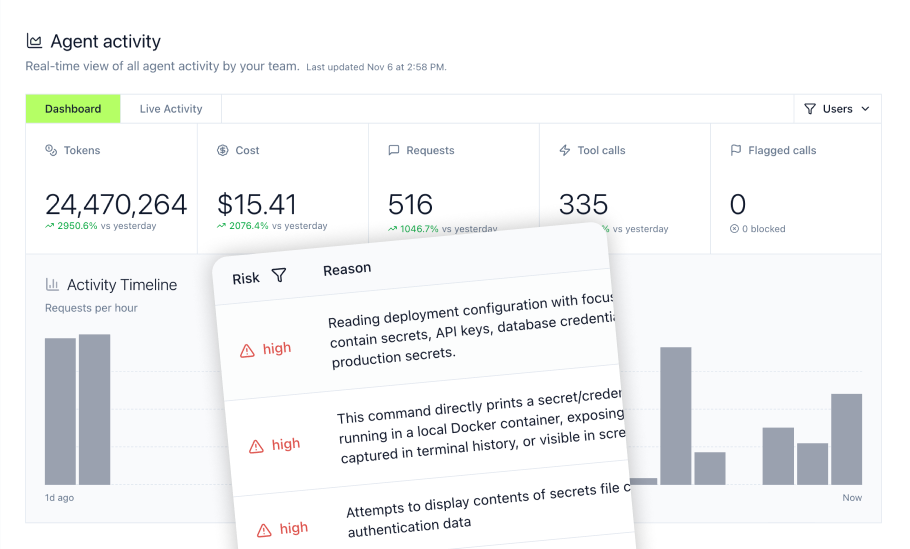
Data-driven insights revealing how governance frameworks, access controls, and compliance measures protect enterprises deploying AI at scale
AI adoption has outpaced security infrastructure across enterprises worldwide. Organizations race to deploy AI tools while governance policies lag dangerously behind—creating substantial risk exposure. MintMCP's MCP Gateway provides the centralized governance, audit logging, and access controls enterprises need to close this gap. The data proves that policy enforcement isn't optional: 97% of organizations compromised by AI-related security incidents lacked proper access controls. This comprehensive analysis examines market growth, governance adoption rates, security incidents, regulatory developments, and implementation strategies shaping enterprise AI policy enforcement.
Key takeaways
- Governance market is exploding – The AI governance market reached $227.65 million in 2024 and is projected to reach $4.83 billion by 2034, demonstrating 35.74% CAGR
- Policy gaps create massive risk – Only 43% of organizations have AI governance policies
- Shadow AI costs compound – Unauthorized AI usage adds $670,000 to average breach costs compared to organizations with low or no shadow AI usage
- Security automation delivers ROI – Organizations with extensive AI and automation save $1.9 million in breach costs
- Regulations are accelerating – U.S. federal agencies introduced 59 AI-related regulations in 2024, more than double the prior year
- Board oversight is rising – In 2025, 48% of Fortune 100 companies cite AI risk as part of board oversight, triple the 16% from 2024
Market growth and adoption statistics
1. The global AI governance market reached $227.65 million in 2024
Market research confirms enterprise investment in AI governance infrastructure has reached critical mass. This valuation reflects growing recognition that AI deployment without proper controls exposes organizations to regulatory, operational, and reputational risk. The market encompasses governance platforms, compliance tools, monitoring systems, and implementation services that enable enterprises to deploy AI responsibly at scale.
2. AI governance market projected to reach $4,834.44 million by 2034
Industry analysts forecast the governance market will grow more than 20-fold over the next decade. This explosive expansion reflects mainstream enterprise adoption as boards and executives recognize AI governance as a strategic priority. The projection accounts for expanding regulatory requirements, increasing AI deployment complexity, and growing awareness of ungoverned AI risks.
3. Market growing at a CAGR of 35.74% from 2025 to 2034
The 35.74% compound annual growth rate substantially exceeds most enterprise software categories. This acceleration stems from proven ROI in risk reduction, regulatory pressure across jurisdictions, and competitive dynamics as governance-mature organizations gain advantages in compliance posture and operational efficiency. Enterprises deploying MCP infrastructure benefit from built-in governance capabilities rather than retrofitting controls.
4. MarketsandMarkets forecasts AI governance market to reach $5,776.0 million by 2029
An alternative projection indicates the market could reach $5.78 billion by 2029—suggesting even faster near-term growth than longer-range forecasts. This variance reflects uncertainty about regulatory timelines and enterprise adoption rates. Either scenario confirms governance infrastructure as one of the fastest-growing enterprise technology categories.
5. Expected CAGR of 45.3% for AI governance market through 2029
MarketsandMarkets projects 45.3% CAGR through 2029, indicating compressed adoption timelines as enterprises accelerate governance investments. This growth rate validates AI governance as a high-priority budget category competing successfully against other technology initiatives. Organizations delaying governance investments face compounding risk exposure as AI deployments expand.
6. 88% of organizations report using AI in at least one business function
McKinsey survey data confirms near-universal AI adoption across enterprises. This saturation creates urgent governance requirements—organizations cannot secure AI they cannot see or control. The high adoption rate means governance gaps affect nearly every enterprise, regardless of industry or size.
7. Only 33% of organizations have begun scaling AI programs across their enterprise
Despite widespread AI usage, just one-third have moved beyond pilots to enterprise-scale deployment. This transition phase represents the critical moment for governance implementation—scaling AI without controls multiplies risk exposure proportionally. Organizations implementing centralized MCP governance during scaling avoid retrofitting controls later.
Governance policy statistics
8. Only 43% of organizations have an AI governance policy in place
PEX Report data reveals a dangerous gap between AI adoption and governance readiness. More than half of organizations deploying AI lack formal policies governing its use. This policy vacuum creates inconsistent practices, unmanaged risk, and potential regulatory violations as requirements expand. Separately, McKinsey found that 88% of organizations use AI in their business functions, highlighting the stark contrast between AI usage and governance maturity.
9. 63% of breached organizations either don't have an AI governance policy or are still developing one
IBM Cost of Data Breach analysis links governance gaps directly to security incidents. Organizations without established policies face substantially higher breach risk. This correlation validates governance investment as risk mitigation rather than compliance overhead. Solutions like MintMCP's LLM Proxy provide immediate visibility and control while governance policies mature.
10. 48% of fortune 100 companies cite AI risk as part of board oversight responsibilities
In 2025, Fortune 100 disclosure analysis shows board-level attention to AI risk has tripled from 16% in 2024. This dramatic increase reflects regulatory pressure, shareholder concerns, and high-profile AI incidents driving executive attention. Board oversight creates accountability structures that cascade governance requirements throughout organizations.
11. 40% disclosed charging at least one board-level committee with AI oversight
Committee-level AI oversight increased from 11% to 40% year-over-year among Fortune 100 companies. This structural change embeds AI governance into corporate governance frameworks permanently. Organizations without formal oversight structures face increasing scrutiny from investors, regulators, and auditors.
12. 36% of fortune 100 companies now disclose AI as a separate 10-K risk factor
Regulatory filing analysis shows AI-specific risk disclosure more than doubled from 14% in 2024. This disclosure pattern indicates AI governance has become material to investor decisions. Organizations must demonstrate governance capabilities to satisfy disclosure requirements and maintain investor confidence.
Security incident statistics
13. 97% of organizations reporting ai-related security incidents lacked proper AI access controls
IBM breach research establishes a near-perfect correlation between access control gaps and security incidents. This statistic proves that governance infrastructure prevents incidents rather than merely documenting them. Platforms providing granular tool access control address this risk directly through role-based permissions.
14. 13% of organizations reported breaches of AI models or applications
One in eight organizations experienced AI-specific security incidents. This breach rate will increase as AI deployment expands without proportional governance investment. The relatively low current rate reflects AI's recent mainstream adoption—breach rates will normalize upward as attackers target AI infrastructure more systematically.
15. 233 ai-related incidents documented in 2024, representing a 56.4% increase year-over-year
Stanford AI Index tracking shows AI security incidents accelerating rapidly. The 56.4% annual increase outpaces both AI adoption growth and overall cybersecurity incident trends. This trajectory validates proactive governance investment before incidents occur rather than reactive controls after breaches.
16. 60% of ai-related security incidents led to compromised data
Incident outcome analysis shows most AI security incidents result in data exposure. This high compromise rate reflects AI's inherent data access requirements—AI tools need data to function, creating attack surfaces that traditional security controls don't address. Complete audit trails enable incident investigation and scope determination.
17. 31% of AI security incidents led to operational disruption
Nearly one-third of incidents caused business operations to halt or degrade. As organizations embed AI into critical workflows, this disruption risk magnifies. Operational dependencies on AI require governance controls that maintain availability while enforcing security policies.
Shadow AI statistics
18. One in five organizations reported a breach due to shadow AI
In 2025, shadow AI breach data shows 20% of organizations experienced security incidents from unauthorized AI usage. Employees using unsanctioned AI tools create ungoverned data flows that bypass security controls entirely. LLM Proxy monitoring provides visibility into AI tool usage across organizations, transforming shadow AI into sanctioned AI.
19. Only 37% of organizations have policies to manage AI or detect shadow AI
Less than four in ten organizations can identify or control unauthorized AI usage. This detection gap allows shadow AI to proliferate unchecked. Organizations cannot govern AI they cannot see—visibility must precede policy enforcement.
20. Shadow AI adds $670,000 to average breach costs
Cost impact analysis quantifies shadow AI's financial risk at nearly $700,000 per incident above baseline breach costs compared to organizations with low or no shadow AI usage. This premium reflects investigation complexity, scope uncertainty, and regulatory penalties when unauthorized tools access regulated data. Governance ROI calculations should include avoided shadow AI costs.
21. 78% of employees report using AI tools in the office
Employee usage surveys show AI adoption has reached nearly four in five workers. This penetration level makes governance essential—AI usage will continue regardless of organizational policies. Effective governance enables safe AI usage rather than attempting prohibition.
22. 58% of employees admit to providing sensitive company information to large language models
Data handling surveys reveal the majority of employees share sensitive data with AI tools. This behavior creates data leakage risk that traditional DLP tools don't address. Prompt security controls and sensitive file protection prevent unauthorized data exposure.
Cost and ROI statistics
23. Organizations with extensive AI security and automation usage save $1.9 million in breach costs
IBM breach cost research demonstrates substantial ROI from AI security investments. The $1.9 million savings reflect faster incident detection, automated response, and reduced breach scope. This cost avoidance funds governance infrastructure many times over.
24. Global average cost of a data breach is $4.4 million USD
Baseline breach costs of $4.4 million USD establish the risk exposure organizations face from inadequate governance. At $4.4 million per incident, even modest breach probability creates substantial expected loss. Governance investments delivering 5-10% risk reduction generate positive ROI immediately.
25. 64% of respondents say AI is enabling their innovation
Innovation impact surveys show most organizations see AI driving new capabilities. Policy enforcement enables innovation by providing guardrails that let teams experiment safely. Governance accelerates AI adoption by reducing risk that otherwise slows deployment.
Regulatory statistics
26. U.S. Federal agencies introduced 59 ai-related regulations in 2024
Regulatory tracking shows federal AI regulation more than doubled year-over-year. This acceleration creates compliance requirements across industries and use cases. Organizations need governance infrastructure that adapts to evolving regulations without requiring complete system rebuilds.
27. Legislative mentions of AI rose 21.3% across 75 countries since 2023
Global legislative analysis confirms AI regulation is a worldwide phenomenon. Multinational organizations face compliance requirements across jurisdictions with varying approaches. Data residency controls enable geographic compliance flexibility.
28. At least 69 countries have proposed over 1,000 ai-related policy initiatives
Policy initiative tracking reveals the breadth of global AI governance activity. This regulatory diversity creates compliance complexity for organizations operating across borders. Unified governance platforms reduce the overhead of meeting varied requirements.
29. In 2025, state legislatures considered more than 1,000 bills related to AI
State-level regulatory analysis shows U.S. AI regulation extends far beyond federal requirements. Organizations must track and comply with state-specific mandates that vary substantially. Complete audit logs support compliance demonstration across jurisdictions.
30. 136 ai-related bills were signed into law in 40 states in 2025
Enacted legislation tracking confirms AI regulation is now active law in 80% of U.S. states. This legislative momentum will continue as AI incidents drive constituent demands for protection. Governance infrastructure deployed now positions organizations for compliance with future requirements.
31. 73% of fortune 100 companies now disclose alignment with external cybersecurity frameworks
Framework alignment reporting increased from 57% to 73% year-over-year. This disclosure pattern indicates standardized governance frameworks are becoming expected practice. SOC2 Type II certified platforms like MintMCP provide compliance alignment without custom implementation.
Strategic implementation insights
Policy enforcement succeeds when governance infrastructure matches AI deployment scope. Organizations implementing AI governance tools report 54% rely on AI gateways for centralized control. The most effective implementations share common characteristics:
- Start with visibility – Deploy monitoring before enforcement to understand current AI usage patterns
- Centralize authentication – Implement OAuth and SSO for all AI tool access through unified identity management
- Establish audit trails – Enable complete logging for compliance documentation and incident investigation
- Define role-based access – Configure tool permissions by team function rather than blanket enablement
- Monitor continuously – Track usage patterns, detect anomalies, and maintain SLA compliance through real-time dashboards
MintMCP's enterprise MCP deployment infrastructure addresses these requirements through one-click deployment, automatic OAuth protection, and complete audit logging. Organizations achieve governance readiness in minutes rather than months—deploying controls before AI tools proliferate beyond visibility.
The AI governance trends point toward increasing regulatory requirements and higher breach costs. Organizations investing in governance infrastructure now gain compounding advantages as requirements expand and competitors struggle with retrofitted controls.
Frequently asked questions
What is policy enforcement in the context of AI statistics?
Policy enforcement in AI refers to the systematic implementation of governance controls that regulate how AI tools access data, execute actions, and interact with enterprise systems. It encompasses authentication requirements, access controls, audit logging, and compliance monitoring that ensure AI operates within defined boundaries. Effective enforcement requires visibility into AI usage, defined policies, and technical controls that prevent unauthorized actions.
Why is AI governance critical for modern enterprises using statistical AI?
AI governance protects enterprises from regulatory penalties, data breaches, and operational disruptions that ungoverned AI creates. With 97% of organizations compromised by AI-related incidents linked to access control failures, governance directly prevents incidents. Additionally, 58% of employees admit sharing sensitive data with AI tools—governance provides guardrails that enable productive use while preventing data exposure.
How does MintMCP ensure compliance with data privacy regulations like GDPR and HIPAA?
MintMCP is SOC2 Type II certified with HIPAA compliance options and GDPR-compliant audit trails. The platform provides complete audit logs documenting every MCP interaction, access request, and configuration change. Data residency controls enable geographic compliance, while role-based access controls limit tool availability based on compliance requirements.
What role do audit trails play in AI policy enforcement for statistical data?
Audit trails provide the evidentiary foundation for compliance demonstration, incident investigation, and governance verification. Complete logs document who accessed what data, when, through which AI tools, and what actions resulted. This visibility satisfies SOC2, HIPAA, and GDPR audit requirements while enabling security teams to detect anomalies, investigate incidents, and verify policy compliance.
Can MintMCP help control which AI tools access sensitive statistical data?
MintMCP's Virtual MCPs expose only minimum required tools rather than entire MCP servers. Granular tool access control enables administrators to configure permissions by role—enabling read-only operations while excluding write tools, for example. Combined with OAuth enforcement and real-time monitoring, organizations maintain precise control over AI tool capabilities and data access.