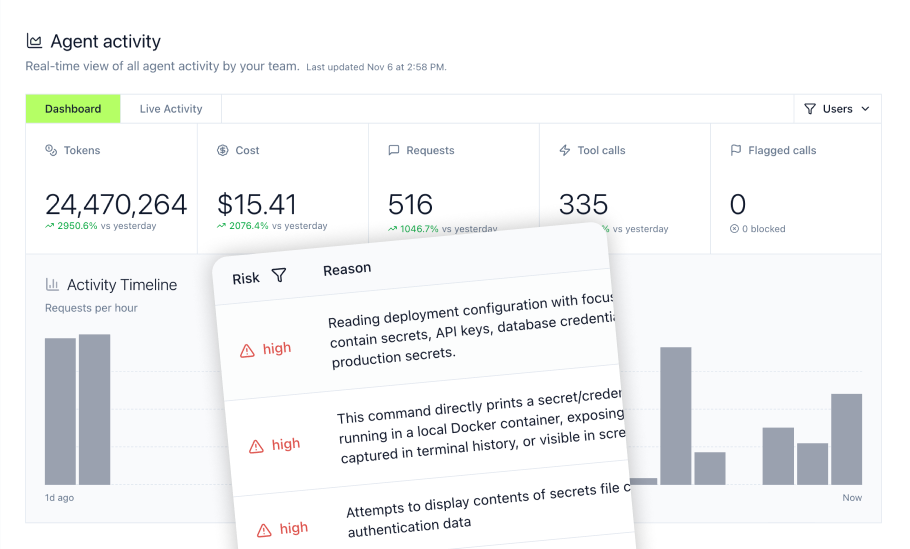
Multi-agent AI systems are rewriting how enterprises operate, but scaling from a single AI assistant to dozens of autonomous agents creates security, governance, and infrastructure challenges that the Model Context Protocol alone doesn't solve. An MCP gateway sits between AI clients and backend tools, providing authentication, observability, and centralized control over every tool invocation.
The MCP ecosystem is growing rapidly as enterprises connect AI assistants, coding agents, and internal automation to more tools and data sources. Yet without proper governance, AI tools operate as black boxes with significant security risks: limited telemetry, no consistent request history, and uncontrolled access to sensitive data.
This guide evaluates 12 MCP gateways for multi-agent workflows in 2026, comparing compliance posture, governance depth, deployment flexibility, and published performance indicators where vendors provide them. Whether organizations need SOC 2 Type II-audited controls for regulated deployments or low-latency infrastructure for high-frequency agent operations, one of these solutions fits enterprise requirements.
Key Takeaways
- MintMCP Gateway is strongest for regulated internal employee and internal-agent governance, with SOC 2 Type II-audited controls, SSO and SCIM-driven RBAC, tool-level policy, credential management, and audit logs
- TrueFoundry delivers a performance-focused managed option, with best-case latency claims and reported 350+ RPS/core in published benchmark materials
- Bifrost offers open-source performance with reported benchmark overhead around 11 microseconds
- Docker MCP Gateway provides container-native security isolation for teams already invested in Docker infrastructure
- Organizations should evaluate gateways based on compliance requirements, performance needs, MCP-specific governance primitives, and deployment flexibility before committing
1. MintMCP Gateway: Enterprise MCP Governance Gateway
MintMCP Gateway transforms local MCP servers into production-ready infrastructure with one-click deployment, OAuth protection, and enterprise-grade governance. As a SOC 2 Type II-audited MCP gateway focused on enterprise governance, MintMCP provides the trust and verification that regulated industries require before deploying AI agents at scale.
What Makes MintMCP Different
MintMCP's approach addresses the gap between AI assistants like ChatGPT and Claude and internal data. The platform handles authentication and permissions, credential management, audit trails, and the complexity that comes with enterprise deployments. Data-permissions-first controls start with SSO, SCIM-driven RBAC, IdP groups, Virtual MCP Bundles, tool-level policy, and audit, then enable agents on top. Virtual MCP Bundles expose only the minimum required tools per team or use case, not entire server capabilities.
Core Capabilities
- SOC 2 Type II-audited controls, compliant with HIPAA standards, penetration testing, and configurable security and audit features that can support regulated compliance programs
- SSO and SCIM-driven RBAC, tool-level allowlisting, rule-based policy, and centralized audit logs
- Virtual MCP Bundles: per-use-case endpoints with SCIM-driven membership, curated tools, and scoped access policy
- Agent Bundles with M2M auth and an “act as agent” flow for per-agent identity and governed agent access
- OAuth brokering for stdio and hosted MCP servers, plus credential management across connected tools
- Hosted MCP connectors run by MintMCP, including Elasticsearch, Snowflake, and Gmail
- Gateway + Agent Monitor two-layer governance for MCP traffic and local agent activity across Claude, Cursor, ChatGPT, Gemini, and Copilot workflows
- Official Cursor Hooks partner for validated coding agent integration
Best For
Regulated industries requiring audited security controls, enterprises with existing SOC 2 requirements, organizations turning shadow AI into sanctioned AI, and teams governing internal employees and internal agents across multiple AI clients
Getting Started: Visit mintmcp.com to book a demo
2. TrueFoundry MCP Gateway
TrueFoundry is a performance-focused managed MCP gateway option, with best-case sub-3ms latency claims and reported 350+ requests per second per core in published benchmark materials. For multi-agent systems where latency compounds across hundreds of tool calls per conversation, these performance characteristics may translate to improved user experience.
Where TrueFoundry Fits Best
TrueFoundry unifies LLM routing and MCP tool management in a single gateway, providing consolidated billing and observability across both workloads. The architecture is positioned for teams that need both AI gateway functionality and MCP governance in managed SaaS or self-hosted control-plane deployments.
Core Capabilities
- Performance-optimized architecture for high-throughput scenarios
- Hybrid deployment support, including managed SaaS and self-hosted control-plane options
- LLM routing and MCP tool management in one gateway layer
- Cost analytics and usage tracking per team and project
Tradeoffs to consider
TrueFoundry can fit platform and ML teams that want LLM routing and MCP management together. Teams prioritizing IT and security-led internal agent governance should also evaluate whether they need MintMCP-specific primitives such as Virtual MCP Bundles, Agent Bundles with M2M auth, hosted MCP connectors, and Gateway + Agent Monitor coverage.
Best For
High-throughput multi-agent systems, organizations requiring both LLM and MCP management, performance-critical applications
3. Bifrost by Maxim AI
Bifrost delivers an open-source MCP gateway option built in Go for compiled-language performance. The project reports microsecond-range overhead in benchmark scenarios and offers a self-hosted path for teams requiring maximum control without vendor lock-in.
Where Bifrost Fits Best
Bifrost's dual MCP client/server architecture supports both incoming agent requests and outbound tool connections from a single deployment. The Apache 2.0 license provides code transparency, with enterprise options available for organizations needing additional commercial features.
Core Capabilities
- Reported benchmark overhead around 11 microseconds
- Built-in tool registry with integration capabilities
- Lightweight self-hosted deployment for rapid prototyping
- Open-source under the Apache 2.0 license, with enterprise options available
Tradeoffs to consider
Bifrost gives engineering teams more infrastructure control, but self-hosted-first deployments can require teams to operate gateway infrastructure, connector runtime, scaling, and policy workflows themselves. MintMCP addresses this with managed SaaS-first deployment, hosted MCP connectors, SCIM-driven RBAC, and centralized auditability.
Best For
Teams requiring maximum performance and control, cost-conscious organizations, developers evaluating MCP infrastructure
4. Docker MCP Gateway
Docker's MCP Gateway applies container-native security practices to MCP workloads, isolating each server in its own container with resource limits. For organizations already invested in Docker infrastructure, this approach leverages familiar tooling while reducing blast radius if an MCP server or dependency is compromised.
Where Docker Fits Best
Docker Compose integration means MCP servers deploy with the same workflows teams already use for application containers. Each server runs in isolation, helping limit lateral movement if one tool is compromised.
Core Capabilities
- Container isolation with resource quotas per MCP server
- Docker Compose deployment for familiar workflows
- Supply-chain hygiene via containerized isolation, controlled privileges, and operational guardrails
- Support for running multiple servers per node in production environments
Limitations
Container overhead can add latency compared to native deployments. Docker-first deployments may also require teams to operate their own connector lifecycle, access policies, and audit workflows. MintMCP addresses these needs with managed hosted connectors, tool-level policy, credential management, and centralized observability.
Best For
Container-first organizations, teams prioritizing security isolation, enterprises with existing Docker expertise
Price: Free open-source option available
5. Lunar.dev MCPX
Lunar.dev MCPX combines governance capabilities with accessible pricing, offering reported low-latency performance alongside granular role-based access control at global, service, and tool levels. The free tier enables teams to evaluate governance before committing to enterprise pricing.
Primary Focus
MCPX provides multi-level access control that goes beyond simple role-based permissions. Administrators can grant access to specific tools within an MCP server while blocking others, which is useful for implementing least-privilege principles in multi-agent environments.
Core Capabilities
- Granular RBAC at global, service, and tool levels
- Comprehensive audit logs for compliance reporting
- Tool customization features to improve LLM accuracy
- Integration with Lunar AI Gateway for broader coverage
Tradeoffs to consider
MCPX is relevant for teams focused on MCP access control and service-level governance. Teams that need SCIM-driven per-use-case bundles, per-agent identity with M2M auth, hosted MCP connectors, and local agent activity monitoring should compare those requirements against MintMCP's data-permissions-first model.
Best For
Teams starting with governance, organizations needing fine-grained access control, enterprises evaluating before enterprise commitment
Price: Free tier available, paid plans on contact
6. IBM ContextForge
IBM's ContextForge represents an architecturally ambitious approach in the MCP gateway market, supporting multi-gateway federation with auto-discovery across distributed enterprise environments. It is an open-source option for teams exploring gateway federation and protocol bridging.
Primary Focus
ContextForge creates virtual MCP servers that combine multiple backends into unified interfaces, with protocol bridging capabilities that wrap REST and gRPC APIs as MCP tools without code changes.
Core Capabilities
- Federation architecture for distributed deployments
- Protocol bridging, including REST/gRPC to MCP conversion
- Virtual MCP servers combining multiple backends
- Multi-database support, including PostgreSQL, MySQL, and SQLite
- Open-source under the Apache 2.0 license
Considerations
Before production use, teams should verify the current release maturity, support model, and operational requirements directly. ContextForge may fit organizations with internal platform teams that can run and support open-source gateway infrastructure, while MintMCP is designed for managed SaaS-first governance, hosted connector runtime, and IT/security-led operational ownership.
Best For
Large distributed enterprises with federation requirements, teams evaluating protocol bridging, organizations with internal platform support capabilities
Price: Free open-source option available
7. Lasso Security MCP Gateway
Lasso Security builds an MCP gateway focused on threat detection. Real-time prompt injection detection, MCP server reputation scoring, and PII masking address attack vectors that general-purpose gateways may not prioritize.
Security-First Architecture
Lasso's plugin-based architecture enables custom security extensions without modifying core gateway code. Security teams can implement organization-specific policies while benefiting from Lasso's baseline threat detection.
Core Capabilities
- Real-time prompt injection detection
- MCP server reputation scoring
- PII masking and redaction
- Plugin architecture for custom security rules
Trade-off
Security scanning can add latency overhead, which matters for high-frequency operations. Teams should also evaluate whether they need MintMCP-style SCIM-driven RBAC, per-use-case Virtual MCP Bundles, Agent Bundles, hosted connector runtime, and Gateway + Agent Monitor coverage in addition to threat detection.
Best For
Security-first organizations, enterprises in adversarial environments, teams handling sensitive data
Price: Open-source and commercial platform options available
8. Composio
Composio positions itself as a practical choice for real-world teams by providing hundreds of managed integrations out of the box. Rather than building custom MCP servers for each tool, teams connect to pre-built integrations with unified OAuth authentication.
Integration Breadth
Composio abstracts authentication complexity across many tools, handling OAuth flows, API key rotation, and token refresh without custom code. This breadth reduces time-to-value for teams connecting agents to established SaaS tools.
Core Capabilities
- 500+ pre-built tool integrations
- Unified authentication layer across tools
- Developer-first SDK and documentation
- Managed SaaS-first deployment, with VPC/on-prem options on enterprise tiers
Tradeoffs to consider
Composio is strongest for developer and AI engineering teams building agentic apps with broad SaaS integration needs. Teams focused on internal employee and internal-agent governance should also evaluate whether they need MintMCP capabilities such as SCIM-driven RBAC, Virtual MCP Bundles, Agent Bundles, audit logs, rule-based policy, and Gateway + Agent Monitor coverage.
Best For
Rapid prototyping, teams connecting to many SaaS tools, organizations prioritizing integration breadth
Price: Free tier with paid plans available
9. Microsoft Azure MCP Solutions
Azure API Management can act as a governance layer for MCP servers in Azure-committed enterprises, integrating with Entra ID for authentication and Azure Monitor for observability. Dual deployment paths support both open-source Kubernetes deployments and managed Azure API Management integration.
Azure Ecosystem Integration
Organizations already invested in Azure can govern MCP server exposure without introducing new identity providers or observability stacks. For deeper tool-level governance and MCP-specific controls, teams should compare API-layer controls versus purpose-built MCP governance platforms.
Core Capabilities
- Native Azure AD/Entra ID integration
- Azure Monitor and App Insights observability
- Kubernetes-native architecture on AKS
- Dual deployment: open-source or Azure APIM
Consideration
Azure-first design creates multi-cloud challenges. Cloud-based deployment may add latency compared to edge deployments. Teams should also evaluate whether API management controls cover MCP-specific primitives such as Virtual MCP Bundles, Agent Bundles, stdio/hosted-server OAuth brokering, and tool-update policy.
Best For
Azure-committed organizations, enterprises with existing Azure Monitor investments, teams requiring native Entra ID integration
Price: Free open-source option on AKS or Azure APIM pricing
10. Kong AI Gateway
Kong extends its API gateway platform with MCP capabilities, offering organizations with existing Kong deployments a path to auto-generate MCP servers from REST APIs. LLM-as-a-Judge policy validation enables semantic review of tool outputs before they reach agents.
API Gateway Heritage
Kong's API gateway heritage makes it relevant for teams that already standardize API traffic through Kong and want to expose REST APIs as MCP tools. Adding MCP support lets organizations reuse existing infrastructure patterns rather than deploying a separate gateway stack for every MCP use case.
Core Capabilities
- REST-to-MCP conversion for existing APIs
- LLM-as-a-Judge policy validation
- Enterprise API gateway deployment patterns
- Unified API and MCP management console
Tradeoffs to consider
Kong can be a strong fit for API platform teams, especially when the goal is exposing REST APIs through MCP. Teams focused on internal agent governance should also assess whether they need MintMCP-specific controls such as SCIM-driven Virtual MCP Bundles, Agent Bundles, credential management, hosted connector runtime, and Agent Monitor coverage for local non-MCP activity.
Best For
Organizations with existing Kong deployments, teams exposing REST APIs as MCP tools, enterprises requiring unified API/MCP governance
Price: Enterprise pricing
11. Traefik Hub MCP Gateway
Traefik Hub implements a Triple Gate Pattern providing defense-in-depth across AI, MCP, and API layers. For organizations already using Traefik for cloud-native routing, adding MCP capabilities requires minimal infrastructure changes through middleware-based deployment.
Defense-in-Depth Security
Traefik's On-Behalf-Of (OBO) Authentication and Task-Based Access Control (TBAC) go beyond simple role-based permissions, enabling fine-grained policies tied to specific agent tasks rather than just user identities.
Core Capabilities
- Triple Gate security across AI, MCP, and API layers
- On-Behalf-Of authentication for delegated access
- Task-Based Access Control (TBAC)
- Cloud-native middleware deployment
Tradeoffs to consider
Traefik Hub is useful for teams already standardized on Traefik and cloud-native routing. Teams should compare task-level and middleware controls with MintMCP's MCP-specific governance primitives, including Virtual MCP Bundles, Agent Bundles, hosted MCP connectors, OAuth brokering, tool-update policy, and centralized audit trails.
Best For
Organizations using Traefik, teams requiring defense-in-depth security, cloud-native deployments
Price: Commercial licensing tied to Traefik Hub subscription
12. Operant AI
Operant AI combines MCP gateway functionality with dedicated security research and runtime defense capabilities. Its 3D Runtime Defense framework addresses emerging attack vectors such as Shadow Escape and other attempts to bypass agent security controls.
Security Research Focus
Operant's research-oriented approach focuses on discovering and responding to MCP security risks. Shadow Escape attack detection identifies attempts to bypass security controls through prompt manipulation.
Core Capabilities
- Shadow Escape and emerging threat detection
- 3D Runtime Defense framework
- Inline redaction and dynamic control
- Security research and publication
Tradeoffs to consider
Operant is relevant for security teams prioritizing emerging threat detection. Teams should also evaluate whether they need MintMCP's data-permissions-first governance model, SCIM-driven RBAC, per-use-case Virtual MCP Bundles, Agent Bundles with M2M auth, hosted connector runtime, and Gateway + Agent Monitor coverage.
Best For
Security-conscious organizations, teams prioritizing emerging threat detection, enterprises requiring research-backed security
Price: Enterprise platform with contact-based pricing
Deploy Enterprise AI with MintMCP
The Model Context Protocol has fundamentally changed how enterprises connect AI assistants to their data and tools. But deploying MCP at scale requires more than protocol support. It demands enterprise-grade security, governance, and monitoring that transforms experimental AI into production-ready infrastructure.
MintMCP Gateway stands out as a pragmatic path from pilot to production, offering one-click deployment that can reduce substantial configuration work in many enterprise setups. With SOC 2 Type II-audited controls, compliant with HIPAA standards, pre-built connectors for enterprise data sources, and an official Cursor Hooks partner integration, MintMCP removes technical barriers that keep organizations stuck in AI pilot mode.
Whether securing access to Snowflake data warehouses, Elasticsearch knowledge bases, or custom enterprise tools, MintMCP provides the infrastructure that makes AI deployment practical, governed, and auditable.
For a deeper understanding of MCP gateway architecture, see the guide to MCP gateway patterns.
Ready to transform AI infrastructure? Visit mintmcp.com to schedule a demo and see how MintMCP Gateway can accelerate enterprise AI deployment.
Frequently Asked Questions
What is an MCP gateway and why is it essential for multi-agent workflows?
An MCP gateway sits between AI clients such as Claude, Cursor, ChatGPT, Gemini, and Copilot and backend MCP servers, providing authentication, observability, and governance for every tool invocation. Without a gateway, multi-agent systems operate as black boxes, making it difficult for organizations to see what data agents access or control their actions. Gateways solve three problems: tool organization, protocol translation, and security control. For detailed architecture guidance, MintMCP's documentation covers gateway patterns and deployment models.
How do MCP Gateways address 'shadow AI' concerns within large organizations?
Shadow AI, where employees use unapproved AI tools, represents a growing governance challenge according to industry research. MCP gateways transform shadow AI into sanctioned AI by providing centralized visibility into which tools agents access, complete audit trails for compliance, and policy enforcement that blocks unapproved operations. Rather than restricting AI use, gateways enable IT teams to safely expand access while maintaining governance.
What compliance standards should organizations look for in an MCP Gateway?
For regulated industries, SOC 2 Type II-audited controls provide independent verification of security practices. Complete audit trails support SOC 2 reporting and broader internal compliance programs, including security reviews and privacy governance, with policy and logging controls configurable per environment. GDPR-aligned privacy governance typically requires strong access control, minimization, and auditable processing. End-to-end logging and policy enforcement help support those requirements. Review the MCP deployment guide for compliance implementation details.
Can MCP Gateways integrate with enterprise data sources like Snowflake or Elasticsearch?
Yes. Enterprise MCP gateways provide pre-built connectors for common data sources. MintMCP offers hosted Snowflake integration for AI-driven analytics queries and Elasticsearch connectors for knowledge base search. These connectors handle authentication, rate limiting, and audit logging without custom development.
What deployment options exist for MCP Gateways, and what should organizations consider for scalability?
Deployment models range from fully managed SaaS to self-hosted open-source to hybrid approaches. MintMCP is managed SaaS-first, with US and EU deployment options and VPC/self-hosted deployment on request. Key scalability considerations include connector runtime ownership, multi-region needs, failover capabilities, audit requirements, and whether internal teams want to manage gateway infrastructure. For engineering team guidance, MintMCP's documentation covers scaling patterns.
How do MCP Gateways help monitor and control AI agent tool usage?
MCP gateways track tool calls across connected MCP servers, while agent monitoring can extend visibility to local non-MCP activity such as shell commands, file reads, file writes, and prompt submissions. Real-time monitoring dashboards show server health, usage patterns, and security alerts. Administrators can block dangerous commands, restrict file access, and control MCP permissions before operations execute. Complete audit trails support SOC 2 and internal compliance programs with granular detail on who accessed what data and when, following OWASP security principles for AI applications.