Connecting AI agents to Confluence without proper governance can create authentication, permission, and audit gaps. Atlassian Rovo MCP uses OAuth 2.1 and inherits each user's existing Confluence permissions, while an MCP gateway can add centralized token handling, tool-level policy, DLP integrations, and cross-platform audit controls.
The right gateway transforms Confluence from a documentation silo into an AI-accessible knowledge layer. Support teams can retrieve troubleshooting guides through their AI client. Engineers can query architecture documentation from supported development tools. Compliance teams can review logs showing which users and tools accessed Confluence content and when.
Governed AI access should follow a defined risk-management process, such as the NIST GenAI Profile, rather than assuming that a gateway alone guarantees a fixed return on investment. This guide covers the six primary approaches to Confluence integration, from managed enterprise gateways to self-hosted options, so you can match the right solution to your team's security requirements and operational capacity.
Key Takeaways
- MintMCP Gateway provides governed Confluence integration with Virtual MCP Bundles, SCIM-driven RBAC, OAuth brokering, tool-level policy, hosted connectors, and centralized audit logging
- Atlassian Rovo MCP is included for Atlassian Cloud customers and provides direct Confluence connectivity with OAuth 2.1, inherited user permissions, MCP invocation logs, domain controls, and per-app read, write, and search settings
- Gateway RBAC controls which teams can access specific MCP servers and tools, while Atlassian permissions continue to govern which Confluence pages and spaces each user can access
- Security-first gateways focus on threat protection with Agent Personas, DLP scanning, and real-time prompt injection detection for regulated industries
- ML platform gateways combine LLM proxy and MCP gateway functionality for teams centralizing AI infrastructure on a single control plane
- Self-hosted solutions provide reduced dependence on managed vendors for organizations with air-gapped requirements or dedicated DevOps capacity
1. MintMCP Gateway: enterprise Confluence governance in minutes
MintMCP Gateway provides an enterprise-grade MCP gateway for Confluence integration with authentication, tool-level access control, credential management, logging, and rule-based policy. The platform's data-permissions-first architecture starts with SSO, SCIM-driven RBAC, Virtual MCP Bundles, and audit logs, then enables agents on top. MintMCP's Agent Gateway builds on this MCP Gateway foundation to govern agent identities, permissions, memory, and monitoring.
MintMCP centralizes OAuth brokering and token handling for governed Confluence access, reducing client-by-client authentication management. Teams connect Claude, ChatGPT, Cursor, Gemini, and Copilot to Confluence through one SSO-fronted endpoint with complete governance from day one.
What makes MintMCP Gateway different
MintMCP solves the fundamental Confluence integration challenge: giving AI agents access to documentation while maintaining enterprise-grade security. The platform's Bundle architecture wraps Confluence access behind SSO-fronted remote MCP endpoints with OAuth brokering, SCIM-driven membership, and rule-based policy. This eliminates the fragmented security policies and visibility gaps that make direct connections impractical at scale.
Core capabilities for Confluence
- Automatic OAuth token management centralizes each user's Atlassian OAuth 2.1 connection and securely reuses stored credentials, reducing client-by-client authentication setup
- Tool-level access control restricts which Confluence tools and gateway endpoints each team can use, while each signed-in user's existing Atlassian permissions continue to determine which pages and spaces they can access
- Virtual MCP Bundles create per-use-case endpoints with SCIM-driven membership, curated tool lists, and fine-grained gateway permissions, while Atlassian permissions continue to govern the Confluence content available to each signed-in user
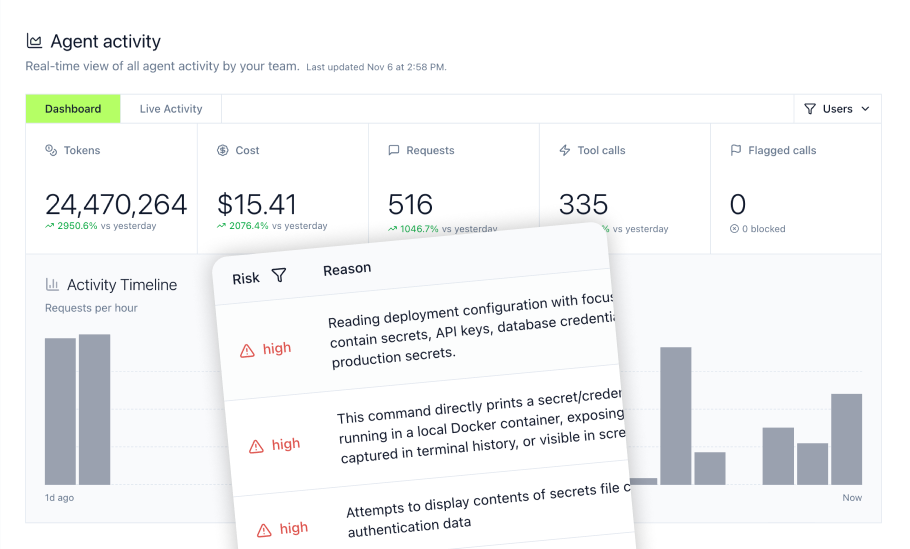
- Agent Monitor provides visibility into local agent activity, including shell commands, file access, prompt injection, secrets exposure, and unauthorized tool use; PII detection and external DLP integrations are handled through Gateway Middleware
- Hosted MCP connectors run on MintMCP's infrastructure with auto-scaling and sandboxed execution per connector, eliminating the need to operate Kubernetes pods for the connector layer
- Custom Gateway Middleware runs customer-authored JavaScript in a sandbox with integrations for AWS Bedrock Guardrails, Google Cloud DLP, Microsoft Purview, Nightfall, and Skyflow
Security and compliance
MintMCP is SOC 2 Type II audited and compliant with HIPAA standards, with continuous compliance monitoring. Enterprise SSO, complete audit trails, PII detection, and role-based access control are built into the platform. Customers handling protected health information can request HIPAA documentation, and MintMCP signs BAAs through its Trust Center.
Every Confluence page view, search query, and content creation is logged with full context: who initiated it, which tools were called, what data flowed through, and when. These audit trails export to SIEM platforms including Splunk and Microsoft Sentinel for compliance investigations.
Deployment
Managed SaaS-first delivery with US and EU availability. VPC and self-hosted deployment available on request.
Pricing
Contact for enterprise demonstration and pricing.
Getting started
Visit mintmcp.com/mcp-gateway for deployment documentation.
2. Atlassian Rovo MCP
Atlassian provides native MCP server support for Confluence through their Rovo platform. The cloud-hosted integration connects directly from supported AI clients, including Claude Desktop, ChatGPT, and Cursor. Some legacy or custom desktop clients may require Node.js and the mcp-remote proxy.
Primary focus
The native approach prioritizes speed to deployment. Users navigate to their AI client's integrations section, search for Atlassian Rovo MCP Server, and complete OAuth authorization. After the client is connected and the user authenticates, actions inherit the user's existing Confluence permissions. Organization or site administrators may still need to approve the client, enable the Atlassian MCP app, or configure authentication and app permissions.
Capabilities
- One-click OAuth connection from supported AI clients
- Access to Confluence pages, spaces, and comments based on user permissions
- MCP tool invocation logging in Atlassian Administration, including the tool name, action, and OAuth-authenticated user
- Support for Claude Desktop, ChatGPT, Cursor, and VS Code Copilot
Rate limits
Confluence plan tier determines API call limits:
- Free plans: 500 calls per hour
- Standard plans: 1,000 calls per hour
- Premium and Enterprise plans: 1,000 plus 20 per user, maximum 10,000 per hour
Tradeoffs to consider
The native approach inherits each user's existing Confluence permissions and provides organization controls for approved domains, IP allowlists, authentication methods, and per-app read, write, and search permissions. An external gateway is most relevant when teams need cross-platform policy, centralized DLP, tool-level governance across multiple systems, or a unified audit stream beyond Atlassian. API token authentication is an optional admin-controlled method, while OAuth 2.1 is the default.
Pricing
Included for Atlassian Cloud customers, subject to the organization's existing Atlassian plan and applicable usage limits.
3. MCP Manager
MCP Manager by Usercentrics connects to Atlassian's Rovo MCP server through per-user OAuth and adds centralized RBAC, tool provisioning, audit logs, PII filtering, and policy enforcement.
Primary focus
The platform addresses token lifecycle management and adds gateway-layer controls. Organizations configure gateway policies through a dedicated admin interface, controlling which teams can access specific MCP servers and tools while each user's existing Atlassian permissions continue to govern Confluence content access.
Capabilities
- Server and tool-level RBAC for teams and gateway users
- OAuth enforcement and token-rotation controls
- Tool and message filtering before requests reach MCP servers
- PII detection and redaction for sensitive content
- Audit logging and OpenTelemetry export for centralized observability
Where it fits
Teams that want to place Atlassian Rovo behind a centralized MCP gateway for RBAC, tool provisioning, PII filtering, audit logs, and policy enforcement across multiple MCP servers.
Tradeoffs to consider
Teams should evaluate whether they need capabilities beyond Confluence access, including multi-platform governance across Claude, Cursor, ChatGPT, Gemini, and Copilot, hosted connector runtime, Virtual MCP Bundles for per-use-case endpoints, or Agent Bundles with per-agent identity and M2M authentication.
Pricing
Free to start; enterprise plans are available directly from Usercentrics with additional SSO, PII filtering, observability, and support capabilities.
4. Cequence AI Gateway
Cequence AI Gateway approaches Confluence integration with security as the foundational design principle. The platform focuses on protecting agentic workflows from prompt injection, credential theft, and tool poisoning attacks.
Primary focus
Security teams requiring defense-in-depth protection for AI agent deployments. The platform implements Agent Personas, which allow administrators to define AI agent boundaries using plain-English job descriptions rather than technical policy configurations.
Capabilities
- Agent Personas that specify AI agent scope and limitations in natural language
- Real-time prompt injection detection and blocking
- DLP scanning integrated with Confluence content retrieval
- OAuth 2.1 and identity-provider integration
- Per-tool authorization, rate limits, and inline security policies
- Security-event logging with SIEM integration
Where it fits
Organizations in regulated industries or handling sensitive data who prioritize threat protection in their AI deployments. Security-first teams who want DLP scanning integrated directly into the Confluence access layer.
Tradeoffs to consider
Teams should also evaluate whether they need SCIM-driven RBAC, per-use-case Virtual MCP Bundles, hosted connector management, per-agent identity with M2M authentication, and centralized observability across multiple AI platforms.
Pricing
Custom enterprise pricing.
5. TrueFoundry
TrueFoundry combines LLM proxy functionality with MCP gateway capabilities as part of a broader ML platform. The approach appeals to teams centralizing their AI infrastructure on a single platform.
Primary focus
ML platform teams who want Confluence connectivity as part of a unified AI infrastructure layer rather than a standalone gateway deployment. The platform combines LLM routing, model management, and MCP gateway in one control plane.
Capabilities
- Combined LLM proxy and MCP gateway functionality
- Low-latency design for performance-sensitive deployments
- Integration with existing ML platform workflows
- SaaS, VPC, on-premises, air-gapped, and multi-cloud deployment options
- Streamable HTTP gateway proxy, hosted stdio MCP servers, and limited legacy SSE compatibility outside the standard proxy path
Where it fits
Engineering teams building on ML platforms who want Confluence access integrated with their existing AI infrastructure rather than managed separately. Organizations already evaluating TrueFoundry for LLM management who want to add Confluence connectivity.
Tradeoffs to consider
Teams focused specifically on Confluence governance should evaluate whether the platform provides MCP-specific primitives including SCIM-driven Virtual MCP Bundles, Agent Bundles with per-agent identity, tool-update policy, hosted connector operations, and OAuth brokering for stdio servers.
Pricing
Published plans include Developer at $0, Pro at $499 per month, and Pro Plus at $2,999 per month, with custom Enterprise pricing.
6. Self-hosted solutions
Self-hosted MCP gateways provide full infrastructure control for organizations with air-gapped requirements or dedicated DevOps capacity. Options include Docker-based deployments, Kubernetes configurations, and open-source gateway implementations.
Primary focus
Organizations requiring complete infrastructure ownership. Self-hosted approaches suit teams with existing container orchestration expertise, regulatory requirements prohibiting cloud services, or specialized customization needs that managed platforms cannot accommodate. IEEE security standards provide guidance for implementing authentication and authorization in distributed systems.
Capabilities
- Complete control over gateway infrastructure, networking, and security configuration
- Air-gapped deployment when the selected gateway, connector stack, and dependencies explicitly support offline operation
- Custom authentication integration with internal identity providers
- Unlimited customization of policy logic and access controls
- Reduced dependence on a managed gateway vendor, with continuing dependencies on the selected software projects, infrastructure, and update process
Where it fits
Platform engineering teams with Kubernetes expertise who can dedicate resources to gateway operations. Organizations with strict data sovereignty requirements that prohibit any cloud-based processing of Confluence content.
Tradeoffs to consider
Self-hosted deployments require the organization to operate connector runtimes, scaling, authentication integration, and Kubernetes infrastructure. Infrastructure and engineering costs vary by architecture, connector count, identity requirements, security controls, and support model. Teams should account for setup, patching, observability, backups, incident response, and ongoing maintenance rather than relying on a single deployment-time estimate. Teams should evaluate whether they have capacity to build and maintain authentication, SCIM-driven RBAC, audit logging, OAuth brokering, and governance features that managed platforms provide out of the box.
Pricing
Infrastructure and engineering costs vary by architecture, connector count, identity requirements, security controls, and support model. Teams should account for setup, patching, observability, backups, incident response, and ongoing maintenance rather than relying on a single deployment-time estimate.
Why teams choose MintMCP Agent Gateway
The choice between Confluence integration approaches comes down to governance requirements and operational capacity. Organizations needing enterprise-grade security, automatic token management, tool-level access controls, and compliance-ready audit trails should evaluate MintMCP Gateway.
MintMCP's governance layer addresses the core challenges teams face when connecting AI agents to Confluence: OAuth tokens that require client-by-client management, fragmented access policies across AI platforms, and missing audit trails for compliance investigations. The platform's Virtual MCP Bundles let teams create per-use-case endpoints with SCIM-driven membership and curated Confluence tools, while existing Atlassian permissions determine which pages and spaces each user can access.
Beyond MCP Gateway capabilities for governed data and tool connections, MintMCP is defining the Agent Gateway category for organizations deploying coworker agents that work alongside users. These long-running agents live in Slack, hold memory, continue work across days, and operate with persistent identities. MintMCP's Agent Gateway provides the control layer for agent identities, permissions, memory, and monitoring that coworker agents require.
Agent Gateway builds directly on MintMCP's MCP Gateway foundation. The same SSO, SCIM-driven RBAC, Virtual MCP Bundles, and audit infrastructure that governs Confluence access also governs agent behavior. Teams get Git-like memory that is company-owned, versioned, reviewable, auditable, and portable, not opaque vendor-controlled stores. Agent Monitor tracks local agent activity including secrets exposure, prompt injection, and unauthorized tool use, while Gateway Middleware handles PII detection and external DLP integrations.
For organizations ready to move beyond basic Confluence connectivity, MintMCP provides the governance infrastructure that transforms experimental AI usage into production-ready agent deployments. Start with MintMCP's seven-day free trial to evaluate Virtual MCP Bundles, Agent Monitor visibility, and hosted connector deployment for your Confluence environment.
Frequently asked questions
What causes AI agents to disconnect from Confluence mid-session?
Atlassian uses OAuth 2.1 with rotating refresh tokens. Direct connections can require reauthentication because of revoked consent, expired refresh credentials, missing scopes, or client-specific caching issues, but not universally after every access-token expiry. MCP gateways can centralize OAuth brokering and token handling, maintaining persistent connections with reduced client-side authentication complexity.
How do MCP gateways protect sensitive Confluence content from AI access?
OWASP's MCP guidance recommends authentication, least privilege, input and output validation, and centralized logging for MCP deployments. Gateways can add server and tool-level RBAC, policy enforcement, and DLP, while Confluence space access continues to depend on Atlassian permissions unless the connector provides a separately verified data-level policy. PII detection scans content before it reaches AI models, redacting or blocking sensitive data. Complete audit trails log every page view, search, and content creation with user attribution for compliance investigations.
Can MCP gateways work with multiple AI platforms simultaneously?
Yes. Enterprise gateways like MintMCP provide centralized governance across Claude, ChatGPT, Cursor, Gemini, and Copilot. Teams configure Confluence access policies once and apply them consistently across all AI platforms, eliminating the need to manage separate security configurations for each tool.
What is the difference between Atlassian Rovo MCP and an enterprise gateway?
Atlassian Rovo MCP provides direct connectivity using existing Confluence permissions, along with MCP invocation logs, domain and IP controls, and per-app read, write, and search settings. Enterprise gateways add cross-platform policy, centralized observability, DLP integrations, broader tool governance, and unified controls across Claude, Cursor, ChatGPT, Gemini, and Copilot. Reauthentication depends on token lifecycle and client behavior rather than being required after every access-token expiry.
How long does it take to deploy a Confluence MCP gateway?
Deployment time depends on Atlassian administrator approvals, identity-provider integration, connector scope, policy design, security review, and rollout size. Native OAuth setup may be completed quickly, while production gateway and self-hosted deployments require additional time for permissions, observability, testing, and organizational rollout. Avoid fixed timelines unless they are supported by a named deployment case study.